TGA Pulled 13,700+ Ads: Comments Now Count as Advertising
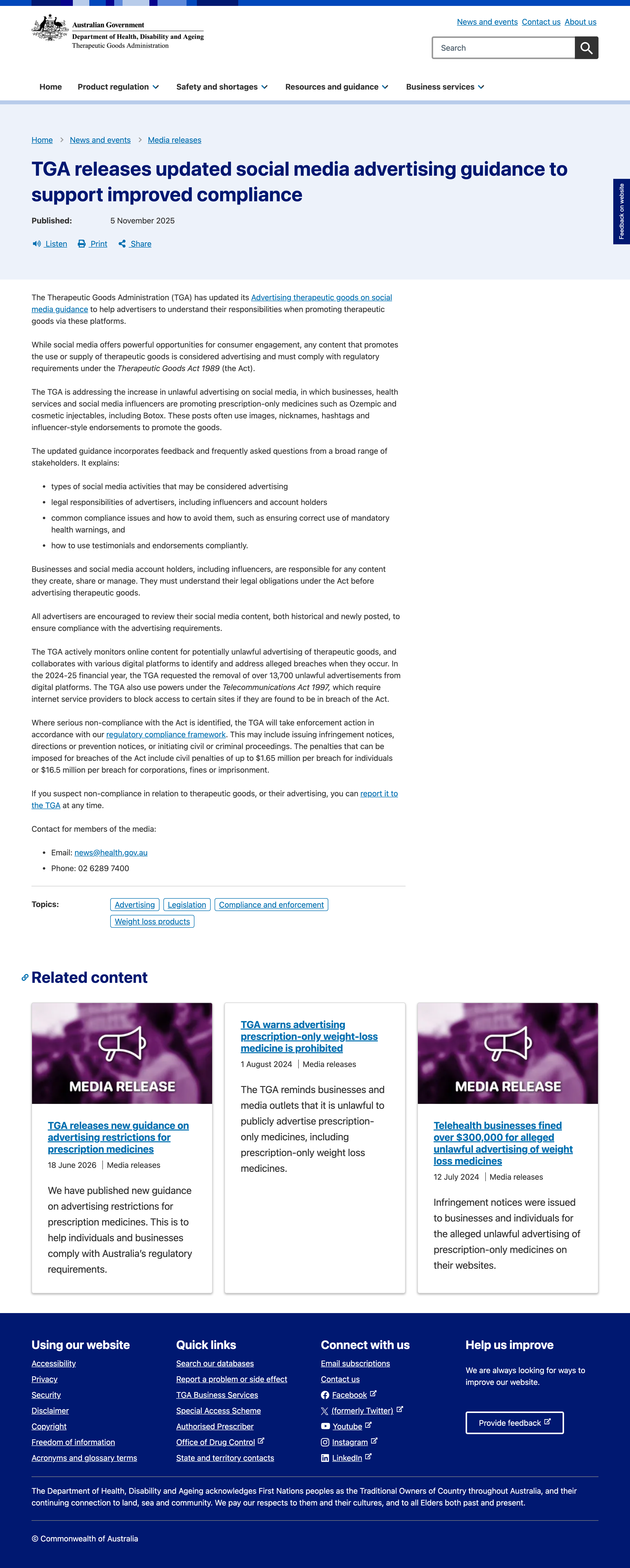
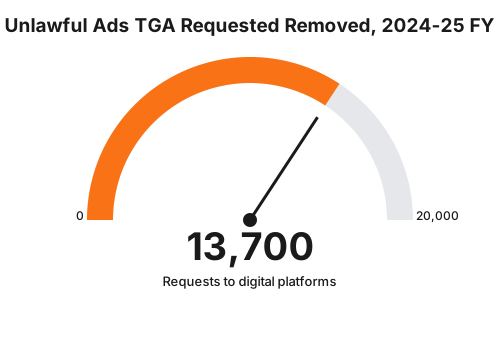
The TGA requested removal of more than 13,700 unlawful therapeutic goods ads in the 2024-25 financial year, then published updated social media guidance on 5 November 2025 confirming comments, hashtags, tags and closed Facebook groups all count as advertising. For cosmetic clinics, the compliance perimeter now runs past the website into every comment thread and private group a staff member posts in.
 Vikas Thakur Founder, RockingWeb 8 min read
On this page 8
Key takeaways
- The TGA published updated social media advertising guidance on 5 November 2025, explaining how the Therapeutic Goods Act 1989 applies across social platforms.
- Comments on a business’s own posts count as advertising when they come from someone with a financial interest in the goods, and third-party comments that read as testimonials fall under the same rules.
- “Certain links, tags and hashtags” are named directly in the guidance as one of the factors that makes a post more likely to be classed as promotional.
- Closed and private groups, including Facebook groups and closed LinkedIn channels, are still advertising if the content promotes therapeutic goods, per the TGA’s own worked example.
- In the 2024-25 financial year, the TGA requested removal of more than 13,700 unlawful therapeutic goods advertisements from digital platforms.
- Civil penalties for a breach run up to $1.65 million per breach for an individual or $16.5 million per breach for a corporation, on top of possible imprisonment.
- The guidance flags tagging a government body, including the TGA itself, in a product post as a separate risk, since it can read as an implied government endorsement.
- Businesses are responsible for content their engaged influencers and content creators publish whenever the advertising is paid for or posted on the business’s behalf.
The TGA’s 5 November 2025 guidance confirms comments, hashtags, tags and closed group posts all count as advertising under the Therapeutic Goods Act 1989. Cosmetic clinics can no longer treat their public feed as the only compliance surface.
Thirteen thousand, seven hundred. That is how many unlawful therapeutic goods ads the TGA pulled from Australian digital platforms in the 2024-25 financial year alone. On 5 November 2025, the regulator followed that number with updated guidance that closes a gap most clinics did not know they had. Comments, hashtags, tags and posts inside closed Facebook groups all count as advertising now, not just the post a marketing team approved. A staff member replying to a comment with a treatment name, a patient tagging the clinic under a branded hashtag, a private support group where someone names a product: all three now sit inside the same rules that already govern a clinic’s homepage. Most social media policies stop at what a business posts. This one does not.
What actually counts as advertising now
Strip away the platform jargon and the TGA’s test is simple: any content that promotes the use or supply of a therapeutic good is advertising, whatever it is labelled and whatever the intent behind it was. The updated guidance, linked directly from the 5 November 2025 release, spells out exactly which social media tools fall inside that test.
| Social media element | Counts as advertising? | What the TGA’s guidance says |
|---|---|---|
| Business’s own posts, reels, stories, links | Yes | Listed as the most common social media tools that fall under the rules |
| Comments on your own posts, paid or influencer-posted | Yes | Content “disseminated by, or on behalf of, a person with a financial interest” is more likely promotional |
| Third-party comments read as a testimonial | Yes | ”Third-party reviews, including comments… are testimonials and must comply” |
| Certain links, tags and hashtags | Yes | Named directly as one of four factors that make a post more likely to be viewed as promotional |
| Closed or private Facebook groups | Yes | Worked example: a private patient support group’s posts “are still subject to all relevant legislative requirements” |
| Tagging the TGA or another government body | Risk flagged | Tagging can be read as implying government endorsement, which is separately unlawful |
The guidance’s own worked example makes the closed-group point hard to miss: a pharmaceutical company runs a private patient support group, members discuss medicines and treatment options, and the TGA states plainly that although the group is private, any post that advertises a therapeutic good still has to comply with the Act. Swap “medicines” for “injectables” and that example describes half the closed Facebook groups cosmetic clinics already run for past patients.
Takeaway: if a comment, hashtag, tag or closed-group post promotes a treatment, it is advertising under the Act, full stop, regardless of how private the audience looks.
Why your website audit now has to include your comment threads
Most clinic digital compliance work still stops at the homepage: treatment page copy, before-and-after galleries, booking widget language. That is the visible, indexed surface, so it is where audits naturally start. It is also no longer where the exposure ends. A free compliance read of your site built around this guidance has to check three things a website-only review misses entirely: who replies to comments on the clinic’s own posts and what they say, whether staff or contracted influencers are tagging the clinic’s account under hashtags that name a specific injectable or device, and whether any closed group, whether a “VIP” Facebook group or a private booking community, contains posts that promote a named product.
None of this means a clinic’s public-facing pages are suddenly less important. It means the compliance perimeter got wider on 5 November 2025, and a review that only covers the website is now checking less than half the surface the TGA considers advertising.
Takeaway: an audit scoped to the website alone now misses the exact content types the TGA named by name in its own guidance.
The penalty math behind the guidance
The TGA does not treat this as a minor clarification. The same regulatory framework that applies to a clinic’s homepage carries real financial weight, and the guidance restates the ceiling directly: civil penalties of up to $1.65 million per breach for an individual, or $16.5 million per breach for a corporation, with imprisonment also on the table for serious non-compliance.
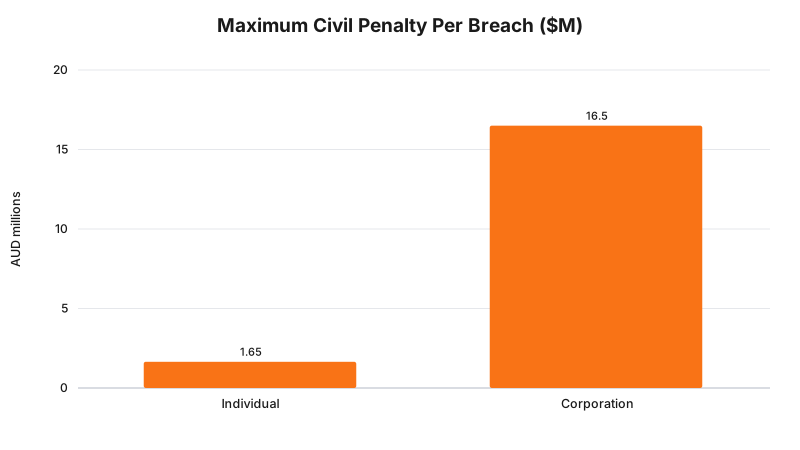
Per-breach matters here. A single non-compliant hashtag campaign running across a dozen posts is not one breach, it is potentially a dozen, and the TGA’s guidance already puts businesses on notice that they are expected to review both historical and newly posted content for compliance. A closed group with two years of archived posts is exactly the kind of historical content that guidance is aimed at.
Takeaway: the guidance did not just widen what counts as advertising, it widened the base a per-breach penalty gets calculated against.
What to check on your clinic’s social accounts this week
This is not legal advice, and whether a specific comment or hashtag crosses the line in your case is a question for your medical defence organisation or your lawyer. It is a starting checklist, the kind RockingWeb runs as part of a cosmetic clinic website build or refresh, extended to cover what the updated guidance actually names.
| Where to look | What to check | Why it matters under the new guidance |
|---|---|---|
| Comments on recent posts | Staff, contractor or influencer replies naming a product or making a benefit claim | Comments from anyone with a financial interest are more likely to be classed as promotional |
| Hashtags in use | Any tag naming a specific injectable, device or “TGA approved” claim | Named directly as a factor that makes a post promotional |
| Closed groups and communities | VIP groups, alumni groups, booking communities | The TGA’s own example confirms private groups are not exempt |
| Tags of government accounts | Any post tagging the TGA, AHPRA or another regulator alongside a product | Risk of implying government endorsement, a separate breach |
Work through the table in the order it is written. Comment threads on recent posts are the fastest thing to check and the easiest to miss, since most clinics review what they post, not what gets said underneath it. Closed groups take longer because the content is archived and rarely revisited, which is exactly why the guidance calls out historical content as something advertisers are expected to review, not just what goes up tomorrow.
Takeaway: treat this as a four-item weekly check, not a one-off cleanup, since the guidance expects ongoing review of both new and historical content.
Frequently Asked Questions
Does the TGA’s updated guidance change the law?
No. It clarifies how the existing Therapeutic Goods Act 1989 applies to social media tools, including comments, hashtags, tags and closed groups. The underlying advertising rules have not changed, only the guidance explaining how they apply online.
Does a comment I did not write count as my advertising?
It can. The guidance states that content disseminated by, or on behalf of, someone with a financial interest in the goods is more likely to be viewed as promotional, and third-party comments that function as testimonials must also comply with advertising requirements.
Is a private Facebook group for past patients exempt from these rules?
Not automatically. The TGA’s own worked example describes a private patient support group and states plainly that posts advertising a therapeutic good inside it are still subject to the Act’s requirements, regardless of how the group’s privacy is set.
Get Your Social Presence Checked
Ready to see what a regulator would find in your comment threads and closed groups, not just your website? Book a compliance-focused website review before an old post or an archived hashtag campaign gets tested against the new guidance.
Sources and References
- Therapeutic Goods Administration, “TGA releases updated social media advertising guidance to support improved compliance,” media release, published 5 November 2025. tga.gov.au. Date checked: 28 August 2026. Source for the publication date, the 13,700+ unlawful ad removal figure for the 2024-25 financial year, and the $1.65 million/$16.5 million per-breach penalty figures.
- Therapeutic Goods Administration, “Advertising therapeutic goods on social media,” guidance page. tga.gov.au. Date checked: 28 August 2026. Source for the closed-group worked example, the comments/testimonials rule, the “links, tags and hashtags” promotional factor, and the government-body tagging guidance, all linked directly from source 1.
Vikas Thakur
Founder of RockingWeb. 16 years building for companies like TPG, iiNet and Monadelphous, now focused on websites and marketing that comply with AHPRA's advertising guidelines and still book patients.