TGA's $2M Peptide Bust: A New 2026 Compliance Priority
The TGA formally added unapproved peptide products to its compliance priority list on 10 June 2026, citing a joint operation with the Australian Border Force and Victoria Police that seized more than $2 million in peptides, PIEDs and steroids. If your clinic's treatment menu mentions peptides, this is the newest line on the regulator's watch list.
 Vikas Thakur Founder, RockingWeb 9 min read
Key takeaways
- The TGA published a media release on 10 June 2026 formally adding unapproved peptide products to its compliance priority focus areas.
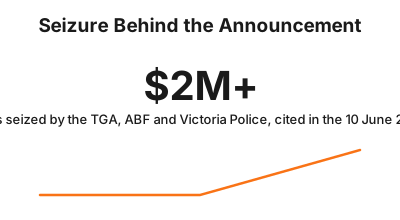
- A joint TGA, Australian Border Force and Victoria Police operation seized peptides, performance and image enhancing drugs (PIEDs) and illicit steroids with a street value the TGA put at “in excess of $2 million.”
- TGA head Professor Anthony Lawler said “the availability of unapproved peptide products has increased” alongside “evidence of potential risk to consumers.”
- Unapproved peptide products commonly reported in the market, per ABC News coverage of the announcement, include BPC-157, GHK-Cu, TB-500, retatrutide, CJC-1295 and Melanotan II.
- Regulatory responses the TGA lists for this priority area: infringement notices, product seizures, import interventions and, where appropriate, civil or criminal penalties.
- The TGA’s own release tags the notice under “Cosmetics” and “Advertising,” alongside “Compliance and enforcement” and “Import and export.”
- The announcement sits inside the same Compliance Principles 2026 and 2027 framework already driving TGA action against cosmetic injectable imports.
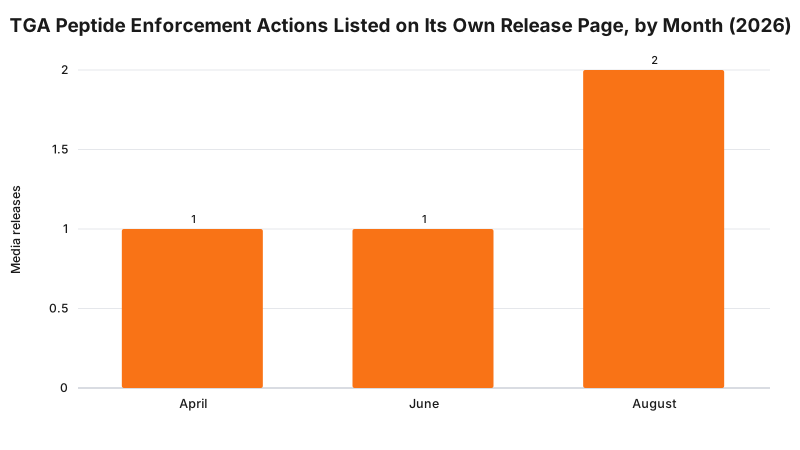
- The TGA’s release page lists 3 further dated peptide or PIED enforcement actions from April and August 2026, all published after the original priority announcement.
Australia’s medicines regulator formally named unapproved peptide products a compliance priority on 10 June 2026, after a joint operation with the Australian Border Force and Victoria Police seized more than $2 million worth of peptides, performance and image enhancing drugs and illicit steroids. Peptides such as BPC-157 and GHK-Cu are not listed on the Australian Register of Therapeutic Goods, the register the TGA uses to confirm a product has actually been assessed for quality, safety and efficacy.
Here’s the part that matters for a clinic website: the TGA’s own release tags this announcement under “Cosmetics” and “Advertising,” not just “Compliance and enforcement.” That is not accidental categorisation. If a treatment menu, blog post or booking widget on your site mentions peptide therapy, you are now inside the same enforcement bracket the TGA already applies to unlisted cosmetic injectables.
What the TGA actually announced
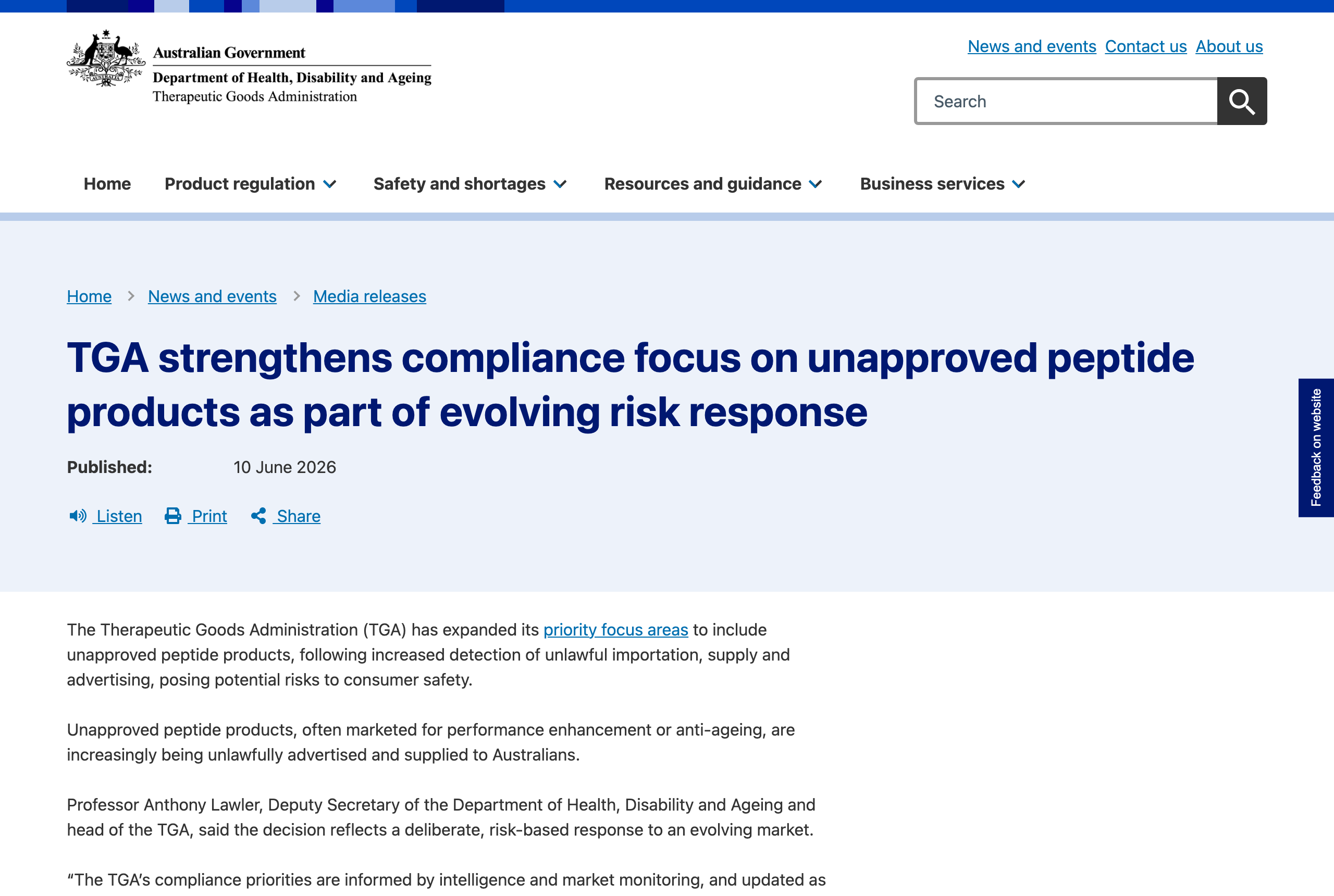
Strip away the press release language and the facts are simple. On 10 June 2026, the TGA said it had “expanded its priority focus areas to include unapproved peptide products, following increased detection of unlawful importation, supply and advertising, posing potential risks to consumer safety.” Peptides join weight loss products, vapes and sunscreens on that same priority list.
Professor Anthony Lawler, Deputy Secretary of the Department of Health, Disability and Ageing and head of the TGA, framed the move as a “deliberate, risk-based response to an evolving market.” His direct quote is worth reading twice: “As the availability of unapproved peptide products has increased, so too has evidence of potential risk to consumers.” That is a regulator telling an industry, in writing, that it is watching a category it was not watching as closely before.
The release also confirms what triggered the timing. A joint operation between the TGA, the Australian Border Force and Victoria Police recovered peptide products, PIEDs and illicit steroids with an estimated street value the TGA itself put at “in excess of $2 million.” Reporting on the same announcement by the ABC named several of the unapproved peptides circulating in the market: Melanotan II, retatrutide, BPC-157, GHK-Cu, TB-500 and CJC-1295, typically supplied as injectables and promoted for anti-ageing, weight loss and performance benefits.
Takeaway: the TGA did not quietly update a compliance page. It issued a named press release, with a ministerial quote and a dollar figure, the exact combination that makes a story worth journalists linking to.
Why unapproved peptides are treated like unapproved injectables
Peptides sit in an odd spot for a lot of clinics. They are frequently sold as “research chemicals” or “wellness” products, which makes them feel less regulated than a Schedule 4 injectable. The TGA’s own framing says otherwise. Unapproved peptide products, per the release, “may not meet required standards for quality, safety or efficacy,” “be incorrectly labelled or promoted,” and “pose risks if used without medical supervision.” That is the same three-part risk language the TGA uses for unapproved cosmetic injectables.
The practical difference for a clinic is where the exposure sits. An injectable compliance gap usually shows up in a before-and-after gallery or a product-naming issue. A peptide compliance gap usually shows up in copy: a treatment menu line, a blog post explaining “what peptide therapy can do,” or an FAQ answering “is BPC-157 safe.” None of that copy needs a photo to become a problem. Words on a page are enough.
A clinic offering both injectables and peptide-adjacent treatments is now carrying two separate but parallel compliance surfaces on the same website, reviewed by two functionally overlapping enforcement priorities. For a website audit, that means peptide-mentioning pages need the same pass a treatment-menu page gets for injectable naming: not doing so leaves a website tuned for last year’s risk list, not this year’s.
Takeaway: if your site treats peptide copy as “wellness content” rather than regulated therapeutic-goods advertising, that gap is exactly what a 2026 compliance priority exists to close.
Four places peptide copy hides on a clinic website
This is not legal advice, and it is not clinical advice about which peptides to stock or recommend. It is a website content audit, the kind RockingWeb runs for cosmetic clinic clients as standard practice. Four checks, roughly in the order a regulator or a curious competitor would find them:
| Page element | What to look for | Why it matters here |
|---|---|---|
| Treatment/service pages | Named peptides (BPC-157, GHK-Cu, TB-500) or generic “peptide therapy” listings | Named unapproved products invite the ARTG-status question directly |
| Blog and education content | Explainer posts on “what peptides do” without an ARTG or supervision caveat | Educational framing does not remove advertising obligations |
| FAQ and booking widgets | Dropdown items or FAQ answers naming a specific peptide product | Structured, indexable content a regulator can screenshot in one click |
| Sourcing and provenance copy | Phrases like “clinically sourced peptides” or “premium peptide range” | Unverifiable sourcing claims sit awkwardly next to an active import-focused priority |
Work through the table in order. Treatment pages get indexed and cached, which makes them the most durable record. If a page names a specific peptide, check its current ARTG status directly on the TGA’s public register before deciding whether the copy needs to change, and re-check periodically since ARTG entries can be varied, suspended or cancelled after a page goes live. A free AHPRA compliance audit checklist covers the injectable side of this in detail; treat peptide copy as the same exercise applied to a newer product category.
Takeaway: treat this as a four-item checklist against your own site today, not a wait-and-see item for next quarter.
The pattern, not just the announcement
The 10 June 2026 announcement did not stand alone. The TGA’s own release page lists three further dated enforcement actions against peptide and PIED importers: one from 17 April 2026 (three Victorians arrested over an alleged importation syndicate), and two from August 2026 (13 August, further charges against two Victorian residents; 17 August, a seizure worth more than $120,000 from residential premises allegedly linked to a social media influencer). Four dated actions across five months, all sitting on the same regulator page, is what a “priority” looks like in practice rather than in a press release.
Whether any specific fact pattern here applies to your clinic, your supplier or your website is a question for your medical defence organisation or your lawyer. What a website audit can answer today is whether your site already carries the kind of peptide copy that turns a supplier question into a public one. RockingWeb builds and audits AHPRA-aware cosmetic clinic websites, and this is the exact kind of emerging-category gap that a scheduled content review is meant to catch before a regulator finds it first.
Takeaway: one announcement is a headline. Four dated enforcement actions across five months is a trend, and a website audit should be checked against the trend, not just the original press release.
Frequently Asked Questions
When did the TGA add peptides to its compliance priority list?
The TGA published its media release on 10 June 2026, titled “TGA strengthens compliance focus on unapproved peptide products as part of evolving risk response.” Peptides joined weight loss products, vapes and sunscreens as a named priority focus area.
What triggered the announcement?
A joint operation between the TGA, the Australian Border Force and Victoria Police seized peptide products, performance and image enhancing drugs and illicit steroids with an estimated street value the TGA described as “in excess of $2 million.”
Which peptides is the TGA concerned about?
The TGA’s release does not name specific products. ABC News reporting on the same announcement named Melanotan II, retatrutide, BPC-157, GHK-Cu, TB-500 and CJC-1295 as examples of unapproved peptides circulating in the Australian market.
Does mentioning peptides on my clinic website automatically breach TGA rules?
Not automatically. Whether specific copy on your site creates a compliance issue depends on what the page actually says, whether it names an unapproved product, and how it is promoted. This is a website content question, separate from clinical or legal advice about supplying or recommending any peptide product.
Get Your Treatment Pages Checked
Not sure whether your treatment menu, blog content or booking widget already carries peptide or injectable language that needs a second look? Talk to RockingWeb about an AHPRA and TGA-aware website review for your clinic.
Sources and References
- Therapeutic Goods Administration, “TGA strengthens compliance focus on unapproved peptide products as part of evolving risk response,” media release, published 10 June 2026. tga.gov.au. Date checked: 28 August 2026. Source for the announcement date, the priority-area expansion, the $2 million-plus joint-operation seizure figure, both direct quotes from Professor Anthony Lawler, the listed regulatory responses, the “Cosmetics” and “Advertising” topic tags, and the three related enforcement actions dated 17 April, 13 August and 17 August 2026.
- Caitlyn Gribbin and Stephanie Dalzell, “TGA cracks down on unregulated peptides, says increased imports are posing a risk to consumer safety,” ABC News, published 10 June 2026. abc.net.au. Date checked: 28 August 2026. Source for the named unapproved peptide examples (Melanotan II, retatrutide, BPC-157, GHK-Cu, TB-500, CJC-1295) and additional context on documented adverse effects.
- Therapeutic Goods Administration, “Australian Register of Therapeutic Goods (ARTG).” tga.gov.au. Date checked: 28 August 2026. Reference for how to check a product’s current ARTG listing status.
- Therapeutic Goods Administration, “Compliance Principles 2026 and 2027.” tga.gov.au. Date checked: 28 August 2026. Referenced directly within source 1 as the framework this priority area sits under.
Vikas Thakur
Founder of RockingWeb. 16 years building for companies like TPG, iiNet and Monadelphous, now focused on websites and marketing that comply with AHPRA's advertising guidelines and still book patients.