NSW Cosmetic Regulation 2026: The Systems Your Site Must Now Talk To
NSW Health confirmed the Medicines, Poisons and Therapeutic Goods Regulation 2026 commences 5 November 2026, 77 days from this article's publish date. Its cosmetic medicine section pushes clinics toward one clinical record a prescriber can open, not a booking widget, a CRM and a paper file working alone.
 Vikas Thakur Founder, RockingWeb 13 min read
On this page 12
Key Takeaways
- NSW Health confirmed on 3 July 2026 that the Medicines, Poisons and Therapeutic Goods Regulation 2026 commences on 5 November 2026, 77 days from this article’s publish date
- Secondary reporting on the Regulation’s Part 9 describes prescribing practitioners needing visibility of the patient’s clinical record, and clinics being pushed toward one clinical system rather than disconnected platforms
- Named record elements reported include prescribing directions, batch numbers, complete clinical notes and prescriber oversight
- NSW cosmetic injectable prescriptions run for six months, against twelve months in Victoria and Queensland, per clinical publisher Healthed, a fact not yet independently verified against the Regulation’s own text
- The Regulation is state medicines law, separate from AHPRA’s national advertising guidelines and from the Medical Board’s own rules for doctors
- No enforcement outcome exists under this Regulation yet, since it has not commenced; a related, recent NSW case shows the same category of failure already gets prosecuted under existing law
NSW Health confirmed the date on 3 July 2026: the Medicines, Poisons and Therapeutic Goods Act 2022 and its new Regulation commence on 5 November 2026. That’s 77 days from today. Buried inside it is a cosmetic medicine section that has nothing to do with advertising rules and everything to do with where your patient records actually live.
Picture a typical setup. A visitor books through a widget that emails a lead. A separate CRM stores the phone number for follow-up. The prescriber’s notes sit in a third system, or a paper file in a drawer. Three places, one patient, no single record a prescriber could pull up and trust.
That is the pattern the new Regulation’s record-keeping detail points away from. This piece covers what NSW Health and the available secondary reporting say, what changes for the systems your site connects to, and what to check before the countdown runs out.
What NSW Health Actually Confirmed
The NSW Health Pharmaceutical Services page states plainly that “the Medicines, Poisons and Therapeutic Goods Act 2022 and Regulation will commence on 5 November 2026.” A consultation on proposed controls for cosmetic-use substances closed on 27 February 2026; NSW Health thanks submitters but does not say how, or whether, their feedback changed the final text.
The instrument itself is the Medicines, Poisons and Therapeutic Goods Regulation 2026 (sl-2026-0330) on the NSW legislation register. That register blocked automated access during research for this article, so every clause-level detail below is reported from secondary sources, named individually, rather than read directly off the Regulation’s text.
| Milestone | Date |
|---|---|
| Cosmetic-use substances consultation closed | 27 February 2026 |
| NSW Health confirmed final commencement date | 3 July 2026 |
| Medicines, Poisons and Therapeutic Goods Act 2022 and Regulation commence | 5 November 2026 |
Takeaway: the 5 November 2026 date sits on a NSW Health page today, government-confirmed, not a leaked draft or a lobby group’s guess.
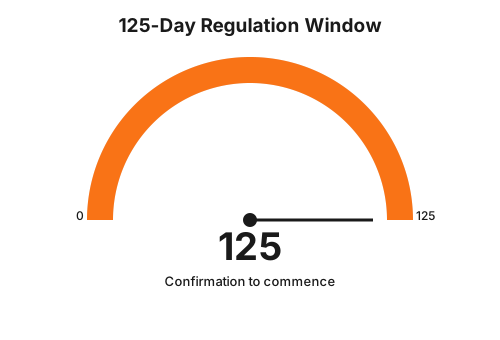
That 125-day window runs from NSW Health’s 3 July 2026 confirmation to the 5 November 2026 commencement date. From this article’s publish date of 20 August 2026, 77 days remain on the countdown.
What the Regulation Reportedly Says About Records
Clinic software vendor Juvae describes a dedicated cosmetic medicine section, referred to as Part 9, appearing in NSW legislation for the first time. That reporting names record-keeping elements including “current prescribing directions, comprehensive treatment records, batch number documentation, complete clinical notes” and “clear evidence of prescriber oversight,” plus Category 1 and Category 2 governance requirements for cosmetic use substances.
The same reporting states prescribing practitioners need “visibility of the patient’s clinical record, to support informed clinical decision-making and ongoing patient care,” and draws the build conclusion directly: “this highlights the importance of working within a single clinical system, rather than relying on multiple disconnected platforms or paper records.” RockingWeb has not independently verified this against the Regulation’s own clauses, for the access reason noted above.
Separately, clinical education publisher Healthed reports NSW cosmetic injectable prescriptions run for six months, against twelve months in Victoria and Queensland, a detail outside NSW Health’s own confirmation page. Treat it as secondary-sourced until your adviser confirms the clause.
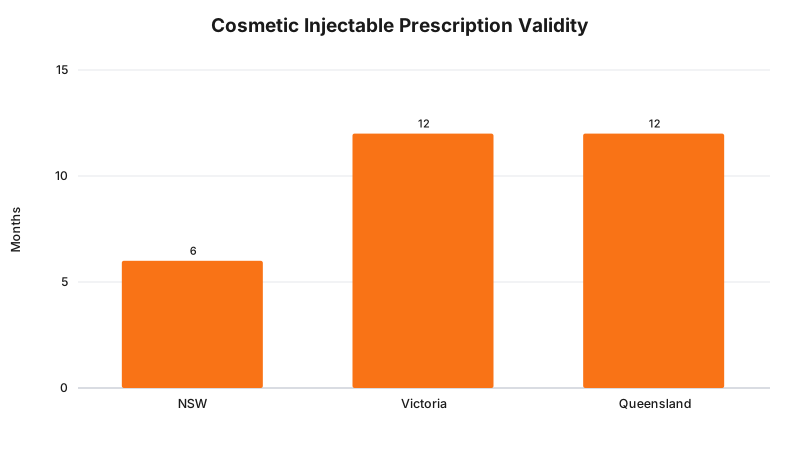
Takeaway: whatever the exact clause wording turns out to be, the reported direction is consistent across two independent sources: cosmetic-use substances are getting a dedicated, more structured record-keeping regime, and a shorter recall window in NSW than in the two most-cited comparison states.
What That Means for the Build
None of this is advice on how to prescribe, store or administer anything. It’s a map of where a structured record-keeping regime is most likely to collide with how a typical clinic website is built today.
Give the booking record a stable identifier. A field like booking_reference, generated at booking and carried through every downstream system, replaces a lead landing in an inbox with an ID a prescriber’s software can query.
Add a status field the booking cannot skip past. Values like pending_prescriber_review and confirmed gate an instant-book funnel behind an actual step, instead of letting a visitor reserve an injectable slot the moment they submit a form.
Route the treatment field into the clinical record, not just a marketing CRM. If your widget captures “treatment: anti-wrinkle, area: forehead” but that value only ever reaches a Mailchimp tag, it never reaches the system Part 9’s reported requirement is actually about.
Stop building consent and intake as a single generic form. A contact form with a message box does not produce “comprehensive treatment records.” A structured intake, with fields that map onto what a clinical record needs, does.
Keep practitioner attribution current. If Part 9 is about prescriber oversight, the bio page naming who prescribes at your clinic needs to match who actually does, not a photo from two staff changes ago.
| System | Typical role today | What Part 9’s reported requirements ask of it |
|---|---|---|
| Booking widget | Captures name, phone, treatment interest | Should hand off a stable patient reference, not just generate a lead |
| Video consult platform | Runs the appointment | Should be the point prescriber visibility is actually exercised, not a black box |
| Practice management system | Holds the “real” record, sometimes | Should be the single system everything else writes into |
| SMS and email reminders | Pulls a name and a time slot | Should read from the same record, not a separate export |
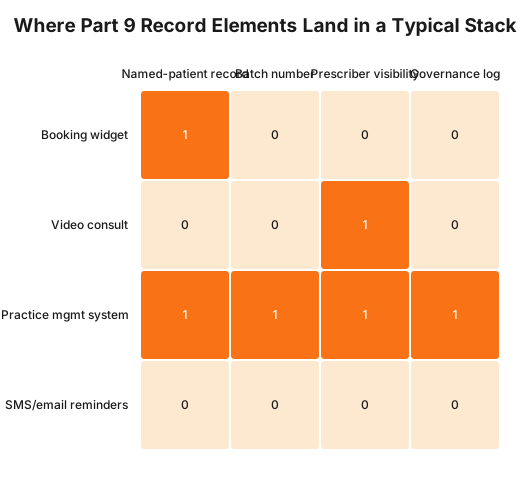
This heatmap is RockingWeb’s own build analysis, mapping the record elements named in the secondary reporting above against the systems a typical NSW cosmetic clinic site already runs. It is not a measured statistic. The pattern it shows is the point: three of the four systems currently touch none, or almost none, of what a single clinical record needs to hold.
Takeaway: the fix is rarely a new piece of software. It’s usually a missing connection between systems that already exist.
A Worked Example
Cosmetic clinic, three treatment rooms. The website ran an instant-book widget for anti-wrinkle and filler appointments, confirming a slot the moment a card was held. Treatment interest, captured as a dropdown, went to a marketing CRM used for email campaigns. Clinical notes lived entirely in the practice management software the nurse and prescribing doctor used in person, with no link back to the booking record.
Under the reported Part 9 direction, that gap is the whole problem. A prescriber reviewing a booked patient had no system-level way to see what was booked, only what a nurse manually re-entered from a CRM export each morning. The fix, ahead of 5 November, was not a new booking platform. It was a webhook from the existing widget into the practice management system’s API, writing the treatment field and a generated patient reference straight into the record the prescriber already opens, and changing the widget’s confirmation logic from instant to pending_prescriber_review until that write succeeded.
Takeaway: the build work is usually integration, not replacement. The systems already exist; they were never told to talk to each other.
What to Check on Your Own Site
- Trace a single booking from your widget through every system it touches. Count the systems. Count how many of them a prescriber can actually open.
- Check whether your booking confirmation is instant or gated behind a review status.
- Check whether the treatment name captured at booking reaches your clinical record system, or only your marketing tools.
- Check whether SMS and email reminders read from the same record as your practice management system, or a separate export that can drift out of sync.
- Check your practitioner bio pages against who is actually prescribing and administering today.
- Ask your practice management vendor directly whether they have published anything about Part 9 or the 5 November 2026 commencement.
The Enforcement Anchor
No infringement notice or determination exists under the Medicines, Poisons and Therapeutic Goods Regulation 2026 itself, because it has not commenced. There is nothing to cite against this specific instrument yet.
What does exist is a recent case showing the same regulator active on the same category of failure. According to reporting on a Health Care Complaints Commission decision, an unregistered practitioner operating a Burwood beauty salon unlawfully administered botulinum toxin, a Schedule 4 medicine, to a patient hospitalised with symptoms of botulism. The reporting states “appropriate records were not kept, and those which were found were mostly in Mandarin,” and that the patient had not been told what product or quantity was being injected. The Commission issued a five-year prohibition from providing any health services, effective 19 May 2026.
That case sits under existing law, not the new Regulation, and involves an unregistered operator rather than a registered clinic. It shows the HCCC currently prosecuting the exact combination the new Regulation’s reported record-keeping detail targets: an undocumented Schedule 4 administration with no record a clinician could review afterward.
Takeaway: there is no case yet under the new Regulation. There is a recent one under the old law, for the same underlying failure.
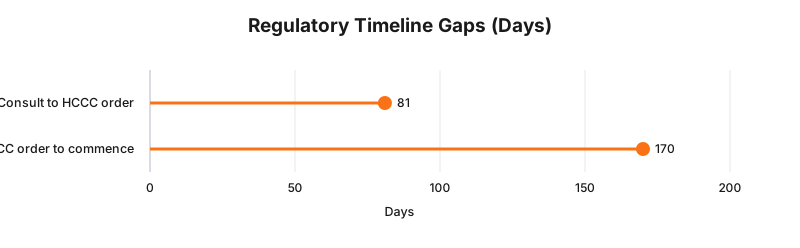
The 27 February 2026 consultation close, the 19 May 2026 HCCC prohibition order and the 5 November 2026 commencement date are all confirmed dates cited earlier in this article; the gaps between them are simple day counts, not a new statistic.
Where This Gets Hard
The honest limit is that most of what this article reports about Part 9’s actual clauses comes from secondary sources, not the Regulation’s own text, because the NSW legislation register blocked automated access during research. Juvae and Healthed are named, reputable industry sources whose reporting agrees on the broad direction. Neither is a substitute for reading sl-2026-0330 yourself, or having your compliance adviser read it, before 5 November.
The Category 1 and Category 2 distinction is a specific example. Secondary reporting confirms both categories exist inside Part 9’s governance requirements. Nothing found in this research states where the line between them sits, so this article does not guess at it.
The regulator says prescribing practitioners need visibility of the patient’s clinical record to support informed clinical decision-making; the build consequence is that a booking widget, a video consult platform and a practice management system should write to one record a prescriber can actually open, not three disconnected ones; whether single-record prescriber visibility applies to your circumstances is a question for your medical defence organisation or your lawyer.
Status
Passed but not yet commenced, as at 20 August 2026. NSW Health’s ministerial confirmation is dated 3 July 2026 and the Regulation commences 5 November 2026; nothing in this Regulation is currently in force, and it sits separate from AHPRA’s national guidelines and the Medical Board’s own 2023 cosmetic guidelines for doctors, both of which are already in force.
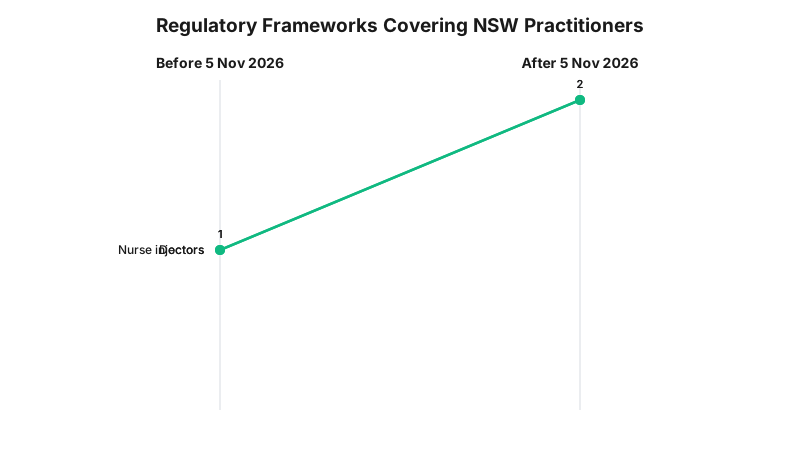
Doctors currently sit under the Medical Board’s 2023 guidelines alone. Nurse practitioners and authorised nurses currently sit under AHPRA’s September 2025 guideline alone. From 5 November 2026, the new Regulation adds a second, state-level layer on top of whichever national guideline already applies, per the scope described above.
Frequently Asked Questions
When does the NSW Medicines, Poisons and Therapeutic Goods Regulation 2026 commence?
NSW Health confirmed on 3 July 2026 that the Medicines, Poisons and Therapeutic Goods Act 2022 and its Regulation commence on 5 November 2026, 77 days from this article’s publish date of 20 August 2026.
Does this Regulation cover doctors as well as nurse injectors?
Yes, in a different way to AHPRA’s advertising rules. The Regulation is state medicines and poisons law, so it applies to whoever is prescribing or administering a scheduled substance, doctor, nurse practitioner or authorised nurse. That is separate from AHPRA’s September 2025 guideline for registered health practitioners who perform non-surgical cosmetic procedures, which covers all registered health practitioners except medical practitioners, who remain under the Medical Board’s own 2023 cosmetic guidelines.
Can a booking widget and a separate CRM still operate as two disconnected systems after 5 November 2026?
The Regulation does not name specific software. What NSW Health’s confirmation and secondary reporting on the Regulation’s Part 9 both point to is that prescribing practitioners need visibility of the patient’s clinical record to support informed clinical decision-making. A booking widget that never connects to the system a prescriber actually opens makes that expectation hard to meet, whatever software you run.
What is the difference between Category 1 and Category 2 under the new Regulation?
NSW Health’s own confirmation page does not spell out the distinction, and RockingWeb has not verified it against the Regulation’s text since the legislation register blocked automated access during research. Secondary reporting describes both categories sitting inside Part 9’s governance requirements for cosmetic use substances. Treat the exact boundary as unconfirmed until you or your adviser reads the clauses directly.
Is there a published penalty or enforcement outcome under this specific Regulation yet?
No, because it has not commenced. The NSW Health Care Complaints Commission has acted recently against unlawful administration and record-keeping failures for the same class of substance under existing law, covered in the enforcement section above, but that is not an outcome under the new Regulation itself.
Get Your Booking-to-Record Path Reviewed
RockingWeb builds and audits clinic websites against exactly this kind of gap, tracing a booking from the widget through to whatever system a prescriber actually opens, and flags where the two never meet.
Talk to us about your clinic’s booking flow and systemsSources
- NSW Health - Medicines, Poisons and Therapeutic Goods legislation update: confirmed 5 November 2026 commencement date and 27 February 2026 consultation close date. Checked 20 August 2026.
- NSW Legislation - Medicines, Poisons and Therapeutic Goods Regulation 2026 (sl-2026-0330), the instrument itself. Automated access blocked during research; checked 20 August 2026.
- Juvae - secondary source: description of Part 9’s record-keeping, governance and single-clinical-system detail.
- Healthed - secondary source: NSW six-month prescription validity against twelve months in Victoria and Queensland.
- Mondaq - reporting on the Health Care Complaints Commission’s prohibition order, effective 19 May 2026.
- AHPRA - Guidelines for registered health practitioners who perform non-surgical cosmetic procedures, effective 2 September 2025.
- Medical Board of Australia - Guidelines for registered medical practitioners who perform cosmetic surgery and procedures, effective 1 July 2023.
Related reading:
- 88 Days to NSW’s New Injectable Law: Audit Your Booking Flow: the booking-flow audit checklist for the same commencement date
- Cosmetic Injectable Laws by State Australia: Full Guide: the state-by-state comparison, including NSW’s pre-commencement position
- Age Gating a Cosmetic Booking Flow: a related booking-flow record-keeping problem
Last reviewed: 20 August 2026.
Vikas Thakur
Founder of RockingWeb. 16 years building for companies like TPG, iiNet and Monadelphous, now focused on websites and marketing that comply with AHPRA's advertising guidelines and still book patients.