Discount Pages and Section 133: What AHPRA Restricts
Section 133 of the National Law lets a clinic advertise a discount as long as the terms and conditions are stated in the ad itself. A separate rule bans certain discount mechanics outright, no matter what the terms say. Building a discount page means knowing which rule you are up against.
 Vikas Thakur Founder, RockingWeb 13 min read
Key Takeaways
- Section 133 of the National Law does not prohibit discounts. It requires that any ad offering a gift, discount or other inducement states its terms and conditions
- A second, separate rule bans certain mechanics outright: financially inducing patients via third parties, trading free or discounted treatment for promotion, and promoting financing schemes. Disclosure does not cure any of these
- The outright ban sits in two different documents depending on who is advertising: the Medical Board’s 2023 guideline for doctors, and Ahpra’s September 2025 guideline for every other registered health practitioner
- Listing a payment method is fine. Promoting it as a reason to book is not, on either guideline
- A discount page needs a mandatory terms field, not a design decision left to whoever built the banner
- In force since 2 September 2025 for the practitioner-conduct rules; section 133 itself has been in force for longer and is not new
A clinic discount page usually gets built by whoever owns the CMS that week, and the terms and conditions field is the first thing skipped when the banner needs to ship by Friday. That single missing field is enough to put the ad in breach of section 133 of the Health Practitioner Regulation National Law, a rule that predates the 2025 cosmetic guidelines and applies to every regulated health service, not just cosmetic ones.
But a disclosed discount can still be an outright breach of a different rule. Trade a free treatment for an Instagram post, run a refer-a-friend scheme paying cash to whoever sent the patient, or put “pay in four with Afterpay” in your hero banner as a selling point, and no fine print saves it. Two rules, two fixes, and most clinic sites conflate them into one vague “avoid discounts” instruction nobody on the build team can act on.
What the Rule Says
Section 133 of the Health Practitioner Regulation National Law makes it an offence to advertise a regulated health service in a way that offers a gift, discount or other inducement to attract a person to use the service or the business, unless the advertisement also states the terms and conditions of the offer. The provision sits inside a broader list at section 133 that also catches false or misleading claims, testimonials, and advertising creating an unreasonable expectation of beneficial treatment, but the gift-discount-inducement limb governs a promotion page.
Ahpra’s own guidelines for advertising higher risk non-surgical cosmetic procedures, in effect from 2 September 2025, set out the types of cosmetic advertising the National Boards consider will contravene section 133. The discount and inducement limb applies to every advertiser of a regulated health service, not only to higher-risk cosmetic procedures.
A second, separate obligation sits with the practitioner rather than the advertisement. Ahpra’s guideline for registered health practitioners who perform non-surgical cosmetic procedures, which covers every registered health practitioner except medical practitioners, bans financially inducing patients directly or through a third party, financially incentivising promotion in exchange for free or discounted treatment, and offering, promoting or recommending financing schemes such as loans or payment plans. Medical practitioners sit outside that document. They fall under the Medical Board’s own 2023 guideline for registered medical practitioners who advertise cosmetic surgery, which independently bans the same three behaviours in near-identical wording and names concrete examples: a discount tied to booking before a set date, a package bundling a procedure with unrelated benefits such as flights or spa treatments, and a gift or prize for promoting a practice.
That consistency is unusual for this category of Ahpra rule and worth knowing: the outright-ban wording lands almost the same whether a discount mechanic is run by a doctor or a nurse injector, even though two separate documents govern them, so a build decision does not need a practitioner-type branch for this particular rule, unlike several others.
What That Means for the Build
Add a mandatory terms field to every offer content type. A discount, gift or promotional banner should not publish from the CMS without a populated terms field: what the discount is, which treatments it covers, who is eligible, and an expiry date or an explicit “ongoing” flag. Make the field required, so the person shipping the banner on a Friday cannot skip it.
Put the terms in the same asset as the offer, not a linked page. Terms buried three clicks away on a separate policy page is a weak position under section 133’s plain wording, which requires the advertisement itself to state them. A visible summary line under the banner, linking out for full detail, is the safer pattern.
Build a hard stop for referral-cash and influencer-discount mechanics, not a disclosure form for them. This is a feature-flag problem, not a content-review problem. A refer-a-friend module paying cash or free treatment to the referrer needs to be switched off for regulated procedures rather than dressed up with better terms, because no terms field fixes an outright prohibition.
Separate “we accept” from “we recommend.” A payment options list showing Visa, Mastercard and a buy-now-pay-later provider as accepted methods is informational. A banner or call-to-action promoting a financing scheme as the reason to book now is promotional. Keep the first pattern in a footer or neutral payment-info block, and do not build the second for treatment or booking pages.
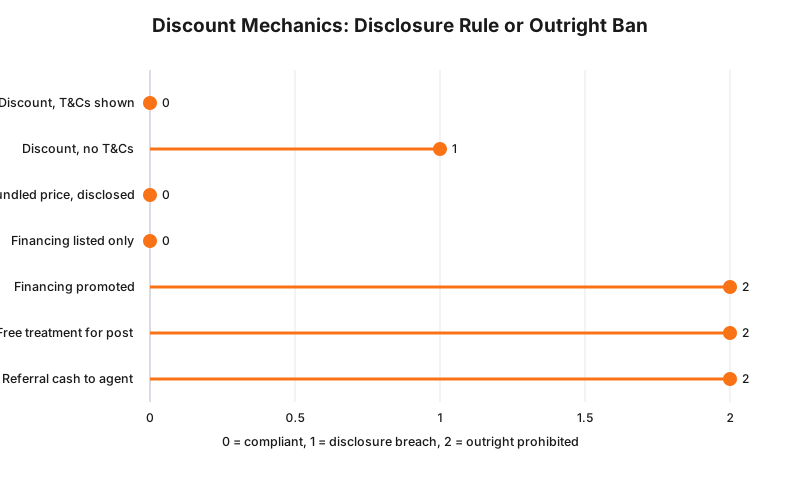
That classification traces to the two rules named above: section 133 governs whether disclosure fixes a mechanic, values 0 and 1, and the practitioner-conduct guidelines govern which mechanics are prohibited regardless of disclosure, value 2. It is a status, not a frequency.
Decision Matrix
| Mechanic | Governing rule | Fixed by better terms and conditions | Build verdict |
|---|---|---|---|
| Percentage-off discount, terms stated in the ad | Section 133 disclosure test | Already compliant | Ship as is |
| Percentage-off discount, no terms in the ad | Section 133 disclosure test | Yes, add the field | Block publish until terms are added |
| Bundled package price, scope and terms stated | Section 133 disclosure test | Already compliant | Ship as is |
| Financing provider listed as an accepted payment method | Practitioner guideline, “informing” | Not applicable | Keep it neutral, no promotional framing |
| Financing scheme promoted as a reason to book | Practitioner guideline, “promoting” | No | Remove the promotional framing |
| Free or discounted treatment traded for a social post | Practitioner guideline, financial incentive ban | No | Turn the mechanic off |
| Cash or credit paid to a third party for a referred patient | Practitioner guideline, third-party inducement ban | No | Turn the mechanic off |
The column that matters is the fourth one. Three of these seven rows cannot be repaired by writing better terms and conditions, however they are stated, because the rule they trip is a conduct prohibition, not a disclosure requirement.
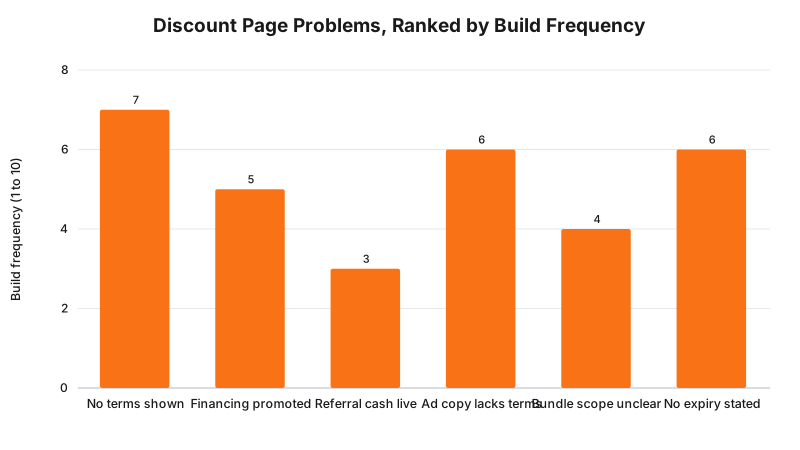
That ranking is a build-experience estimate, not an audited sample. The two highest bars, missing terms and promoted financing, are also the cheapest to fix, since neither needs a mechanic removed, only a field added or a banner restyled.
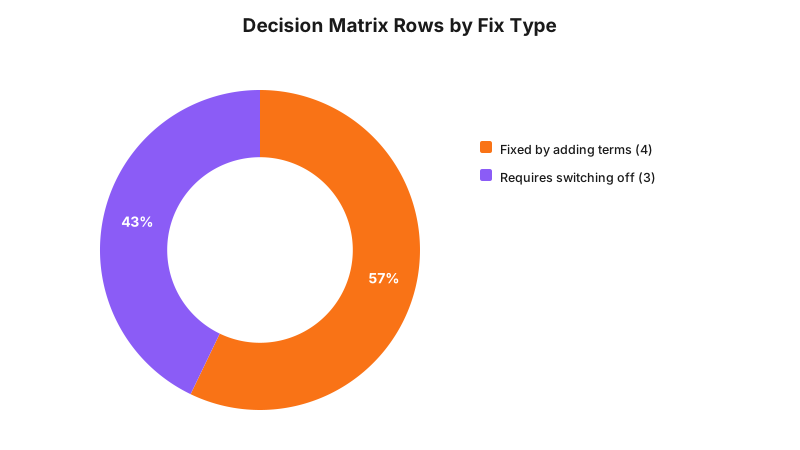
Four of the seven mechanics in the table above are a terms-and-conditions problem, already solved or solved by adding a field. Three are not, and no amount of rewriting the fine print changes that: the fix is a feature flag, not a copy edit.
A Worked Example
Cosmetic clinic. A nurse-led injectables clinic ran a “bring a friend” mechanic paying both the existing patient and the new patient $50 off their next treatment. The offer carried a visible terms line stating the amount, eligible treatments and a twelve-month expiry, satisfying section 133’s disclosure test on its face. The mechanic itself was the problem: paying an existing patient to bring in a new one is a financial inducement offered via a third party, the exact wording the practitioner guideline prohibits. The fix was not better terms. It replaced the cash-back structure with a referral acknowledgement carrying no financial value, a thank-you gift unrelated to treatment pricing, which sits outside the inducement wording because nothing of value changes hands for the referral itself.
Dental practice. A cosmetic dentistry page for veneers, a procedure named in Ahpra’s visual examples material, had a hero banner reading “Smile now, pay later” with a buy-now-pay-later logo and a bold call to action to apply. The same practice’s general dental page listed the same provider in a small “payment options” footer alongside health fund rebates and card payments. The veneers page was promoting the financing scheme as the reason to book; the general page was informing patients what it accepted. The fix moved the veneers page’s financing mention out of the hero banner and into the same neutral payment-options block used elsewhere on the site.
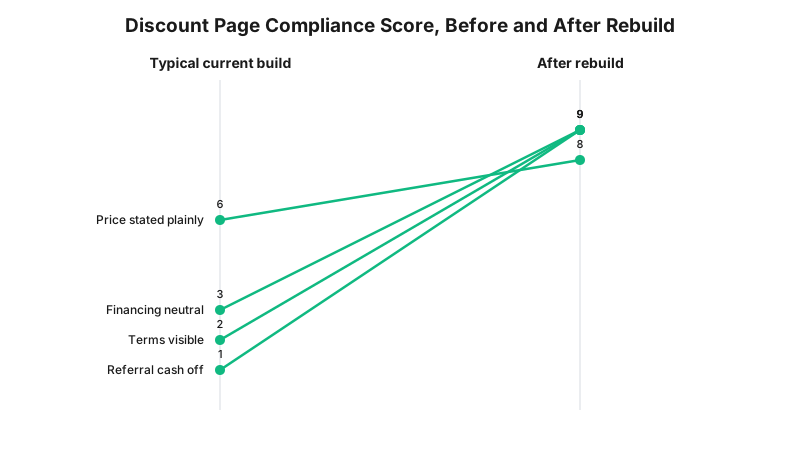
Both worked examples map onto this pattern. The score is a build-judgement scale, not a regulator’s measure. Referral cash and financing framing move furthest because those are switch-off fixes, while price clarity was already reasonable before either rebuild started.
What to Check on Your Own Site
- Find every discount, gift or promotional offer on your site and confirm each has a visible terms statement on the same page, not only on a linked policy page.
- Check whether your CMS allows an offer banner to publish without a terms field populated. If it does, that is a process gap, not just a content gap.
- Search your site and booking platform for any refer-a-friend, loyalty-cash or affiliate mechanic paying money or free treatment for bringing in a patient.
- Check whether any influencer or partnership arrangement trades free or discounted treatment for a social media post.
- Look at how buy-now-pay-later or financing options are presented: a neutral payment-info section, or a promotional call to action on a treatment page?
- Check paid social and Google Ads creative separately. Terms often exist on the landing page but not in the ad copy itself, where section 133 applies first.
The Enforcement Anchor
Section 133 enforcement is real, not theoretical, even without a case naming the discount-and-inducement limb specifically. AHPRA’s purpose-built Cosmetic Surgery Enforcement Unit closed its 200th notification within 18 months of being set up, with 315 notifications still open against 127 practitioners as of March 2024, and around 9% of completed notifications led to regulatory action such as conditions, cautions or enforceable undertakings. That volume of activity sits under the National Law’s general advertising provisions, section 133 included, rather than under any single published case testing this specific wording.
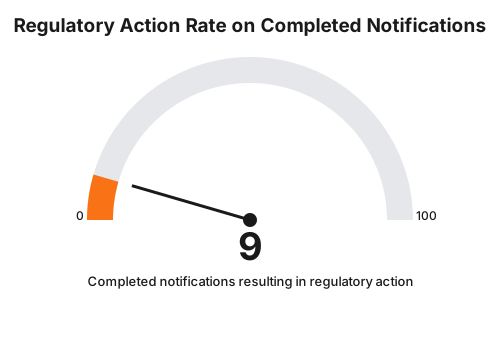
Nine percent sounds small until it is read as a rate rather than a headcount: it is the share of completed notifications, out of a caseload already numbered in the hundreds, where AHPRA imposed conditions, a caution or an enforceable undertaking. A discount banner missing its terms field is exactly the kind of finding that volume of casework catches.
What is not available is a published Australian court or tribunal decision turning specifically on the gift-discount-inducement limb of section 133, or on the practitioner-conduct financial-inducement ban. Reporting that gap plainly beats manufacturing a case that does not exist. AHPRA’s notification volume confirms the general provision carries real regulatory exposure; a decision testing this specific limb against a discount banner is not on the public record as at the date of this post.
Where This Gets Hard
The hardest judgement calls sit in the grey area between a loyalty gesture and a prohibited inducement. A birthday discount code emailed to existing patients reads differently to most people than a cash-back referral scheme, but both involve a financial benefit tied to bringing about treatment, and the guideline wording does not draw a bright line between them. Bundled packages raise a related question: a course of six treatments priced as a package is a normal pricing structure until the bundling itself becomes the inducement, and the Medical Board’s guideline names bundling with unrelated benefits as an example without settling where an ordinary treatment-course package sits.
The regulator says an advertised discount, gift or inducement must state its terms and conditions, and separately that certain financial-inducement mechanics are prohibited outright regardless of disclosure; the build consequence is a mandatory terms field on every offer element plus a hard switch-off for referral-cash and influencer-discount mechanics rather than a disclosure fix for them; whether a specific mechanic on your site falls into the disclosure category or the outright-prohibited category is a question for your medical defence organisation or your lawyer.
For the urgency and scarcity mechanics that sit alongside discount pages, countdown timers and exit-intent popups, see the companion piece on deposit pages and inducement.
Status
In force, not a proposal. As at 17 August 2026, section 133’s disclosure requirement has applied for years, the Medical Board’s inducement ban has applied since 1 July 2023, and Ahpra’s equivalent for other registered practitioners has applied since 2 September 2025.
Frequently Asked Questions
Can a cosmetic clinic advertise a percentage-off discount at all?
Yes. Section 133 of the National Law does not ban discounts. It requires that any advertisement offering a gift, discount or other inducement also states the terms and conditions of that offer. A discount banner with a clear percentage, an eligible treatment list and an expiry date, or a note that it is ongoing, meets that test.
Does giving a discount code to an influencer break the rules?
Yes, and disclosing the terms does not fix it. Both the Medical Board’s 2023 guideline for doctors and Ahpra’s 2025 guideline for other registered health practitioners prohibit financially incentivising the promotion of cosmetic procedures in exchange for free or discounted treatment. This sits outside section 133’s disclosure test altogether.
Can I promote buy-now-pay-later on a treatment page?
The practitioner guidelines separate informing from promoting. Listing a buy-now-pay-later provider alongside credit cards as an accepted method is neutral. A banner or call to action recommending a financing scheme as a reason to proceed is the behaviour the guidelines target.
Does the discount and inducement rule apply to dental practices?
Section 133 applies to advertising any regulated health service, and dentistry is regulated under the same National Law as medicine and nursing. A veneers discount page faces the same disclosure test as a filler discount page. General dental promotions sit under the same test, without the added higher-risk cosmetic procedure guidelines layered on top.
What happens if a clinic’s discount banner has no terms and conditions?
It breaches section 133’s disclosure requirement, an offence under the Health Practitioner Regulation National Law carrying a maximum penalty of $60,000 for an individual and $120,000 for a body corporate per offence, separate from any Board disciplinary action against the practitioner named or implied in the ad. That figure is the current Act text at section 133, not a marketing-blog paraphrase, so treat the legislation itself as the reference point if a secondary source quotes something different.
Get Your Discount Pages Checked
Hire RockingWeb to review every discount, referral and financing element on your site and flag which ones need a terms field, and which ones need to be switched off altogether.
Sources
- AHPRA - Guidelines for advertising higher risk non-surgical cosmetic procedures, in effect from 2 September 2025. Checked 17 August 2026.
- AHPRA - Putting patients first: new guidelines for cosmetic procedures, including the practitioner-conduct financial inducement prohibitions. Checked 17 August 2026.
- Medical Board of Australia - Guidelines for registered medical practitioners who advertise cosmetic surgery, in effect from 1 July 2023. Checked 17 August 2026.
- AHPRA - Cosmetic surgery crackdown closes 200th notification, 11 April 2024: notification and enforcement action volume cited in the Enforcement Anchor section.
- Queensland Legislation - Health Practitioner Regulation National Law Act 2009, current as at 10 April 2026: section 133, $60,000 (individual) / $120,000 (body corporate) maximum penalty.
Last reviewed: 17 August 2026.
Vikas Thakur
Founder of RockingWeb. 16 years building for companies like TPG, iiNet and Monadelphous, now focused on websites and marketing that comply with AHPRA's advertising guidelines and still book patients.