TGA Now Reads Booking Systems as $16.5m Ad Risk
The TGA's 18 June 2026 guidance names business names, logos, booking systems, and price pages as advertising surfaces for prescription medicines, carrying penalties up to $16.5 million per breach for corporations. Here is the website self-audit it demands.
 Vikas Thakur Founder, RockingWeb 9 min read
Key Takeaways
- The TGA published new guidance on 18 June 2026 covering advertising restrictions for prescription medicines under the Therapeutic Goods Act 1989
- Two documents were involved: “Complying with the restrictions on advertising prescription medicines to the public” (new) and “Advertising health services that involve therapeutic goods” (updated)
- Named high-risk categories include cosmetic injectables, peptides, weight loss injections, medical cannabis, IV drip therapies, and erectile dysfunction medicines
- Prohibited advertising can appear in websites, social media, business names and logos, booking systems, product catalogues, and price information
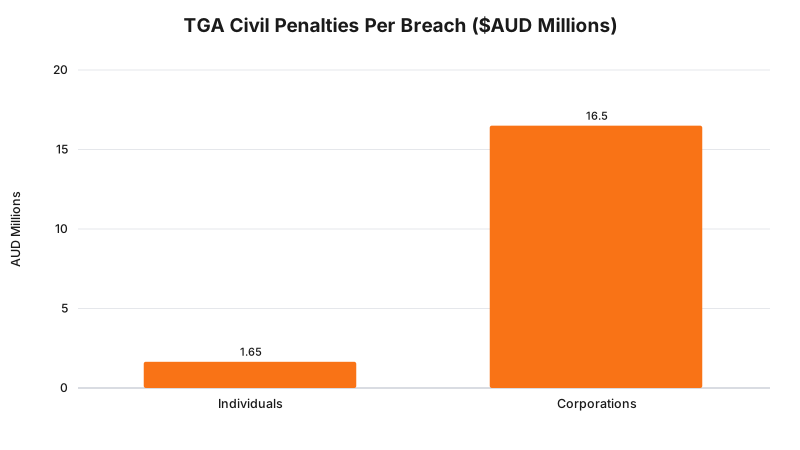
- Civil penalties reach $1.65 million per breach for individuals and $16.5 million per breach for corporations, plus fines, imprisonment, and possible criminal proceedings
- The updated guidance now names online and telehealth services specifically, closing a gap around consultations that lead to a prescription without naming a drug
- The TGA says it works with industry on voluntary compliance first, but expects prompt review and removal of non-compliant content
The TGA’s 18 June 2026 guidance lists your business name, your logo, your booking system, and your price page as advertising surfaces for prescription medicines. Under the Therapeutic Goods Act 1989, a clinic can breach the rules with no drug name anywhere on the page.
Two documents changed. One spells out what counts as prohibited advertising for prescription medicines sold to the public, naming cosmetic injectables, peptides, weight loss injections, medical cannabis, IV drips, and erectile dysfunction medicines as the categories under watch. The other updates the rules for health services, including telehealth, that lead a visitor toward a specific prescription treatment. Civil penalties run to $16.5 million per breach for a corporation. This is what changed, and what it means for the pages your site already has live.
What the TGA Actually Published
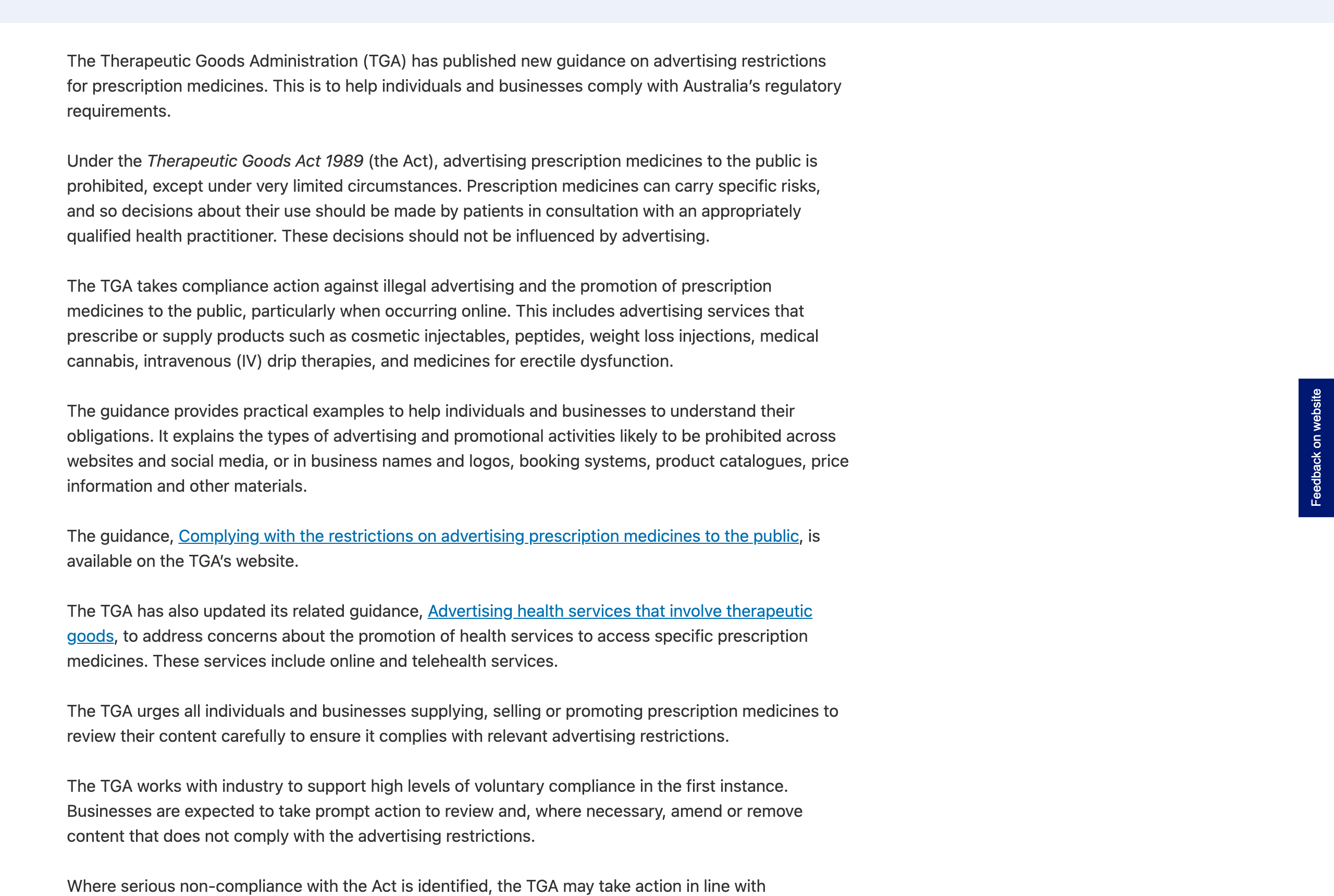
The TGA’s media release, published 18 June 2026, announces guidance on advertising restrictions for prescription medicines, published to help individuals and businesses comply with the Therapeutic Goods Act 1989. Under that Act, advertising prescription medicines to the public is prohibited except in very limited circumstances, because decisions about their use should sit between a patient and an appropriately qualified health practitioner, not be shaped by a marketing page.
The release names the treatment categories the TGA is watching most closely: services that prescribe or supply cosmetic injectables, peptides, weight loss injections, medical cannabis, intravenous drip therapies, and medicines for erectile dysfunction. If your site sells access to any of these, this guidance describes exactly how the TGA reads your pages.
The new document is titled “Complying with the restrictions on advertising prescription medicines to the public.” A companion piece, “Advertising health services that involve therapeutic goods,” was also updated on the same day, specifically to address concerns about promoting health services, including online and telehealth services, that lead someone toward a specific prescription medicine.
Takeaway: this is not a single new rule. It is two guidance documents working together, one for direct product advertising, one for the consultation and booking path that leads to it.
The Six Surfaces the TGA Is Now Reading
Here is the sentence that matters most for anyone who builds or runs a clinic website. The TGA’s guidance explains the types of advertising and promotional activities likely to be prohibited “across websites and social media, or in business names and logos, booking systems, product catalogues, price information and other materials.”
Read that list again slowly. It is not “your ad copy.” It is six separate surfaces, most of which nobody thinks to check when reviewing a site for compliance.
| Surface named in the guidance | Common example on a clinic site |
|---|---|
| Websites and social media | Treatment landing pages, Instagram bio, service descriptions |
| Business names and logos | A trading name or logo that references a drug or treatment category |
| Booking systems | A public booking widget that lets a visitor reserve a prescription treatment directly |
| Product catalogues | A price list or “our treatments” page naming specific injectables or peptides |
| Price information | Per-unit or per-session pricing tables for prescription-only treatments |
| Other materials | PDFs, brochures, intake forms, and confirmation emails |
A price page rarely uses the word “advertising” in anyone’s head while it is being built. It is a page of numbers. Under this guidance, it is read the same way as a billboard.
Takeaway: the TGA is not only reading your marketing copy. It is reading your price page, your booking flow, and your business name as advertising in their own right.
Telehealth Gets Its Own Line
The second document, the updated “Advertising health services that involve therapeutic goods” guidance, is the one that catches telehealth and online-only providers off guard. The TGA changed it to address concerns about the promotion of health services to access specific prescription medicines, and it names online and telehealth services directly.
The practical effect is that a consultation booking page does not need to mention a drug name to fall under this guidance. If the page’s overall message is “book a consult and get the treatment,” and the treatment in question is a prescription medicine, the consultation itself can be read as the advertising vehicle. A generic “start your consultation” button sitting above a list of outcomes (“weight loss,” “smoother skin,” “better performance”) is exactly the kind of page this guidance was updated to address.
Takeaway: if your business runs any part of its funnel through a telehealth or online consultation flow, this guidance change applies to you even if you never touch a syringe.
What This Costs If It Goes Wrong
The TGA’s release states its enforcement position plainly. It works with industry to support voluntary compliance in the first instance, and expects businesses to take prompt action to review and, where necessary, amend or remove non-compliant content.
Where serious non-compliance is identified, the TGA says it may act under its regulatory compliance framework, which can include infringement notices, directions, prevention notices, or civil or criminal proceedings. The stated penalties for breaches of the Act are civil penalties of up to $1.65 million per breach for individuals, or $16.5 million per breach for corporations, alongside fines or imprisonment.
The TGA has told the industry what it will treat as a breach. Whether a specific page on your site actually crosses that line is a question for your medical defence organisation or your lawyer, not for a web developer. What a web developer can tell you is which pages carry the risk profile this guidance describes, and get them in front of the right person before a regulator does.
A Website Self-Audit Against This Guidance
This is the practical version of the six-surface table above, written as a checklist you can run against your own site this week.
- Business name and logo. Does either reference a prescription treatment category directly, in a way that could be read as promoting access to it?
- Treatment and price pages. Do they name specific prescription medicines, or substitute terms for them, alongside pricing?
- Booking system. Can a visitor book a prescription-only treatment without any clinical assessment step appearing first?
- Telehealth or consultation funnels. Does the page frame a “book a consult” call to action around a specific outcome tied to a prescription medicine?
- Product catalogues and PDFs. Do downloadable price lists or brochures carry the same claims your web pages do, or have they drifted out of sync?
- Intake and confirmation content. Do automated booking confirmation emails or intake forms repeat claims your reviewed website copy no longer makes?
An audit against this list is not a guess. It follows the same six surfaces the TGA named in its own release.
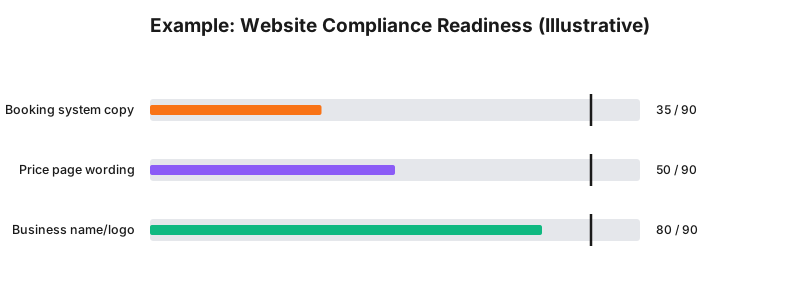
The chart above is a worked example, not a real audit score from any actual clinic. It shows the pattern RockingWeb sees most often: business names and logos usually score well because they were set years before any treatment was added, while booking systems and price pages lag because they get edited fastest and reviewed least.
Takeaway: the surface most likely to breach this guidance is also the one edited most often without a compliance review, your booking system and price page.
Frequently Asked Questions
What exactly did the TGA publish on 18 June 2026?
Two guidance documents. The first, “Complying with the restrictions on advertising prescription medicines to the public,” sets out practical examples of prohibited advertising. The second is an updated version of “Advertising health services that involve therapeutic goods,” which now addresses online and telehealth services specifically.
Does my website’s price list or booking system count as advertising under this guidance?
The TGA’s guidance says prohibited advertising can appear “across websites and social media, or in business names and logos, booking systems, product catalogues, price information and other materials.” A booking flow, a price page, or even a business name can be assessed the same way as a display ad.
What are the penalties if a website breaches the Therapeutic Goods Act 1989?
The TGA states civil penalties of up to 1.65 million dollars per breach for individuals and 16.5 million dollars per breach for corporations, alongside fines, imprisonment, and the possibility of civil or criminal proceedings for serious non-compliance.
Does this guidance apply to telehealth providers, not just clinics with a physical location?
Yes. The TGA’s updated “Advertising health services that involve therapeutic goods” guidance was changed specifically to address concerns about promoting health services, including online and telehealth services, that give access to a specific prescription medicine.
Get Your Site Checked Against the New TGA Guidance
RockingWeb reviews clinic and telehealth websites against current TGA and AHPRA advertising rules, checking the exact surfaces this guidance names: business names, booking systems, price pages, and telehealth intake flows, and flags what needs to change before a regulator finds it first.
Sources and References
- Therapeutic Goods Administration - TGA releases new guidance on advertising restrictions for prescription medicines, published 18 June 2026. Date checked: 15 August 2026.
Related reading:
- TGA Fined a Nurse $11,880 Over a Booking Loophole: the substitute-term loophole and 2026 infringement cases
- AHPRA Advertising Fines for Cosmetic Clinics: the parallel AHPRA penalty structure
- AHPRA Compliance Audit Checklist: a step-by-step self-audit guide
For booking systems and websites built compliant from the first draft, see ClinicPipeline or talk to us about your clinic’s marketing.
Vikas Thakur
Founder of RockingWeb. 16 years building for companies like TPG, iiNet and Monadelphous, now focused on websites and marketing that comply with AHPRA's advertising guidelines and still book patients.