TGA Fined a Company $59,400 in March 2026, Not for Advertising
In March 2026 the TGA issued three infringement notices totalling $59,400 to Canngea Pty Ltd, a Queensland medicinal cannabis wholesaler, over an alleged failure to answer a request for information about its supply of therapeutic vaping goods. The case has nothing to do with advertising copy, and that gap between what most clinics prepare for and what the TGA actually fined is the reason it belongs in your compliance file.
 Vikas Thakur Founder, RockingWeb 14 min read
On this page 11
- What the TGA said
- What this means for the build
- Decision matrix: who fines what, and why the numbers are not the same thing
- Worked example: a cosmetic clinic’s import paperwork
- What to check on your own site
- Is this being enforced, or just a risk on paper
- Where this gets hard
- Is this in force right now
- Frequently asked questions
- Ready to get this checked before a letter arrives
- Sources and last reviewed
In March 2026 the Therapeutic Goods Administration issued three infringement notices totalling $59,400 to Canngea Pty Ltd, a Queensland-based medicinal cannabis wholesaler. The reason was not a misleading claim, a banned trade name, or a before-and-after photo. The TGA’s stated ground was an alleged failure to comply with a request for information about Canngea’s supply of therapeutic vaping goods, in alleged breach of the conditions attached to the exemption those goods were supplied under. If your compliance checklist only covers advertising copy, this case is the reason to widen it.
What the TGA said
The Therapeutic Goods Administration’s own media release, titled “Canngea Pty Ltd issued infringement notices totalling $59,400 for alleged failure to comply with a request for information about the supply of therapeutic vaping goods,” states that in March 2026 it issued three infringement notices totalling $59,400 to the Queensland company. tga.gov.au blocks automated fetching, so the figures below are cross-checked against the reachable secondary reporting that republishes and confirms the release: the industry outlet AJP, government-release aggregator National Tribune, and the TGA’s own official social accounts.
The notices were issued for allegedly failing to comply with requests to provide information about the supply of therapeutic vaping goods, a category of product that can be supplied without full TGA premarket evaluation provided the supplier meets specified conditions. The release states that sponsors of goods supplied this way must retain, and provide on request, certain information about those goods, and that supplying false or misleading information is itself a separate offence under the Therapeutic Goods Act 1989. Canngea has agreed to pay the $59,400 total.
Two things worth holding onto here. First, this is not a court finding. An infringement notice is a civil compliance tool, and paying one carries no admission of guilt and creates no criminal record, the same as the TGA’s practice in every other infringement matter this site has covered. Second, and more useful for a clinic reading this: the alleged breach sits entirely in the sponsor’s obligation to answer a regulator’s request, not in what the company said publicly about its products.
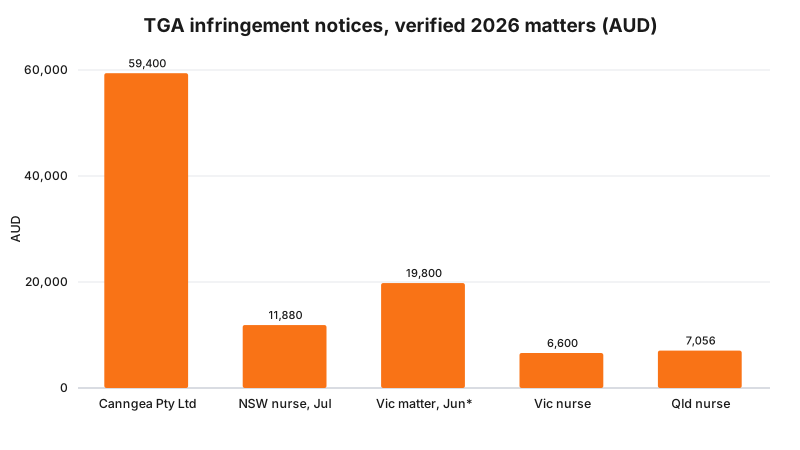
Canngea’s $59,400 is the largest confirmed TGA infringement total against a therapeutic-goods supplier so far in 2026, well ahead of any of the practitioner-level import cases this site has separately verified. The company that paid the most was not selling a treatment to the public at all. It was answering, or failing to answer, a letter.
The asterisk on “Vic matter, Jun” matters. That $19,800 is not one person’s fine. It is a reported total across two separately penalised individuals in the same June 2026 Victorian matter, a nurse fined $7,920 and a separate individual fined $11,880. The other four bars are each a single party’s total; that one is a sum, kept as one bar here only because the source reports the two figures together as a single matter.
What this means for the build
Read narrowly, this case says nothing about a clinic website. Read for what actually caused the fine, it says something specific: the exposure sat in whether the business could produce records and respond to a regulator on request, not in what its marketing said.
That is a records and communications problem before it is a legal one, and both halves have a build component. Start with where compliance correspondence lands. A generic reception@ or info@ inbox, unmonitored outside business hours or triaged by whoever is at the front desk that week, is a common way a formal information request goes unanswered past its deadline. If your contact form, footer email, and listed compliance contact all route to the same unmonitored box, a regulator’s request can sit unread for the exact window that turns a request into a notice.
Next, look at where supply records actually live. Invoices, ARTG entries or exemption paperwork, supplier certificates, and import documentation for TGA-regulated stock, injectables included, are frequently scattered across email threads, a practice management system, and a filing cabinet, roughly in that order of retrievability. A clinic’s booking or practice-management backend is usually the one system already structured to hold batch numbers, supplier details, and dates against a patient record. Extending that structure into a standing, retrievable supply-and-correspondence log, rather than searching old emails when a request lands, is the practical version of the lesson this case teaches.
Finally, check that your publicly listed business details, registered address, ABN, and compliance contact match what a regulator actually has on file for you. A changed premises or a lapsed contact address is a mundane, entirely fixable reason for correspondence to miss its target, and it is a five-minute audit against your footer and About page.
Decision matrix: who fines what, and why the numbers are not the same thing
| Trigger | Regulator | Legal basis | Amount reported or at stake | What fixes it |
|---|---|---|---|---|
| Naming a prescription-only trade name in health-service advertising | TGA | Advertising Code, Therapeutic Goods Act 1989 | No confirmed standalone paid total; illustrated by the Qld nurse matter, which combined this with an import breach in a $7,056 notice total (2026) | Rewriting page copy, schema fields, PDFs |
| Importing unapproved therapeutic goods | TGA | TG Act 1989, import provisions | NSW nurse, $11,880 (Jul 2026); Vic and Qld matters, $6,600 to $19,800 (2026) | Sourcing only ARTG-listed stock |
| Failing to answer a TGA request for supply information | TGA | TG Act 1989, sponsor recordkeeping | Canngea Pty Ltd, $59,400 (Mar 2026) | Monitored inbox, retrievable records |
| False, misleading, or unreasonable-expectation advertising | AHPRA (National Law) | s133, National Law | Up to $60,000 individual, $120,000 body corporate (statutory max, not a paid total) | Compliant ad copy, reviewed pre-publish |
The last row is worth reading carefully against the others. The TGA figures in this table are amounts businesses actually paid, reported case by case. The AHPRA figure is the statutory ceiling set by section 133 of the National Law, the most a single breach can theoretically cost, not a number any cosmetic clinic has been confirmed to have paid at that level. Some marketing commentary conflates the two, or circulates a lower $30,000 and $60,000 figure for the AHPRA maxima. The correct figures, current as of 2023 court guidance and unmoved since, are $60,000 for an individual and $120,000 for a body corporate. Treat the TGA column as evidence of what happens, and the AHPRA column as evidence of what could.
One more distinction worth holding onto, because it is easy to blur the two TGA rows together: the NSW nurse’s $11,880 total and the Victorian totals in the import row are reported as import breaches only, with no confirmed advertising component. The Queensland nurse’s $7,056 is the one verified 2026 matter that combined both, an alleged import breach and a separate penalty for advertising prescription-only medicines on social media. The advertising row above exists because that rule is standing and enforced, not because any single case has a confirmed dollar figure attached to advertising alone.
Worked example: a cosmetic clinic’s import paperwork
Take a fictional but representative Perth cosmetic clinic that imports Schedule 4 anti-wrinkle injectables under a prescriber-held authorisation, sourced through a registered wholesaler. Its current setup: supplier invoices land in the practice manager’s personal inbox, batch and expiry data is written into each patient’s paper consult card and never digitised, and the only listed compliance contact on the website is the same general enquiries form used for booking questions.
If a regulator sent that clinic a written request tomorrow for supply records covering the last twelve months, three things would need to happen inside a short compliance window: someone notices the request landed, someone locates every relevant invoice and batch record across two disconnected storage systems, and someone confirms nothing in that paperwork is itself inaccurate before sending it. None of those steps involves the clinic’s marketing, and every one is slower than it needs to be because the records live in separate places.
The fix is not a rebuild. It is adding a structured supply-record field set to the practice management or booking system already in use, so batch number, supplier, and certificate reference sit against the treatment record the same way appointment time already does, and pointing the site’s compliance contact at a monitored, logged inbox rather than the general enquiries form. Both are configuration changes, not development, and both address the exact gap that turned Canngea’s alleged non-response into a $59,400 notice.
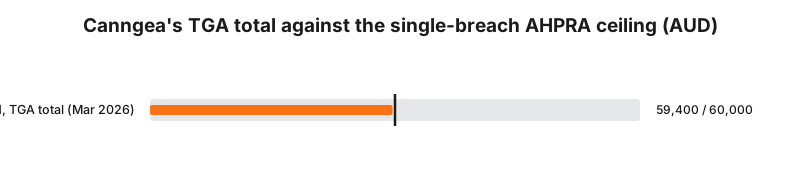
Canngea’s reported total sits close to the individual-practitioner ceiling under a completely different Act, enforced by a completely different regulator, for a completely different kind of breach. The two regimes are not interchangeable, but the scale of the numbers is a useful reality check against the assumption that only advertising breaches carry a serious figure.
What to check on your own site
- Confirm your site’s listed compliance, privacy, or regulatory contact email is actively monitored, not the same box as general booking enquiries
- Confirm your registered business address and ABN, as shown in your footer or About page, match what is currently on file with the regulators relevant to your stock
- Confirm supplier invoices, ARTG entries, and any exemption or permit paperwork for TGA-regulated stock are stored somewhere searchable in minutes, not somewhere searchable in an afternoon
- Confirm your practice management or booking backend captures batch, supplier, and date fields against treatments using TGA-regulated goods, not just the appointment itself
- Confirm whoever answers your general contact form knows to escalate anything that looks like regulator correspondence, rather than treating it as a routine enquiry
- Confirm your site does not carry an unqualified “TGA approved” or similar claim about a product or exemption status without a current, checkable basis for it
Is this being enforced, or just a risk on paper
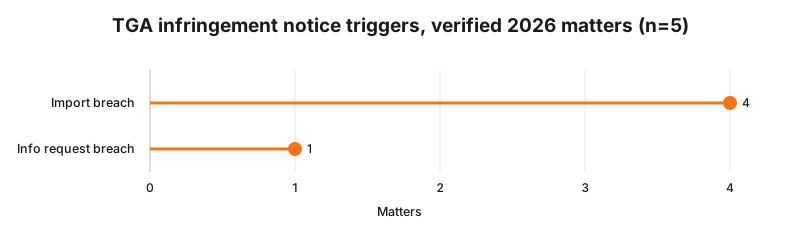
Of the five verified 2026 TGA infringement matters this site has confirmed against therapeutic-goods suppliers, four involved importing unapproved stock and one, Canngea, involved an alleged failure to respond to an information request. That is a small sample, and it should not be read as a claim about the TGA’s overall enforcement mix. What it shows is that the information-request trigger is not hypothetical. It happened, it was the largest single total of the five, and it happened to a business with no reported connection to false advertising.
Where this gets hard
Nothing in the public record connects Canngea’s case to a cosmetic clinic, an injectable, or a website. The company is a vaping goods sponsor, not a clinic, and this guide has not claimed otherwise. The parallel drawn here, that a clinic importing or stocking TGA-regulated injectables sits under a similar sponsor recordkeeping and information-request framework, is a structural reading of the same Act, not a reported case against a cosmetic business. Treat it as a real category of exposure worth checking, not as evidence that any specific clinic is currently at risk.
The regulator says a sponsor of therapeutic goods supplied under an exemption must retain and provide specified supply information to the TGA on request; the build consequence is that your compliance records and any regulator correspondence need to sit somewhere monitored and retrievable, not scattered across personal inboxes; whether your own import, supply, or exemption arrangement carries that same information-request obligation is a question for your medical defence organisation or your lawyer.
Is this in force right now
As at 2 September 2026, the sponsor recordkeeping and information-request obligations under the Therapeutic Goods Act 1989 that the TGA relied on in the Canngea matter are in force, standing law, not a proposal or a scheme awaiting commencement. Section 133 of the Health Practitioner Regulation National Law, the AHPRA advertising penalty referenced in the comparison table above, is likewise currently in force. Neither has a pending start date.
Frequently asked questions
Was Canngea fined for false advertising?
No. The TGA’s stated reason was an alleged failure to comply with a request for information about the supply of therapeutic vaping goods, in alleged breach of the conditions attached to Canngea’s exemption. Nothing in the TGA’s release or the secondary reporting of it concerns advertising claims, website copy, or marketing conduct.
Who is Canngea and what does it supply?
Canngea Pty Ltd is a Queensland-based medicinal cannabis wholesaler. The infringement notices related specifically to its supply of therapeutic vaping goods, a separate product category from the medicinal cannabis products the company is more commonly associated with.
Is a TGA infringement notice the same as a criminal conviction?
No. Paying an infringement notice is not an admission of guilt or liability and does not create a criminal record. It is a civil compliance tool the TGA can use instead of referring a matter for prosecution.
Does this case apply to cosmetic clinics that stock injectables?
The underlying obligation, that a sponsor of TGA-regulated goods must keep and hand over supply information on request, sits in the same Therapeutic Goods Act 1989 framework that governs how a clinic imports and stocks prescription-only injectables. No public TGA infringement notice against a cosmetic clinic on this specific ground has been confirmed, so treat the parallel as a live exposure to check, not a reported outcome to cite.
What should a clinic do differently after reading this?
Confirm that supply and import records for any TGA-regulated stock are retrievable on short notice, and that correspondence from a regulator has a monitored destination rather than sitting in an inbox nobody checks. Both are administrative and website-adjacent fixes, not clinical ones.
Ready to get this checked before a letter arrives
If you already know your supply records and compliance contact are in order, this post has cost you five minutes. If you are not sure, that uncertainty is the risk this case describes. Talk to us about your clinic’s website and compliance contact setup and we will tell you within one business day what we find and what it takes to fix it. For the advertising-side companion to this case, see the July 2026 nurse infringement notice breakdown, and for a full compliance pass on your site, get in touch with RockingWeb or see compliant cosmetic clinic websites.
Sources and last reviewed
- Therapeutic Goods Administration, “Canngea Pty Ltd issued infringement notices totalling $59,400 for alleged failure to comply with a request for information about the supply of therapeutic vaping goods,” media release, March 2026. www.tga.gov.au blocks automated fetching, so the figures here were corroborated against the reachable secondary reporting below rather than a direct TGA page fetch.
- AJP (Australian Journal of Pharmacy), “Medicinal cannabis wholesaler fined over vapes,” by Nicholas O’Donoghue, published 10 July 2026.
- National Tribune, “Canngea Pty Ltd issued infringement notices totalling $59,400 for alleged failure to comply with a request for information about the supply of therapeutic vaping goods,” syndicated republication of the TGA release.
- MMJ Daily, “Canngea fined $59,400 for withholding supply information from TGA.”
- Therapeutic Goods Administration, official LinkedIn and Facebook posts confirming the $59,400 total and the three-notice breakdown.
- AJP (Australian Journal of Pharmacy), “TGA fines unapproved botox importer,” published 7 July 2026, source for the NSW nurse’s $11,880 total, issued and made public in July 2026 over alleged import of unapproved botulinum toxin and lidocaine-containing syringes, not any advertising conduct (verified in this site’s companion post on the July 2026 NSW nurse infringement notices).
- Therapeutic Goods Administration, “Two nurses fined for allegedly importing unapproved cosmetic injectables,” media release, and Medtree, “TGA Fines Victorian Pair Over Illegal Cosmetic Injectable Imports,” published 17 June 2026, source for the comparison figures in the bar chart above. The Vic matter, Jun figure is a combined total across two individuals fined in the Medtree-reported matter, a nurse fined $7,920 and a separate individual fined $11,880; the Queensland nurse in the TGA release was also penalised for advertising prescription-only medicines on social media, in addition to the import breach (also verified in this site’s companion post on the July 2026 NSW nurse infringement notices).
- Health Practitioner Regulation National Law, section 133 (Advertising); Stephens Lawyers & Consultants, “Advertising of Health Services: New Advertising Guidelines” (2023), source for the corrected $60,000 individual and $120,000 body corporate penalty maxima.
- Therapeutic Goods Act 1989 (Cth), sponsor recordkeeping and information-request provisions.
Last reviewed 2 September 2026. Regulator and secondary sources checked 2 September 2026.
Vikas Thakur
Founder of RockingWeb. 16 years building for companies like TPG, iiNet and Monadelphous, now focused on websites and marketing that comply with AHPRA's advertising guidelines and still book patients.