TGA Hits Nurse, Individual With $19,800 in Fines
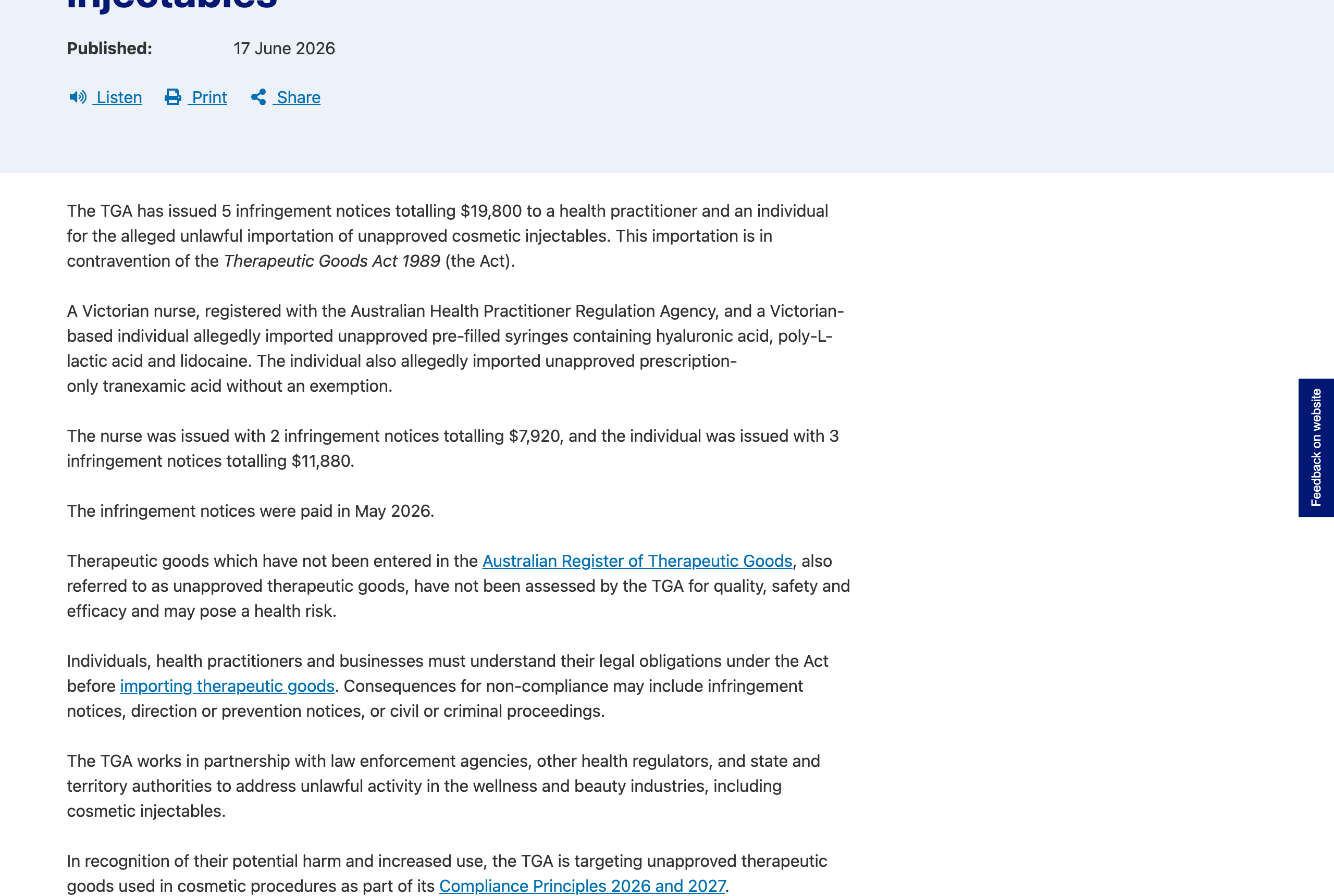
The TGA issued 5 infringement notices totalling $19,800 to a Victorian nurse and a Victorian individual on 17 June 2026 over unapproved injectables never listed on the ARTG. The import case is not a website problem on its own, but the same enforcement priority pulls in whatever a clinic site says about product sourcing.
 Vikas Thakur Founder, RockingWeb 9 min read
Five infringement notices. One nurse. One individual. $19,800 total, paid out before most clinics even knew the case existed. On 17 June 2026, the TGA fined a Victorian nurse and a Victorian individual $19,800 total over unlisted cosmetic injectables never entered on the Australian Register of Therapeutic Goods. Neither party’s name is public. The pattern is the point: this sits inside a stated TGA enforcement priority running through 2027, and it is not really an import story. It is a paper trail story, and the paper trail usually starts on a website.
Key Takeaways
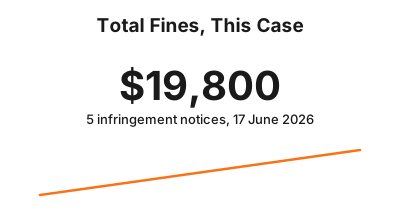
- The TGA issued 5 infringement notices totalling $19,800 on 17 June 2026, to a Victorian nurse and a separate Victorian individual.
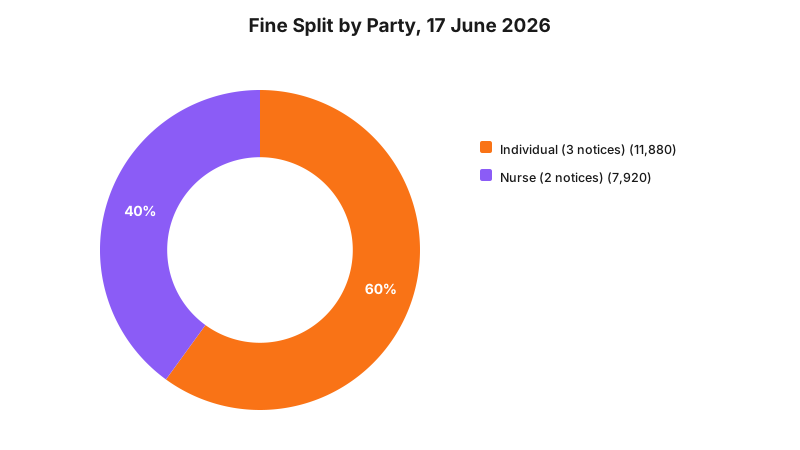
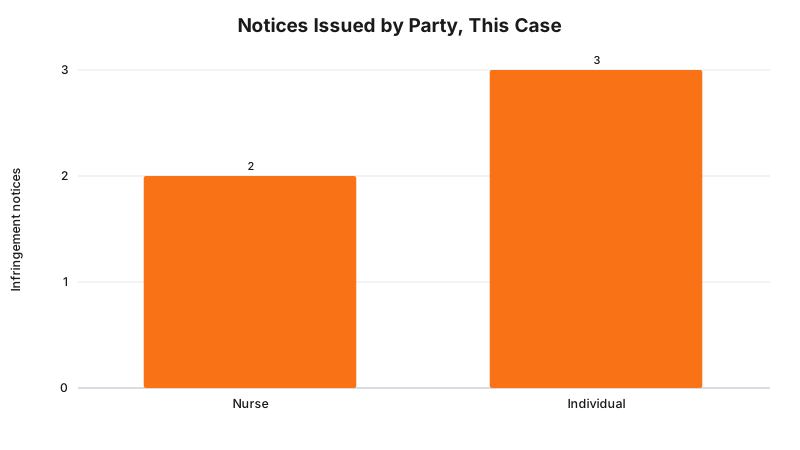
- The nurse received 2 notices totalling $7,920. The individual received 3 notices totalling $11,880.
- Both parties allegedly imported pre-filled syringes containing hyaluronic acid, poly-L-lactic acid and lidocaine, none listed on the ARTG.
- The individual also allegedly imported unapproved prescription-only tranexamic acid without an exemption.
- Both sets of notices were paid in May 2026, ahead of the public release.
- The TGA names this enforcement area explicitly as part of its Compliance Principles 2026 and 2027.
- The TGA’s own release names two specific unapproved parallel-imported products, Profilo and sculptura, as examples of goods not approved for the Australian market.
- The TGA’s own release page lists at least two other 2026 cosmetic injectable import infringement cases in its “Related content” section, alongside this one.
What the TGA actually said
Strip away the acronyms and the case is simple. A Victorian nurse, registered with the Australian Health Practitioner Regulation Agency, and a separate Victorian-based individual allegedly imported unapproved pre-filled syringes containing hyaluronic acid, poly-L-lactic acid and lidocaine. The individual went further, allegedly importing unapproved prescription-only tranexamic acid without an exemption. None of it was on the ARTG, the register the TGA uses to confirm a therapeutic good has actually been assessed for quality, safety and efficacy.
The nurse copped 2 infringement notices totalling $7,920. The individual copped 3, totalling $11,880. Both paid up in May 2026, a month before the case became public. Run the maths and something interesting falls out: $7,920 divided by 2 notices is $3,960. $11,880 divided by 3 notices is also $3,960. Same per-notice figure, different party, different count. That is not a coincidence, it is how a fixed statutory penalty scales: more alleged breaches, more notices, same rate per notice.
The TGA’s release does not stop at the fine. It states plainly that “the TGA is targeting unapproved therapeutic goods used in cosmetic procedures as part of its Compliance Principles 2026 and 2027.” That is not throwaway language in a press release. It is the regulator telling the industry, in writing, where its attention sits for the next two years. And it names two of the actual unapproved products in the image caption on the release: Profilo and sculptura, described as parallel imported cosmetic injectables not approved for the Australian market.
Here is why that detail matters more than the dollar figure. Profilo and sculptura are not obscure code names. They are the kind of product names that show up in a clinic’s treatment menu, a booking widget dropdown, or a before-and-after caption. A regulator naming specific brand-adjacent products in an enforcement release is a signal about what search terms and what page content draw scrutiny next.
Takeaway: the fine is the headline. The named products and the stated 2026-2027 priority window are the parts that should change what you check on your own site this week.
Why an import case becomes a website problem
An infringement notice for unlawful importation is not, on its face, a website issue. The TGA case above is about what crossed the border, not what was published online. Paying an infringement notice is not an admission of guilt and does not create a criminal record. It is an alternative the TGA can offer instead of referring a matter to prosecution.
But regulators do not investigate in a vacuum. When the TGA or AHPRA opens a file on a practitioner or a clinic, the first thing anyone checks is the public-facing website, because it is the one piece of evidence that requires no subpoena. Three website patterns turn an import question into a documented advertising and provenance question:
- Named, unnamed or generic product ranges. A treatment page that says “premium dermal filler range” or names a specific product without stating its ARTG status invites the question: is this the product actually used, and is it listed?
- “In-house sourced” or “clinically sourced” language. Vague sourcing claims read as reassurance copy. To a regulator cross-referencing an import investigation, the same words read as an unverified provenance claim sitting on a public page.
- Before-and-after galleries tied to a named or implied procedure. A gallery captioned with a treatment name, run alongside stock or sourcing claims, becomes the visual evidence that ties a specific procedure to specific claims about the product behind it.
None of this means a clinic did anything wrong. It means the website is the one document a regulator, a journalist or a competitor can pull up without asking anyone’s permission. The TGA case above did not touch either party’s website (none is on the public record). The exposure point for a clinic is different: it is what your own site says while a case like this one runs in your industry.
Takeaway: an ARTG import breach and a website compliance gap are two separate questions, and a clinic site is often the only place both questions get answered in public at once.
What to check on your own site this week
This is not legal advice, and it is not clinical advice about which products to use. It is a website content audit, the kind RockingWeb runs for clinic clients as a matter of course. Four checks, in order of how quickly a regulator or a curious competitor would find them:
| Page element | What to look for | Why it matters here |
|---|---|---|
| Treatment/service pages | Any named injectable brand or generic “range” language | Named products invite the question of ARTG status directly |
| About/sourcing copy | Phrases like “in-house sourced”, “premium range”, “clinically imported” | Unverifiable provenance claims read differently under active TGA enforcement |
| Before/after galleries | Captions naming a procedure alongside product claims | Ties a specific claim to a specific, checkable image |
| Booking widgets and menus | Dropdown or package names referencing specific product lines | Structured data a regulator can screenshot in one click |
Work through the table in order. Treatment pages get indexed by Google and cached, so they are the most durable record. Booking widgets are the most likely to reveal a product name nobody thought to check, because they are often built by a third-party vendor and rarely reviewed after launch. If a page names a specific product, confirm the product’s current ARTG status directly on the TGA’s public register before deciding whether the copy needs to change. Re-check periodically: ARTG entries can be varied, suspended or cancelled after a page was written.
Takeaway: treat this as a four-item checklist, not a full legal review, and start with the pages Google has already indexed.
The pattern, not just the case
This 17 June 2026 case does not stand alone. The TGA’s own media release page lists its own “Related content” links to at least two other 2026 infringement actions over unapproved cosmetic injectable or therapeutic goods imports, all pulling from the same statutory framework and the same stated 2026-2027 compliance priority. A regulator naming a two-year priority window in a media release is telling you the sample size is going to keep growing. Whether any specific fact pattern here applies to your clinic, your supplier or your website is a question for your medical defence organisation or your lawyer. What a website audit can tell you today is whether your own pages already contain the kind of language that turns a supplier question into a public one.
Takeaway: one case is a headline. A stated two-year priority is a trend, and trends are what a website audit should be checked against, not just the latest fine.
Frequently Asked Questions
How much did the TGA fine the nurse and the individual?
The TGA issued 5 infringement notices totalling $19,800 on 17 June 2026. A Victorian nurse, registered with AHPRA, received 2 notices totalling $7,920. A separate Victorian-based individual received 3 notices totalling $11,880. Both parties paid the notices in May 2026.
What products were involved in the TGA case?
The nurse and the individual allegedly imported unapproved pre-filled syringes containing hyaluronic acid, poly-L-lactic acid and lidocaine. The individual also allegedly imported unapproved prescription-only tranexamic acid without an exemption. None of the products were listed on the Australian Register of Therapeutic Goods at the time.
Does an unlisted ARTG product automatically mean my website is non-compliant?
Not automatically. Whether a specific product claim, sourcing statement or before-and-after image on your site creates a compliance issue depends on what your site actually says and what was actually used. The TGA case is about importation, a separate question from advertising content. Whether either applies to your circumstances is a question for your medical defence organisation or your lawyer.
What is the TGA Compliance Principles 2026 and 2027?
It is the TGA’s stated enforcement framework for targeting unapproved therapeutic goods used in cosmetic procedures, referenced directly in the 17 June 2026 media release covering this case. The TGA describes it as a priority area, meaning cosmetic injectable imports are getting sustained regulatory attention, not a one-off crackdown.
Sources and References
- Therapeutic Goods Administration, “TGA issues infringement notices to a health professional and an individual for alleged unlawful importation of cosmetic injectables,” media release, published 17 June 2026. tga.gov.au. Date checked: 15 August 2026. Source for the $19,800 total, the $7,920 nurse figure, the $11,880 individual figure, the notice counts, the products named, the May 2026 payment date and the direct quote referencing Compliance Principles 2026 and 2027.
- Therapeutic Goods Administration, “Australian Register of Therapeutic Goods (ARTG).” tga.gov.au. Date checked: 15 August 2026. Reference for how to check a product’s current ARTG listing status.
- Therapeutic Goods Administration, “Compliance Principles 2026 and 2027.” tga.gov.au. Date checked: 15 August 2026. Referenced directly within source 1 as the stated enforcement priority this case sits under.
Vikas Thakur
Founder of RockingWeb. 16 years building for companies like TPG, iiNet and Monadelphous, now focused on websites and marketing that comply with AHPRA's advertising guidelines and still book patients.