Google Axed Its Cosmetic Ad Ban Sept 22: AHPRA Didn't
From September 22, 2025, Google Ads stopped restricting mature cosmetic procedure ads under its Sexual Content policy. AHPRA's before/after and outcome-claim bans for Australian cosmetic clinics have not moved at all.
 Vikas Thakur Founder, RockingWeb 7 min read
On this page 8
Key takeaways
- Google Ads stopped restricting mature cosmetic procedures under its Sexual Content policy from September 22, 2025, per Google’s own policy announcement
- The change covers five procedure categories: female breast augmentation, penis enlargement surgery, vaginal laser rejuvenation, buttock implants, and pubic hair grooming services
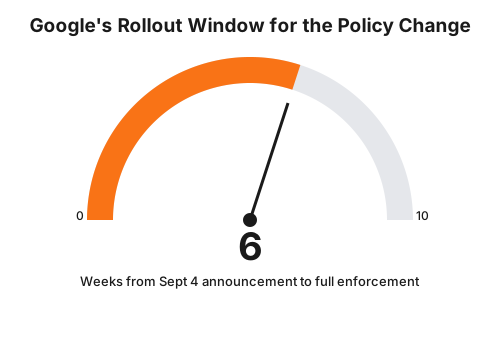
- Google announced the change on September 4, 2025, with full enforcement deprecation completing over roughly six weeks, by mid-October 2025
- Ads for these procedures still must comply with Google’s separate Sexually Suggestive Elements and Nudity policies
- Google made this change to its own ad platform ten months before Meta’s better-known July 22, 2026 update to before/after image review, the same kind of platform-vs-regulator gap in a different order
- AHPRA’s advertising guidelines for cosmetic procedures, in force since September 2, 2025, ban before/after imagery and outcome claims outright, regardless of what any ad platform allows
- The maximum penalty for an AHPRA advertising breach is $120,000 per breach for a corporation and $60,000 for an individual practitioner
- AHPRA defines advertising broadly enough to cover a Google Search ad exactly the same way it covers a shopfront sign
Google Ads will now let a “mature cosmetic procedure” ad through that it would have auto-restricted a year ago. That happened on September 22, 2025. AHPRA’s rules for advertising those exact procedures did not move. They took effect three weeks earlier, on September 2, 2025, and they still ban before/after imagery and outcome claims outright.
A clinic running Google Search ads for breast augmentation or laser vaginal rejuvenation now clears a gate that used to stop it. Nothing about that changes what AHPRA will fine you for. This guide breaks down exactly what Google changed, what it did not touch, and the checklist to run against your own account before you assume a Google-approved ad is a compliant one.
What Actually Changed at Google on 22 September 2025
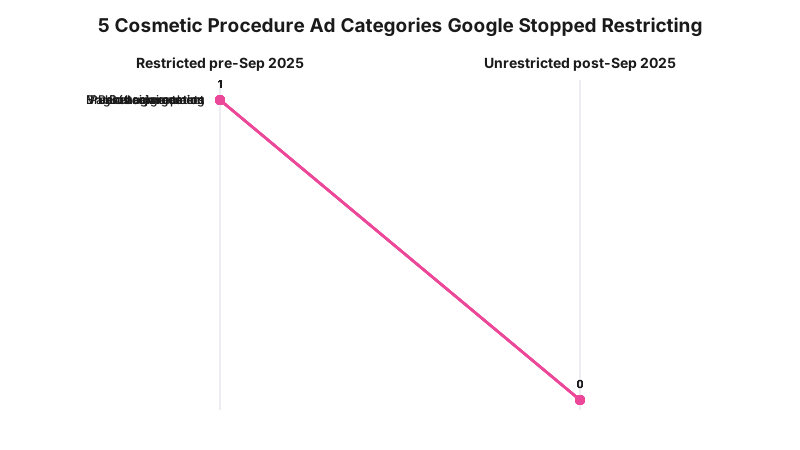
Google previously classified “mature cosmetic procedures” inside its Sexual Content policy, the same policy that governs nudity and sexually suggestive material. Five procedure categories sat inside that classification: female breast augmentation, penis enlargement surgery, vaginal laser rejuvenation, buttock implants, and pubic hair grooming services. Ads for any of them faced the tight geographic and audience restrictions that apply to sexual content generally.
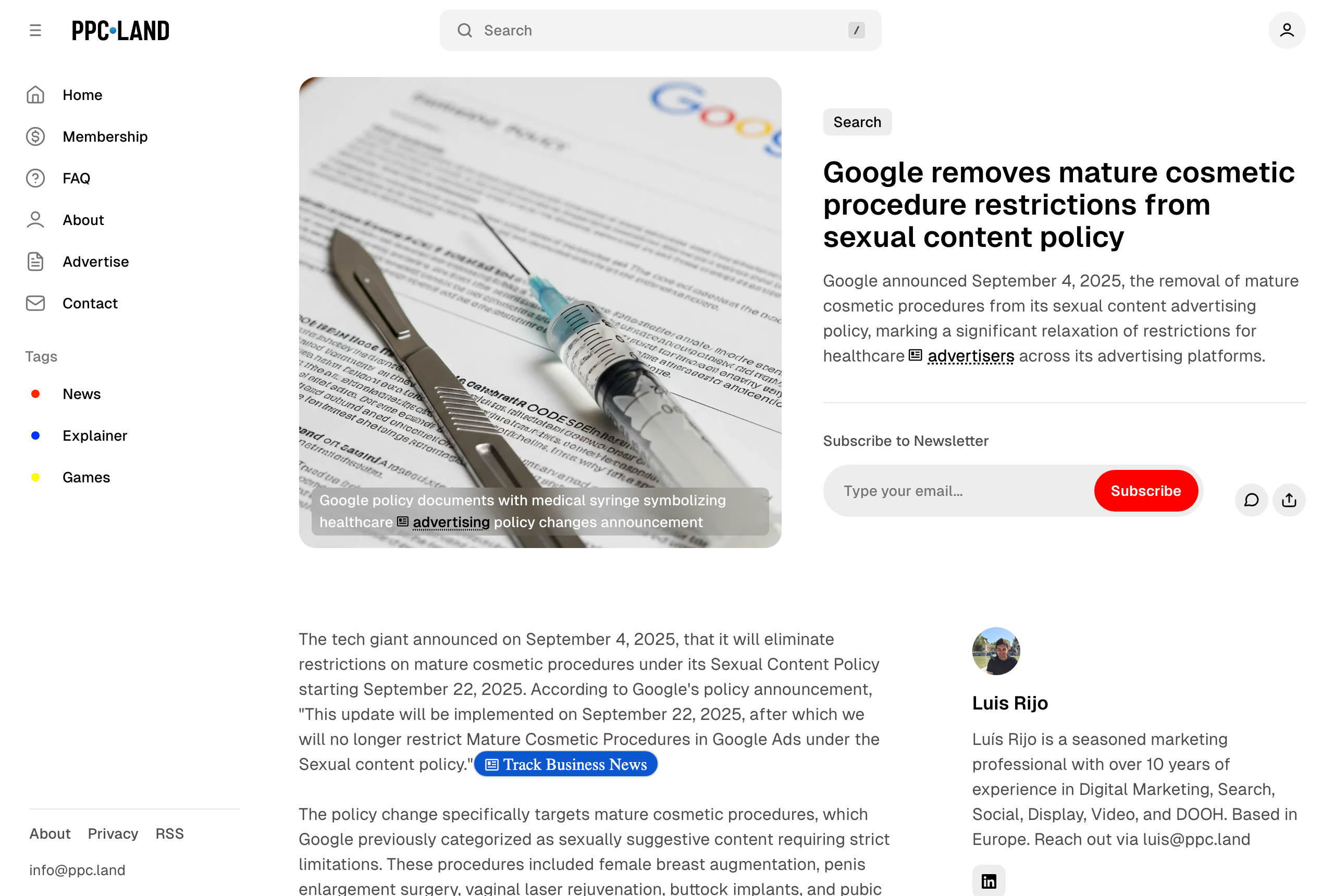
Google announced the change on September 4, 2025. Its own policy update states: “This update will be implemented on September 22, 2025, after which we will no longer restrict Mature Cosmetic Procedures in Google Ads under the Sexual content policy.” Enforcement of the old restriction phased out over the following weeks, with full deprecation by mid-October 2025.
| Procedure category | Status before 22 Sep 2025 | Status after 22 Sep 2025 |
|---|---|---|
| Female breast augmentation | Restricted under Sexual Content policy | No longer restricted on that basis |
| Penis enlargement surgery | Restricted under Sexual Content policy | No longer restricted on that basis |
| Vaginal laser rejuvenation | Restricted under Sexual Content policy | No longer restricted on that basis |
| Buttock implants | Restricted under Sexual Content policy | No longer restricted on that basis |
| Pubic hair grooming services | Restricted under Sexual Content policy | No longer restricted on that basis |
Takeaway: five procedure categories that used to trip Google’s sexual content filter now clear it, purely on Google’s side of the ledger.
What’s Still Off-Limits on Google Ads
Google’s update did not touch its wider sexual content rules. Ads continue to be subject to all remaining Google Ads policies, including the Sexually Suggestive Elements and Themes policy and the Nudity policy. Google’s own advertising policy pages still ban nudity, sexually suggestive entertainment, sexual merchandise, and sexually explicit content outright, with no cosmetic-procedure carve-out.
For a clinic running Google Search campaigns, the practical effect is narrow: a “mature cosmetic procedure” ad clears one specific content gate it used to fail. It still has to clear every other Google Ads policy, and none of those policies say anything about AHPRA’s rules for the Australian health practitioners actually delivering the procedure.
Takeaway: the update removed one classification, not a general licence. Every other Google Ads policy, and every AHPRA rule, still applies in full.
Why This Looks Familiar: Same Gap, Different Platform
If this pattern feels familiar, it should. RockingWeb covered the same shape of gap when Meta moved from auto-rejecting before/after and side-by-side cosmetic imagery to a claims-based review on July 22, 2026. The mechanism is identical: a platform stops treating a category of cosmetic-ad content as an automatic red flag, and clinics read platform approval as a compliance signal.
What’s different here is the order. Google made its move first, on September 22, 2025, ten months before Meta’s headline-grabbing update. Nobody wrote about the Google change as a compliance story at the time, because it read as a minor ad-policy footnote rather than a health-advertising event. It created exactly the same gap Meta’s update later did, just quieter.
Takeaway: this is now the second major ad platform in under a year to loosen a content gate that has zero bearing on what AHPRA will fine an Australian clinic for.
What Hasn’t Changed at AHPRA
AHPRA’s guidelines for advertising higher-risk non-surgical cosmetic procedures took effect September 2, 2025, three weeks before Google’s update. They ban before/after imagery for cosmetic procedures outright, along with testimonials, naming Schedule 4 substances promotionally, and claims that create an unreasonable expectation of benefit. None of that references Google, and Google’s Sexual Content policy update does not reference AHPRA.
AHPRA also defines “advertising” broadly under the National Law: any public communication, paid or not, that promotes a regulated health service counts. That covers a Google Search ad exactly the same way it covers a website, a Google Business Profile post, or a shopfront sign. Clearing Google’s Sexual Content policy says nothing about whether the ad copy itself breaches AHPRA rules. A free compliance check against the current AHPRA rules is the only way to know whether an approved, live Google ad is actually safe.
| Rule | Google Ads Sexual Content policy | AHPRA (National Law) |
|---|---|---|
| Before/after imagery | Not addressed by this specific policy | Banned outright since 2 Sep 2025 |
| Outcome or efficacy claims | Governed by separate ad-review policies | Banned as an unreasonable expectation of benefit |
| Maximum penalty | Ad disapproval or account suspension | $120,000 per breach (corporation), $60,000 (individual) |
Takeaway: Google approval and AHPRA compliance are two unrelated checks. Passing the first tells you nothing about the second.
What to Check on Your Google Ads Account Today
Run this against any live campaign that mentions the five affected procedures:
- Before/after or side-by-side imagery of a cosmetic procedure: banned under AHPRA regardless of Google’s Sexual Content status.
- Testimonials, including a “journey” style video testimonial: banned under AHPRA since September 2025.
- Naming a Schedule 4 substance (Botox, dermal filler brand names) in ad copy: banned.
- Outcome claims or wording that creates unreasonable expectations of benefit: banned.
- Landing page content matching any of the above: an approved ad linking to a non-compliant landing page is still a breach.
If any of these show up in a currently running, Google-approved ad, its policy status on Google is irrelevant to the AHPRA exposure sitting underneath it. A compliant cosmetic clinic website build keeps the landing page side of that equation clean from the start.
Takeaway: the AHPRA checklist above doesn’t change based on what Google allows. Treat it as the actual compliance bar, every time.
Get Your Google Ads Checked Against AHPRA Rules
RockingWeb reviews cosmetic clinic websites and Google Ads accounts against the current AHPRA advertising rules and flags every breach against the specific provision it falls under.
Sources and References
PPC Land - Google removes mature cosmetic procedure restrictions from sexual content policy: the September 4 announcement, September 22 implementation date, and Google’s own quoted policy text
Google Ads Advertising Policies Help - Sexual content policy: the current, live version of the policy Google updated
AHPRA - New guidelines for cosmetic procedures: the September 2, 2025 before/after and testimonial ban
AHPRA - Social media: how to meet your obligations under the National Law, confirming advertising rules apply to social and digital channels the same way they apply in person
Related reading:
- Meta’s New Ad Rules Won’t Save You From a $120K AHPRA Fine: the same platform-vs-regulator gap, on Meta
- Cosmetic Clinic Websites: compliant website builds for AHPRA-regulated clinics
For ad accounts and websites that stay inside AHPRA’s rules regardless of what any platform allows, talk to us about your clinic’s Google Ads.
Vikas Thakur
Founder of RockingWeb. 16 years building for companies like TPG, iiNet and Monadelphous, now focused on websites and marketing that comply with AHPRA's advertising guidelines and still book patients.