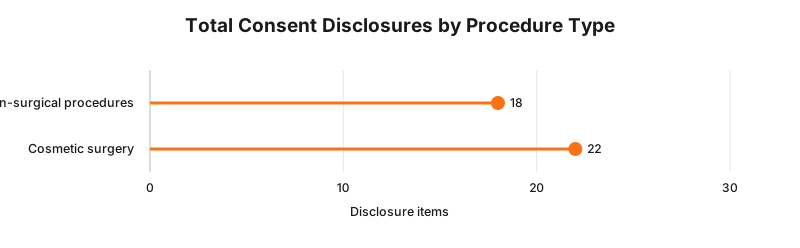
Cosmetic Surgery Consent Needs 22 Facts, Injectables 18
A cosmetic surgeon in Australia must disclose at least 22 separate pieces of information before a patient's consent is valid. Injectables and other non-surgical procedures need 18. Both counts come straight from the Medical Board of Australia and AHPRA's own guidelines.
 Vikas Thakur Founder, RockingWeb 10 min read
On this page 10
- Key takeaways
- What Counts as Informed Consent for a Cosmetic Procedure
- The 22-Item Disclosure Checklist for Cosmetic Surgery
- Non-Surgical Procedures Need 18 Disclosures, Not 22
- BDD Screening Only Names a Tool for Surgery
- Consent for Photos Is a Separate Process
- What This Means for a Clinic’s Website and Enquiry Flow
- FAQ
- Get Your Clinic’s Consent and Website Content Reviewed
- Sources and References
Key takeaways
- Cosmetic surgery consent in Australia must cover at least 22 separate disclosures, under Medical Board of Australia guidelines in force since 1 July 2023
- Non-surgical cosmetic procedures such as injectables need at least 18 disclosures, under National Boards’ guidelines in effect since 2 September 2025, four fewer once the shared items are set aside
- Every cosmetic surgery patient, at any age, must be screened for body dysmorphic disorder using a validated psychological screening tool, a term the non-surgical guidelines do not use
- A surgery patient needs at least 2 pre-operative consultations, with at least 1 in person with the operating practitioner, before they can sign anything
- Consent forms cannot be signed at a patient’s first surgical consultation, and informed consent must be given at least 7 days before the day of surgery
- Cost disclosure alone accounts for 9 of the 22 surgery items, compared with 6 of the 18 non-surgical items, because of implant, facility and assistant-practitioner costs
- Consent to use a patient’s photos in advertising is a second, separate consent process, with its own list of disclosure requirements
- A signed copy of the consent form must be handed to the patient for both surgical and non-surgical procedures, under both sets of guidelines
A cosmetic surgeon in Australia must disclose at least 22 separate pieces of information before a patient’s consent is valid, under Medical Board of Australia guidelines in force since 1 July 2023. Nurses and other practitioners performing non-surgical procedures such as injectables need 18. That gap is not a rounding difference. It comes from specific line items: implant costs, facility fees, and a validated psychological screening tool that only the surgical guidelines name outright. Most clinics know the headline rules, cooling off periods, under-18 restrictions, testimonial bans, but few have counted what a valid consent conversation is actually supposed to include. This guide sets out the full checklist for both procedure types, where they diverge, and what the disclosure requirement means for a clinic’s website and booking flow.
What Counts as Informed Consent for a Cosmetic Procedure
Both sets of guidelines, the Medical Board of Australia’s rules for surgery and the National Boards’ rules for non-surgical procedures, define informed consent the same way. It is not a form signed at the counter. The practitioner must hold a verbal consent discussion and separately provide written information in plain language, and the information must not glamorise the procedure, minimise its complexity, or overstate results in a way that implies outcomes the patient cannot realistically expect. That instruction sits inside the clinical guidelines, not the advertising guidelines, which means the same standard governing a Meta ad also governs the conversation in the consult room.
Once the practitioner has covered the required information, the patient’s consent, including financial consent, must be documented and a signed copy handed to the patient. For surgery, consent has to be given at a consultation, in person or by video, at least seven days before the day of the operation, and reconfirmed again on the day itself.
Takeaway: informed consent is a two-part obligation, a spoken conversation and a written document, and both have to clear the same bar against glamorising or overstating results.
The 22-Item Disclosure Checklist for Cosmetic Surgery
The Medical Board of Australia’s Guidelines for registered medical practitioners who perform cosmetic surgery and procedures, in effect since 1 July 2023, break the required disclosure into three groups plus one standalone item. Counted line by line, they add up to 22: eight items about the procedure itself, from what it involves through to recovery times, four about the practitioner including registration and endorsement status, and nine about cost, including implants, facility fees and assistant-practitioner costs. The last item stands alone: the patient must be told cosmetic surgery is not covered by Medicare.
| Disclosure category | Cosmetic surgery items | Non-surgical items | Example |
|---|---|---|---|
| About the procedure | 8 | 8 | Recovery times and care requirements |
| About the practitioner | 4 | 3 | Registration type and endorsement status |
| Costs | 9 | 6 | Total cost, deposits, refund of deposits |
| Medicare notice | 1 | 1 | Cosmetic procedures are not Medicare-rebated |
| Total | 22 | 18 |
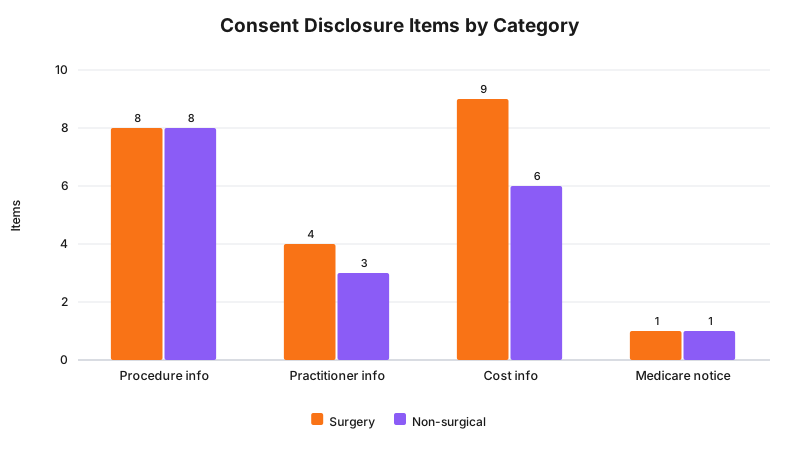
Takeaway: cost disclosure alone is nine of the 22 items, more than a third of the entire consent checklist for cosmetic surgery.
Non-Surgical Procedures Need 18 Disclosures, Not 22
Injectables, thread lifts, laser treatments and the other procedures covered by the National Boards’ Guidelines for registered health practitioners who perform non-surgical cosmetic procedures, in effect since 2 September 2025, follow an identical structure but count out at 18 rather than 22, because three items do not apply outside an operating theatre. There is no facility fee, no assistant-practitioner cost, and no endorsement for cosmetic surgery to disclose. What remains is eight items about the procedure, three about the practitioner, and six about cost, plus the same standalone Medicare notice.
The eight procedure-level items are identical in substance between the two guidelines. A patient booking lip filler is entitled to the same depth of information about risks and recovery as a patient booking a surgical facelift.
Takeaway: the gap between 22 and 18 is not about how seriously non-surgical risk is treated. It is a byproduct of what a non-surgical procedure does not have: no theatre, no assistant surgeon, no implant.
BDD Screening Only Names a Tool for Surgery
Both guidelines require an assessment of the patient’s suitability before any procedure, including consideration of underlying psychological conditions such as body dysmorphic disorder. The surgical guidelines go one step further.
For cosmetic surgery, the practitioner performing the assessment must use a validated psychological screening tool to screen for BDD, and the process and outcome must be documented in the patient’s record for every patient, regardless of age. Only if the screening flags a concern is the patient referred to an independent psychologist, psychiatrist or GP. The non-surgical guidelines describe the same obligation in general terms, an evidence-based, holistic assessment that considers conditions including BDD, but neither non-surgical guideline uses the phrase validated psychological screening tool.
All patients seeking cosmetic surgery must also have a referral, preferably from their usual GP, before the first consultation with the operating practitioner. Non-surgical procedures carry no equivalent referral requirement.
Takeaway: the paperwork trail for a surgery patient starts before the first consultation and includes a named, documented screening tool. Neither of those applies in the same form to a standard injectables booking.
Consent for Photos Is a Separate Process
Both guidelines treat consent to use a patient’s photos or videos as entirely separate from consent to the procedure itself. A practitioner needs specific consent before taking any images, and the patient must be told the purpose, for the practice record or for advertising, how they will be used, and where they will be stored, on a secure device only.
Patients must be given an opportunity to view the images before consenting to their use in advertising, and cannot be required to agree to that use as a condition of treatment. They can withdraw consent later, and the practitioner must promptly stop using the images where possible, though the non-surgical guidelines note removal is not always possible once material has already been published.
Takeaway: a signed procedure consent form does not cover photo use. That needs its own, separately documented consent, every time.
What This Means for a Clinic’s Website and Enquiry Flow
Every item on the 22-point and 18-point lists has to reach the patient at some stage before consent is valid. Nothing in the guidelines says that information has to originate in the consult room. A treatment page that already sets out typical recovery times, realistic outcomes, and how costs are structured gives a patient a head start, which tends to produce a shorter, more focused consultation rather than one spent covering ground a website could have handled first. Surgical procedures, with nine cost items and four practitioner items to work through, benefit from a dedicated page more than a single-item non-surgical treatment does, simply because there is more ground to cover before a patient is ready to book.
The same restriction that governs the consent conversation also governs that page. Both guidelines state information must not glamorise the procedure, minimise its complexity, or overstate results, the same standard sitting behind AHPRA’s advertising rules. RockingWeb checks a clinic’s site against both sets of rules together, rather than treating consent content and advertising content as separate problems. A website built for cosmetic clinics can structure that information without drifting into the outcome claims the guidelines rule out.
Takeaway: the procedures with the heaviest consent disclosure are the ones where a clinic’s own website has the most work to do before a patient ever reaches the consult room.
FAQ
How many pieces of information must a cosmetic surgeon disclose for informed consent in Australia?
At least 22, under the Medical Board of Australia’s Guidelines for registered medical practitioners who perform cosmetic surgery and procedures, in effect since 1 July 2023. The list covers the procedure itself, the practitioner performing it, and every cost involved, plus a statement that cosmetic surgery is not covered by Medicare.
Is informed consent different for non-surgical cosmetic procedures like injectables?
Yes. The National Boards’ Guidelines for registered health practitioners who perform non-surgical cosmetic procedures, in effect since 2 September 2025, set a minimum of 18 disclosure items rather than 22. Most of the gap sits in the cost category, which drops from 9 items to 6 because there is no facility, implant or assistant-practitioner cost to disclose.
Do all cosmetic surgery patients have to be screened for body dysmorphic disorder?
Yes. Every patient seeking cosmetic surgery, regardless of age, must be assessed using a validated psychological screening tool for body dysmorphic disorder, and the process and outcome must be documented in their record. They are only referred to an independent psychologist, psychiatrist or GP if screening flags a concern, except for patients under 18, who must be referred regardless of the result.
Is consent to use a patient’s before and after photos the same as consent to the procedure?
No. Both the surgical and non-surgical guidelines treat image consent as a separate process with its own disclosure list, covering the purpose of the images, how and where they will be stored, and the patient’s right to view images before they are used in advertising and to withdraw consent later. A patient cannot be required to agree to image use as a condition of having the procedure.
Get Your Clinic’s Consent and Website Content Reviewed
RockingWeb reviews cosmetic clinic websites, treatment pages and booking flows against the current Medical Board and AHPRA consent rules, and flags every gap against the specific guideline it falls under.
Sources and References
AHPRA - the 18-item non-surgical consent disclosure list, effective 2 September 2025
Medical Board of Australia - the 22-item surgical consent disclosure list, the BDD screening tool requirement, and the 1 July 2023 date of issue
AHPRA - “Putting patients first”: confirms the 2 September 2025 effective date for the non-surgical guidelines
Related reading:
- Cosmetic 7-Day Cooling Off Period Advertising Rules: what the cooling off timing means for booking and ads
- AHPRA Under-18 Rules: 7-Day vs 3-Month Cooling Off: the age-specific cooling off periods that sit alongside the consent checklist
- Before and After Photos: AHPRA Rules: the advertising rules that apply once a patient has consented to image use
For a website and booking flow built around what patients actually need to know before they consent, see ClinicPipeline or talk to us about your clinic’s marketing.
Vikas Thakur
Founder of RockingWeb. 16 years of experience from working at TPG, iiNet and Monadelphous, now building websites, software and digital marketing for local businesses in Rockingham and Perth.