30 Days to Fix a Breach: The DIY AHPRA Ad Audit for 2026
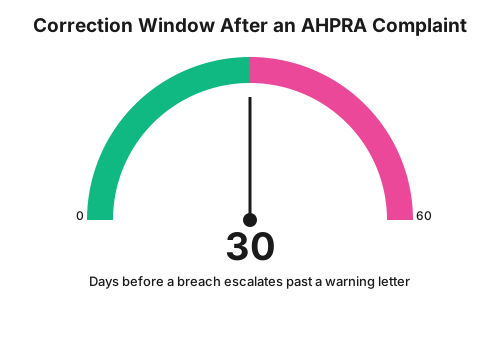
AHPRA gives most clinics a 30-day window to fix a non-compliant advertisement before enforcement escalates, once a complaint has been reviewed and assessed. This guide runs AHPRA's own three-step process, Review, Assess, Action, against your own website and ad accounts first.
 Vikas Thakur Founder, RockingWeb 9 min read
On this page 10
- Key takeaways
- The 30-Day Window Nobody Tells You About
- What Section 133 Actually Bans
- What a Fine Actually Costs
- AHPRA’s Own 13-Point Checklist
- New Rules Since September 2025 for Higher-Risk Procedures
- How to Run the Audit Yourself This Week
- FAQ
- Get Your Website and Ad Accounts Audited Before AHPRA Does
- Sources and References
Key takeaways
- AHPRA gives most advertisers a 30-day window to fix a breach before it escalates, once a complaint has been reviewed and assessed
- Section 133 of the National Law lists 5 specific practices that make advertising unlawful, from false or misleading claims to indiscriminate encouragement of use
- A breach carries a maximum penalty of $120,000 per offence for a body corporate and $60,000 per offence for an individual practitioner
- Those higher penalty caps have applied in every Australian jurisdiction, including Western Australia, since July 2024
- AHPRA’s own Summary of the Advertising Requirements lists 13 separate categories a website and an ad account both have to pass, reviewed 2 September 2025
- New guidelines for higher-risk non-surgical cosmetic procedures took effect 2 September 2025
- Under-18s now require a mandatory 7-day cooling-off period before any non-surgical cosmetic procedure, and advertising targeting them is banned outright
- Lower and medium risk breaches can be closed through an administrative process, so most advertising complaints never reach a court
AHPRA gives most advertisers a 30-day window to fix a non-compliant ad before enforcement escalates, once a complaint has been reviewed and assessed. That figure comes straight from AHPRA’s own published complaints process, current as of August 2026. Here’s the catch: that clock only starts once someone else finds the problem first, usually a patient, sometimes a competitor.
A self-audit, run before that clock starts, is the only version of this process you actually control. AHPRA reviews advertising in three steps: Review, Assess, Action. This guide runs the same three steps against your own website and ad accounts, using AHPRA’s own published rules, so a competitor’s screenshot never becomes your first warning.
The 30-Day Window Nobody Tells You About
AHPRA’s published process for handling an advertising complaint has three stages. First, it reviews the advertising to check whether it complies and identifies who the advertiser is. Second, it runs a risk assessment, factoring in the advertiser’s history of prior complaints. Third, it takes action, and the type of action depends on the risk level.
For most cases, that action starts with a letter. AHPRA writes to the advertiser, sets out the breach, and requires it corrected within 30 days. Fix it inside that window and AHPRA typically closes the matter. Miss it, and a registered practitioner can face proposed conditions on their registration, while a non-practitioner advertiser, such as a marketing manager or an agency, can face prosecution instead. Very serious breaches can still be prosecuted even after the advertising has already been corrected.
Takeaway: the 30-day window exists for you, not against you, but only if you find the breach before AHPRA does.
What Section 133 Actually Bans
Every advertising rule AHPRA enforces traces back to one section of the Health Practitioner Regulation National Law. Section 133 sets out five specific ways advertising a regulated health service becomes unlawful.
| Prohibited practice | What AHPRA checks for |
|---|---|
| False, misleading or deceptive | Claims that are false, misleading, or likely to be misleading |
| Undisclosed gift or discount | An inducement offered without stating its terms and conditions |
| Testimonials | Any testimonial or purported testimonial about the service |
| Unreasonable expectation of benefit | Claims that create an unreasonable expectation of beneficial treatment |
| Indiscriminate encouragement | Content that directly or indirectly encourages unnecessary use of the service |
A breach of any one is a criminal offence under the National Law, though AHPRA can manage lower and medium risk breaches administratively rather than through a court. Advertising that infringes a protected title, such as calling a non-specialist practitioner a “specialist,” is a separate offence under the same section.
Takeaway: five practices cover every complaint AHPRA can consider. If your advertising doesn’t fall into one of these five, it’s likely a matter for a different regulator, not AHPRA.
What a Fine Actually Costs
The financial penalties attached to section 133 breaches are set per offence, not per campaign. Each non-compliant ad, page, or post can be treated as a separate offence.
| Advertiser type | Maximum penalty per offence | Applies in WA since |
|---|---|---|
| Individual practitioner | $60,000 | July 2024 |
| Body corporate | $120,000 | July 2024 |
These caps rose after a 2022 amendment and, as of July 2024, apply in every Australian jurisdiction, including Western Australia. A breach involving unlawful use of a protected title carries the same caps, plus up to three years’ imprisonment for an individual.
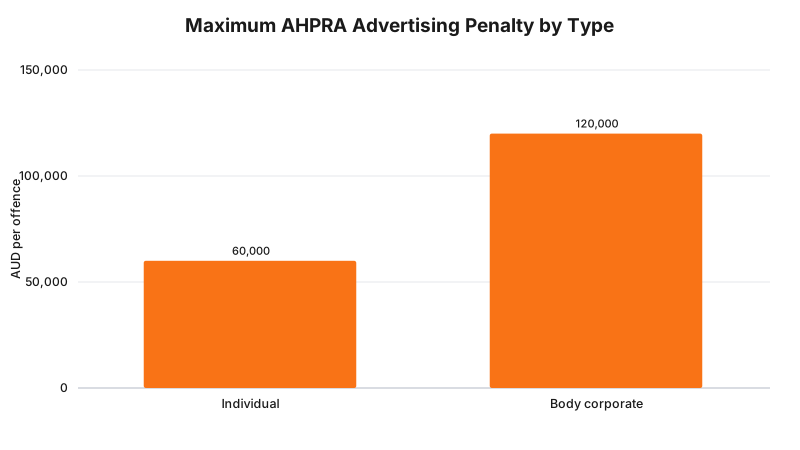
Takeaway: a body corporate’s exposure is double an individual practitioner’s, which matters if your clinic trades through a company rather than a sole practitioner.
AHPRA’s Own 13-Point Checklist
AHPRA publishes a Summary of the Advertising Requirements, reviewed 2 September 2025, that breaks the section 133 rules into 13 practical categories: accuracy and clarity, acceptable evidence, claims about treating health conditions, information about risk, comparisons, descriptions of profession and qualifications, pricing, gifts and inducements, testimonials, personal experience anecdotes, before and after images, recommending unnecessary check-ups, and time-limited offers.
Two of those 13 catch the most clinic websites off guard: evidence for treatment claims, and before and after images. A landing page that states an outcome without evidence on file, or shows a before and after comparison for a cosmetic procedure, is a finding under AHPRA’s own list before a single ad dollar is spent.
For a full walkthrough of your site against every one of the 13 categories, hire RockingWeb to cover the same ground AHPRA’s own reviewers would, and flag each finding against the specific category it falls under.
Takeaway: AHPRA already told you what it checks. Running its own checklist against your own site costs nothing and takes a fraction of the 30 days you’d get after a complaint.
New Rules Since September 2025 for Higher-Risk Procedures
If your clinic advertises higher-risk non-surgical cosmetic procedures, such as injectables, fillers, or thread lifts, a second layer of guidelines applies on top of section 133. These took effect 2 September 2025.
Three changes matter most for a website and ad account: advertising must now use only real, unedited images and avoid airbrushing that misleads the public; where images are used, it must include a warning that results may vary between patients; and the testimonial ban was strengthened to close off testimonials sourced from social media influencers. A mandatory seven-day cooling-off period also applies between a person under 18’s first consultation and any non-surgical cosmetic procedure, and advertising targeting under-18s for these procedures is banned outright.
For a clinic weighing whether a procedure justifies its own dedicated landing page, this is the deciding factor: a page covering a higher-risk procedure needs evidence-backed claims and unedited imagery built in from the start, not retrofitted after a complaint. A compliant cosmetic clinic website build handles that structure at the template level.
Takeaway: the procedures with the newest, strictest rules are exactly the ones where a generic template is the biggest risk. Build those pages to the current guidelines, not last year’s.
How to Run the Audit Yourself This Week
Mirror AHPRA’s own three-step process against your own advertising before anyone else does.
- Review. List every place your clinic advertises: website pages, Google Ads, Meta Ads, organic social, Google Business Profile, and email. Check each against the five section 133 practices above.
- Assess. Note the risk on anything that doesn’t clearly pass. A testimonial still live on an old landing page is a clear, high-risk finding. Pricing shown without full terms is a smaller, medium-risk one.
- Action. Fix the clear breaches first: testimonials, before/after imagery, unevidenced claims. Keep a dated screenshot of each fix. AHPRA’s own complaint form asks a complainant for a screenshot as evidence; a dated record of your own works the same way in reverse.
This does not tell you whether any specific piece of your advertising is lawful. It tells you what AHPRA’s own published rules say to check, so you’re working from the same list AHPRA is.
Takeaway: running this list once, this week, replaces a 30-day scramble with a same-day fix.
FAQ
How long do I have to fix a non-compliant ad before AHPRA takes action?
In most cases, once AHPRA reviews and assesses a complaint, it writes to the advertiser and requires the breach to be corrected within 30 days. If the advertising is fixed inside that window, AHPRA typically closes the matter, according to AHPRA’s own advertising complaints process.
What’s the maximum fine for an AHPRA advertising breach?
Up to $120,000 per offence for a body corporate and $60,000 per offence for an individual practitioner, under section 133 of the Health Practitioner Regulation National Law. Those higher caps have applied in every Australian jurisdiction, including Western Australia, since July 2024.
Do the new cosmetic procedure advertising rules apply to my website, not just paid ads?
Yes. AHPRA’s Guidelines for advertising higher risk non-surgical cosmetic procedures, in effect since 2 September 2025, apply to any public communication that promotes the service, which includes a website, not only a paid campaign.
Can a competitor report my clinic’s advertising to AHPRA?
Yes. Any person or organisation can lodge an advertising complaint with AHPRA if they have concerns about the advertising of a regulated health service, and there is no requirement that the complaint come from a patient.
Get Your Website and Ad Accounts Audited Before AHPRA Does
RockingWeb reviews cosmetic clinic websites and ad accounts against AHPRA’s current advertising requirements, flags every finding against the specific category it falls under, and delivers results as a walkthrough within five business days. No cost, no obligation.
Talk to us about your clinic’s website and ad complianceSources and References
- AHPRA - the Review, Assess, Action complaint process and the 30-day correction window
- AHPRA - section 133 of the National Law, the five prohibited practices, and the $60,000/$120,000 penalty caps applying in WA since July 2024
- AHPRA - the 13-category Summary of the Advertising Requirements, reviewed 2 September 2025
- AHPRA - new guidelines for higher-risk non-surgical cosmetic procedures, effective 2 September 2025, the under-18 cooling-off period, and the real-image advertising requirement
- AHPRA - who can lodge an advertising complaint and what AHPRA can and cannot consider
Related reading:
- AHPRA Advertising Compliance Audit Checklist 2026: a 12-point channel-by-channel checklist
- 13 AHPRA Rules Every Clinic Website Must Pass in 2026: the full website-specific breakdown of the 13 categories
- AHPRA Advertising Complaints Hit 380 a Year: what actually triggers a complaint
For a website and ad account built to stay inside these rules from the start, see Cosmetic Clinic Websites or talk to us about your clinic’s marketing.
Vikas Thakur
Founder of RockingWeb. 16 years of experience from working at TPG, iiNet and Monadelphous, now building websites, software and digital marketing for local businesses in Rockingham and Perth.