Auditing Your Site for Schedule 4 References
The Therapeutic Goods Advertising Code restricts referring to Schedule 4 substances in advertising to the public, and the Act defines advertising broadly enough to reach a URL slug, an image filename or an alt attribute, not just visible body copy. Here is how to find every hidden reference before the TGA does.
 Vikas Thakur Founder, RockingWeb 11 min read

Key takeaways
- The Therapeutic Goods Advertising Code Instrument 2021 governs how advertisements about therapeutic goods must be structured once published, under authority of the Therapeutic Goods Act 1989.
- Section 42DL of the Act catches an advertisement that refers to a substance in Schedule 3, 4 or 8 of the Poisons Standard, unless the reference is authorised or required by a government authority.
- The Act’s definition of “advertise” covers any statement, pictorial representation or design intended, directly or indirectly, to promote use or supply, a wording broad enough to reach metadata a visitor never sees rendered on the page.
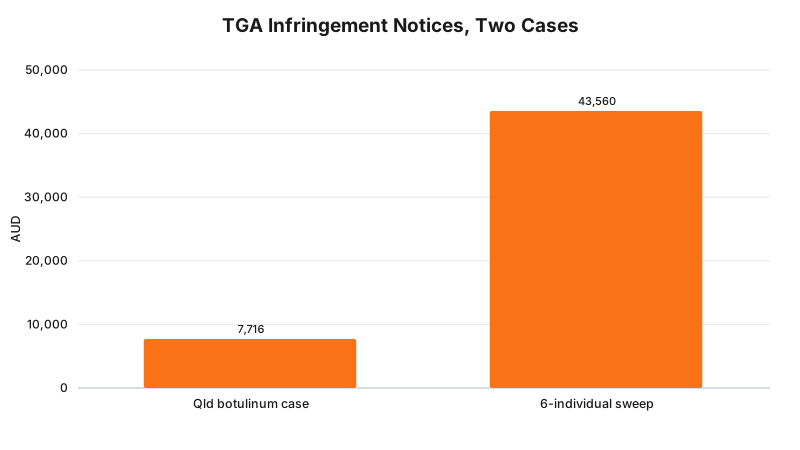
- The TGA issued 11 infringement notices totalling $43,560 to 6 individuals for alleged unlawful advertising and importation of therapeutic goods, with a separate Queensland case totalling $7,716 tied specifically to counterfeit botulinum toxin type A.
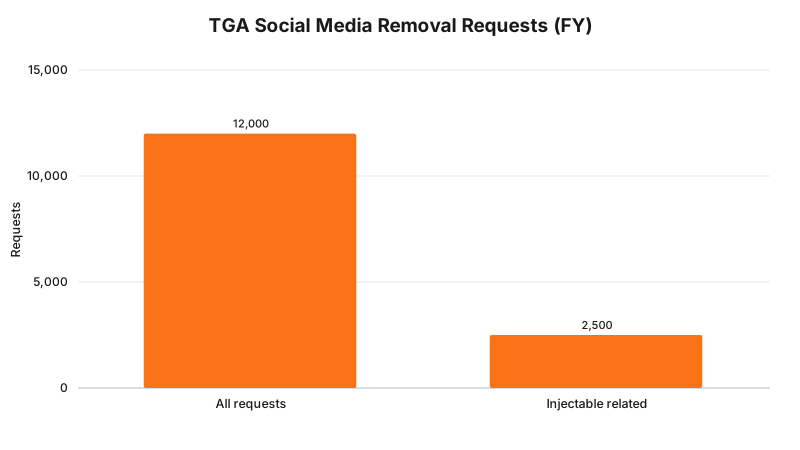
- The TGA logged more than 12,000 social media removal requests in the year before its November 2025 guidance update, part of a stated two-year enforcement priority on cosmetic injectables under the TGA Compliance Principles 2026-2027.
- AHPRA’s separate advertising guidelines for higher-risk non-surgical cosmetic procedures took effect 2 September 2025 and sit alongside, not instead of, the TGA’s Schedule 4 restriction.
- Four site fields carry the most risk: URL slugs, image filenames, alt attributes and meta descriptions, because all four are written for search engines to find, which is the opposite of hidden.
Botulinum toxin type A is a Schedule 4 prescription-only substance under the current Poisons Standard, which means the Therapeutic Goods Act 1989 restricts how it can be advertised to the public. Most clinics clean the visible copy on a treatment page and stop there. The Act’s definition of advertising does not stop at visible copy. It reaches any statement or design intended to promote the goods, which is exactly what a keyword-rich URL slug or an SEO-friendly image filename is built to do.
This post walks through what the rule actually says, where a Schedule 4 reference hides in the parts of a page nobody reads directly, and how to audit your own site for it before a regulator does.
What the Advertising Code Says
The Therapeutic Goods (Therapeutic Goods Advertising Code) Instrument 2021, made under section 42BAA of the Therapeutic Goods Act 1989, is the legislative instrument that sets requirements for advertisements about therapeutic goods to the public. It is not, on its own, where the Schedule 4 restriction lives. That sits in section 42DL of the Act itself, which applies to an advertisement that refers to a substance, or goods containing a substance, included in Schedule 3, 4 or 8 of the current Poisons Standard (excluding anything listed in Appendix H), other than a reference authorised or required by a government or government authority.
The Instrument’s own definitions section confirms how wide “advertise” reaches. Under the Act, advertising in relation to therapeutic goods “includes make any statement, pictorial representation or design that is intended, whether directly or indirectly, to promote the use or supply of the goods,” including where that statement or design appears on the label, on the packaging or on any material included with the package. A clinic website is not a label or a package, but the same underlying test applies to it: a statement or design intended to promote use or supply. A URL slug written as /botox-injections-perth/ was written for exactly that reason.
The Instrument also shows the pattern regulators use elsewhere in the Code for goods that cannot be advertised freely. Section 16 requires that where an advertisement is published to the general public and the goods are only available through a health professional, the advertisement must carry the statement “THIS PRODUCT IS NOT AVAILABLE FOR PURCHASE BY THE GENERAL PUBLIC,” prominently displayed. Section 6(2) separately treats price information about medicines containing a Schedule 3, 4 or 8 substance as its own restricted category, governed only by Part 9 of the Code rather than general advertising rules. Every mechanism in this instrument treats a Schedule 4 substance as something that needs a deliberate compliance response, not something that can be handled the same way as an over-the-counter product.
Takeaway: the restriction is in the Act, the Code sets the mechanics around it, and both apply to anything that promotes the goods, not only to text a reader consciously sees.
What That Means for the Build
A page’s rendered copy is one surface. A clinic site has at least six others that carry the same legal risk and get audited far less often.
URL slugs. /treatments/botox-injections/ names the substance in the path itself, and that path shows up in the browser address bar, in search results, and in every internal and external link built against it.
Image filenames. botox-before-after-1.jpg sitting in a media library is a design element with a name that promotes the goods, whether or not a visitor ever opens the file directly.
Alt attributes. alt="Botox injection results, Perth clinic" exists specifically so search engines and screen readers can read out what the image is about. That is the definition of a statement intended to promote.
Title tags and meta descriptions. These render in the search results snippet before a visitor reaches the page at all, which makes them advertising in the plainest possible sense.
Structured data. Product, MedicalProcedure and FAQ schema markup often repeats the exact treatment name in a name or description field, invisible on the page but fully machine-readable.
Sitemap and CMS fields. sitemap.xml entries, CMS slug fields, and downloadable PDF filenames for a treatment brochure all carry the same string, usually unedited since the page was first built.
Fixing the visible heading on a treatment page while any of these six fields still name the substance leaves the actual legal exposure exactly where it started.
Decision Matrix: Where the Risk Sits
| Site field | Visible to a reader | Read by search engines | Typical clinic fix priority |
|---|---|---|---|
| Page heading and body copy | Yes | Yes | Usually fixed first |
| URL slug | Yes, in the address bar | Yes, and cached long-term | Often missed |
| Image filename | No | Yes | Almost always missed |
| Alt attribute | No, unless using assistive tech | Yes | Almost always missed |
| Meta description | Yes, in search results | Yes | Sometimes missed |
| Schema markup fields | No | Yes | Almost always missed |
| Sitemap entries | No | Yes | Almost always missed |
| PDF or brochure filenames | Yes, if downloaded | Yes, if indexed | Rarely checked |
A Worked Example
A Perth cosmetic clinic ran a single treatment page for anti-wrinkle injections. The visible copy had already been rewritten to describe the concern rather than the product, following AHPRA’s advertising guidelines for higher-risk non-surgical cosmetic procedures, in effect since 2 September 2025. The clinic considered the page compliant.
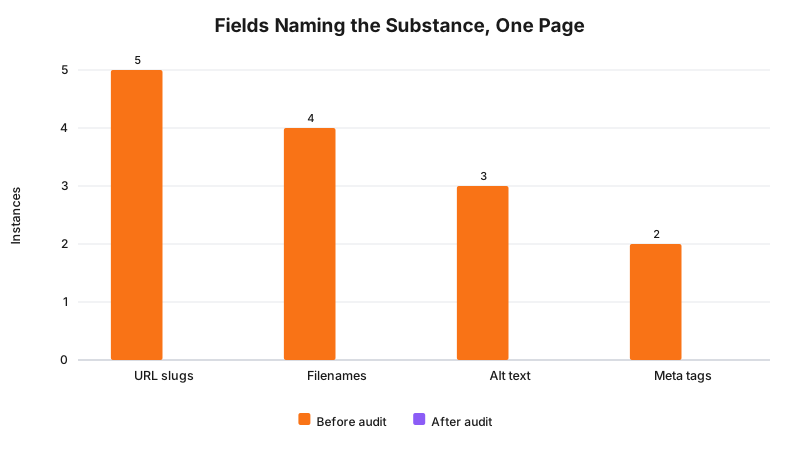
A field-by-field audit found the substance name still present in five other places: the URL slug, the hero image filename, two alt attributes on before-and-after images, and the <title> tag, which still read “Botox Perth | [Clinic Name]” because it predated the copy rewrite and nobody had checked it since.
The fix rewrote the slug to a concern-led phrase, renamed the image files, rewrote the alt text to describe the visual content without naming the substance, and set a 301 redirect from the old URL so existing backlinks and rankings carried over rather than resetting to zero. The chart below is an illustrative example of what that kind of fix removes across a single page, not a measured result from this or any specific clinic.
What to Check on Your Own Site
- Export every published URL on your site and search the list for any Schedule 4 substance or brand name, not just the treatment category.
- Open your image media library and search filenames the same way, including images uploaded years ago for pages that have since been rewritten.
- Run “view source” or a crawler on each treatment page and search the raw HTML for the substance name in
alt,title,meta name="description"and any<script type="application/ld+json">block. - Check
sitemap.xmldirectly. It is generated automatically by most CMS platforms and rarely audited by hand. - Search your downloadable PDFs and brochures, both the filename and the document text, since these often lag behind a website copy rewrite by months or years.
- If a page’s slug needs to change, plan the 301 redirect before you change it, not after, so you do not lose the page’s existing search visibility while you fix a different problem.
The Enforcement Anchor
This is not a theoretical risk. The TGA issued infringement notices to a Queensland-based individual totalling $7,716 over the alleged unlawful importation of counterfeit botulinum toxin type A and unlawful advertising of cosmetic injectables, part of a wider action in which the TGA issued 11 infringement notices totalling $43,560 to 6 individuals for alleged importation and unlawful advertising of therapeutic goods.
No published TGA infringement notice we could find names a URL slug, an image filename or an alt attribute specifically as the advertising conduct. Every published case we found involved visible advertising: social media posts, imagery and captions. The metadata layer is where the same legal test applies but has not yet produced a public enforcement example. That gap is worth taking seriously rather than reading as safety, because it is easier for a regulator to search and screenshot a headline than to inspect a page’s source code, not because the source code sits outside the rule.
Where This Gets Hard
The Act’s “authorised or required by a government or government authority” exemption is written for a narrow set of circumstances, not for a clinic’s own marketing decisions, and nothing in the Instrument spells out how the broad “advertise” definition applies to a field a visitor cannot see rendered on the page. That is a genuine grey area. The regulator says advertising includes any statement or design intended to promote use or supply; the build consequence is that URL slugs, filenames and alt text plausibly qualify; whether that applies to your specific page is a question for your medical defence organisation or your lawyer.
There is a second, practical trade-off. Alt text exists for screen reader users, and stripping it of any descriptive detail to avoid naming a substance can leave a genuinely worse experience for someone relying on assistive technology. The safer fix is describing the visual content of the image accurately without using the substance or brand name, not deleting the alt attribute altogether.
A third limit: search engines and archival services cache old URLs, filenames and page snapshots long after you fix the live version. A 301 redirect stops new traffic from reaching the old page, but it does not erase an indexed screenshot or a cached search snippet that already exists elsewhere.
Status
In force. The Therapeutic Goods Advertising Code Instrument 2021 and the advertising restrictions in the Therapeutic Goods Act 1989 are enacted law with no pending change to the Schedule 4 rule itself. The TGA’s Improvements to the Therapeutic Goods Advertising Code consultation, which closes 3 September 2026, presents options only and states no preferred approach, so it does not currently change anything covered in this post.
Frequently Asked Questions
Does the Schedule 4 advertising restriction apply to a website’s URL and image filenames, not just visible text?
The Therapeutic Goods Act 1989 defines advertising broadly, covering any statement, pictorial representation or design intended to promote the use or supply of goods. A URL slug or alt attribute written to describe a Schedule 4 treatment for search visibility is doing exactly that, even though a site visitor never reads it directly. Whether a specific field meets the legal threshold in your case is a question for your medical defence organisation or your lawyer.
Is Botox a Schedule 4 substance under the Poisons Standard?
Yes. Botulinum toxin type A, sold under brand names including Botox, Dysport and Xeomin, is classified as a Schedule 4 prescription-only medicine under the current Poisons Standard, which is why the TGA has issued infringement notices over its advertising and unlawful importation.
What is the practical fix if a page’s URL currently names a Schedule 4 treatment?
Rewrite the slug to describe the concern rather than the product, for example replacing /botox-injections/ with /anti-wrinkle-treatment/, then 301 redirect the old URL so existing links and rankings carry over. Do the same for the filename, alt text, title tag and meta description on that page, and check your sitemap and any schema markup for the same substance name.
Get Your Site Audited
Get in touch and RockingWeb will check every field on your treatment pages, not just the headline, against the Schedule 4 restriction and AHPRA’s advertising guidelines together.
Sources
- Federal Register of Legislation - Therapeutic Goods (Therapeutic Goods Advertising Code) Instrument 2021. Checked 15 August 2026.
- AustLII - Therapeutic Goods Act 1989, section 42DL, Advertising offences - general. Checked 15 August 2026.
- TGA - Queensland-based individual issued infringement notices for allegedly importing and advertising counterfeit botulinum toxin type A. Checked 15 August 2026.
- TGA - TGA issues infringement notices to 6 individuals for alleged importation and unlawful advertising of therapeutic goods. Checked 15 August 2026.
- TGA - TGA releases updated social media advertising guidance to support improved compliance, November 2025. Checked 15 August 2026.
- AHPRA - Guidelines for advertising higher risk non-surgical cosmetic procedures, in effect 2 September 2025. Checked 15 August 2026.
- TGA Consultations - Improvements to the Therapeutic Goods Advertising Code, consultation paper, closes 3 September 2026. Checked 15 August 2026.
Last reviewed: 15 August 2026.
Vikas Thakur
Founder of RockingWeb. 16 years of experience from working at TPG, iiNet and Monadelphous, now building websites, software and digital marketing for local businesses in Rockingham and Perth.