Rebuilding Your Clinic Gallery Without Before/After Photos
A "Results" page built entirely around before/after photo pairs is a compliance liability under AHPRA's advertising guideline, in effect since 2 September 2025. Here is the page-by-page rebuild spec, a worked example for a cosmetic clinic and a cosmetic dental practice, and what to check on your own site first.
 Vikas Thakur Founder, RockingWeb 13 min read
On this page 12
- Key takeaways
- What AHPRA’s Guideline Actually Says
- What This Means for the Build
- Decision Matrix: What Replaces Each Gallery Element
- Worked Example: Two Gallery Rebuilds
- What to Check on Your Own Site
- The Enforcement Anchor
- Where This Gets Hard
- Status
- Frequently Asked Questions
- Get Your Gallery Page Checked Before You Rebuild It
- Sources and References
Key takeaways
- AHPRA’s advertising guideline, in effect since 2 September 2025, does not ban before/after photos outright. It sets six conditions that all have to hold at once, and most legacy gallery pages fail on the first one: the after shot leading the page.
- A gallery page built as photo pairs has four other options that do not depend on any of the six conditions: facility and process photography, credentials, written outcome descriptions, and consultation-first booking content.
- The maximum penalty under the Health Practitioner Regulation National Law is $60,000 per breach for an individual and $120,000 for a body corporate. Some secondary sources still circulate the pre-2025 figures of $30,000 and $60,000, so check which figure a source is quoting before you rely on it.
- AHPRA investigated roughly 360 notifications about non-surgical cosmetic procedures between September 2022 and March 2025, with about 300 closed, alongside more than 1,500 calls to its cosmetic surgery hotline in the same period.
- A cosmetic dental smile gallery carries the same six-condition test as a cosmetic clinic gallery whenever the procedure sits on AHPRA’s higher-risk list, which most veneer and smile-makeover work does.
- No individual notification tied specifically to a gallery page has been publicly confirmed at the time of writing. The enforcement backdrop is the volume of advertising activity AHPRA is already reviewing, not a single named case.
If your clinic’s “Results” or “Gallery” page is a grid of photo pairs and nothing else, it needs a rebuild, not a touch-up. AHPRA’s Guidelines for advertising higher risk non-surgical cosmetic procedures, in effect since 2 September 2025, do not ban the before/after format outright. They set six conditions an image has to clear at once, and a page built entirely around that format has no fallback content if a single image fails one of them. This guide sets out what replaces the format on a page level: what to keep, what to remove, and what a compliant cosmetic clinic and cosmetic dental gallery page looks like once you stop treating the photo pair as the only asset on the page.
What AHPRA’s Guideline Actually Says
AHPRA’s Guidelines for advertising higher risk non-surgical cosmetic procedures took effect on 2 September 2025. The guideline covers procedures on AHPRA’s higher-risk list, injectables, energy-based skin treatment, chemical peels, thread lifts, and dental aesthetic work such as veneers, among others, and it treats before/after imagery as conditionally permitted rather than banned.
A before/after image is compliant only if all six of these hold at the same time:
- The patient is genuine, and a current patient of the specific practitioner or practice advertising the result.
- Neither image is edited, filtered, retouched, or otherwise enhanced.
- The before image, or a composite of both images, is the most prominent image. The after image alone can never lead.
- A disclaimer states that results vary between individuals.
- The after image states how long after treatment it was taken.
- The patient is 18 or over, and on social media the content carries the platform’s adult-content flag.
Reported not interpreted: AHPRA’s own guideline text sets out these six conditions as a package, not a checklist where partial compliance is a partial pass. A gallery page with twenty photo pairs that meet five of six conditions each is not “mostly compliant”. Every image that fails even one condition is a non-compliant image sitting on a live page.
Takeaway: the rule is conditional, not a blanket ban, but a page built with no other content type has nothing to fall back on when a photo fails.
What This Means for the Build
Read the six conditions as a specification for the page, not just the images.
The page structure. A legacy gallery page is usually a single content type repeated: image grid, image grid, image grid. A rebuilt page needs at least three distinct content blocks so the page still has substance once photo pairs are removed or reduced: a facility and process section, a credentials section, and a written-outcome or booking section. None of AHPRA’s six conditions apply to any of these three, because none of them show a before and after state.
The CMS fields. If the gallery pulls from a custom post type or repeater field built around a “before image” and “after image” pair, that field structure is the problem, not just the content in it. Replacing the photos while keeping the same before/after field pair invites the same content back in six months. Rebuild the field structure around a generic “gallery image” type with a caption field, not a before/after pair.
The URL and navigation label. A page at /results/ or /before-after/ signals to every future content editor what belongs there. Renaming the page to /our-clinic/ or /treatments-and-facilities/, with a 301 redirect from the old URL, removes the standing invitation to re-populate it with photo pairs later.
The image metadata. Alt text, filenames, and any structured data referencing “before” or “after” carry the same signal machine-readable content always does: a search engine or AI answer engine indexes what the field says, not what a human editor intended. Facility photos should carry alt text describing the facility, not a leftover “before treatment” label from the template.
Takeaway: treat this as a content-model change, not a photo swap. If the underlying field structure still expects a before/after pair, the compliant version of the page is one content update away from reverting.
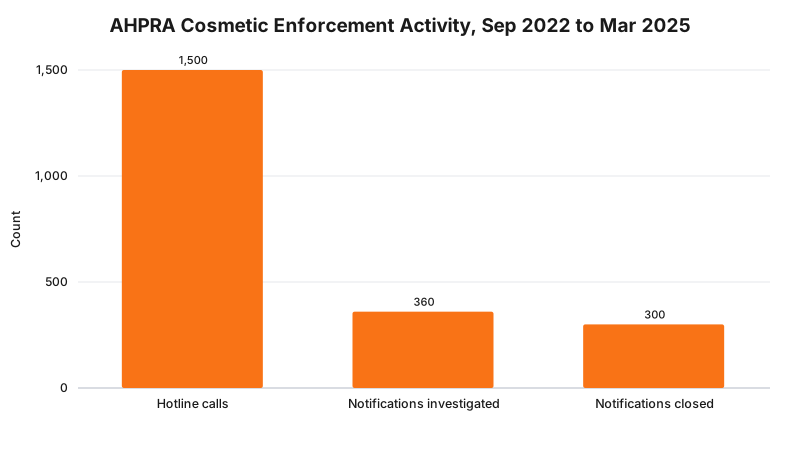
AHPRA investigated roughly 360 notifications concerning non-surgical cosmetic procedures between September 2022 and March 2025, with about 300 closed, alongside more than 1,500 calls to its dedicated cosmetic surgery complaints hotline in the same period. AHPRA’s public reporting does not break this figure down by specific advertising element, so treat it as the general enforcement backdrop, not evidence about gallery pages specifically. Source: AHPRA cosmetic procedure guideline announcements.
Decision Matrix: What Replaces Each Gallery Element
| Old gallery element | Why it is a liability | Compliant replacement |
|---|---|---|
| After-photo hero banner | After image cannot be the most prominent image under condition 3 | Facility or equipment hero photo, or a practitioner portrait |
| Photo-pair grid with no captions | No disclaimer, no time-elapsed label present on most legacy grids | Remove, or rebuild each surviving pair with both required labels visible on the image itself |
| ”Our results” heading over a photo wall | Implies outcome by imagery alone, with no supporting written content | ”Our approach” or “Meet the team” heading over credentials and process content |
| Stock or archived patient photos | Fails the genuine-patient condition outright, no conditional path to compliance | Genuine current patient photos only, or written case summaries with identifying detail removed |
| Undated “after” images | Fails the time-elapsed labelling condition | Written outcome descriptions with a stated timeframe, not tied to a specific identifiable image |
| Gallery page as the primary conversion path | One screenshot of a non-compliant image is a lodgeable complaint | Consultation booking as the primary conversion path, gallery content as supporting, not load-bearing |
Takeaway: every row on the right still tells the patient what to expect. None of it depends on the six conditions that make a photo pair the highest-risk asset on the page.
Worked Example: Two Gallery Rebuilds
Cosmetic clinic. A Perth injectables and skin clinic’s “Results” page was a single scrolling grid of forty photo pairs, most with an after shot as the larger image in each pair, no visible disclaimer, and no time-elapsed labels. The rebuild kept twelve pairs that could be brought up to all six conditions with genuine, current, consenting patients, relabelled with a before-led composite layout, a disclaimer, and a time-elapsed caption on each. The page gained three new sections that carried no photo-pair risk at all: a facility and equipment section with treatment-room photography, a practitioner credentials section naming AHPRA registration numbers and training history, and a written “what to expect” section describing the consultation and treatment process. The page’s primary call to action moved from “view our results” to “book a consultation”, and the URL moved from /results/ to /our-clinic/, 301-redirected.
Cosmetic dental practice. A smile-makeover page built around veneer before/after composites had the same structural problem: the after smile led every composite, and none carried a disclaimer. Because veneers sit on AHPRA’s higher-risk non-surgical list, the same six conditions applied. The rebuild replaced the composite gallery with a process section (digital smile design, provisional fitting, final fitting), a materials and technology section explaining the difference between porcelain and composite veneers without referencing any specific patient’s result, and a practitioner bio section. A small number of compliant before/after composites remained, each rebuilt with before-image prominence, disclaimer, and time-elapsed labelling, positioned below the process content rather than as the page’s opening section.
Takeaway: both rebuilds kept some before/after content. Neither rebuild treated it as the page’s only asset, which is the structural fix that survives the next photo audit.
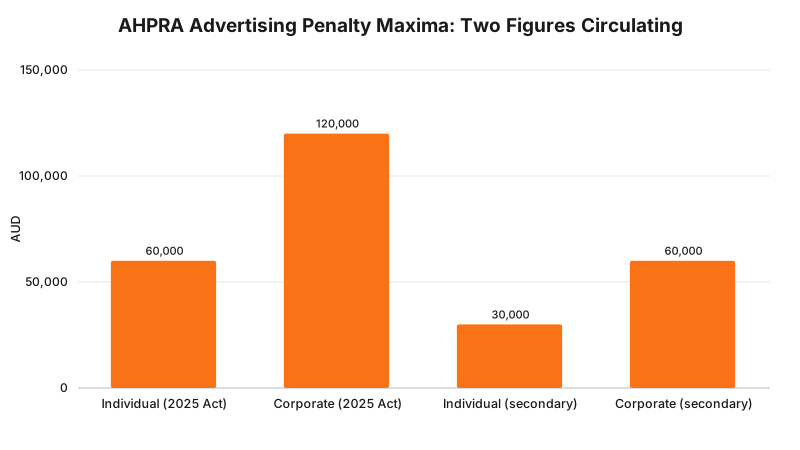
The Health Practitioner Regulation National Law’s advertising provisions set a maximum penalty of $60,000 per breach for an individual and $120,000 for a body corporate, following the 2025 amendment act. Some secondary compliance guides and blog posts still circulate the pre-amendment figures of $30,000 and $60,000. The two sets of figures are not interchangeable, and a clinic reading only the lower, older figures is underestimating current exposure.
What to Check on Your Own Site
- Open your gallery, results, or smile-gallery page and identify every image that is a before/after pair.
- For each pair, check all six conditions individually. A pair passing five out of six is still non-compliant.
- Check what the page contains besides photo pairs. If the answer is nothing, the page has no fallback content once non-compliant pairs come down.
- Check the CMS field structure behind the page. A before/after repeater field invites the same content back in even after a manual cleanup.
- Check the page URL and navigation label for a name that signals “photo gallery” to future content editors.
- Check image alt text and any structured data for leftover before/after labelling on images that are not photo pairs.
- Confirm the page’s primary call to action is a consultation booking, not “view our results”.
The Enforcement Anchor
No individually verified AHPRA notification or complaint outcome naming a website gallery or results page specifically has been publicly confirmed at the time of writing, and this guide does not assert one. What is confirmed is the volume of activity behind the rule: AHPRA investigated roughly 360 notifications about non-surgical cosmetic procedures between September 2022 and March 2025, about 300 of them now closed, and its dedicated cosmetic surgery complaints hotline logged more than 1,500 calls in the same period. A complaint against advertising content, including a gallery page, can be lodged anonymously and at no cost by anyone, including a competitor, which is the mechanism that turns a non-compliant page into a live file rather than a theoretical risk.
Where This Gets Hard
The six conditions are not equally easy to verify from outside the clinic. Genuine-patient status and consent documentation are not visible on the page itself, so an external audit, including this guide’s own advice, can flag structural failures like after-image prominence or a missing disclaimer, but cannot confirm consent paperwork exists behind a compliant-looking image. A page can look correct and still be non-compliant for a reason no visitor could ever detect.
There is also a genuine cost-benefit judgement clinics have to make themselves. Managing full compliance on twelve photo pairs indefinitely, re-checking captions, consent status, and prominence rules on every content update, is an ongoing operational cost that removing the format entirely avoids completely. Neither choice is wrong. The mistake is a page that has not made either choice deliberately and is running the old format on autopilot.
The regulator says a before/after image must meet all six conditions at once; the build consequence is a page that keeps some or none of the format, backed by content types that do not depend on it; whether your specific gallery content meets the six conditions is a question for your medical defence organisation or your lawyer.
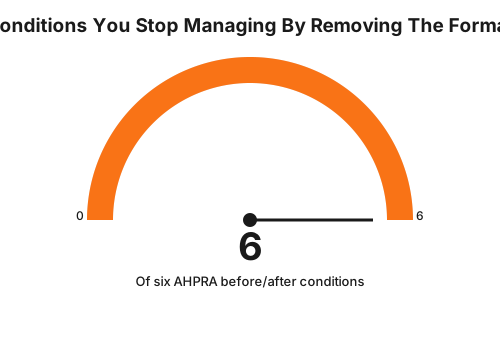
Removing before/after imagery from a page does not just avoid a breach on that content, it removes all six conditions from the page’s ongoing compliance workload at once, since none of them apply to content that is not a before/after image.
Status
In force. AHPRA’s Guidelines for advertising higher risk non-surgical cosmetic procedures have applied since 2 September 2025. Nothing in this guide depends on the TGA’s separate advertising code consultation, which closes 3 September 2026 and presents options only, with no preferred approach stated and no change yet made.
Frequently Asked Questions
Does AHPRA ban before and after photos completely?
No. AHPRA’s Guidelines for advertising higher risk non-surgical cosmetic procedures, in effect since 2 September 2025, allow before and after imagery only where six conditions are met at once, genuine unedited patient photos, before-image prominence, a disclaimer, a time-elapsed label, and adult-only content flagging. A single failed condition makes the image non-compliant, which is why many clinics rebuild the gallery page around other content instead of managing six conditions on every image indefinitely.
What can I put on a gallery page instead of before and after photos?
Facility and equipment photography, practitioner credentials and registration detail, plain-language treatment and process explanations, written outcome descriptions that avoid implied comparison, and a consultation-first booking path. None of these depend on the six before/after conditions because none of them show a before and after state.
Do cosmetic dental smile galleries fall under the same rule?
A smile gallery showing veneers, whitening or a smile makeover before and after is treated the same way as a cosmetic clinic gallery whenever it advertises a procedure on AHPRA’s higher-risk non-surgical list. Veneers and similar aesthetic dental work commonly sit inside that list, so a dental smile gallery carries the same six-condition test.
What is the maximum penalty for a non-compliant gallery page?
Under the Health Practitioner Regulation National Law’s advertising provisions, the maximum is $60,000 per breach for an individual practitioner and $120,000 for a body corporate, following the 2025 amendment act. Some secondary compliance guides still circulate an earlier figure of $30,000 and $60,000. Treat the higher, current figures as the ones that apply, and treat the lower figures you may see elsewhere as outdated.
Get Your Gallery Page Checked Before You Rebuild It
RockingWeb can check every image on your gallery, results, or smile-makeover page against all six conditions individually, and return a specific finding for each one, not a general pass or fail. If the finding is a full rebuild, talk to us about your clinic’s website and we will scope the replacement page structure before a single photo comes down.
Sources and References
AHPRA
- Guidelines for advertising higher risk non-surgical cosmetic procedures, in effect 2 September 2025, the six conditions for before/after imagery. Checked 11 August 2026.
AHPRA
- Booming billion-dollar cosmetic industry on notice with new cosmetic procedures guidelines, notification and hotline volumes. Checked 11 August 2026.
- Health Practitioner Regulation National Law, section 133, advertising offence and penalty provisions. Maximum penalties of $60,000 for an individual and $120,000 for a body corporate follow the Health Practitioner Regulation National Law and Other Legislation Amendment Act 2025, passed by the Queensland Parliament on 9 April 2025. Some secondary compliance guides continue to cite the pre-amendment figures of $30,000 and $60,000; this guide cites the current, higher figures and flags the discrepancy rather than picking a source silently.
- Before-and-After Photo Rules AHPRA: Full Guide - the full six-condition rule explainer this guide’s rebuild spec is built on top of.
TGA
- Improvements to the Therapeutic Goods Advertising Code, consultation paper, options only, closes 3 September 2026. Checked 11 August 2026.
Last reviewed: 11 August 2026.
Vikas Thakur
Founder of RockingWeb. 16 years of experience from working at TPG, iiNet and Monadelphous, now building websites, software and digital marketing for local businesses in Rockingham and Perth.