Queensland Nurse-Led Cosmetic Clinics: What Your Website Can Say
Queensland Health confirms only a doctor or nurse practitioner can buy and hold Schedule 4 cosmetic injectable stock at a clinic, never a registered nurse. Two compliant business models exist instead, and your clinic's own bio pages and consulting-hours listing are part of how the state assesses which one you're actually running.
 Vikas Thakur Founder, RockingWeb 13 min read

Key takeaways
- Queensland Health states only a doctor or nurse practitioner may buy Schedule 4 cosmetic injectable stock for a clinic. A registered nurse cannot, even under Extended Practice Authority
- Two business models are permitted: an exclusive or joint custody model, where a doctor or NP holds stock on site, and a remote services model, where a doctor or NP prescribes for dispensing only and the medicine is sent to the clinic
- Standing orders cannot be used for an RN’s administration of Schedule 4 cosmetic injectables in Queensland
- Queensland Health assesses a doctor or NP’s genuine “connection to clinic” partly from what the clinic’s own website says, including signage and listed consulting hours
- No legislative change has occurred since September 2021. The clarification came through revised fact sheets released after December 2024, not a new Act or Regulation
- Nationally, AHPRA investigated about 360 notifications about non-surgical cosmetic procedures between September 2022 and March 2025, a separate but related compliance pressure this article does not cover in detail
If your clinic’s About page says “our nurses handle all your injectable treatments” and stops there, Queensland Health’s own guidance treats that sentence as evidence, not just marketing copy. The state’s cosmetic injectable rules turn on who legally holds Schedule 4 medicine stock, and a registered nurse working alone can never be that person under Queensland law, no matter how experienced the nurse is.
That single fact reshapes what a nurse-led Queensland clinic’s website can honestly claim about how it operates. This article reports what Queensland Health’s own guidance says, what it means for your bio pages, consulting-hours listing and booking copy, and where the honest limits of that guidance sit.
What Queensland Health Actually Says
Queensland regulates Schedule 4 (S4) medicines used in cosmetic injectable treatments, including botulinum toxin products and dermal fillers, under the Medicines and Poisons Act 2019 and its accompanying Medicines and Poisons (Medicines) Regulation 2021. Queensland Health’s own guidance page sets out the position plainly: “Only doctors or NPs may buy S4 cosmetic injectable medicines to be held in stock for use in a beauty treatment/cosmetic clinic.” A registered nurse who is not also a nurse practitioner cannot buy that stock, cannot order it, and cannot hold a general supply of it at a clinic. The same guidance states an RN “may hold individually dispensed medicines for individual clients,” a narrower allowance tied to a named patient, not a clinic stock cupboard.
Queensland Health names two business models that comply with this rule:
Exclusive or joint custody model. A doctor or nurse practitioner maintains custody and control of S4 medicines at the clinic itself. After consulting a client, including by telehealth, they prescribe the medicine for an authorised person to administer.
Remote services model. A doctor or NP prescribes S4 medicine for dispensing only, after a consultation. A doctor or pharmacist dispenses the medicine and sends it to the clinic. Clinic staff, including an RN, then administer it strictly according to the dispensing label.
The guidance is explicit that standing orders cannot substitute for either model: “Standing orders cannot be used for the administration of S4 cosmetic injectables to clients by registered nurses.” It also confirms telehealth consultations are lawful before a doctor or NP prescribes, which is what makes the remote services model workable for a clinic without a resident doctor.
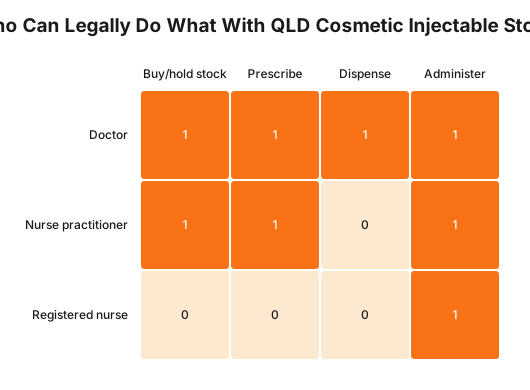
This heatmap reads straight from Queensland Health’s own wording above: doctors and NPs can buy, hold and prescribe stock, only doctors dispense it under the guidance’s own definition of dispensing, and an RN’s lawful role is limited to administering medicine someone else already prescribed and dispensed for a named client.
Takeaway: the rule is not about clinical skill. It is about which licence category the state allows to buy and hold the stock in the first place.
What That Means for the Build
None of this is advice on how to run your clinic’s medicine cabinet. It is a map of where Queensland Health’s own compliance test touches your website’s content, not just your back office.
Name the doctor or NP on your team page, not just “our clinicians.” Queensland Health lists the doctor or NP’s name appearing “on formal clinic documentation” as one factor in assessing genuine custody. A bio page that names a real, current prescriber does double duty: it is honest marketing copy and it is the kind of documentation the state looks for.
Publish consulting hours, and keep them current. The guidance specifically names “clinic signage or webpage listing the doctor/NP with consulting hours” as evidence of connection. A stale bio page for a doctor who left eighteen months ago works against you here, not just against your credibility with patients.
Stop describing your nurses as the ones who “supply” or “hold” your injectables. Website copy that implies your RNs manage the stock, even loosely written marketing language, describes exactly the model Queensland Health says is unlawful. Write instead about who prescribes, who dispenses, and who administers, matching whichever model you actually run.
State your model in plain terms somewhere a patient (and, if it ever comes to it, an investigator) can find it. A short line such as “Treatments are prescribed by Dr [Name], dispensed under their direction, and administered by our registered nursing team” tells a reader which of the two compliant models applies, instead of leaving it implied.
Match your booking flow’s practitioner field to reality. If your booking widget lets a patient select “Nurse [Name]” as the treating practitioner with no visible link to a prescribing doctor or NP, the flow itself misrepresents who is legally responsible for the medicine involved.
| Model | Who buys/holds stock | Who prescribes | Who administers |
|---|---|---|---|
| Exclusive or joint custody | Doctor or NP, on site | Doctor or NP, after consult | Doctor/NP or authorised staff, under their order |
| Remote services | No one at the clinic; dispensed off site | Doctor or NP, for dispensing only | Staff, including RNs, per the dispensing label |
| Unlawful default | RN holds general stock at the clinic | Not applicable | RN administering from stock they should never hold |
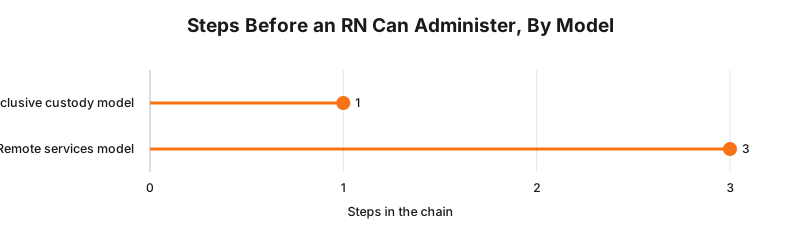
This lollipop chart is RockingWeb’s own read of the two models Queensland Health describes, not a published statistic. Under exclusive custody, the doctor or NP prescribes on site and hands off directly. Under the remote model, three separate steps have to happen in sequence, prescribe for dispensing, dispense off site, deliver to the clinic, before an RN can legally administer anything. More steps means more places a website’s copy or a booking flow can quietly misstate what actually happens.
Takeaway: your clinic’s bio page and consulting-hours listing are not just SEO content. Queensland Health names them as evidence in its own compliance test.
A Worked Example
Nurse-led cosmetic clinic, regional Queensland, three registered nurses on staff. The website’s About page read: “Our team of experienced cosmetic nurses provides anti-wrinkle and dermal filler treatments in a relaxed, boutique setting.” No doctor or nurse practitioner was named anywhere on the site. The clinic held its own stock of botulinum toxin, ordered periodically from a pharmaceutical wholesaler in the clinic’s own name.
Under the rule reported above, that stock-holding arrangement is the exact pattern Queensland Health’s guidance describes as unlawful: a registered nurse cannot buy or hold S4 cosmetic injectable stock, whatever the website says about “our team.” The clinic moved to the remote services model. A telehealth-affiliated doctor now consults each new client, prescribes for dispensing only, and a contracted pharmacy dispenses and couriers the labelled medicine to the clinic for the RNs to administer.
The website changes followed the operational ones. The About page now names the prescribing doctor, states plainly that “your treatment is prescribed by Dr [Name] following a consultation, dispensed by [Pharmacy], and administered by our qualified nursing team,” and a short FAQ entry explains why a doctor’s name appears on a nurse-run clinic’s site. Nothing about the patient experience changed. What changed was whether the website’s own words matched a model Queensland Health recognises as lawful.
Takeaway: the fix was operational first and always would be, since a website cannot make an unlawful stock arrangement lawful. But the website was the first place the old, unlawful model was visible to anyone checking.
What to Check on Your Own Site
- Does your About or team page name a specific doctor or nurse practitioner, or only “our qualified nurses”?
- Does your site show consulting hours or a visible schedule for that doctor or NP, matching the factors Queensland Health names?
- Does any page or FAQ use language suggesting your nurses “supply,” “order” or “hold” your Botox or filler stock?
- Does your site state which of the two compliant models you run, custody or remote dispensing, in words a reader could actually find?
- Does anything on the site describe RN administration under a “standing protocol” or similar wording that reads like a standing order?
- Does your booking flow’s practitioner selection reflect who actually prescribes, not just who the patient will meet in person?
The Enforcement Anchor
Queensland Health’s own guidance describes an education-first compliance posture rather than a published enforcement register: its FAQ states the department’s approach “depend[s] on the severity of non-compliance,” pointing to engagement and education ahead of formal action. This research did not find a published infringement notice, prosecution or disciplinary determination specifically against a Queensland clinic for the stock-holding or custody rule described in this article. That is a genuine gap in public enforcement data for this exact rule, not a claim that the rule goes unenforced. Say so plainly rather than reaching for an unrelated case to fill it.
What does exist, nationally, is volume evidence that regulators are actively working this space. AHPRA reports around 360 notifications about non-surgical cosmetic procedures investigated between September 2022 and March 2025, about 300 of them closed, alongside more than 1,500 calls to its cosmetic surgery hotline in the same period.
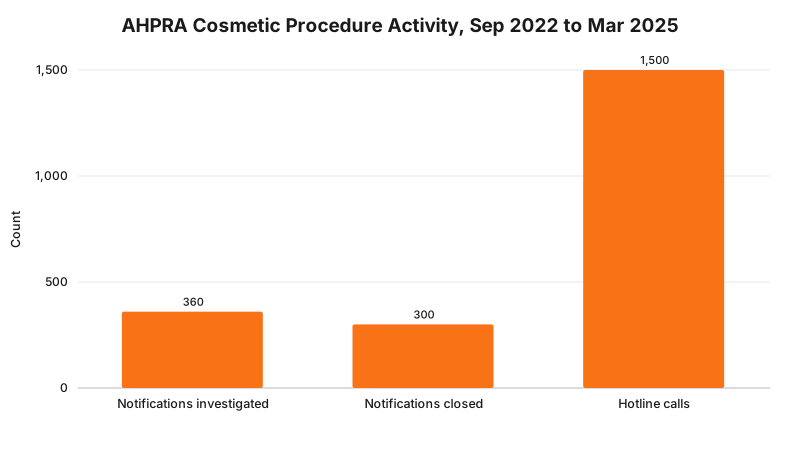
That AHPRA data covers professional conduct notifications nationally, not Queensland’s stock-holding rule specifically, so treat it as evidence the wider cosmetic sector is under active regulatory attention rather than proof of enforcement against this particular rule.
The regulator says a registered nurse cannot buy or hold Schedule 4 cosmetic injectable stock without a doctor or NP’s genuine custody; the build consequence is that your website’s practitioner pages, consulting-hours listing and booking copy should reflect whichever compliant model you actually run, not imply your nursing team manages the stock alone; whether your specific arrangement meets Queensland Health’s custody test is a question for your medical defence organisation or your lawyer.
Takeaway: the absence of a public case against this exact rule is not the same as the rule having no teeth. Queensland Health’s own compliance language, and AHPRA’s national activity, both point the other way.
Where This Gets Hard
Queensland Health’s “connection to clinic” test is a set of named factors, not a numeric threshold. The guidance lists what counts (documentation, signage, consulting hours, independent access) and what falls short (a doctor who visits monthly, no clinic access, no signage), but it does not say how many of the negative factors tip a clinic from compliant to unlawful. A clinic could satisfy some factors and not others, and Queensland Health’s own page gives no formula for weighing that mix.
The guidance is also administrative, not legislative. It clarifies how Queensland Health reads the Medicines and Poisons Act 2019 and its Regulation, and the department states plainly that neither instrument has changed since September 2021. That means the guidance could be revised again without a Bill passing Parliament, in a way a change to the Act itself would not allow. Build your compliance position on the underlying legislation your adviser reads, and treat Queensland Health’s fact sheets as the department’s current interpretation of it, not a fixed rule that can never move.
Status
In force, as at 20 September 2026. The Medicines and Poisons Act 2019 and Medicines and Poisons (Medicines) Regulation 2021 are both currently in force and unchanged since September 2021, per Queensland Health’s own guidance. The stock-holding clarification itself is administrative guidance, not new legislation, most recently revised through fact sheets released after December 2024, and remains Queensland Health’s current published position at the time of writing.
Frequently Asked Questions
Can a nurse-led cosmetic clinic in Queensland hold its own Botox or filler stock?
No. Queensland Health states only a doctor or nurse practitioner may buy Schedule 4 cosmetic injectable medicines to be held in stock for use in a clinic. A registered nurse cannot possess a stock of these medicines, though an RN may hold medicine dispensed for a specific, named client.
What is Queensland’s connection to clinic test?
It is how Queensland Health assesses whether a doctor or nurse practitioner has genuine custody and control of stock at a clinic, rather than lending their name to cover an RN-run operation. Named factors include the doctor or NP appearing on formal clinic documentation, having independent access to the clinic, and being listed on clinic signage or the clinic’s own webpage with consulting hours.
Can a nurse practitioner buy and hold cosmetic injectable stock, even though a registered nurse cannot?
Yes. Queensland Health treats nurse practitioners the same as doctors for buying, holding and prescribing Schedule 4 cosmetic injectables. The restriction applies specifically to registered nurses who are not also nurse practitioners.
Has Queensland’s cosmetic injectable law actually changed recently?
No legislative change. Queensland Health states there have been no changes to the Medicines and Poisons Act 2019 or its regulation since September 2021. What changed is the guidance itself, clarified through revised fact sheets released after December 2024.
Is this the same as AHPRA’s national cosmetic procedure guidelines?
No, and the two are easy to conflate. This is Queensland state medicines law about who can buy, hold and administer a specific class of medicine. AHPRA’s separate national guideline for registered health practitioners who perform non-surgical cosmetic procedures, in effect since 2 September 2025, covers professional conduct and applies to every registered health practitioner except medical practitioners, who instead sit under the Medical Board’s own 2023 cosmetic guidelines.
Get Your Clinic’s Site Checked Against the Custody Model You Actually Run
RockingWeb builds and audits clinic websites so the practitioner pages, consulting-hours listing and booking copy match the business model behind them, not a generic template that never mentions who prescribes.
Talk to us about your clinic’s website and operating modelSources
- Queensland Health - Medicines in beauty treatment and cosmetic injectable businesses: stock-holding rules, the two compliant business models, the connection to clinic test, and the compliance-approach FAQ. Checked 20 September 2026.
- Queensland Legislation - Medicines and Poisons Act 2019, the underlying Act referenced by Queensland Health’s guidance. Checked 20 September 2026.
- Australian College of Nursing - secondary reporting on the stock-holding clarification’s practical effect on nurse-led clinics, published 27 June 2025.
- AHPRA - national notification and hotline call volumes for non-surgical cosmetic procedures, September 2022 to March 2025.
- AHPRA - Guidelines for registered health practitioners who perform non-surgical cosmetic procedures, effective 2 September 2025.
- Medical Board of Australia - Guidelines for registered medical practitioners who perform cosmetic surgery and procedures, effective 1 July 2023.
Related reading:
- NSW Cosmetic Regulation 2026: The Systems Your Site Must Now Talk To: the equivalent record-keeping story for NSW’s incoming Regulation
- Age Gating a Cosmetic Booking Flow: a related booking-flow compliance mechanic
Last reviewed: 20 September 2026.
Vikas Thakur
Founder of RockingWeb. 16 years of experience from working at TPG, iiNet and Monadelphous, now building websites, software and digital marketing for local businesses in Rockingham and Perth.