TGA Names Cosmetic Injectables a Priority to 2027
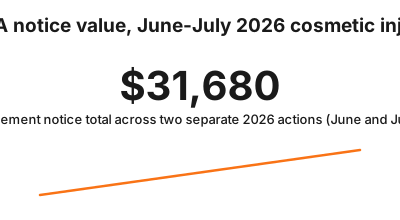
The TGA's Compliance Principles 2026-27 names therapeutic goods used in cosmetic procedures, including dermal fillers and anti-wrinkle injectables, as a stated enforcement priority for the full two-year window. Across June and July 2026, two separate infringement actions against practitioners over unapproved injectable imports totalled $31,680 combined, with the TGA explicitly linking one action to this priority.
 Vikas Thakur Founder, RockingWeb 11 min read
On this page 13
Key takeaways
- The TGA’s Compliance Principles 2026-27 names therapeutic goods used in cosmetic procedures, including dermal fillers and anti-wrinkle injectables, as a stated priority area for the full two-year window
- Across June and July 2026, the TGA issued at least eight infringement notices across two separate actions against practitioners over unapproved cosmetic injectable imports, worth a combined $31,680
- The TGA explicitly linked one of those actions, worth $19,800 across five notices, to the Compliance Principles 2026-27 priority in its own public statement
- Every individual infringement notice reviewed for this post carries the same $3,960 flat value, consistent across every 2026 case checked
- A separate, older TGA advertising restriction already bans naming a prescription-only substance or its trade name in health-service material aimed at the public, independent of where a product came from
- The priority is an operational statement, not new legislation. It changes where the TGA looks, not what the underlying law says
The Therapeutic Goods Administration has told the industry exactly where it plans to look for the next two years, and cosmetic injectables made the list. That is not a guess about regulatory mood. It is a stated line item in a published document, and the TGA has already put money behind it.
This post covers what the priority document actually says, what it changes for a clinic website’s build, and the enforcement action the TGA itself tied directly to this priority.
What the Policy Actually Says
The TGA’s Compliance Principles 2026-27, released in 2026, sets out how the regulator will direct compliance and enforcement attention across import, export, manufacture, supply and advertising of therapeutic goods for the two years to the end of 2027. Therapeutic goods used in cosmetic procedures sit inside the named priority areas for that window, alongside other product categories the TGA considers higher risk.
The clearest evidence that this is not just a policy paragraph sitting unused is the TGA’s own words when it announced infringement notices against a Victorian nurse and a Victorian individual in June 2026. Reporting on that action quoted the regulator directly: the TGA was “targeting unapproved therapeutic goods used in cosmetic procedures as part of its Compliance Principles 2026 and 2027.” That is the regulator naming its own priority document as the reason for the action, not a journalist’s inference.
Read plainly, the document does two things. First, it tells industry which categories get resourcing priority for the stated period. Second, it puts a public record behind that statement the moment an action lands, which is exactly what happened within months of the window opening.
What That Means for the Build
A compliance priority does not change a single line of code by itself. What it changes is the cost of getting an existing rule wrong, because the category it names is now the one the TGA is more likely to be looking at.
The underlying rule that matters for a website predates this priority document by years. An advertisement for a health service should not refer, directly or indirectly, to a prescription-only substance or its trade name, in material aimed at the public. That reaches further into a site than most clinics assume.
Start with the visible page. Treatment headings, body copy, meta titles and meta descriptions should describe the treatment category, not the branded product, on any page a member of the public can reach. “Anti-wrinkle injectable consultations” and “dermal filler treatments” describe a service. A specific brand name in that same spot names a prescription-only good.
Then check what a human editor never reads. Structured data on a treatment page, typically a MedicalProcedure or Service schema block, often has a free-text field a content team fills in from whatever the internal treatment list calls the item. If that field carries a brand name, it gets indexed exactly as written by every search engine and AI answer engine crawling the page, in a channel nobody proofreads by eye. The same check applies to image alt text on before-and-after galleries, to downloadable PDF price lists, and to any booking-widget dropdown that lists services by brand before a patient has had a clinical consultation.
URL slugs are worth a specific pass. A page living at a brand-named path keeps that reference live in a permanent, indexable location regardless of what the rendered copy says. Renaming the slug to a generic term and redirecting the old URL removes a standing exposure that most manual reviews miss, because they read the page, not the address bar.
Decision Matrix: What Your Copy Can Say
| Website element | Product named | Public-facing risk | Where the rule sits |
|---|---|---|---|
| Treatment page H1 and meta title | Botulinum toxin brand name | Restricted, names a prescription-only good | Therapeutic Goods Act 1989 |
| Treatment page H1 and meta title | ”Anti-wrinkle injections” | Generally treated as service description, not product advertising | Standard industry practice |
| Schema markup treatment name field | Filler brand name | Restricted, indexed even if never displayed on the visible page | Therapeutic Goods Act 1989 |
| Before and after image captions | Any injectable brand or generic category | Separate restriction applies regardless of TGA status | AHPRA advertising guidelines |
| Booking widget service dropdown | Brand name shown before consultation | Restricted, treated as advertising the good itself | Therapeutic Goods Act 1989 |
A generic service description is the lower-risk pattern across every row. The exception, before and after imagery, sits under AHPRA’s guidelines rather than the TGA’s, and needs its own check regardless of what the copy says.
A Worked Example
A Perth cosmetic clinic ran its anti-wrinkle treatment page under a URL and page title that both named a specific botulinum toxin brand, because that was the term the practice used internally and it matched what patients typed into Google. The visible copy read well and made no false claims. The problem sat one layer down: the page’s MedicalProcedure schema carried the same brand name in a field the content team had never opened since the site launched, and the booking-widget dropdown listed the service by brand before any consultation step.
The fix did not touch clinical content. The page title and H1 moved to a generic treatment-category description, the URL was renamed with a 301 redirect from the old brand-named path, the schema field was corrected to match the new generic wording, and the booking-widget label was updated to the same generic term. Search rankings held within the normal range of week-to-week variation, because the change removed a brand reference rather than any information a patient needed.
What to Check on Your Own Site
- Search your own site for every branded injectable name you can think of, using your own site search or a
site:search. - Check your treatment page’s structured data output, not just the rendered page, for the same brand names.
- Check image alt text on before and after galleries separately from the visible caption.
- Check any downloadable PDF price list or treatment menu for brand references.
- Check your booking widget’s service list as it appears before a patient reaches a consultation step.
- Check the URL slug of every treatment page, not just the visible copy.
The Enforcement Anchor
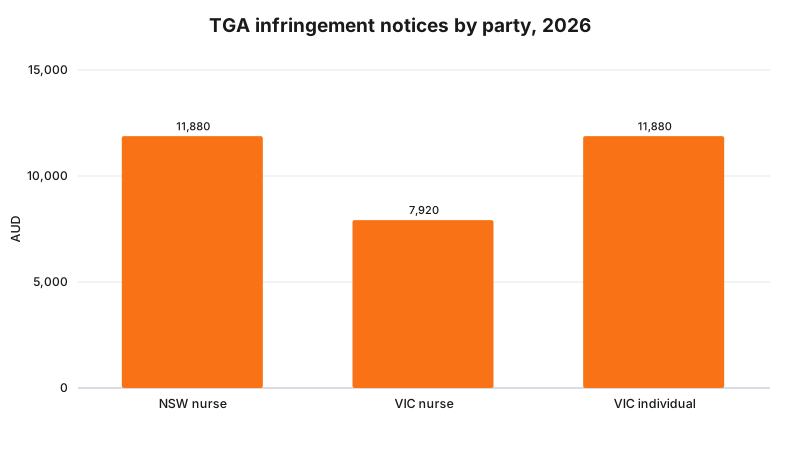
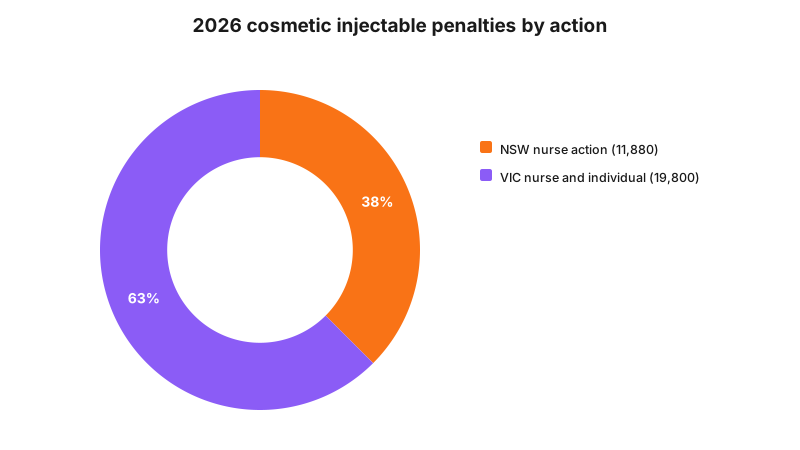
In June 2026 the TGA issued five infringement notices totalling $19,800 to a Victorian AHPRA-registered nurse and a Victorian-based individual, for the alleged unlawful importation of unapproved pre-filled syringes containing hyaluronic acid, poly-L-lactic acid and lidocaine. The individual was also issued a notice over unapproved tranexamic acid imported without the required exemption. The nurse’s share came to $7,920 across two notices; the individual’s share came to $11,880 across three. Reporting on the action quoted the TGA linking it directly to the Compliance Principles 2026-27 priority.
The following month, in July 2026, a separate action issued three infringement notices totalling $11,880 to a New South Wales registered nurse, over unapproved vials of botulinum toxin and lidocaine-containing pre-filled syringes never listed on the Australian Register of Therapeutic Goods. That case is covered in full in our breakdown of the July 2026 nurse infringement notice.
Every individual notice across both actions carries the same $3,960 value, which is a statutory amount rather than a discretionary one. None of this is a court finding. An infringement notice is an alternative the TGA can offer instead of prosecution, and paying one is not an admission of guilt.
Where This Gets Hard
The genuinely hard part is not the import case. It is the line between describing a service and naming the good used to deliver it, and that line is not always as clean as a treatment-category label makes it look. A page that says “anti-wrinkle injections using premium Swiss product” is naming a treatment category and pointing at a brand in the same sentence, and where exactly that crosses from description into promotion depends on wording a general rule cannot fully anticipate.
The regulator says an advertisement for a health service should not refer, directly or indirectly, to a prescription-only substance or its trade name; the build consequence is that treatment pages, schema fields, alt text and booking widgets should use a generic treatment-category description rather than a specific branded product name anywhere the public can reach it; whether a particular page’s wording crosses that line in your circumstances is a question for your medical defence organisation or your lawyer.
Status
In force. The Compliance Principles 2026-27 document is an operational statement already being acted on, not a proposal and not pending commencement, and the underlying Therapeutic Goods Act 1989 restrictions it sits alongside have been in force for years. As at 4 September 2026, the priority window runs through the end of 2027.
Get a Direct Answer on Your Copy
If you are not sure whether your treatment pages, schema, or booking widget carry a brand name they shouldn’t, talk to us about your clinic’s website and we will tell you within one business day what we find and what it takes to fix it. For the specific rule on referring to injectables in advertising, see the July 2026 nurse infringement breakdown, or for a full pass on your site, talk to us.
Frequently Asked Questions
What is the TGA Compliance Principles 2026-27 document?
It is the Therapeutic Goods Administration’s published statement of where it will direct compliance and enforcement effort across import, export, manufacture, supply and advertising of therapeutic goods for the two years to the end of 2027. Therapeutic goods used in cosmetic procedures, covering dermal fillers and anti-wrinkle injectables, sit inside the named priority areas for that window.
Does a stated priority mean every clinic gets audited?
No. A compliance priority is a resourcing statement, not a guarantee of individual review. It tells you where the TGA is more likely to look and act, based on the pattern of infringement notices already issued in 2026. It does not mean a specific clinic is under investigation.
Can I put a brand name like Botox or a filler brand on my clinic website?
Naming a prescription-only substance or its trade name in material that promotes a health service to the public is restricted under the Therapeutic Goods Act 1989. The safer, common industry pattern is to describe the treatment category, such as anti-wrinkle injections or dermal filler treatments, rather than the specific branded product, in any page aimed at the public.
Is a TGA infringement notice the same as being found guilty in court?
No. Paying an infringement notice is not an admission of guilt and does not create a criminal record. It is an option the TGA can offer as an alternative to referring a matter for prosecution or civil proceedings, and the amounts involved are set by statutory formula, not discretion.
How is this different from AHPRA’s advertising rules?
They are separate regulators enforcing separate law. The TGA administers the Therapeutic Goods Act 1989 and deals with unapproved products and restricted advertising of medicines. AHPRA administers the Health Practitioner Regulation National Law and deals with practitioner conduct and testimonials. A clinic can be compliant with one and still be exposed under the other.
Need a hand with your website?
If you want a second pair of eyes on how this applies to your own site, request a callback and we will talk it through.
Sources
- TGA - Compliance and enforcement, home of the Compliance Principles 2026-27. Checked 4 September 2026.
- TGA - Infringement notices register. Checked 4 September 2026.
- National Tribune - TGA issues infringement notices to a health professional and an individual for alleged unlawful importation of cosmetic injectables, reporting the TGA’s own statement linking the action to the Compliance Principles 2026 and 2027. Checked 4 September 2026.
- Pharmabiz - TGA issues infringement notices for alleged unlawful importation of cosmetic injectables, corroborating the June 2026 Victorian action and dollar figures. Checked 4 September 2026.
- Federal Register of Legislation - Therapeutic Goods Act 1989. Checked 4 September 2026.
- RockingWeb - the July 2026 nurse infringement notice, covering the separate NSW case and the advertising-copy rule in full.
Last reviewed: 4 September 2026.
Vikas Thakur
Founder of RockingWeb. 16 years of experience from working at TPG, iiNet and Monadelphous, now building websites, software and digital marketing for local businesses in Rockingham and Perth.