Multi-State Clinic Sites: One Clinical-Model Page, Two Laws
Queensland Health tells clinics that use interstate services to check their obligations under Queensland law regardless. New South Wales adds a new cosmetic recordkeeping regime on 5 November 2026. A clinic group with locations in more than one state cannot describe its clinical model with one templated paragraph and expect it to be accurate everywhere it appears.
 Vikas Thakur Founder, RockingWeb 17 min read

Key takeaways
- Queensland Health’s own guidance states plainly that its cosmetic injectable rules apply to “businesses that use interstate services”, not just single-site Queensland clinics
- Queensland allows only a doctor or nurse practitioner to buy and hold Schedule 4 cosmetic injectable stock; a registered nurse alone cannot, under either of Queensland’s two permitted business models
- NSW’s current rule, Part 3A of the Poisons and Therapeutic Goods Regulation 2008, restricts administration to an authorised practitioner or a nurse acting under that practitioner’s direction, and is already in force
- NSW’s Medicines, Poisons and Therapeutic Goods Regulation 2026 was made 3 July 2026 and commences 5 November 2026, 43 days after this article’s publish date, adding a new Category 1 and Category 2 framework
- Western Australia has published no cosmetic-injectable-specific guidance at all, so a multi-location clinic expanding there has no fact sheet to check a page’s copy against, only the general Medicines and Poisons Act 2014
- The AHPRA national guideline that governs advertising and professional conduct is a single, uniform layer that does not vary by state. The layer that varies is state medicines and poisons law, and the two are easy to conflate on a website
- A clinic that copies one location’s clinical-model paragraph onto another location’s page risks describing a model the second state’s regulator does not permit
If your clinic group has locations in more than one state, the “About Our Clinical Model” paragraph on your website cannot be one paragraph. Queensland Health’s own guidance names the exact scenario: clinics that use interstate services still have to meet Queensland’s rules, and Queensland’s rules about who can buy, hold and administer cosmetic injectable stock are not the same rules that apply in New South Wales or Western Australia.
That gap is easy to miss because it hides behind a different, better-known layer of regulation that genuinely is national. AHPRA’s guideline for registered health practitioners who perform non-surgical cosmetic procedures applies the same way in every state. State medicines and poisons law does not. This article reports what changes state to state, what stays constant everywhere, and how a multi-location site’s architecture should reflect that difference instead of papering over it.
Two Layers, Only One of Which Varies
Cosmetic clinic compliance runs on two separate regulatory layers, and a website built around only one of them will get the other wrong somewhere.
Layer one: professional conduct, national, uniform. The Guidelines for registered health practitioners who perform non-surgical cosmetic procedures, in effect since 2 September 2025, is a single consolidated guideline that applies to every registered health practitioner except medical practitioners, who instead sit under the Medical Board’s own 2023 cosmetic guidelines. This layer covers advertising claims, testimonials, before-and-after imagery and cooling-off periods. It reads the same in Perth as it does in Sydney. A clinic group’s advertising copy can genuinely be templated across locations, because this layer does not vary.
Layer two: medicines and poisons, state, not uniform. Who may buy Schedule 4 cosmetic injectable stock, who may hold it, and who may administer it are questions each state answers under its own Act. Queensland Health’s own guidance states that “authorised prescribers, clinics and suppliers operating in Queensland should ensure they meet their obligations under the legislation,” and adds a line worth reading twice if your clinic group operates across state lines: “this includes businesses that use interstate services.” Queensland Health is telling multi-location operators directly that having a compliant head office somewhere else changes nothing about a Queensland location’s obligations.
Under Queensland’s Medicines and Poisons Act 2019 and its Medicines and Poisons (Medicines) Regulation 2021, only a doctor or nurse practitioner may buy Schedule 4 cosmetic injectable medicines to hold as stock at a clinic where they have exclusive or joint custody. A registered nurse cannot buy or hold that stock alone, under either of Queensland’s two permitted models, exclusive or joint custody, or the remote services model where a doctor or NP prescribes for dispensing only. The rule reported in full, with both models explained, is covered in depth in our companion article on Queensland’s nurse-led clinic rules. This article does not repeat that detail; it treats Queensland as one data point in a wider pattern.
NSW’s current rule sits in Part 3A of the Poisons and Therapeutic Goods Regulation 2008: administration is restricted to an authorised practitioner, meaning a medical practitioner, nurse practitioner or dentist, or a nurse acting under that practitioner’s direction, and the prescriber must have personally reviewed the patient first. That rule is already in force. A separate, new instrument, the Medicines, Poisons and Therapeutic Goods Regulation 2026, was made and published on 3 July 2026 and commences 5 November 2026. It adds a Part 9 governing cosmetic use substances, split into Category 1 requirements (who can administer, prescriber checks, responsible-provider risk management) and Category 2 requirements (the written direction, records and storage), reported in full in our companion article on NSW’s Category 1 and Category 2 requirements and the systems your booking flow needs to talk to. This article treats NSW as a second data point, not a full breakdown.
Western Australia is the third data point, and the simplest one to describe: no published cosmetic-injectable-specific guidance exists. Clinics there operate under the general Medicines and Poisons Act 2014, which requires a permit (Health Service, Government, Research/Education or Pharmaceutical Samples category) before a business can buy, hold or supply Schedule 4 stock, but no Queensland-style fact sheet clarifies who specifically may hold cosmetic injectable stock in a beauty or cosmetic setting.
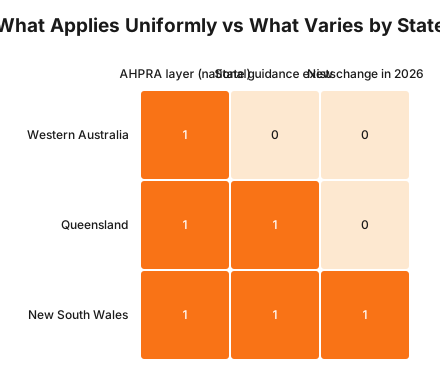
The first column is a flat line across all three states, because the AHPRA layer does not move. The second and third columns are where a multi-location clinic’s website actually has work to do, and Queensland and NSW answer them differently from each other, let alone from Western Australia.
Takeaway: if a clinical-model paragraph would read the same for your Queensland location and your Western Australia location, that is itself a signal something has been templated past the point where it is still accurate.
What That Means for the Build
None of this is advice on which business model to run in which state. It is a map of where state variation should show up in a multi-location site’s structure, not just in a compliance officer’s notes.
Store the clinical-model description per location, not per site. If your CMS has one global “Our Clinical Model” content block included on every location page, that is the exact pattern Queensland Health’s interstate-services line warns against. A structured field, something like a clinicalModel object on each location’s record, with sub-fields for state, custodyModel, prescriberName and lastReviewedDate, lets each location page render its own accurate description instead of inheriting one written for a different state.
Make the state itself a first-class field, not just an address line. A location’s postal address already implies its state, but if the clinical-model copy is driven by a separate region or serviceArea tag that was set once at launch and never revisited, a new location can quietly inherit the wrong template. Tie the clinical-model content directly to the state field used for compliance, not a marketing region grouping.
Give each location page its own review date, not a site-wide one. NSW’s new Part 9 commences 5 November 2026. Queensland’s fact sheet was last revised in April 2025. Those are two different clocks. A single “last updated” date in the site footer cannot tell a reader, or a regulator, which location’s clinical-model description was actually checked against which state’s current rules.
Separate the shared layer from the state-specific layer in the template itself. Build the location page template with two distinct content regions: one for the AHPRA-governed advertising and conduct content that genuinely is safe to share across every location, and one for the state-specific clinical-model paragraph that must not be. Mixing the two into a single freeform rich-text block is how a compliant sentence for one state ends up copied onto a page where it isn’t compliant.
Flag a location page automatically when its state’s rules change. A regulatoryReviewDue boolean or a scheduled task tied to a known commencement date, 5 November 2026 for NSW, means the NSW location pages get flagged for review on that date instead of relying on someone remembering.
| Dimension | Western Australia | Queensland | New South Wales |
|---|---|---|---|
| AHPRA advertising and conduct guideline | Applies, same as every state | Applies, same as every state | Applies, same as every state |
| State-published cosmetic injectable guidance | None published | Fact sheet, Dec 2024, revised Apr 2025 | Yes, since 2021 (Part 3A), expanding 5 Nov 2026 |
| New state instrument commencing in 2026 | None | None | Yes, Medicines, Poisons and Therapeutic Goods Regulation 2026, 5 Nov 2026 |
| Who may administer, as currently published | General Poisons Act only, no cosmetic-specific clarification | Doctor/NP or authorised person, under one of two published models | Authorised practitioner or nurse under that practitioner’s direction |
| Governing instrument | Medicines and Poisons Act 2014 | Medicines and Poisons Act 2019 + Regulation 2021 | Poisons and Therapeutic Goods Act 1966 + Regulation 2008 (current); Medicines, Poisons and Therapeutic Goods Act 2022 + Regulation 2026 (from 5 Nov 2026) |
Takeaway: the fix is architectural before it is legal. A per-location field that can hold a different, correct answer for each state does more compliance work than any amount of careful proofreading on a shared template.
A Worked Example
Clinic group, head office in Perth, three Western Australia locations, opening a fourth location in Brisbane. The website’s location pages all pulled the same “About Our Clinical Model” paragraph from a shared component: “Our experienced nursing team delivers your treatment in a relaxed, boutique setting, working closely with our clinical team to ensure the best results.” No custody model, no prescriber name, no distinction between locations. It read fine in Western Australia, where no published guidance exists to check it against.
The Brisbane location launched with the identical paragraph. Under Queensland Health’s published rules, that paragraph says nothing about who buys and holds the Schedule 4 stock the Brisbane clinic uses, and gives no indication of whether the location runs the exclusive custody model or the remote services model. Worse, a related page on the site described “our nurses managing your treatment plan from consultation through to aftercare,” language that, read literally on a Queensland location page, edges toward implying the nursing team manages the stock itself, the exact arrangement Queensland Health’s guidance says is not permitted for a registered nurse acting alone.
The fix split the shared component into two pieces. The advertising and conduct copy, the AHPRA-governed layer, stayed shared: it does not vary by state. The clinical-model paragraph became a per-location field. The Brisbane page now states plainly which doctor or nurse practitioner holds custody of stock at that location and which of Queensland’s two permitted models the clinic runs, while the three Western Australia pages kept their original, simpler description, since no published state guidance requires them to say more.
Takeaway: the Perth locations were never wrong. The mistake was assuming a paragraph that happened to be safe in a state with no published guidance would still be safe the moment it appeared on a page for a state that has one.
What to Check on Your Own Site
- Does every location page state its own state or region explicitly, not just “our clinics” as a group?
- Does the clinical-model paragraph on each location page match that specific state’s current, published rules, rather than the head office location’s?
- Is the clinical-model copy stored once as a shared component included across every location page, or does each location have its own field that can hold a different answer?
- Does any page reference a specific state’s rule, Queensland’s custody models, NSW’s Part 3A, by name on a location page in a different state, where it does not apply?
- Is there a review date or flag tied to each location individually, so a state-level change like NSW’s 5 November 2026 commencement triggers a review of only the NSW pages, not a manual site-wide check?
- Does your booking flow’s location and practitioner selector match the clinical model actually described on that specific location’s page, rather than a generic group-wide practitioner list?
The Enforcement Anchor
No published infringement notice, determination or complaint outcome specifically addresses a multi-location clinic’s clinical-model description across states. That is a genuine gap in public enforcement data for this exact scenario, not a claim that regulators ignore it.
What exists instead is Queensland Health naming the scenario directly. Its own guidance does not wait for a multi-location clinic to get it wrong before addressing the risk: “authorised prescribers, clinics and suppliers operating in Queensland should ensure they meet their obligations under the legislation. This includes businesses that use interstate services.” Queensland Health’s published compliance posture is education-first rather than punitive-first for a first instance, stating in its own FAQ that “in the first instance, depending on the severity of the non-compliance, our approach will be to educate clinics on how to become compliant.” That is a real, sourced statement of regulatory intent, not an invented worst case, and it applies with no carve-out for a clinic whose head office sits in a different state.
For evidence that the underlying category of failure, an unclear or undocumented practitioner and stock model, does get prosecuted somewhere in this regulatory neighbourhood, a recent NSW Health Care Complaints Commission decision is on point even though it does not involve a multi-location business. An unregistered practitioner administered botulinum toxin at a Burwood beauty salon in October 2025; according to reporting on the decision, “appropriate records were not kept, and those which were found were mostly in Mandarin.” A five-year prohibition order took effect 19 May 2026. That case predates the new NSW Regulation and does not concern a website’s clinical-model description, but it shows the same regulator willing to act hard on the same underlying gap, an unclear or absent record of who was actually responsible for a scheduled substance.
The regulator says a clinic’s obligations follow the state it operates in, interstate services included; the build consequence is that a clinical-model description belongs to the location, not the site; whether your specific multi-location arrangement satisfies each state’s rules is a question for your medical defence organisation or your lawyer.
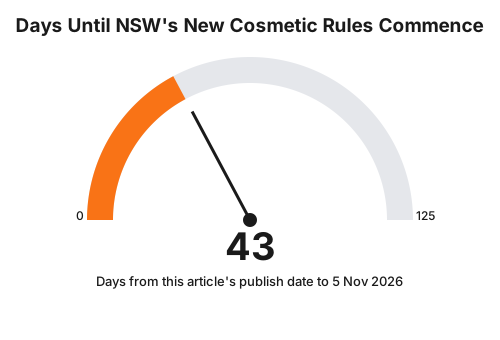
That 125-day span runs from NSW Health’s 3 July 2026 made-and-published date to the 5 November 2026 commencement date. From this article’s publish date, 43 days remain, and every NSW location page that describes a clinical model should be reviewed again before that date passes.
Takeaway: the absence of a published case naming multi-location clinics specifically is not the same as the underlying rule having no teeth. Queensland Health wrote the interstate scenario into its own guidance before any case forced it to.
Where This Gets Hard
The honest limit sits with the states that have published nothing. Western Australia, South Australia, the ACT and the Northern Territory have no cosmetic-injectable-specific fact sheet at all, which means a multi-location clinic expanding into any of them has no published document to check a clinical-model paragraph against, only the general Poisons or Medicines Act each jurisdiction runs. That is not the same as those states having no rules. It means the specific question this article is about, what can your clinical-model page say, has a confirmed answer in Queensland and NSW and an unconfirmed one everywhere else.
Where a published test does exist, it tends to be a set of named factors rather than a checklist with a numeric threshold. Queensland Health’s own guidance on genuine custody, covered in depth in our companion article, lists factors like documentation, signage and consulting hours without saying how many have to be present. A multi-location site’s clinical-model copy can satisfy some factors and not others, and no state publishes a formula for weighing that mix, which means “get the copy technically accurate” is necessary but not automatically sufficient.
This article also relies on our own two companion articles for the full detail of Queensland’s and NSW’s rules, rather than re-deriving each one from scratch. Where those articles carry their own caveats, particularly NSW’s Category 1 and Category 2 pinpoint section numbers, which could not be independently confirmed because the NSW legislation register blocks automated access, those same caveats apply here.
Status
Mixed, as at 23 September 2026. The AHPRA national conduct guideline is in force everywhere and does not vary by state. Queensland’s stock-holding clarification is in-force administrative guidance under legislation unchanged since 2021, most recently revised through fact sheets released after December 2024. NSW’s current Part 3A rules are in force today; NSW’s Medicines, Poisons and Therapeutic Goods Regulation 2026 has been made and published but is not yet in force, commencing 5 November 2026, 43 days from this article’s publish date. Western Australia has no published cosmetic-injectable-specific instrument to report a status on.
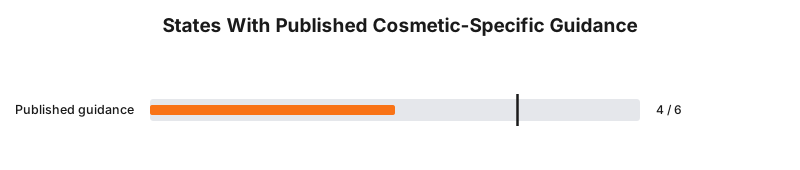
Four of Australia’s eight states and territories, NSW, Queensland, Victoria and Tasmania, have published something addressing cosmetic injectables specifically, a fact our companion state-by-state guide covers in full. The other four, including Western Australia, have not, which is exactly why a multi-location clinic operating across that line cannot use the same confidence level in its clinical-model copy everywhere.
Frequently Asked Questions
Does one “About Our Clinical Model” page work for a clinic group with locations in more than one state?
Not reliably. State medicines and poisons law decides who can buy, hold and administer Schedule 4 cosmetic injectable stock, and that answer differs from state to state. A single paragraph written for one location’s rules can describe an unlawful arrangement the moment it appears on a page for a clinic in a different state.
Do AHPRA’s national cosmetic procedure guidelines vary from state to state?
No. The single national guideline for registered health practitioners who perform non-surgical cosmetic procedures, in effect since 2 September 2025, applies uniformly across every state and territory to every registered health practitioner except medical practitioners, who instead sit under the Medical Board’s own 2023 cosmetic guidelines. What varies by state is a separate, second layer, medicines and poisons law governing who may buy, hold and administer a scheduled substance.
What does Queensland Health say about clinics that also operate interstate?
Queensland Health’s own guidance states that “authorised prescribers, clinics and suppliers operating in Queensland should ensure they meet their obligations under the legislation,” and adds explicitly that “this includes businesses that use interstate services.” A head office in another state does not exempt a Queensland location from Queensland’s rules.
Is NSW’s new cosmetic medicines regulation in force yet?
No. The Medicines, Poisons and Therapeutic Goods Regulation 2026 (NSW) was made and published on 3 July 2026 and commences on 5 November 2026, 43 days after this article’s publish date. Until then, NSW’s current cosmetic-medicine rules under Part 3A of the Poisons and Therapeutic Goods Regulation 2008 remain the operative law.
What should a multi-location clinic’s website architecture actually do differently?
Store the clinical-model description as a structured, per-location field driven by that location’s actual state and operating model, reviewed on its own schedule, rather than a single shared template block or component reused across every location page on the site.
Get Your Multi-Location Site Reviewed Against Each State’s Rules
RockingWeb builds and audits multi-location clinic websites so the clinical-model description on each location page matches the state that location actually operates in, not a paragraph written once and copied everywhere.
Talk to us about your clinic group’s website and operating modelSources
Queensland Health
- Medicines in beauty treatment and cosmetic injectable businesses: the two compliant business models, standing orders, buying/holding/supplying rules, the interstate-services statement, and the compliance-approach FAQ. Checked 23 September 2026.
NSW Legislation
- Medicines, Poisons and Therapeutic Goods Regulation 2026 (sl-2026-0330). The register blocks automated access; cited here for its existence and commencement date only. Checked 23 September 2026.
NSW Health
- Medicines, Poisons and Therapeutic Goods legislation update, confirming the 3 July 2026 made date and 5 November 2026 commencement date. Checked 23 September 2026.
AHPRA
- Guidelines for registered health practitioners who perform non-surgical cosmetic procedures, effective 2 September
Medical Board of Australia
- Guidelines for registered medical practitioners who perform cosmetic surgery and procedures, effective 1 July 2023.
Mondaq
- reporting on the NSW Health Care Complaints Commission’s prohibition order against an unregistered Burwood practitioner, effective 19 May 2026.
Related reading:
- Queensland Nurse-Led Cosmetic Clinics: What Your Website Can Say: the full Queensland custody-model breakdown this article treats as one data point
- NSW Category 1 and Category 2 Cosmetic Rules: What Your Records Must Show: the full breakdown of NSW’s incoming recordkeeping regime
- NSW Cosmetic Regulation 2026: The Systems Your Site Must Now Talk To: the booking and clinical-record integration angle for the same commencement date
- Cosmetic Injectable Laws by State Australia: Full Guide: the full eight-state comparison this article draws its Western Australia and background detail from
Last reviewed: 23 September 2026.
Vikas Thakur
Founder of RockingWeb. 16 years of experience from working at TPG, iiNet and Monadelphous, now building websites, software and digital marketing for local businesses in Rockingham and Perth.