AI Adoption in Australian SMEs: 37% of Medium Firms Use AI
37% of medium-sized Australian businesses already use AI, according to a 2024 survey of SME decision-makers. Official ABS data puts economy-wide adoption at just 12% in 2024-25, and the gap between the two numbers tells you exactly where the opportunity sits.
 Vikas Thakur Founder, RockingWeb 9 min read
On this page 8
Key takeaways
- 37% of medium-sized Australian businesses (51-200 staff) already use AI, according to a 2024 survey of 205 SME directors and decision-makers commissioned by Small Business Loans Australia
- Only 12% of all Australian businesses reported using AI in the workplace in 2024-25, according to the ABS Business Characteristics Survey published 25 June 2026
- ABS-measured AI adoption among medium businesses jumped from 3% in 2021-22 to 22% in 2024-25, a sevenfold rise in three years
- Large businesses lead ABS-measured adoption at 35%, up from 9% three years earlier
- Innovation-active small businesses adopt AI at 19%, almost five times the rate of small businesses that do not innovate at all
- 60% of Australian SMEs plan to be using AI by 2026, and medium businesses expect to hit 90% adoption by then
- The three most common AI tools among Australian SMEs are data analysis tools (27%), reporting tools (25%) and chatbots or automatic email replies (24%)
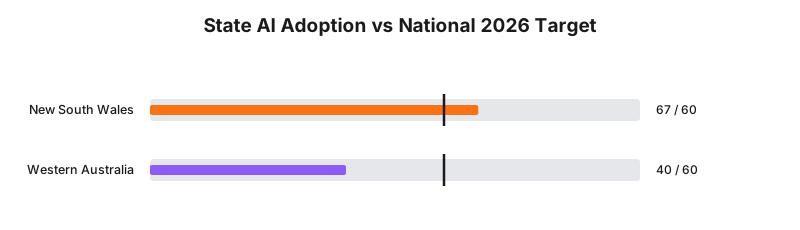
- New South Wales leads state adoption at 67% using or planning to use AI by 2026, ahead of Western Australia at 40%
37% of medium-sized Australian businesses already use AI in their daily operations, according to a 2024 survey of 205 SME decision-makers. That number gets more interesting once you put it next to the government’s own data. The Australian Bureau of Statistics’ latest Business Characteristics Survey, published 25 June 2026, found just 12% of all Australian businesses reported using AI in the workplace in 2024-25. Two credible sources, two very different numbers, and the gap tells you something useful: AI adoption depends heavily on how big your business is, and any single average hides the real story. If you run a business with 50 or more staff, your competitors are already moving. If you run a small or micro business, the headlines about AI taking over are running well ahead of what most businesses your size are actually doing. Here is the full breakdown, by business size, industry and state, so you know exactly where you sit against the rest of the market.
How Many Australian Businesses Actually Use AI
Start with the official number. The ABS Business Characteristics Survey, drawn from nearly 7,000 businesses and covering the 2024-25 financial year, found that 12% of Australian businesses reported using AI in the workplace. That is up from what the ABS describes as “very low rates” in 2021-22, before tools like ChatGPT existed in any mainstream sense.
The 12% figure is an average across every business in the country, and averages flatten out the differences that actually matter. Break the same ABS dataset down by business size and the picture changes fast.
| Business size (ABS) | AI adoption, 2024-25 | AI adoption, 2021-22 |
|---|---|---|
| Large businesses | 35% | 9% |
| Medium businesses | 22% | 3% |
| Small and micro businesses | 11% | Very low (not separately reported) |
| All businesses | 12% | Very low (not separately reported) |
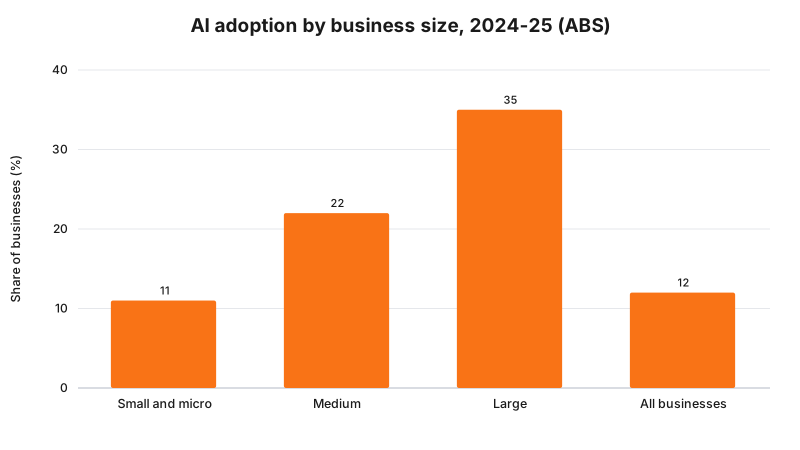
Large businesses are nearly three times more likely to use AI than a small or micro business. That gap is not new. It is the same gap that shows up in every wave of enterprise technology, from cloud computing to CRM software: bigger businesses have the budget, the staff and the appetite for risk to try new tools first.
Takeaway: the official adoption rate for Australian businesses is 12%, but that number triples to 35% once you look at large businesses alone.
Why Medium Businesses Are Moving Fastest
The steepest curve in the ABS data belongs to medium-sized businesses. Their AI adoption rate went from 3% in 2021-22 to 22% in 2024-25, a sevenfold increase in three years. Large businesses grew from 9% to 35% over the same period, a smaller multiple but a bigger absolute jump.
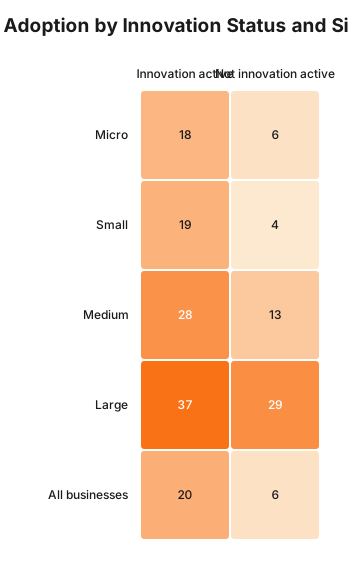
Two other ABS findings explain who is driving that growth. First, businesses that are already innovation-active (meaning they introduced or improved a product, service or process in 2024-25) adopt AI at a far higher rate than businesses that did not. “The AI adoption rate for innovation active small businesses was 19%, which was almost five times greater than the rate for those that did not undertake any innovation activity in 2024-25,” said Tom Lay, the ABS’s head of business statistics. Second, adoption is not spread evenly across industries. Information, media and telecommunications firms lead at 38% adoption, followed by professional, scientific and technical services and financial and insurance services, both at 24%.
| Business size | Innovation-active adoption | Non-innovation-active adoption |
|---|---|---|
| Micro businesses | 18% | 6% |
| Small businesses | 19% | 4% |
| Medium businesses | 28% | 13% |
| Large businesses | 37% | 29% |
| All businesses | 20% | 6% |
| Industry | AI adoption rate |
|---|---|
| Information, media and telecommunications | 38% |
| Professional, scientific and technical services | 24% |
| Financial and insurance services | 24% |
Look at medium businesses through that lens and the 22% headline figure understates the real split. Innovation-active medium businesses reported 28% AI adoption, more than double the 13% rate among medium businesses that did not innovate. Put those two facts together and a pattern emerges. AI adoption is not really about business size on its own. It is about whether a business already treats process change as normal. A medium-sized accounting firm that has already digitised its workflow is a much easier candidate for AI tools than a similarly sized business that still runs on paper and spreadsheets.
Takeaway: medium businesses grew AI adoption sevenfold in three years, and innovation-active businesses of every size are roughly double to five times more likely to have adopted AI than the ones that are not.
What Business Owners Say About Their Own AI Use
The ABS survey asks businesses to self-report AI use across the whole economy. A separate, smaller study asked SME owners directly and got numbers that read very differently for the segments it covers.
Small Business Loans Australia commissioned a survey of 205 directors and decision-makers across micro (1-10 employees), small (11-50 employees) and medium (51-200 employees) businesses, published 14 June 2024. It found 25% of SMEs were already using AI at the time, with 37% of medium businesses reporting they had already integrated it, well above the 22% the ABS later measured for the same size band in its 2024-25 survey. Micro businesses reported 18% current use.
| SME size (SBLA definition) | Using AI now | Planning to add AI | Total by 2026 |
|---|---|---|---|
| Micro (1-10 staff) | 18% | 23% | 41% |
| Medium (51-200 staff) | 37% | 53% | 90% |
| All SMEs surveyed | 25% | 35% | 60% |
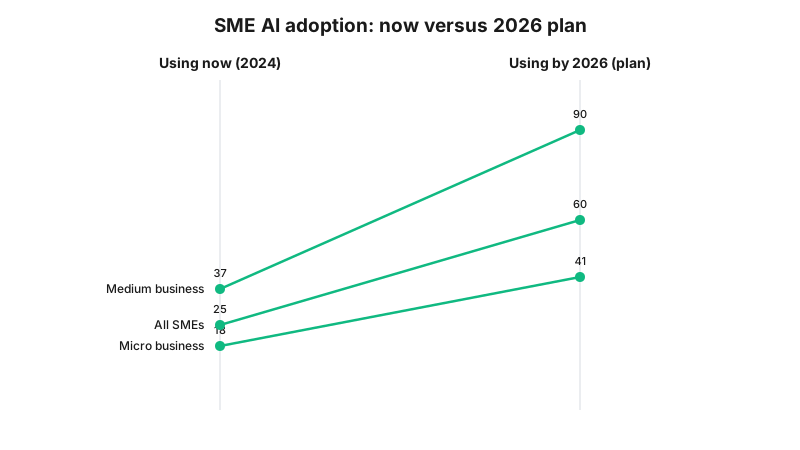
The gap between the two surveys is worth sitting with rather than smoothing over. The ABS number is drawn from a much larger sample and measured behaviour, so treat it as the more reliable population-wide figure. The SBLA number is self-reported by a smaller group of SME decision-makers and captures intent as much as current practice, which is exactly why the planned-adoption columns matter here. Read together, they say the same thing two different ways: adoption is real, it is uneven by size, and the businesses that have not started yet are the majority, not the minority.
Takeaway: medium businesses report the fastest current AI adoption of any SME size band, and nine in ten expect to be using AI by 2026.
Which AI Tools Australian SMEs Actually Use
Adoption numbers do not tell you what businesses are actually doing with AI once they start. The SBLA survey asked that question too, and the answers are unglamorous in the best way: businesses are not chasing novelty, they are cutting repetitive admin.
| AI tool category | Share of SMEs using it |
|---|---|
| Data analysis tools | 27% |
| Reporting tools | 25% |
| Chatbots and email replies | 24% |
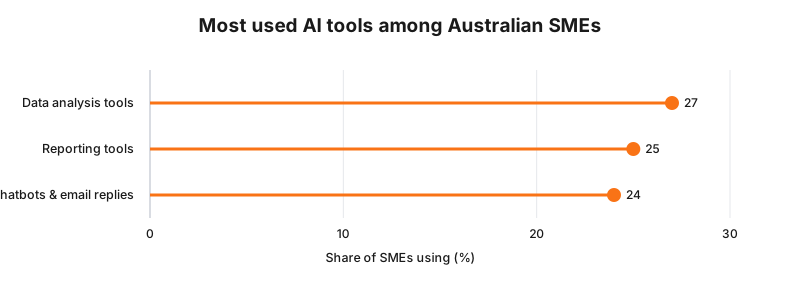
Those three categories sit within a few points of each other, which tells you SMEs are not betting on one killer use case. They are picking off the tasks that eat the most staff hours: pulling numbers out of spreadsheets, writing the same report every month, and answering routine emails that do not need a human’s judgement.
State-level results follow the same pattern of uneven, real progress. New South Wales leads with 67% of SMEs already using or planning to use AI by 2026, the highest of any state or territory in the survey. Western Australia sits at 40% current integration, behind NSW but still a material share of the state’s SME base.
Takeaway: Australian SMEs are using AI for data analysis, reporting and email replies first, the repetitive jobs with the clearest time saving, not for anything flashier.
What This Means If You Run a Small Business
Here is where the numbers stop being a survey result and start being a decision. If you run a business with 50 or more staff, you are already behind the median for your size band, not ahead of it. Whichever survey you trust, somewhere between 22% and 37% of businesses your size have already moved, and both surveys put the 2026 figure for medium businesses at 90% or close to it.
If you run a micro or small business, the picture is calmer than the coverage suggests. Most businesses your size have not adopted AI yet: 82% by the SBLA numbers, closer to 89% by the ABS numbers. That is not a reason to wait. It is a reason to be deliberate about which task you automate first, because you are not racing a market that has already moved, you are picking a spot before it gets crowded.
The tools with the highest reported use, data analysis, reporting and routine email replies, are also the easiest to test without rebuilding how your business runs. Start with the report you write every month, or the customer email you answer the same way fifty times a week. That is where the 27% and the 24% came from, and it is the lowest-risk place to find out if AI actually saves you time before you commit to anything bigger.
Takeaway: the businesses already moving on AI are concentrated in the medium size band and in industries that were already digitising, which means most Australian businesses still have room to move before the market gets crowded.
Get Your Systems Ready Before You Add AI on Top
AI tools save time when the systems underneath them are already sound. A chatbot answering customer emails is only as good as the booking system or CRM feeding it the right information, and a reporting tool is only as fast as the data it can actually reach. If your business is still copying details between spreadsheets and inboxes by hand, that is the gap worth closing first.
Book a no-obligation consultation with the RockingWeb team to talk through where your business actually sits on this curve, and what is worth automating first.
Sources
- Australian Bureau of Statistics. (2026). “Business adoption of Artificial Intelligence accelerates in 2024-25”. Business Characteristics Survey, Cat. No. 8167.0.
- IT Brief Australia. (2024). “AI adoption among Australian SMEs to surge by 2026, survey finds”. Citing Small Business Loans Australia survey of 205 SME decision-makers.
- Australian Broker. (2024). “AI adoption soars among Aussie SMEs”. Citing Small Business Loans Australia survey data, including state-level breakdowns.
- Digital Australia. (2024). “Survey: 60% Australian SMEs will be using AI by 2026”.
Vikas Thakur
Founder of RockingWeb. 16 years of experience from working at TPG, iiNet and Monadelphous, now building websites, software and digital marketing for local businesses in Rockingham and Perth.