WA Digital Grants 2026: Up to $75K Available for Small Businesses
Western Australian small businesses can access up to $75,000 in combined grant funding for digital tools, automation, and technology this financial year. Two state government programs are currently active. Here is what each covers, who qualifies, and how to stack them.
 Vikas Thakur Founder, RockingWeb Updated Jun 6, 2026 7 min read
On this page 8
Key Takeaways
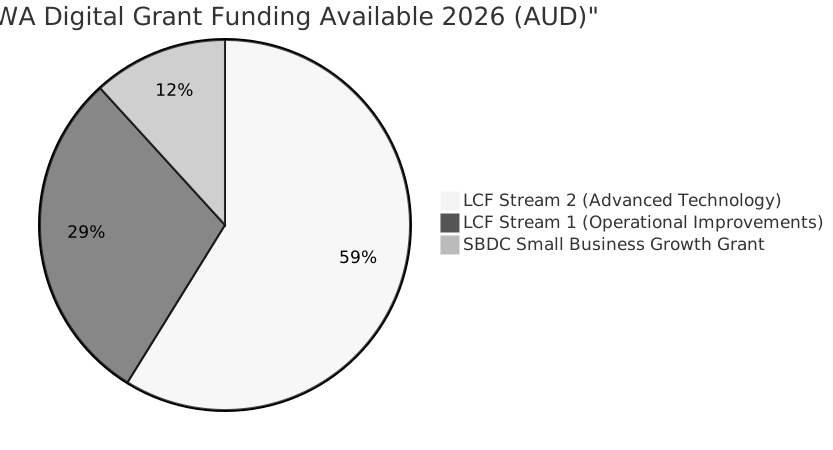
- LCF Stream 1 (operational improvements): up to $25,000 matched 50/50 for software, automation, and cyber security
- LCF Stream 2 (advanced technology): up to $50,000 matched 50/50 for AI, IoT, robotics, and ERP systems
- Combined maximum from LCF alone: $75,000 if you qualify for both streams
- SBDC Small Business Growth Grant: closed for 2025-26; 2026-27 round expected July 2026
- Stack the grants with the $20,000 ATO instant asset write-off (runs to 30 June 2026) for maximum tax benefit
- LCF is funded by the WA Government via the Department of Energy and Economic Diversification
- Eligible business size: must be an existing WA business, operating legally, not under administration
Three months from now, the $20,000 instant asset write-off disappears.
After 30 June 2026, a website that costs $15,000 gives you a $1,000 first-year deduction. Before 30 June, it gives you a $15,000 deduction. That’s a $4,200 difference in tax at the 28% company rate.
The grant stack makes it sharper. A WA business that claims $25,000 from the LCF Stream 1 grant toward a $50,000 automation project pays $25,000 out of pocket. That $25,000 qualifies for the instant asset write-off if it is a single asset under the threshold. The government has paid half your tech spend. The ATO then reduces your tax on the other half.
This combination does not get talked about enough. It should.
Most WA small businesses know about grants or the instant asset write-off. Almost none combine both in the same project. That’s leaving real money on the table.
The Two Active WA Digital Grants in 2026
1. WA Local Capability Fund: Digital Transformation Round
The LCF Digital Transformation Round is the primary state grant for digital adoption. It’s administered by the WA Department of Energy and Economic Diversification and provides two streams of co-funded support.
The round is currently under review (as of March 2026). Check the latest status at wa.gov.au, Local Capability Fund Digital Transformation Round before applying.
| Stream | Focus | Maximum Grant | Co-Contribution |
|---|---|---|---|
| Stream 1 | Operational improvements | $25,000 | 50% required |
| Stream 2 | Advanced technology purchase | $50,000 | 50% required |
| Combined maximum | Both streams | $75,000 | 50% on each |
Stream 1 covers operational and process improvements. Eligible expenses include:
- Software purchase and integration (CRM, ERP, accounting tools)
- Automation of business processes (workflow tools, scheduling, invoicing)
- Cyber security audits and mitigation strategies
- Digital marketing platforms and tools
Stream 2 covers advanced technology purchase. Think bigger:
- AI-driven tools and analytics platforms
- IoT hardware and predictive maintenance systems
- Robotics and automation equipment
- 3D printing software and additive manufacturing tools
- Advanced ERP and data management systems
The 50% co-contribution requirement means you pay half and the grant covers the other half. For a $50,000 automation project, you pay $25,000 and receive $25,000 from the government.
Contact the LCF team at digital.industries@jtsi.wa.gov.au to confirm your project aligns with the correct stream before applying.
2. SBDC Small Business Growth Grant (Opens July 2026)
The SBDC Small Business Growth Grant provides up to $10,000 in matched funding for eligible small businesses in WA.
The 2025-26 round is closed. The $1M pool was exhausted early. The 2026-27 round is expected to open in July 2026.
| Detail | Information |
|---|---|
| Maximum grant | $10,000 |
| Co-contribution | Matched dollar-for-dollar |
| Target businesses | WA small businesses under $10M turnover |
| Eligible uses | Digital marketing, e-commerce, ICT tools, professional development |
| Status (May 2026) | Closed. 2026-27 round expected July 2026 |
| Where to check | smallbusiness.wa.gov.au/growth |
When the new round opens, the growth grant stacks with the LCF. A business that receives $25,000 from LCF Stream 1 and $10,000 from the SBDC Growth Grant has government funding covering $35,000 of a $45,000 project.
Here’s the thing: The SBDC rounds fill fast. The 2025-26 round was oversubscribed in weeks. Set a calendar reminder for July 2026 and prepare your application documents before the round opens. Don’t wait until it goes live to start your paperwork.
What Digital Spending Actually Qualifies
Both grants cover a broader range of digital spending than most business owners realise. Here’s a breakdown for WA trades, construction, and service businesses:
| Category | LCF Eligible? | SBDC Eligible? | Notes |
|---|---|---|---|
| New website | Yes (Stream 1) | Yes | Must be business-use asset |
| CRM setup (HubSpot, Salesforce) | Yes (Stream 1) | Yes | Setup and integration costs |
| Automation (n8n, Zapier, Make) | Yes (Stream 1) | Yes | Workflow tools and integrations |
| Accounting software (Xero, MYOB) | Yes (Stream 1) | Yes | Implementation and training |
| ERP system | Yes (Stream 2) | Partial | May need Stream 2 for advanced deployments |
| Cyber security audit | Yes (Stream 1) | No | LCF-specific eligible expense |
| SEO and digital marketing retainer | No | Yes | Ongoing services vs. capital items |
| Hardware (computers, tablets) | Partial | No | Must be incidental to digital adoption |
| Training and workshops | No | Yes | SBDC grant covers skill development |
Rule of thumb: LCF suits capital projects (buying and integrating systems). SBDC suits smaller digital spend including services and training. When in doubt, apply for the one that fits your project type, then ask if you can stack.
The Instant Asset Write-Off Stack (Before 30 June 2026)
The ATO’s $20,000 instant asset write-off runs until 30 June 2026. Any Australian business with aggregate turnover under $10M can deduct the full cost of any eligible asset under $20,000 in the year it is first used.
Here’s how the stack works in practice:
Scenario: A Rockingham trade business invests in automation
- Project scope: Workflow automation setup + CRM integration, total cost $30,000
- LCF Stream 1 grant: covers $15,000 (50% co-contribution)
- Business out-of-pocket: $15,000
- Asset is used before 30 June 2026: qualifies for instant asset write-off
- Tax saving at 30% company rate: $4,500
- Net effective cost: $10,500 for a $30,000 project
That’s 35 cents in the dollar. The grant and the write-off together reduce the real cost by 65%.
But here’s the catch: the asset must be first used or installed ready for use before 30 June 2026. A project signed in June but not live until August doesn’t qualify for the current-year write-off. Plan your timeline now, not in May.
Construction Training Fund: Software Skills (Ongoing)
WA construction businesses have an extra funding source most miss: the Construction Training Fund.
The CTF reimburses training costs for workers in the WA construction industry at $31 per hour (maximum $248 per day or 70% of course cost, whichever is lower). This covers software-skills training relevant to construction: project management software, BIM platforms, ERP systems, and scheduling tools.
This runs separately from the LCF and SBDC grants. No application round deadline either. You can claim it anytime.
More detail at ctf.wa.gov.au, Making a Claim.
How to Prepare a Strong LCF Application
The LCF assesses applications on demonstrated productivity and competitiveness outcomes. Projects that describe clear, measurable improvements get prioritised over vague “we want to modernise” applications.
Here’s what assessors look for:
- Current state problem: what manual process or inefficiency are you solving?
- Specific technology solution: what tool, platform, or system will you buy?
- Measurable outcome: how will productivity, revenue, or resilience improve? (Be specific: “Reduce quote-to-invoice time from 3 days to 4 hours” is better than “improve efficiency”)
- Implementation plan: who installs it, what is the timeline, how will staff be trained?
- Co-contribution evidence: bank statements or confirmation your business can cover the 50%
A well-scoped project with a clear ROI story wins over a larger budget with vague objectives.
Assessors see hundreds of applications that say ‘improve efficiency’. Write one that says reduce quote-to-invoice time from 3 days to 4 hours and you’re already in the top 20% of applicants.
Grant Stack Checklist
- Check the LCF Digital Transformation Round status at wa.gov.au
- Email digital.industries@jtsi.wa.gov.au to confirm your project fits the correct stream
- Register for SBDC Growth Grant notifications at smallbusiness.wa.gov.au/growth (round expected July 2026)
- If your project includes any asset under $20,000, ensure it is installed and in use before 30 June 2026 for the instant asset write-off
- Check CTF eligibility if your team needs software training at ctf.wa.gov.au
- Talk to your accountant about how grant income interacts with your cost base for future CGT purposes
Get Your Project Grant-Ready
RockingWeb helps WA businesses scope digital projects that qualify for the LCF grant stack, from automation builds to CRM setup and web development. We know what assessors look for and can structure your project to maximise grant eligibility.
Projects start from $3,000. ABN: 918 7857 0066. Contact us here and we will scope a project that fits the grant window and your business goals.
Grant conditions change. Check program pages directly before applying. This post is for general information only. Speak to the relevant grant administrator or a registered business adviser before making decisions based on your specific circumstances.
Vikas Thakur
Founder of RockingWeb. 16 years building for companies like TPG, iiNet and Monadelphous, now focused on websites and marketing that comply with AHPRA's advertising guidelines and still book patients.