41.9% of Australian Small Businesses Have No Website
41.9% of small Australian businesses (5 to 19 staff) had no website, according to ABS data. A newer industry study puts the figure even higher for businesses under 20 staff. Here is what the numbers actually show and why the gap has barely moved.
 Vikas Thakur Founder, RockingWeb 8 min read
On this page 12
- Key takeaways
- Answer Capsule
- 41.9% of Small Australian Businesses Still Skip a Website
- Where the 41.9% Figure Actually Comes From
- The Number Has Only Gotten Worse Since
- Why Owners Skip a Website in the First Place
- What a Website Is Actually Worth
- What a Website Actually Costs
- The Digital Footprint Is Shifting, Even Without a Website
- What This Means for Your Business
- Get Your Business Off the No-Website List
- Sources
Key takeaways
- 41.9% of small Australian businesses (5 to 19 staff) had no web presence, per the ABS
- 63% of Australian microbusinesses (0 to 4 staff) had no website in the same dataset
- 52.9% of all Australian businesses lacked a web presence overall, versus 47.1% that had one
- 59% of Australian small businesses still had no website in a later 2019 industry study, rising to 65% in regional areas
- 44% of business owners without a website say their business is “too small” to need one
- 30% cite cost as the barrier, and 17% say they lack the time to build or manage one
- Small businesses with a website report a 25% attributable lift in growth
- 51% of Australian businesses used social media for their online presence in 2024-25, up from 47% in 2021-22
Answer Capsule
41.9% of Australian small businesses (5 to 19 staff) had no website, per the ABS 2013-14 IT Use and Innovation survey. A 2019 GoDaddy and YouGov Galaxy study of 425 small business owners put the figure closer to 59% for businesses under 20 staff.
41.9% of Small Australian Businesses Still Skip a Website
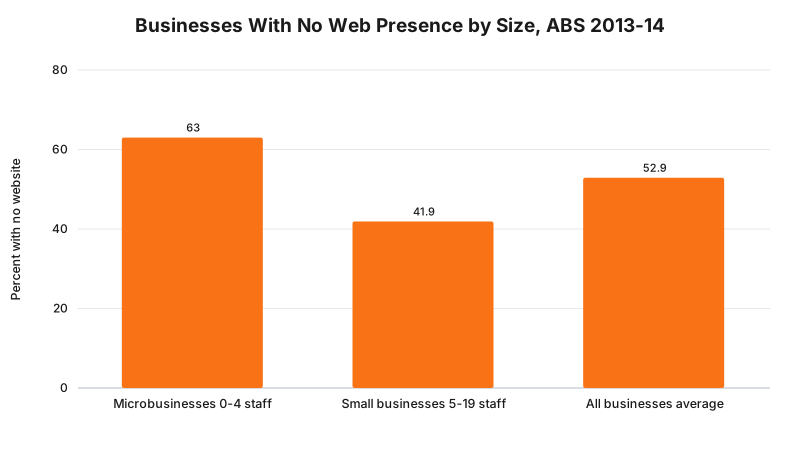
41.9% of small Australian businesses, defined by the ABS as those with 5 to 19 staff, had no web presence at all. That number comes from the Australian Bureau of Statistics’ IT Use and Innovation in Australian Business report, and it sat behind an even bigger figure most owners never see: 63% of Australian microbusinesses, the 0 to 4 staff outfits that make up the bulk of the small business sector, had no website either. Put the two bands together and 52.9% of all Australian businesses had no web presence, against 47.1% that did. That is not a rounding error. That is roughly half the country’s business owners running without a digital front door. If you run a trade business, a clinic, a cafe or a services firm and you are still relying on a Facebook page or word of mouth, you are the rule, not the exception. This post walks through what the data actually says, where the “41%” and “59%” numbers each come from, and what the gap is costing the businesses stuck on the wrong side of it.
Takeaway: almost 42 out of every 100 small Australian businesses had no website, and the true figure across all small operators, including microbusinesses, sat closer to 53%.
Where the 41.9% Figure Actually Comes From
The 41.9% stat traces back to a single, specific source: the ABS IT Use and Innovation in Australian Business survey, covering the 2013-14 financial year and released in June 2015. It is Australia’s own statistical agency, not a vendor survey, which is why it carries weight when a website adoption number gets cited. The catch is the age. That data is now well over a decade old, and the ABS has since folded this indicator into broader releases that report different metrics, like social media use and online ordering, rather than a straight website-or-not split by business size. So while 41.9% is the most authoritative “no website” figure Australia has published for small businesses specifically, treat it as a historical baseline, not a live number.
| Business size (ABS definition) | Had a website | Had no website |
|---|---|---|
| Microbusinesses (0-4 staff) | 37% | 63% |
| Small businesses (5-19 staff) | 58.1% | 41.9% |
| All businesses average | 47.1% | 52.9% |
Takeaway: the ABS 41.9% figure is real and specific to small businesses, but it is a 2013-14 snapshot, not a 2026 one.
The Number Has Only Gotten Worse Since
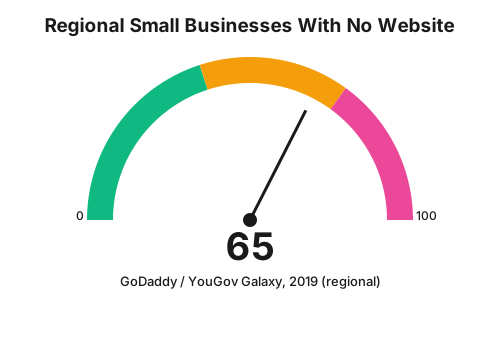
If the ABS baseline feels dated, the next data point should worry you more. A 2019 study run by YouGov Galaxy for GoDaddy, surveying 425 small business owners and managers across capital cities and regional Australia, found that 59% of small businesses had no website. That is 17 percentage points worse than the ABS 41.9% figure from five years earlier, and it climbed to 65% for businesses located outside the major capitals. Two different methodologies, two different sample sizes, so the numbers are not directly comparable in a strict statistical sense. But they point the same direction: website adoption among small operators did not improve through the 2010s, and regional businesses lagged further behind their metro counterparts the whole way.
| Data source and year | Small business definition | No website |
|---|---|---|
| ABS, 2013-14 | 5-19 staff | 41.9% |
| GoDaddy / YouGov Galaxy, 2019 | Under 20 staff | 59% |
| GoDaddy / YouGov Galaxy, 2019 (regional) | Under 20 staff | 65% |
Takeaway: the gap between metro and regional website adoption is as wide as the gap between having a website at all and not.
Why Owners Skip a Website in the First Place
The GoDaddy study did not just measure the gap, it asked business owners why they were on the wrong side of it. The top answer, at 44%, was that owners believed their business was too small to justify one. Cost came second at 30%. Time came third at 17%, with owners saying they could not spare the hours to build or maintain a site once it existed. None of those reasons hold up well against the benefits data from the same study, which is exactly the disconnect worth spelling out.
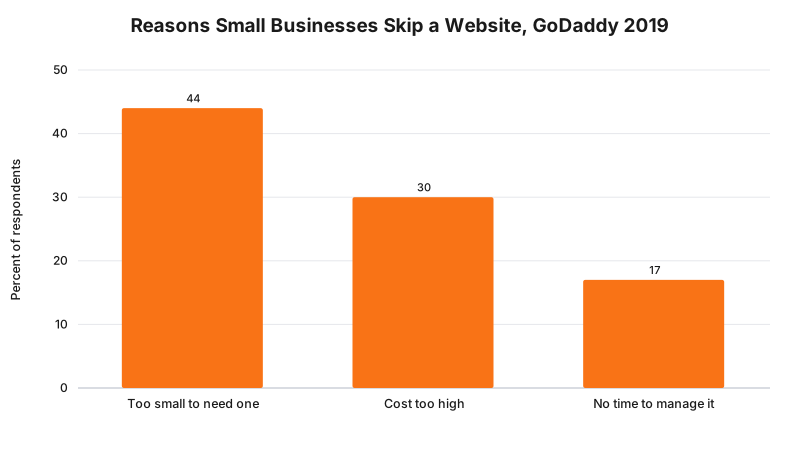
Takeaway: cost and time are real barriers, but “too small” is a belief, not a fact, and it is the single biggest reason owners give.
What a Website Is Actually Worth
Among the businesses that did have a website, the same GoDaddy study found real, self-reported returns. 59% used their site for customer enquiries. 58% reported new business opportunities directly attributable to it. 56% said it made them easier to find on Google. Nearly two-thirds said it improved how customers perceived their credibility and professionalism, and website owners attributed roughly 25% of their business growth to having one. Set that against the 44% who think they are “too small” to need a site, and the gap between belief and outcome gets hard to ignore.
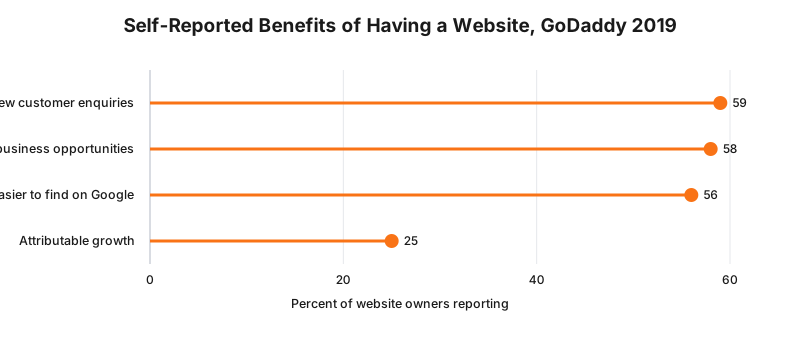
Takeaway: 58% of business owners with a website trace new business directly to it, which is a harder number to argue with than 44% of owners guessing they do not need one.
What a Website Actually Costs
Cost is the second most common reason owners give for staying offline, so it is worth putting a number on it. The GoDaddy study found small business owners expected to pay an average of $3,200 AUD for a professionally built website. That average masked a generational split: millennials expected to pay $4,347, Gen X respondents expected $3,208, and baby boomers expected the least at $2,553. For a fuller breakdown of what a website actually costs to build and host in Australia across different platforms and business types, see our website cost guide.
| Age group | Average expected website cost (AUD) |
|---|---|
| Millennials | $4,347 |
| Gen X | $3,208 |
| Baby boomers | $2,553 |
| Overall average | $3,200 |
Takeaway: expectations run well above what a lean, well-scoped small business site actually costs to build, which is likely inflating the “too expensive” answer.
The Digital Footprint Is Shifting, Even Without a Website
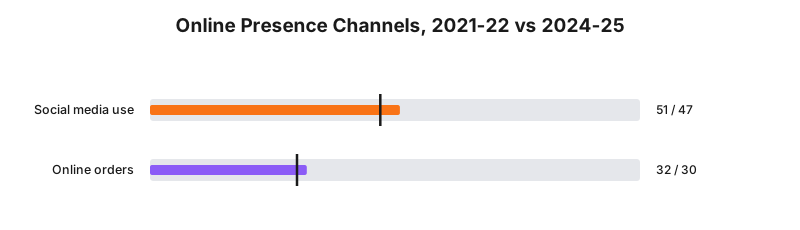
More recent ABS data, from the Characteristics of Australian Business release covering 2024-25, does not repeat the exact “website or not” split by business size. It does show the wider online-presence trend moving up. 51% of Australian businesses used social media for their online presence in 2024-25, up from 47% in 2021-22. 32% of businesses received orders online, similar to 30% in 2021-22. That tells you plenty of businesses without a dedicated website are still building some kind of online presence through social platforms and marketplaces, which is a real channel but a rented one. A Facebook page can be suspended, an algorithm change can bury it, and neither shows up in a Google search the way an owned website does.
Takeaway: social media use is climbing, but it is not a substitute for an owned website that shows up in search and that you actually control.
What This Means for Your Business
If your business sits in that 41.9% to 59% band with no website, the data says three things clearly. First, you are not alone, roughly four to six in ten small operators are in the same position. Second, the businesses that do have a site report real, specific returns: more enquiries, more discoverability, more perceived credibility. Third, the two biggest objections, cost and time, are both more manageable than owners tend to assume once a site is scoped properly rather than built from scratch with no plan.
A website does not need to be complicated to close that gap. It needs to load fast, show up when someone searches your business name or your trade plus your suburb, and make it easy for a customer to contact you. Get those three things right and you are already ahead of a large share of the businesses still counted in the “no website” column.
Get Your Business Off the No-Website List
If you are one of the 41.9% still weighing whether a website is worth it, talk to us before you spend another quarter without one. RockingWeb has built fast, search-ready sites for Rockingham and Perth-area businesses for 16 years, and we can scope exactly what your business needs, no more, no less. See how we build websites for local businesses or get in touch to talk through your project.
Sources
- Australian Bureau of Statistics. IT Use and Innovation in Australian Business, 2013-14 financial year (released June 2015).
- Australian Bureau of Statistics. Characteristics of Australian Business, 2024-25 financial year.
- GoDaddy. Study reveals why 59% of Australian small businesses don’t have a website, 2019 (YouGov Galaxy survey, n=425).
Vikas Thakur
Founder of RockingWeb. 16 years of experience from working at TPG, iiNet and Monadelphous, now building websites, software and digital marketing for local businesses in Rockingham and Perth.