$165.6M by 2030: Teledentistry Statistics Australia
Australia's teledentistry market is forecast to reach US$165.6 million by 2030, growing 16.3% a year, according to Grand View Research. Here is the full data on rural access, COVID-era adoption, and what it means for a dental clinic's website.
 Vikas Thakur Founder, RockingWeb 10 min read
On this page 8
- Key takeaways
- How Big Is Australia’s Teledentistry Market
- Why Rural and Remote Patients Are Driving Demand
- The Real Cost of Skipping Dental Care
- COVID-19 Pushed Australian Dentistry Onto Video Calls
- What the Advertising Rules Mean for a Teledentistry Booking Page
- What This Means for Your Clinic’s Website
- Talk to RockingWeb About Your Dental Practice’s Website
Key takeaways
- Australia’s teledentistry market is forecast to reach US$165.6 million by 2030, growing at 16.3% a year from 2025, according to Grand View Research
- The global teledentistry market was worth US$2.02 billion in 2024 and is projected to hit US$6.41 billion by 2032, per Verified Market Reports
- Around 7 million Australians, 28% of the population, live in a rural or remote area, according to a 2022 scoping review in the Australian Journal of Rural Health
- Dentist availability falls from 56.7 full-time-equivalent dentists per 100,000 people in major cities to just 18.8 in very remote areas, per the Australian Dental Association
- 7.1% of people in outer regional and remote Australia were on a public dental waiting list in 2024-25, more than double the 3.2% rate in major cities, per the ABS
- 16.1% of Australians delayed or avoided dental care because of cost in 2024-25, down slightly from 17.6% the year before, per the ABS
- Only 53.9% of Australians saw a dental professional at all in 2024-25, according to the ABS Patient Experiences survey
- Teledentistry use in Australia “surged” during COVID-19, with a documented shift from asynchronous to synchronous consultations, per a 2022 scoping review of 25 studies
Australia’s teledentistry market is forecast to reach US$165.6 million by 2030, growing at 16.3% a year from 2025, according to Grand View Research. That is real money chasing a real gap. Outer regional and remote patients are more than twice as likely to sit on a public dental waiting list as someone in a capital city, 7.1% against 3.2%, per the ABS. Dentist numbers tell the same story from a different angle: capital cities have 56.7 full-time-equivalent dentists per 100,000 people, very remote areas have 18.8, according to the Australian Dental Association. Close to 7 million Australians, 28% of the population, live somewhere inside that gap.
Teledentistry will not put more chairs or more hands in a remote town. What it changes is who gets triaged first, how a practice screens new patients before they travel, and what a clinic’s website has to do before a patient ever reaches reception. This post lays out the numbers behind Australia’s teledentistry shift: market size, the access gap driving it, what happened during COVID-19, and what any of it means for a dental practice’s booking page.
How Big Is Australia’s Teledentistry Market
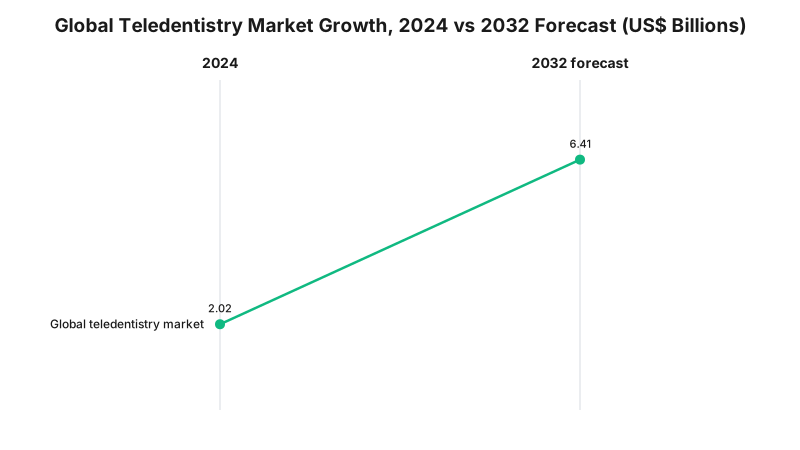
Grand View Research puts Australia’s teledentistry market on track for US$165.6 million by 2030, a 16.3% compound annual growth rate across the 2025 to 2030 forecast window. That is a market research firm’s projection, not a government count, so treat it as an estimate rather than an audited figure. It sits alongside a much larger global trend: Verified Market Reports puts the worldwide teledentistry market at US$2.02 billion in 2024, forecast to reach US$6.41 billion by 2032 at a 15.52% CAGR. A separate estimate from Grand View Research lands close to the same 2024 starting point, in the region of US$2.0 billion, which is a reasonable degree of agreement between two independent research firms on where the global market sits today.
| Market | Base value | Forecast value | Forecast year | CAGR | Source |
|---|---|---|---|---|---|
| Australia (teledentistry) | Not separately published | US$165.6 million | 2030 | 16.3% (2025-2030) | Grand View Research |
| Global (teledentistry) | US$2.02 billion (2024) | US$6.41 billion | 2032 | 15.52% (2025-2032) | Verified Market Reports |
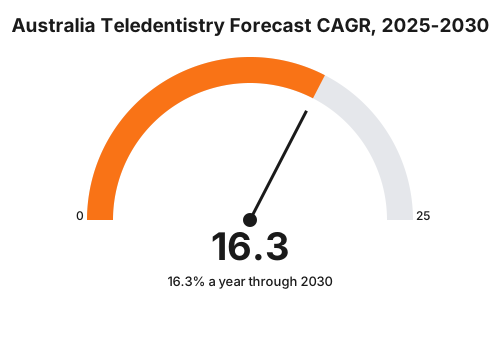
A 16.3% annual growth rate is fast for a category most Australian dental patients have still never used. It tracks with a wider pattern in Australian healthcare: telehealth spread quickly through general practice and specialist care after 2020, and dentistry is following the same curve a few years behind.
Takeaway: the dollar figures are still small next to the broader dental market, but the growth rate says teledentistry is moving from a pandemic workaround to a standing part of how Australian dental care gets delivered.
Why Rural and Remote Patients Are Driving Demand
Teledentistry demand is not evenly spread. It concentrates wherever a patient’s nearest dentist is a long drive away, and Australia has a lot of those postcodes. The Australian Dental Association’s own workforce figures show why: 56.7 full-time-equivalent dentists per 100,000 people in major cities, falling to 34.6 in outer regional areas, 26.6 in remote areas, and 18.8 in very remote areas.
| Location | Dentists per 100,000 people (FTE) |
|---|---|
| Major cities | 56.7 |
| Outer regional | 34.6 |
| Remote | 26.6 |
| Very remote | 18.8 |
Source: Australian Dental Association, workforce data.
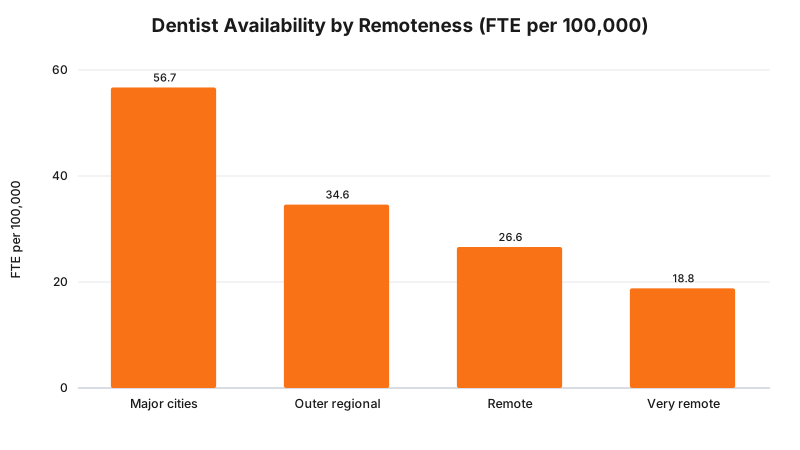
That workforce gap sits on top of a population that is genuinely large in absolute terms, not a rounding error. Roughly 7 million Australians, 28% of the total population, live in a rural or remote region, according to a 2022 scoping review published in the Australian Journal of Rural Health. A single video consult cannot replace a filling or an extraction, but it can triage which of those 7 million people needs to travel this week and which can wait, or be treated closer to home with guidance from a distant clinician.
Takeaway: the case for teledentistry in Australia is not hypothetical. It is a straightforward response to a documented, three-to-one drop in dentist availability between major cities and very remote areas.
The Real Cost of Skipping Dental Care
Access gaps show up in patient behaviour long before they show up in a market forecast. The ABS’s 2024-25 Patient Experiences survey found only 53.9% of Australians saw a dental professional at all that year, similar to 53.2% in 2023-24. Cost is a big part of why: 16.1% of people delayed or avoided dental care because of cost in 2024-25, down from 17.6% the year before but still meaningfully higher than the equivalent figures for GP or specialist care.
| Indicator | 2023-24 | 2024-25 | Source |
|---|---|---|---|
| Saw a dental professional | 53.2% | 53.9% | ABS Patient Experiences |
| Delayed/avoided care due to cost | 17.6% | 16.1% | ABS Patient Experiences |
| On a public dental waiting list, outer regional/remote | Not separately published | 7.1% | ABS Patient Experiences |
| On a public dental waiting list, major cities | Not separately published | 3.2% | ABS Patient Experiences |
The waiting-list split by remoteness is the sharpest number in the whole dataset: 7.1% of people in outer regional and remote areas were on a public dental waiting list in 2024-25, against 3.2% in major cities. People in the most disadvantaged areas nationally sat at 9.9%, against 1.3% in the least disadvantaged areas. None of these figures are teledentistry statistics on their own. They are the access problem teledentistry is being built to soften, and they explain why a growing share of dental marketing budgets is starting to talk about remote consultations at all.
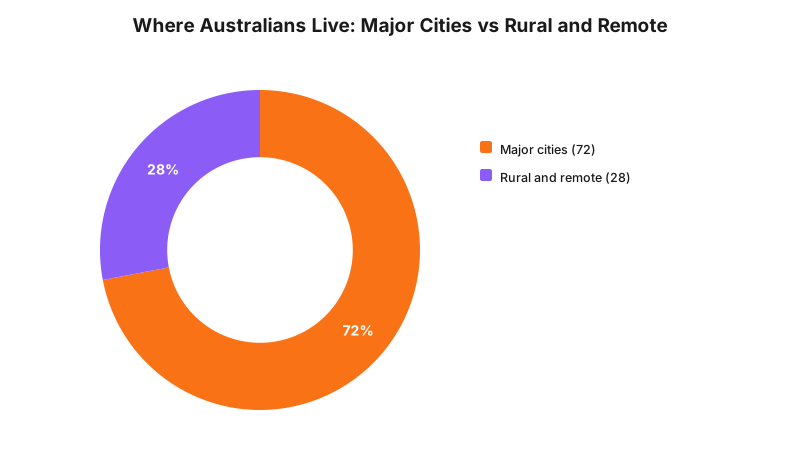
Put another way, more than a quarter of the population sits in the part of that first chart with the fewest dentists, which is exactly the group most likely to be waiting on a public list right now.
Takeaway: cost and distance are still the two biggest reasons Australians skip dental care, and both are the exact pressure points teledentistry is designed to relieve.
COVID-19 Pushed Australian Dentistry Onto Video Calls
Australian teledentistry did not grow steadily from a standing start. It jumped. A 2022 scoping review by Poirier, Jensen and Sethi, published in the Australian Journal of Rural Health, reviewed 25 Australian studies drawn from 758 identified articles and documented “a recent surge in the use of teledentistry services in Australia” that paralleled the COVID-19 pandemic. The same review found a shift in modality: Australian teledentistry moved from mostly asynchronous methods, such as store-and-forward photos reviewed later by a clinician, toward more synchronous, live video consultations in the period after the pandemic began.
That shift matters for what a practice actually needs to build. Asynchronous teledentistry only needs a way to collect and review photos securely. Synchronous teledentistry needs live video booking, identity checks and a consult flow that holds up to the same scrutiny as an in-person appointment, which is a materially bigger build than a photo upload form.
Takeaway: the pandemic did not just create a short-term spike in remote dental consults. It shifted the default mode of Australian teledentistry toward live video, which is the harder, more permanent thing to build well.
What the Advertising Rules Mean for a Teledentistry Booking Page
A teledentistry booking page is still an advertisement for a regulated health service, and every AHPRA-registered dentist sits under the same National Law advertising rules as a cosmetic clinic. That means the same restrictions on testimonials, before-and-after imagery and unrealistic outcome claims apply whether the “before” photo of a smile transformation is being sold for an in-chair procedure or a virtual consult that leads to one. We cover the specific requirements in full in our breakdown of the AHPRA advertising rules for cosmetic dentistry, and they apply in full to teledentistry marketing.
A live-video booking flow adds its own compliance questions on top of the standard rules: what a patient needs to be told before a remote consult substitutes for an in-person exam, how outcome expectations are set for treatment that has not been physically assessed yet, and how identity and informed consent are captured on a page that never sees the patient walk through the door. Most practices building or updating a teledentistry page have not checked their existing site against the current rules at all. Talk to RockingWeb and we will flag exactly where a booking flow, a testimonial, or an outcome claim falls outside the current guidelines before a patient complaint does it first.
Takeaway: teledentistry does not sit outside AHPRA’s advertising rules. It adds a new booking flow that has to satisfy the same rules a static before-and-after gallery does.
What This Means for Your Clinic’s Website
A market growing at 16.3% a year is a market where the practices that build a credible teledentistry offer early get found by patients who are already searching for one. That does not mean bolting a generic video-call widget onto an existing site. It means a booking flow that clearly explains what a remote consult can and cannot do, transparent information about who the consulting dentist is and where they are registered, and a clean path from that first video call to an in-person appointment when one is needed.
Websites built for cosmetic clinics and dental practices need to handle exactly this kind of layered patient journey, remote triage through to in-chair treatment, without losing compliance or conversion at any step. That is a different build brief to a standard dental brochure site, and it is worth getting right while the category is still growing fast enough that most competitors have not built it yet.
Takeaway: the practices that treat teledentistry as a real patient journey, not a bolted-on video widget, are the ones best placed to capture a market growing at double-digit rates every year through 2030.
Talk to RockingWeb About Your Dental Practice’s Website
RockingWeb builds AHPRA-compliant websites for dental and cosmetic clinics across Australia, including the booking flows and compliance groundwork a teledentistry offer needs. If your site is carrying old testimonials, outcome claims, or a booking form that was never built for remote consults, that is worth fixing before AHPRA or a competitor flags it first.
Get in touch to talk through what a compliant teledentistry-ready website looks like for your practice.
Data sources: Grand View Research, Australia Teledentistry Market Size & Outlook (2025-2030 forecast); Verified Market Reports, Teledentistry Market Size and Forecast (2025-2032); Poirier B, Jensen E, Sethi S, “The evolution of the teledentistry landscape in Australia: A scoping review,” Australian Journal of Rural Health, 2022;30(4):434-441; Australian Dental Association workforce data, “The long reach: the oral health challenges of rural and remote dentistry”; Australian Bureau of Statistics, Patient Experiences survey, 2024-25.
Vikas Thakur
Founder of RockingWeb. 16 years of experience from working at TPG, iiNet and Monadelphous, now building websites, software and digital marketing for local businesses in Rockingham and Perth.