Rule of 40 SaaS: Only 15% Hit It in 2026
Only 15% of public SaaS companies cleared the Rule of 40 on EBITDA margin in May 2026, per Aventis Advisors' analysis of 55 listed firms. Switch the profit metric to free cash flow margin and the pass rate nearly triples to 46%. This report breaks down the Rule of 40 by profit definition, by quarter, and by what it is actually worth at exit.
 Vikas Thakur Founder, RockingWeb 9 min read

On this page 11
- Key takeaways
- Answer Capsule
- Introduction
- What the Rule of 40 Actually Measures
- The Real Pass Rate: 15% on EBITDA, 46% on Free Cash Flow
- Why the Profit Metric You Pick Changes Everything
- Quarter to Quarter, the Pass Rate Swings Wildly
- The Score Itself Is Usually Nowhere Near 40
- What a Rule of 40 Score Is Worth at Exit
- What This Means for Your SaaS Business
- Sources and References
Key takeaways
- Only 15% of public SaaS companies (8 of 55) cleared the Rule of 40 on EBITDA margin as of May 2026 (Aventis Advisors)
- Swap the profit leg for free cash flow margin on the same 55 companies and the pass rate nearly triples to 46% (25 of 55)
- Companies that clear the Rule of 40 trade at a median 4.8x EV/Revenue, versus 2.7x for companies that miss it (Aventis Advisors)
- Each 10 percentage point rise in FCF-based Rule of 40 score adds roughly 1.0x to a company’s EV/Revenue multiple
- Among SaaS companies that IPO’d since October 2017, the pass rate swung from 28% to 38% to 64% across three straight quarters in 2025 (Blossom Street Ventures)
- The median Rule of 40 score across that same cohort ranged from just 6% to 18% through 2025, well short of the 40 target
- Median year-on-year revenue growth across 45 non-distressed public SaaS companies was 22% in Q1 2026 (Blossom Street Ventures)
- A Rule of 40 score above 40 is the traditional healthy benchmark; top-quartile public SaaS companies push past 59 (RockingWeb SaaS Metrics Benchmark 2025)
Answer Capsule
Only 15% of 55 public SaaS companies cleared the Rule of 40 on EBITDA margin as of May 2026, per Aventis Advisors. Switch the profit leg to free cash flow margin and the pass rate rises to 46%. The dataset covers global public SaaS companies, mostly US-listed.
Introduction
Only 15% of public SaaS companies cleared the Rule of 40 in May 2026.
That’s eight companies out of 55 tracked by M&A advisory firm Aventis Advisors, using EBITDA margin as the profit leg of the equation.
Founders quote the Rule of 40 in every board deck. Investors use it to filter deals in seconds.
But the metric hides a trap: swap EBITDA margin for free cash flow margin on the exact same 55 companies, and the pass rate nearly triples to 46%.
The businesses didn’t get more efficient overnight. The definition changed.
This report pulls together two separate datasets, from two different research firms, tracking the Rule of 40 from 2023 through 2026, so you know exactly which version of the number your board is actually asking about.
What the Rule of 40 Actually Measures
The Rule of 40 says a healthy SaaS company’s revenue growth rate plus its profit margin should add up to 40 or more. Grow 30% a year with a 10% margin and you clear it. Grow 60% a year while burning cash at a 25% margin and you still clear it, because the two numbers offset.
The catch sits in that second half of the equation. “Profit margin” isn’t one number. Analysts use EBITDA margin, free cash flow margin, or GAAP operating margin interchangeably, and the three produce wildly different scores for the same company. A business with heavy depreciation or working-capital swings can pass on one basis and fail on another in the same quarter.
That ambiguity is why two credible datasets, covering roughly the same universe of public SaaS companies, can report pass rates that look nothing alike.
Takeaway: before you quote a Rule of 40 number in a board meeting, ask which profit metric it’s built on. The answer changes the story.
The Real Pass Rate: 15% on EBITDA, 46% on Free Cash Flow
M&A advisory firm Aventis Advisors analysed 55 publicly listed SaaS companies as of May 2026, spanning enterprise values from USD 362 million to USD 161 billion (median USD 5.8 billion). The sample includes 48 US-listed companies, three Canadian, three Israeli and one Australian-listed firm.
On an EBITDA-margin basis, only 8 of the 55 companies, 15%, cleared the Rule of 40. On a free-cash-flow-margin basis, using the same 55 companies and the same quarter, 25 of them, 46%, cleared it.
| Profit metric used | Companies clearing Rule of 40 | Pass rate |
|---|---|---|
| EBITDA margin | 8 of 55 | 15% |
| Free cash flow margin | 25 of 55 | 46% |
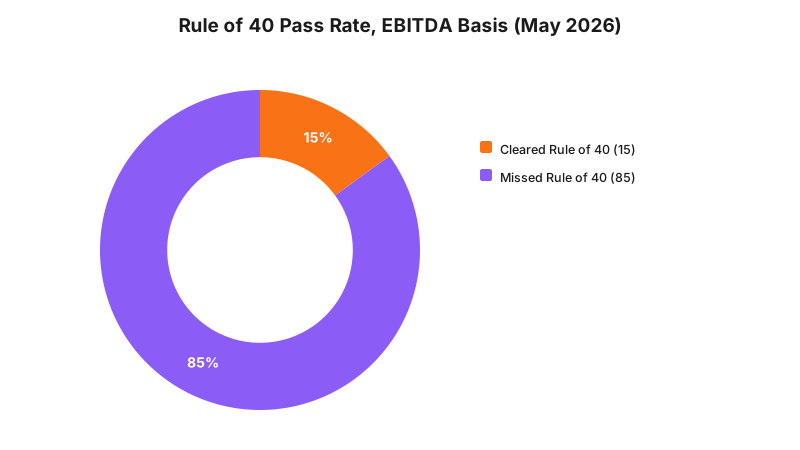
Mean revenue growth across the sample sat at 15.1%, against a mean EBITDA margin of 7.3% and a mean free cash flow margin of 23.0% (Aventis Advisors reports these three figures as means, not medians). That gap between EBITDA and FCF margin is the entire reason the pass rate moves so much between the two methods; free cash flow adds back depreciation and amortisation, both of which are large, structural line items for software companies.
Takeaway: the honest answer to “what percentage of SaaS companies hit the Rule of 40” is “it depends which profit line you use,” and on the stricter EBITDA basis, most don’t come close.
Why the Profit Metric You Pick Changes Everything
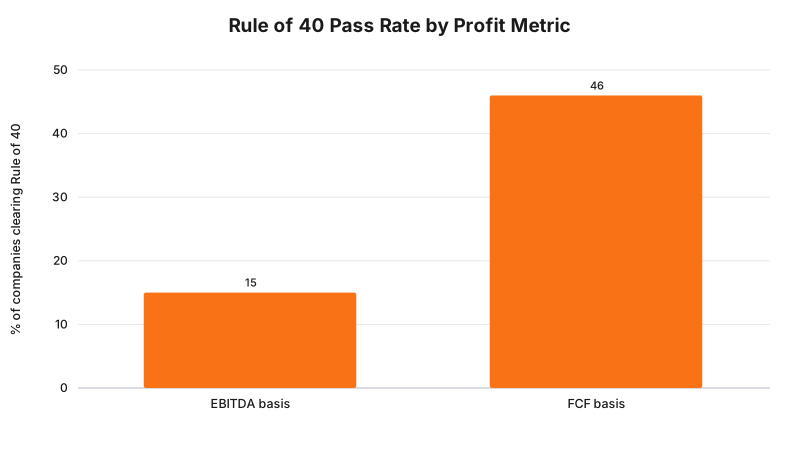
A 31 percentage point gap between two ways of measuring the same 55 companies in the same quarter isn’t a rounding error. It’s a reminder that the Rule of 40 was built as a quick gut-check for growth investors in the 2010s, not a precise accounting standard.
If your board or your acquirer quotes a Rule of 40 target, ask them to specify the formula before you spend a quarter chasing it. A company optimising for EBITDA margin makes different decisions (cutting headcount, deferring investment) than one optimising for free cash flow (managing working capital, collecting receivables faster). Both can technically claim they’re “fixing the Rule of 40.”
Takeaway: know which formula is in your investor deck before you build a plan around hitting 40.
Quarter to Quarter, the Pass Rate Swings Wildly
A second dataset, from Blossom Street Ventures, tracks a different but overlapping group: public SaaS companies that IPO’d since October 2017. This cohort is smaller and more growth-stage than Aventis Advisors’ broader sample, and its quarterly Rule of 40 pass rate has been anything but stable.
| Quarter | Companies tracked | Achieving Rule of 40 or better | Median score |
|---|---|---|---|
| Q2 2025 | 60 | 28% (17 companies) | 12% |
| Q3 2025 | 57 | 38% (21 companies) | 11% |
| Q4 2025 | 47 | 64% (30 companies) | 18% |
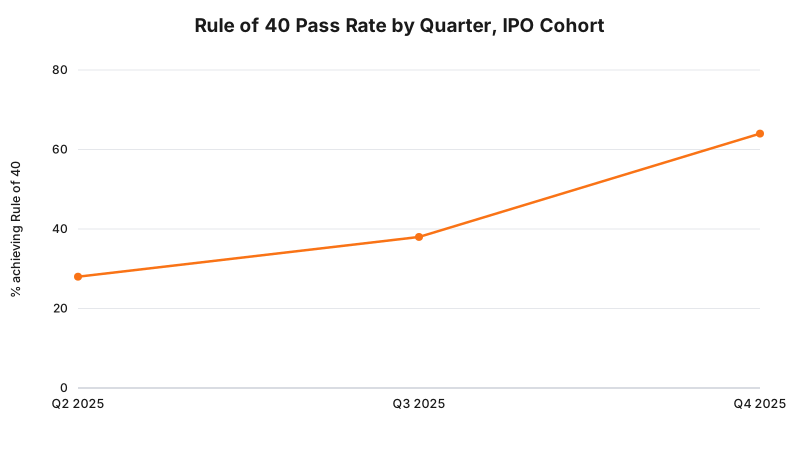
Part of that jump is real improvement: Blossom Street Ventures notes the median score had been “hovering around 11%” for five straight quarters before Q4 2025 pushed it to 18%. Part of it is survivorship: the tracked group shrank from 60 companies to 47 over the same period, as weaker performers got acquired, taken private or delisted, leaving a smaller group of stronger survivors behind.
By Q1 2026, 45 non-distressed companies from the same cohort posted median year-on-year revenue growth of 22%, with average growth at 21%, a meaningfully faster growth backdrop than the sub-15% medians seen through most of 2025.
Takeaway: a single quarter’s pass rate tells you almost nothing on its own. Look at the trend, and check whether the underlying company count changed before you read too much into a jump.
The Score Itself Is Usually Nowhere Near 40
Pass or fail is a blunt way to look at this. The median score itself, growth rate plus profit margin combined, is more revealing, and for most of 2025 it sat far below the 40 target.
| Quarter | Median Rule of 40 Score |
|---|---|
| Q3 2024 | 10% |
| Q4 2024 | 15% |
| Q1 2025 | 6% |
| Q2 2025 | 12% |
| Q3 2025 | 11% |
| Q4 2025 | 18% |
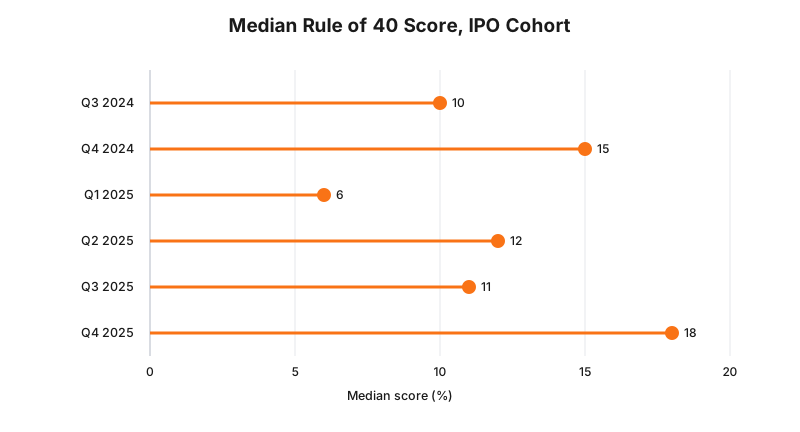
A median score of 6 to 18% across six quarters means the typical company in this cohort is closer to a Rule of 10 than a Rule of 40. That’s a meaningfully different picture from the aspirational framing most founders hear at pitch events.
Takeaway: if your own Rule of 40 score sits in the teens, you’re closer to the actual public-market median than the 40-target headline suggests.
What a Rule of 40 Score Is Worth at Exit
The reason the Rule of 40 survives despite its definitional mess is that it correlates with what the market pays. Aventis Advisors found that companies clearing the Rule of 40 traded at a median 4.8x EV/Revenue, against 2.7x for companies that missed it, after removing seven statistical outliers from the sample.
| Rule of 40 status | Median EV/Revenue multiple |
|---|---|
| Cleared the Rule of 40 | 4.8x |
| Missed the Rule of 40 | 2.7x |
The relationship holds at the margin, not just at the pass/fail line. Each 10 percentage point increase in FCF-based Rule of 40 score adds roughly 1.0x to a company’s EV/Revenue multiple. The EBITDA-based version of the same relationship is weaker, adding roughly 0.7x per 10 points.
Takeaway: the market rewards the free-cash-flow version of the Rule of 40 more than the EBITDA version, which is one more reason to know which formula is driving your own reporting.
What This Means for Your SaaS Business
If your Rule of 40 score sits well under 40, you’re in the majority, not the exception. The public-company medians above put you in good company, whether you’re growth-stage and burning cash or bootstrapped and profitable but slower-growing.
The lever most founders underuse isn’t growth or margin in isolation, it’s the cost structure behind both. A leaner, more efficiently built product needs less engineering headcount to maintain, which lifts margin without slowing growth, the exact combination the Rule of 40 rewards. That’s the kind of work RockingWeb does for SaaS founders rebuilding or scaling their product.
If you want to see how your own growth rate and margin translate into a Rule of 40 score and an estimated valuation multiple, run your numbers through our SaaS valuation calculator. If you’re weighing whether your engineering costs are dragging your margin down, book a consultation or look at our SaaS development services to see where a leaner build could move your number.
For the fuller metrics picture beyond Rule of 40 alone, our SaaS metrics benchmark report covers NRR, gross margin and 47 other KPIs across 2,000-plus companies, and our SaaS CAC payback benchmarks cover the acquisition-cost side of the same efficiency equation.
Sources and References
- Aventis Advisors, Rule of 40 in SaaS: 2026 Data, Benchmarks and Valuation Impact, data as of May 2026, n=55 publicly listed SaaS companies
- Blossom Street Ventures, Q2 2025 Rule of 40 Data in Public SaaS, n=60 companies IPO’d since October 2017
- Blossom Street Ventures, Q3 2025 Rule of 40 Data from Publics, n=57 companies
- Blossom Street Ventures, SaaS Companies Got Much Closer to Rule of 40 in Q4, n=47 companies
- Blossom Street Ventures, Q1 2026 SaaS Data Shows Improving Profitability and Steady Growth, n=45 companies
Note: this is a global public-markets dataset, mostly US-listed companies, with one Australian-listed company in the Aventis Advisors sample. No Australia-specific Rule of 40 benchmark of comparable scale currently exists, so treat these figures as international context rather than a local Australian benchmark.
Vikas Thakur
Founder of RockingWeb. 16 years of experience from working at TPG, iiNet and Monadelphous, now building websites, software and digital marketing for local businesses in Rockingham and Perth.