101% Median NRR: SaaS Retention Benchmarks 2025 Revealed
Median net revenue retention for private SaaS companies hit 101% in 2025, confirmed by two independent surveys of over 1,000 companies. This report breaks NRR down by contract size, funding source, and valuation multiple, using SaaS Capital, Benchmarkit, and Software Equity Group data.
 Vikas Thakur Founder, RockingWeb 8 min read
Key takeaways
- Median private SaaS NRR sits at 101% in 2025, confirmed by two independent surveys covering more than 1,000 companies (SaaS Capital, Benchmarkit)
- Gross revenue retention (GRR) trails at 91%, the churn-only floor SaaS Capital calls “table stakes” for staying competitive
- NRR climbs with contract size: sub-$12k ACV deals average 98% NRR, while contracts above $250k average 106%
- Growth compounds with retention: SaaS companies above 130% NRR post a 50% median growth rate, more than 3x the 15% rate for companies under 90% NRR
- Bootstrapped SaaS companies out-retain VC-backed peers, 104% NRR versus 101% for equity-backed businesses
- Public SaaS companies below 100% NRR trade at 3.1x EV/revenue, versus 9.3x for those above 120% NRR, a 63% premium to the index median of 5.7x
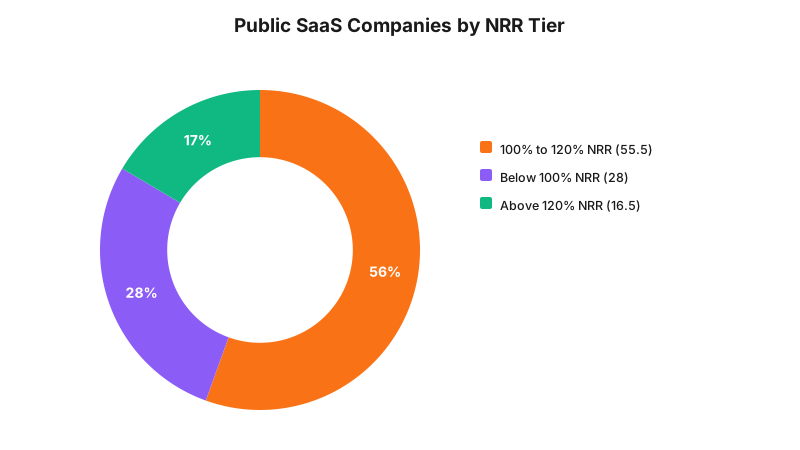
- Only 16.5% of public SaaS companies clear 120% NRR, the level that correlates with premium valuation multiples
- Multi-year contracts retain best: 103% NRR and 94% GRR, against 100% NRR and 89% GRR for month-to-month deals
Median net revenue retention for 1,000+ private US and Canadian B2B SaaS companies is 101% in 2025, per SaaS Capital. Benchmarkit’s independent 2025 report confirms the same 101% median. Public SaaS companies with NRR above 120% trade at 9.3x revenue, per Software Equity Group’s Q2 2024 SaaS Index.
101% net revenue retention. That is the median for private B2B SaaS companies in 2025, according to SaaS Capital’s 14th annual survey of more than 1,000 businesses, and confirmed independently by Benchmarkit’s own 2025 benchmark report. If your NRR sits below that number, the growth data further down shows you are already behind. Above 120% NRR, you are in different territory entirely: public SaaS companies at that level trade at a median 9.3x revenue, more than triple the multiple of businesses stuck under 100% (Software Equity Group, Q2 2024). This report breaks NRR down by contract size, funding source, and contract length, then shows exactly how retention maps to growth rate and valuation. Every figure below comes from a named source you can check yourself.
What Counts as Good SaaS NRR in 2025
Net revenue retention measures how much revenue you keep and grow from existing customers over 12 months, including upsells, cross-sells, and price increases, minus churn and downgrades. It can climb past 100% because expansion revenue offsets losses. Gross revenue retention (GRR) strips out the expansion side and only measures what you kept, so it caps at 100%.
SaaS Capital’s 14th annual B2B SaaS Retention Benchmarks report surveyed more than 1,000 private companies with at least $1M ARR in Q1 2025 and found a median NRR of 101% and a median GRR of 91%. Benchmarkit’s separate 2025 SaaS Performance Metrics report, drawn from its own operator community, landed on the same 101% median NRR, independent confirmation from a different survey population.
Among public companies, the picture is more mixed. Software Equity Group’s SEG SaaS Index, tracking 120+ listed software companies, found that 72% of the companies disclosing NRR reported figures above 100%, and 16.5% cleared the 120% mark that tends to draw premium valuations.
| Metric | 2025 Value | Source |
|---|---|---|
| Median NRR, private SaaS | 101% | SaaS Capital / Benchmarkit |
| Median GRR, private SaaS | 91% | SaaS Capital |
| Public companies above 100% NRR | 72% | Software Equity Group, Q2 2024 |
| Public companies above 120% NRR | 16.5% | Software Equity Group, Q2 2024 |
A 101% NRR is the new average, not the new good. Benchmark against your own contract size before you decide whether your number is a problem.
NRR by Contract Size (ACV)
Retention is not one number across the whole market. SaaS Capital found that companies with higher average contract values (ACV) consistently retain better, because bigger deals come with longer sales cycles, deeper implementation, and dedicated account management, all of which make a product stickier.
| ACV band (USD) | Median NRR | Median GRR |
|---|---|---|
| Under $12,000 | 98% | 90% |
| $12,000 to $25,000 | 103% | 91% |
| $25,000 to $50,000 | 102% | 91% |
| $50,000 to $100,000 | 104% | 90% |
| $100,000 to $250,000 | 102% | 91% |
| Above $250,000 | 106% | 95% |
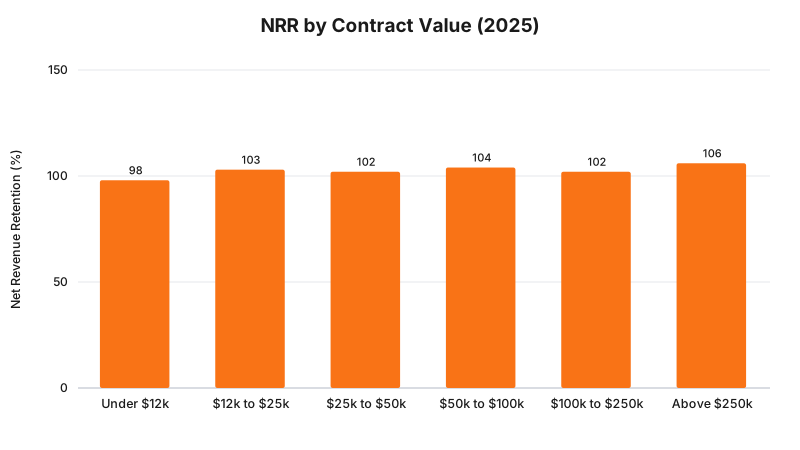
The gap is widest at the extremes. Sub-$12k ACV businesses sit two points below the market median, while contracts above $250k post the highest retention in the survey on both metrics. SaaS Capital’s report also breaks NRR into quartiles by ACV band: the gap between the 25th and 75th percentile is widest in the $12,000 to $25,000 range, meaning that band has the most variability between its best and worst performers. Higher-ACV bands show tighter quartile ranges alongside higher medians, so expansion gets both bigger and more predictable as contract size grows.
Higher-priced SaaS products retain better across the board. If your ACV sits under $25k, expect more retention volatility than the headline number suggests.
Retention Compounds Into Growth
SaaS Capital calls this the “leaky bucket” metaphor: the higher your retention, the less new revenue you need just to refill what leaked out, so more of every new sale compounds instead of merely replacing what left. Across the full 2025 survey, the median growth rate was 24%, but that number splits sharply once you sort by NRR band.
| NRR band | Median growth rate |
|---|---|
| Below 90% | 15% |
| 90% to 100% | 16% |
| 100% to 110% | 21% |
| 110% to 120% | 30% |
| 120% to 130% | 38% |
| Above 130% | 50% |
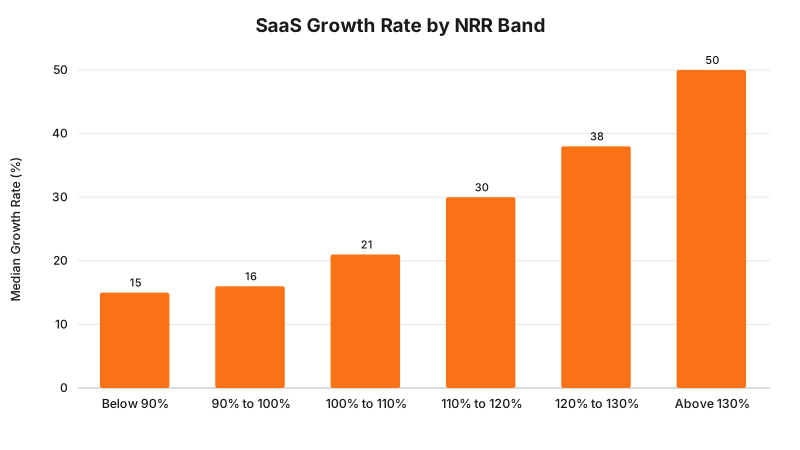
Moving from the 100 to 110% band into 110 to 120% lifts growth by 9 percentage points on its own, without spending an extra dollar on new customer acquisition. SaaS Capital’s report calls this a rare example of increasing returns from investment in upsells and cross-sells, the kind of compounding effect where retention gains keep paying off year after year rather than plateauing.
Companies above 130% NRR grow more than 3x faster than companies under 90%, and none of that extra growth came from a bigger sales team.
Funding Source and Contract Length Change the Number
Two structural factors move NRR beyond product quality alone: how a company is funded, and how long its contracts run.
| Segment | Median NRR | Median GRR |
|---|---|---|
| Bootstrapped | 104% | 92% |
| Equity-backed | 101% | 90% |
| Multi-year contracts | 103% | 94% |
| Annual contracts | 101% | 90% |
| Month-to-month contracts | 100% | 89% |
Bootstrapped companies out-retain equity-backed ones by 3 points of NRR and 2 points of GRR. SaaS Capital’s report frames this as a reversal: VC-backed companies historically retained better on both metrics, and it attributes the shift to customer success best practices becoming standard across the market rather than staying a VC-only advantage. Contract length shows a cleaner pattern: multi-year deals lock in the best retention on both metrics, annual contracts sit right at the market median, and month-to-month plans trail on both, unsurprising given how easy they are to cancel.
Longer contracts and self-funded discipline both push retention higher. Neither replaces a product customers actually want to keep paying for.
NRR and Your Company’s Valuation Multiple
This is where retention stops being an internal metric and starts setting your price tag. Software Equity Group’s SaaS Index tracks EV/TTM revenue multiples against NRR across 120+ public software companies, and the spread is wide.
| NRR tier (public SaaS) | Median EV/revenue multiple |
|---|---|
| Below 100% NRR | 3.1x |
| Index median | 5.7x |
| Above 120% NRR | 9.3x |
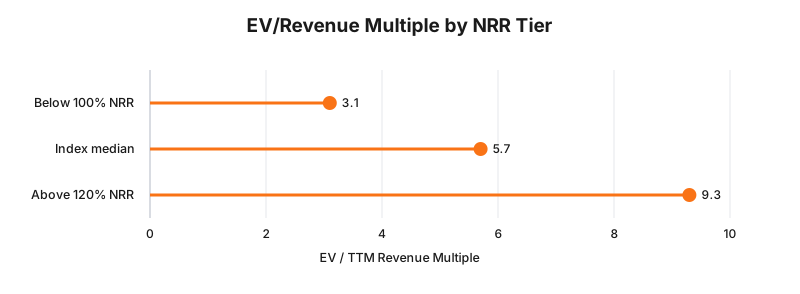
Companies below 100% NRR trade at a 46% discount to the index median. Companies above 120% trade at a 63% premium. Two large public SaaS names show how wide that range gets in practice. Snowflake reported a 126% net revenue retention rate for the quarter ended April 30, 2026, and was trading at roughly 22.7x EV/TTM revenue as of August 2026, per stockanalysis.com, comfortably inside the premium tier. GitLab reported 117% net revenue retention over the same quarter, just under the 120% cutoff, and was trading at roughly 5.5x EV/TTM revenue, per stockanalysis.com, close to the index median rather than the premium tier. NRR alone does not set the multiple; growth rate, margins, and market sentiment all weigh in too.
If you want to see where your own ARR, growth rate, and NRR put you against these public and private benchmarks, run the numbers through RockingWeb’s SaaS Valuation Calculator, which uses the same SaaS Capital and comparable-transaction methodologies referenced throughout this report.
NRR is not just an operating metric. It is priced directly into what a buyer or investor will pay for your business.
Frequently Asked Questions
What is a good net revenue retention rate for SaaS in 2025?
101% is the current median for private B2B SaaS companies, per SaaS Capital and Benchmarkit. Anything above 110% is strong, and 120%+ puts you in the top tier that public markets pay a premium multiple for.
What is the difference between net revenue retention and gross revenue retention?
Net revenue retention (NRR) includes upsells and cross-sells alongside churn, so it can exceed 100%. Gross revenue retention (GRR) strips out expansion revenue and caps at 100%, measuring pure churn. The 2025 median is 101% NRR against 91% GRR.
Does net revenue retention affect SaaS company valuation?
Yes. Public SaaS companies with NRR below 100% trade at a median 3.1x EV/revenue, versus 9.3x for companies above 120% NRR, a 63% premium to the index median of 5.7x, according to Software Equity Group.
For the wider set of 2025 SaaS benchmarks beyond retention, including CAC payback, Rule of 40, and burn multiples, see our full SaaS metrics benchmark report.
Want a clearer picture of where your own retention and growth numbers sit? Run them through RockingWeb’s free SaaS Valuation Calculator and see the multiple they translate to.
Vikas Thakur
Founder of RockingWeb. 16 years of experience from working at TPG, iiNet and Monadelphous, now building websites, software and digital marketing for local businesses in Rockingham and Perth.