Micro-SaaS Failure Rate: 87% Never Reach $10M ARR
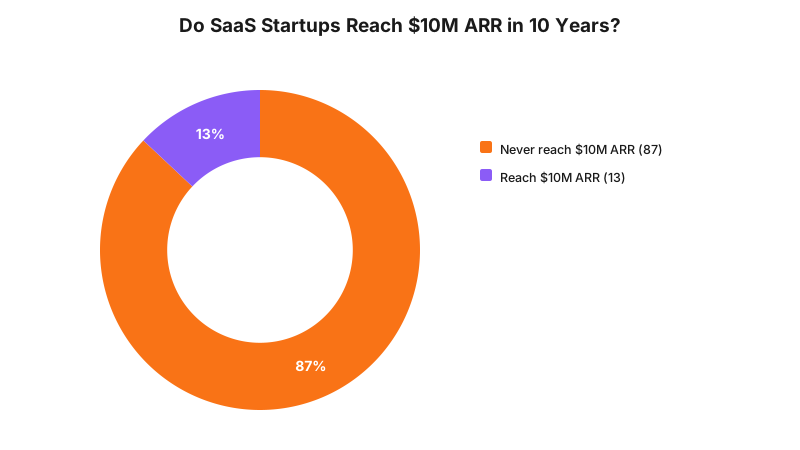
Only 13% of SaaS startups reach $10M ARR within 10 years, according to ChartMogul's analysis of 2,200+ SaaS businesses. Here is what that 87% failure-to-scale rate means for solo-founder micro-SaaS products.
 Vikas Thakur Founder, RockingWeb 8 min read
On this page 11
Key takeaways
- Only 13% of SaaS startups reach $10M ARR within 10 years, meaning 87% never scale that far, per ChartMogul’s analysis of 2,200+ SaaS businesses (data through June 2023).
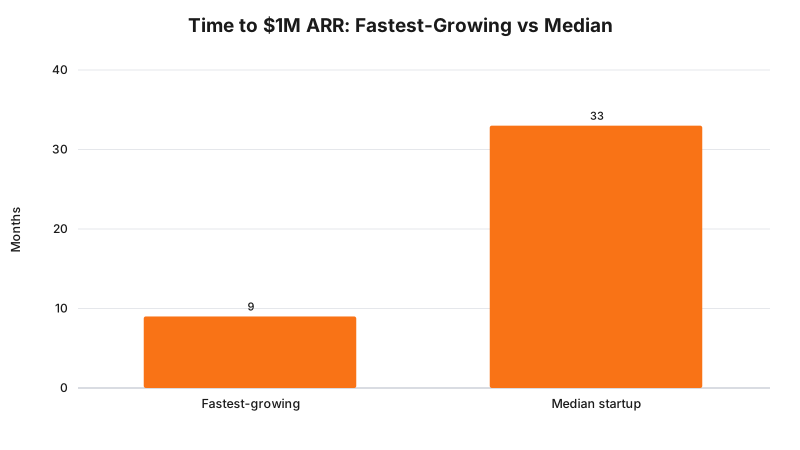
- The median SaaS startup takes 2 years 9 months to reach $1M ARR. The fastest-growing companies do it in 9 months, a 3.7x speed gap.
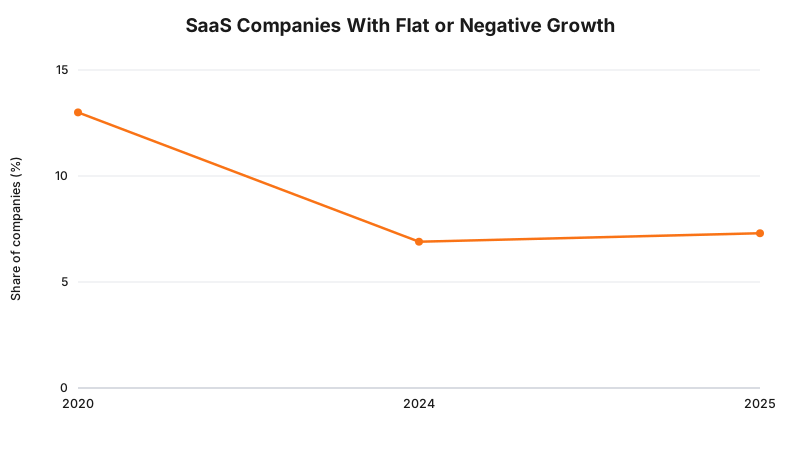
- 7.3% of private B2B SaaS companies reported flat or negative growth in 2025, up from 6.9% in 2024, per SaaS Capital’s 14th annual survey of 1,000+ companies.
- Median annual growth for private SaaS companies fell to 22% in 2025, down from 25% in 2024, according to the same SaaS Capital survey.
- Bootstrapped SaaS companies grew a median 20% in 2025 versus 25% for equity-backed companies, a 5-point gap.
- SaaS companies with net revenue retention above 100% grew a median 54% over 12 months, versus just 12% for companies stuck at 60-80% NRR (ChartMogul).
- Australia recorded a 13.9% business exit rate (370,500 exits) against a 16.4% entry rate (437,150 entries) in 2024-25, according to the Australian Bureau of Statistics.
Answer Capsule
Only 13% of SaaS startups reach $10M ARR within a decade, according to ChartMogul’s 2023 analysis of 2,200+ SaaS businesses worldwide. That 87% shortfall, not a dramatic shutdown, is how most micro-SaaS products fail.
The Failure Nobody Posts About
87% of SaaS startups never reach $10M ARR, even after a decade in business.
That is the finding from ChartMogul’s analysis of more than 2,200 SaaS companies, and it should worry anyone who thinks micro-SaaS failure means a dramatic shutdown announcement on X. It rarely does.
Here’s the thing: most micro-SaaS products do not die in a blaze of “we’re shutting down” tweets, they just stop growing. A founder builds something, gets a trickle of paying customers, and then watches monthly recurring revenue flatline at $400 or $800 for a year while a day job pays the bills.
That flatline is the real failure rate, and it never shows up in the startup graveyard databases people love to screenshot.
This post breaks down what the verified data says about SaaS survival, growth speed, and the retention numbers that separate the products that keep climbing from the ones that stall for good.
What Micro-SaaS Failure Actually Looks Like
Micro-SaaS is not a formal category with its own government statistics agency tracking it. It is a solo or two-person SaaS product, usually bootstrapped, usually built and marketed by the same person who wrote the code.
Because of that, there is no single “micro-SaaS failure rate” published anywhere with a clean methodology behind it. What exists instead is SaaS-wide growth and survival data, and it applies to micro-SaaS with extra force. A funded startup with a sales team and a marketing budget still has an 87% chance of never reaching $10M ARR. A solo founder with zero budget and a few hours a week faces the same growth maths with far fewer resources to fight it.
Treat “failure” here as two separate outcomes, not one:
- Shutdown: the product gets turned off, refunds go out, the domain expires.
- Stall: the product stays live indefinitely at a revenue level too low to replace a salary, sometimes for years.
Stall is the more common outcome, and it is the one the milestone data below measures.
Takeaway: most micro-SaaS products do not die, they plateau, and that plateau is where the real failure rate hides.
The $10M ARR Ceiling
ChartMogul’s SaaS Growth Report tracked benchmark data across 2,200+ SaaS businesses, with growth figures calculated over the 12 months ending June 2023. One number from that dataset stands out for anyone measuring startup survival: only 13% of startups that set out to scale ever reach $10M ARR, even given a full 10 years to do it.
| Milestone | Fastest-growing | Median | Source |
|---|---|---|---|
| Time to $1M ARR | 9 months | 2 years 9 months | ChartMogul, 2023 |
| Reach $10M ARR within 10 years | N/A | 13% do (87% do not) | ChartMogul, 2023 |
| Annual growth, $1-3M ARR (top decile) | 192% | N/A | ChartMogul, 2023 |
| Annual growth, $1-30M ARR (top quartile) | 60-70% | ~30% | ChartMogul, 2023 |
Notice the gap between the fastest-growing companies and the median company. The businesses that do scale are not growing a little faster than average, they are growing multiples faster. A median startup needs almost three years to hit $1M ARR. The fastest ones do it in nine months, before most micro-SaaS founders have even quit their day job.
Takeaway: the 87% figure is not a fringe outcome, it is the median outcome. Reaching real scale is the exception, not the rule.
SaaS Growth Is Slowing Industry-Wide
The $10M ARR ceiling is not a one-off finding. SaaS Capital’s 14th annual growth benchmarks survey, covering more than 1,000 private B2B SaaS companies, shows the same pattern from a different angle: fewer companies growing fast, and more of them stuck.
Median annual growth across the whole survey fell to 22% in 2025, down from 25% the year before. More tellingly, the share of companies reporting flat or negative growth crept up to 7.3% in 2025, from 6.9% in 2024. Both are still well below the 13% flat-or-negative peak recorded during 2020, but the direction in 2025 is the wrong one.
For a micro-SaaS founder, this matters because it sets the baseline difficulty. If growth is getting harder for funded, staffed B2B SaaS companies with dedicated marketing budgets, it is not getting easier for a solo founder running ads out of pocket.
Takeaway: the industry-wide growth slowdown means 2026 is not a forgiving year to coast on organic traffic alone.
Bootstrapped vs Funded: Who Grows Faster
SaaS Capital’s survey also splits results by funding status, and the gap is real but smaller than most founders assume. Bootstrapped companies posted a median growth rate of 20% in 2025, against 25% for equity-backed companies, a 5-point difference.
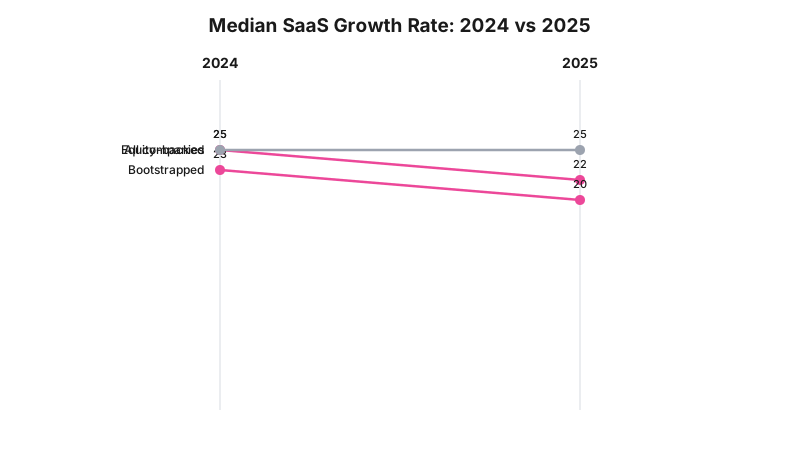
Equity-backed companies held steady at 25% growth across both years. Bootstrapped companies lost 3 points, dropping from 23% to 20%. Cash reserves and a sales team buy some insulation from a slowing market. Most micro-SaaS founders do not have either, which is exactly why the flat-or-negative segment of the market matters more to them than the headline median.
Takeaway: funding buys stability, not immunity, but bootstrapped founders absorb a slowdown with less cushion.
Retention Beats Acquisition
The clearest signal in the whole dataset is net revenue retention, and it is where ChartMogul’s numbers matter most for a micro-SaaS founder deciding where to spend limited hours.
Companies with NRR above 100%, meaning existing customers spend more over time than they lose to churn and downgrades, grew a median 54% over 12 months. Companies stuck at 60-80% NRR grew just 12% in the same period. That is more than a 4x growth gap explained by retention alone, with no new customer acquisition required to produce it.
| Net revenue retention band | Median 12-month growth |
|---|---|
| 60-80% NRR | 12% |
| Above 100% NRR | 54% |
For a solo founder with no marketing budget, this is the single most useful number in the whole post. Fixing churn and finding expansion revenue among existing customers moves growth further than almost anything spent on new customer acquisition.
Takeaway: a leaky bucket beats every acquisition tactic. Fix retention before spending another dollar on ads.
The Australian Angle
Australia does not publish a SaaS-specific failure rate, but the Australian Bureau of Statistics does track business entries and exits economy-wide. In 2024-25, the ABS recorded 437,150 new business entries (a 16.4% entry rate) against 370,500 exits (a 13.9% exit rate).
That national exit rate covers every industry, not just software, so it is not a substitute for a SaaS-specific figure. It is still useful context: even in a broad, mixed economy, more than 1 in 8 businesses closed within the year. A micro-SaaS product competing globally, against faster-growing overseas rivals, faces a tougher version of that same pressure.
Takeaway: Australian founders are not exempt from the global SaaS growth slowdown. If anything, smaller domestic reach makes retention and speed-to-revenue matter more, not less.
What Moves a Micro-SaaS Off the Plateau
Nothing in this data says micro-SaaS is a bad idea. It says the growth curve is unforgiving and the founders who beat it treat retention, not acquisition, as the first lever to pull.
If your product has been sitting at the same MRR for two quarters, that is the 87% pulling you toward the plateau, not a signal that the idea failed. The founders who break out do three things differently: they fix retention before scaling spend, they measure growth in months not vibes, and they build on infrastructure that does not need a rebuild the moment paying customers show up.
That last part is where a lot of technical debt gets baked in early and never gets paid off. If your product’s architecture is the thing standing between you and the next growth stage, our SaaS development team builds and rebuilds micro-SaaS products for founders who are past the idea stage and need the technical foundation to match their growth ambitions.
Sources
- ChartMogul. (2023). “SaaS Growth Report.” Analysis of 2,200+ SaaS businesses, benchmarks calculated over the 12 months ending June 2023.
- SaaS Capital. (2026). “2026 Private B2B SaaS Company Growth Rate Benchmarks.” 14th annual survey of 1,000+ private B2B SaaS companies.
- Australian Bureau of Statistics. (2025). “Counts of Australian Businesses, including Entries and Exits.” 2024-25 financial year data.
Vikas Thakur
Founder of RockingWeb. 16 years of experience from working at TPG, iiNet and Monadelphous, now building websites, software and digital marketing for local businesses in Rockingham and Perth.