The Clinic URL Structure Google Actually Recommends
Google's Search Central guidance, updated 10 December 2025, says use descriptive folders and hyphens instead of query strings or ID numbers. Here is the exact clinic URL pattern for treatments, locations and practitioner pages that follows it, and where it turns into a spam risk if you overbuild it.
 Vikas Thakur Founder, RockingWeb 13 min read
On this page 11
- Key takeaways
- What Google’s Search Central Guidance Actually Says
- What This Means For Your Site’s Build
- A Worked Example: Two Clinics, Same Fix
- What To Check On Your Own Site
- Does Anyone Enforce This?
- Where This Gets Hard
- Status: Guidance, Not Law
- Frequently Asked Questions
- Need a hand with your website?
- Sources and References
Key takeaways
- Google’s Search Central URL structure guidance, last updated 10 December 2025, recommends descriptive words over ID numbers and hyphens over underscores
- The SEO starter guide, also updated 10 December 2025, says grouping pages into folders “can help Google learn how often the URLs in individual directories change”
- Google’s spam policies page, last updated 15 May 2026, names “multiple domain names or pages targeted at specific regions or cities that funnel users to one page” as doorway abuse, the exact risk in an untested location times treatment URL matrix
- A three folder pattern, /treatments/[name]/, /locations/[name]/ and /practitioners/[name]/, covers a typical multi location cosmetic clinic or dental practice without duplicating content
- Google states the benefit of a clean URL structure “is more valuable for really large sites” and less so for a five or ten page brochure site
- No regulator issues a fine or infringement notice for a bad URL structure. This is search visibility guidance, not a legal obligation
- AHPRA’s registered practitioner cosmetic procedure guidelines, in effect from 2 September 2025, still apply to whatever content sits on a practitioner’s own URL, separately from how that URL is built
Google’s current guidance, last updated 10 December 2025, is to structure a clinic website in descriptive, hyphenated folders: one for treatments, one for locations if the practice has more than one site, and one for practitioners, each holding its own page rather than a shared page behind a query string. That single decision affects how easily Google groups related pages together, and whether a patient searching “anti-wrinkle injections Fremantle” lands on a page built for that exact query or on a generic homepage.
Type a treatment name and a suburb into Google and watch what ranks. It is rarely the clinic with the best injector or the most reviews. It is usually the clinic whose website put “anti-wrinkle injections” and “Fremantle” into a URL a search engine could parse cleanly. Most cosmetic clinics and dental practices get this wrong in one of two opposite ways: everything sits on a single flat page (/services), or every treatment times location combination gets its own auto generated page nobody wrote original copy for. Both patterns cost rankings. Here is what Google’s own documentation says a clinic site’s URLs should look like, what that means for your build, and where the “one page per suburb” instinct turns into a spam risk instead of an SEO win.
What Google’s Search Central Guidance Actually Says
Google publishes its URL guidance in two places that matter for a clinic site: the URL structure page inside Search Central documentation, and the SEO starter guide. Both were last updated 10 December 2025.
The URL structure page says to use readable words instead of ID numbers, giving example.com/wiki/Aviation as the preferred pattern over example.com/index.php?topic=42. It recommends “using hyphens (-) instead of underscores (_) to separate words” because underscores have historically signalled two words joined into one concept in programming, which can confuse how a search engine reads the phrase. It also tells site owners to “shorten URLs by trimming unnecessary parameters” and warns that URLs are case sensitive, so /Treatments/ and /treatments/ are two different addresses to a crawler even though they look identical to a person.
The SEO starter guide adds the organisational layer. It says logical organisation “can help search engines and users understand how your pages relate to the rest of your site”, and calls out folders specifically: “Using directories (or folders) to group similar topics can help Google learn how often the URLs in individual directories change.” Its own example splits a slow changing /policies/ folder from a frequently updated /promotions/ folder, so Google learns to recrawl each section at a different rate. That maps directly onto a clinic site, where a /treatments/ folder barely changes month to month but an /offers/ or /news/ folder might update weekly.
One more detail worth knowing: “Google learns breadcrumbs automatically based on the words in the URL”, which is why a well structured path such as /treatments/dermal-fillers/ tends to produce a clean breadcrumb in the search result snippet without extra work, while a flat or parameter driven URL usually does not.
Takeaway: Google’s own documentation treats a clean URL as an organisational signal that helps crawling and breadcrumbs, not as a direct ranking factor with a stated weighting.
What This Means For Your Site’s Build
Turn that guidance into an actual build and three decisions repeat across every clinic project.
First, pick one URL pattern per content type and enforce it at the routing level, not by convention. In WordPress, that means setting the permalink structure for a “Treatment” custom post type to /treatments/%postname%/ rather than leaving it on the default /?p=123 or a flat /%postname%/ that mixes treatments in with everything else. In a static site generator such as Astro, that is a folder based route, for example src/pages/treatments/[slug].astro, which forces every treatment page under the same prefix without a developer needing to remember to type it each time.
Second, decide before launch whether locations live as their own top level folder (/locations/perth/) or as a prefix on treatment pages (/perth/anti-wrinkle-injections/). Both are valid folder structures under Google’s guidance, which does not prefer one over the other. The decision that matters is content, not URL shape: a /locations/perth/ page needs its own real content, an address, opening hours, the practitioners who work from that site, not a copy pasted paragraph with the suburb name swapped in. If you cannot write a genuinely different page for a second location, do not create a second location URL yet.
Third, handle case and trailing slashes once, centrally, rather than per page. Since Google treats /Treatments/ and /treatments/ as different URLs, pick lowercase only and enforce it with a redirect rule, such as a _redirects file on Cloudflare Pages or an .htaccess rewrite rule, rather than trusting every content editor to type the slug in lowercase. Apply the same discipline to trailing slashes: choose one convention and 301 redirect the other to it, so /treatments/dermal-fillers and /treatments/dermal-fillers/ resolve to a single canonical URL instead of splitting ranking signal between two addresses for the same page.
Takeaway: enforce the URL pattern in your routing config or permalink settings, not in a style guide nobody reads before publishing a page.
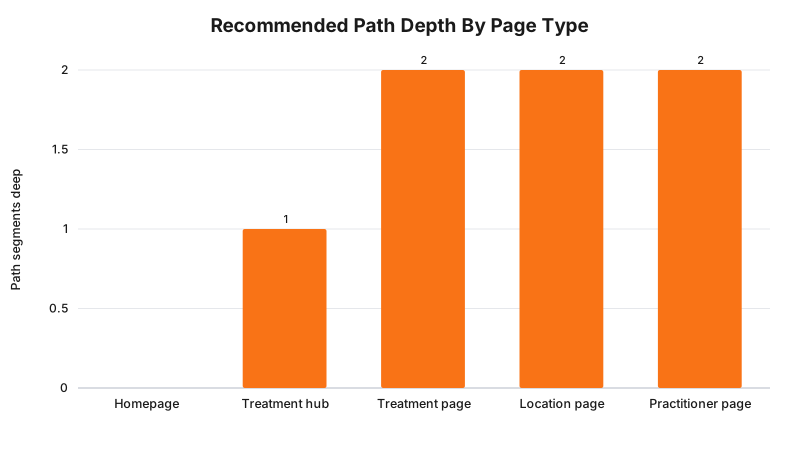
The table below is the pattern RockingWeb uses as a starting point for a clinic or dental practice site.
| Page type | Recommended pattern | Pattern to avoid |
|---|---|---|
| Treatment hub | /treatments/ | /services (mixes treatments with unrelated pages) |
| Individual treatment | /treatments/anti-wrinkle-injections/ | /treatment.php?id=42 |
| Location (multi site clinic) | /locations/fremantle/ | /fremantle-clinic (not grouped with other locations) |
| Practitioner bio | /practitioners/dr-jane-smith/ | /team/1234 |
| Treatment plus location | Only if content is genuinely unique per combination | Auto generated combinations sharing near-identical copy |
| Booking or contact form | /book/ or /contact/ | ?action=book&service=3 |
A Worked Example: Two Clinics, Same Fix
Take two hypothetical practices, not real businesses, built the way RockingWeb sees clinic sites arrive for a build audit far too often.
Cosmetic clinic, before: riversideclinic.com.au/services?type=injectables&location=perth. Everything about the page, the treatment, the location, and any filter the visitor applied, lives in a query string. Google can still index it, but the URL carries no descriptive signal about “anti-wrinkle injections” or “Perth” on its own, and every combination a visitor could click through to generates a slightly different, indexable address.
Cosmetic clinic, after: riversideclinic.com.au/treatments/anti-wrinkle-injections/ for the treatment page, and riversideclinic.com.au/locations/perth/ for the location page, with the two pages linking to each other rather than existing as one combined URL. Two clean, descriptive, hyphenated addresses instead of one parameter driven one, and zero query string parameters on either.
Cosmetic dentistry, before: exampledental.com.au/Page1.aspx?svc=veneers, a legacy ASP.NET pattern with an ID-style filename and inconsistent case. After: exampledental.com.au/treatments/porcelain-veneers/, with the old .aspx URL 301 redirected so any existing backlinks and bookmarks keep working instead of 404ing on launch day.
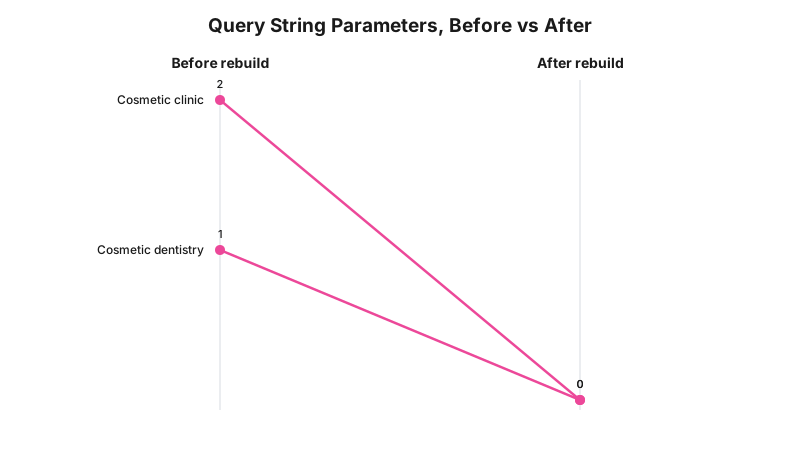
Takeaway: the fix in both worked examples is the same, remove every query string parameter from the page a patient is meant to find in search, and give the treatment and the location each their own descriptive path.
What To Check On Your Own Site
- Open five of your treatment pages. Do the URLs read as words (/treatments/lip-filler/), or as IDs and query strings (?id=42, ?service=lipfiller)?
- Crawl your site or check your XML sitemap for mixed case in any indexed URL. /Treatments/ and /treatments/ indexed as two separate pages is a duplicate content problem you created yourself.
- If you run more than one location, open the same treatment page for two different locations. Is the paragraph identical except for the suburb name? That is the exact pattern Google’s doorway page policy targets.
- Count query string parameters on any URL you would want a patient to find in search. Anything beyond a single tracking parameter, such as a booking source tag, is a candidate for removal or for becoming its own clean path.
- Confirm every practitioner has one dedicated URL, not a shared “our team” page with anchor links, so their bio and registration details can be found and cited on their own.
- Check that old URLs from a previous site redesign 301 redirect to the new pattern rather than 404ing. A rebuilt URL structure with no redirect plan throws away every backlink and every ranking signal the old page had already earned.
Does Anyone Enforce This?
No. Unlike the AHPRA advertising rules or the Privacy Act obligations covered elsewhere on this site, URL structure carries no regulator, no infringement notice and no penalty. Google’s own documentation frames it as helping “search engines and users understand” a site, not as a ranking factor with a stated weighting, and it explicitly says the benefit is “more valuable for really large sites” rather than a five page brochure site. The consequence of getting it wrong is not a fine. It is a competitor with a cleaner /treatments/anti-wrinkle-injections/ URL outranking you for that exact search, and Google recrawling a flat, parameter heavy site less efficiently than it could. That is a real cost for a growing clinic, just not a legal one, and no infringement notice or determination exists to cite here because none applies to this topic.
Where This Gets Hard
The line between a helpful location page and a doorway page is a judgement call, not a bright line. Google’s spam policies name “multiple domain names or pages targeted at specific regions or cities that funnel users to one page” as doorway abuse, and a clinic with three locations offering the same twelve treatments faces exactly that structure by default. Three times twelve is thirty six possible combination pages, and most of them would carry near-identical content if you built one for every combination.
The honest fix takes more content work than URL work. A location page earns its place with unique practitioner names, unique opening hours and ideally unique photography, not a templated paragraph with a suburb swapped in. If you cannot resource unique content for every location times treatment combination, the safer build is a single treatment page with a “find your nearest clinic” section listing every location, rather than a full page per combination.
One more edge case sits specifically on practitioner URLs. A dedicated /practitioners/dr-name/ page is exactly where a clinic is tempted to add a patient testimonial or a before-and-after photo to help that practitioner rank on their own name. AHPRA’s Guidelines for registered health practitioners who perform non-surgical cosmetic procedures, in effect from 2 September 2025, cover every registered health practitioner except medical practitioners, who instead sit under the Medical Board of Australia’s own 2023 cosmetic guidelines. The build consequence is the same either way, keep a practitioner page limited to qualifications, registration details and treatment descriptions rather than results. Whether a specific piece of wording already published on one of your practitioner pages crosses that line is a question for your medical defence organisation or your lawyer, not a URL structure decision. See our AHPRA website compliance checklist for the content side of that same page.
Takeaway: a clean URL cannot fix content that breaks AHPRA’s advertising rules, and content that follows AHPRA’s rules perfectly still needs a URL a search engine can parse.
Status: Guidance, Not Law
This is guidance, not law, and it is not scheduled to become law. Google’s URL structure page and SEO starter guide were both last updated 10 December 2025, and Google’s spam policies page covering doorway pages was last updated 15 May 2026, all currently in effect and subject to change without a commencement date or transition period, the way a search engine’s own documentation always is. The one enforceable rule touched on above, AHPRA’s registered practitioner cosmetic procedure guidelines governing what can sit on a practitioner’s own page, has been in effect since 2 September 2025 for every registered health practitioner except medical practitioners.
Frequently Asked Questions
Does URL structure directly affect Google rankings?
Google’s own guidance frames organised URLs as helping “search engines and users understand how your pages relate to the rest of your site”, not as a stated ranking factor with a weighting. Google also says the benefit is “more valuable for really large sites”, so a five page clinic site gains less from a rebuild than a fifty page site covering treatments, locations and practitioners.
Should each treatment get its own URL, or can I list treatments on one page?
One dedicated URL per treatment works better for both patients and Google, because it lets a search engine match a specific query like “lip filler” to a specific page instead of a shared page trying to cover ten treatments at once. Group them under one folder, such as /treatments/, so Google can also learn how often that section of the site changes.
I run a two location clinic. Do I need a URL for every location and treatment combination?
Only if each combination page has genuinely different content, such as location specific practitioner names, opening hours or photography. Google’s spam policies name “multiple domain names or pages targeted at specific regions or cities that funnel users to one page” as doorway abuse, so a templated location times treatment matrix with the same paragraph reused per suburb is a real risk, not a style choice.
A site audit from RockingWeb checks your existing URL structure, redirect chains and AHPRA-facing page content in one pass rather than three separate reviews. Get in touch if your clinic site is due for one.
Need a hand with your website?
If you want a second pair of eyes on how this applies to your own site, request a callback and we will talk it through.
Sources and References
- Google Search Central, “URL structure”, developers.google.com/search/docs/crawling-indexing/url-structure, last updated 10 December 2025, date checked 15 August 2026.
- Google Search Central, “SEO Starter Guide”, developers.google.com/search/docs/fundamentals/seo-starter-guide, last updated 10 December 2025, date checked 15 August 2026.
- Google Search Central, “Spam policies for Google web search”, developers.google.com/search/docs/essentials/spam-policies, last updated 15 May 2026, date checked 15 August 2026.
- AHPRA, “New guidelines for cosmetic procedures”, ahpra.gov.au/News/2025-09-02-New-guidelines-for-cosmetic-procedures.aspx, guidelines in effect from 2 September 2025, date checked 15 August 2026.
- Medical Board of Australia, medicalboard.gov.au, cosmetic medical and surgical procedures registration standard (2023), date checked 15 August 2026.
Last reviewed: 15 August 2026.
Vikas Thakur
Founder of RockingWeb. 16 years of experience from working at TPG, iiNet and Monadelphous, now building websites, software and digital marketing for local businesses in Rockingham and Perth.