Fix Treatment Page Cannibalisation Before Google Does
Two treatment pages targeting the same search term rarely rank together, they split. Here is how to build a hub-and-spoke treatment hierarchy that matches what Google's own canonicalisation guidance actually rewards.
 Vikas Thakur Founder, RockingWeb 11 min read
On this page 12
- Key takeaways
- What Google’s Guidance Actually Says
- What That Means for the Build
- Decision Matrix: Merge, Keep Separate, or Redirect
- Worked Example: Cosmetic Clinic and Cosmetic Dentistry
- What to Check on Your Own Site
- The Enforcement Anchor
- Where This Gets Hard
- Status
- Frequently Asked Questions
- Get Your Treatment Page Hierarchy Reviewed
- Sources and References
Key takeaways
- Cannibalisation is self-inflicted, not policed. Google has no penalty for it. It simply picks one of your competing pages as canonical and the other loses visibility
- Google’s own guidance calls a 301 redirect and a
rel="canonical"tag “strong” signals, and a sitemap listing a “weak” signal, for telling it which URL should represent a piece of content - Internal links must point to the canonical URL, not the duplicate. Google states this explicitly: “linking consistently to the URL that you consider to be canonical helps Google understand your preference”
- A hub-and-spoke structure (one parent treatment page, several child pages for distinct sub-queries) avoids the problem at the build level rather than patching it after the fact
- Duplicate or overlapping treatment pages are, in Google’s own words, “inefficient, but not something that will cause a manual action”, so there is no fine to cite, only lost rankings
- Search Console’s Performance report grouped by query is the only reliable way to detect cannibalisation on your own site, because Google does not report it as a distinct issue anywhere else
Two treatment pages targeting the same search term almost never rank together. As at August 2026, Google’s own Search Central documentation confirms it picks a single canonical URL to represent each piece of content and shows that one in results, leaving the other to be crawled less often and ranked, if at all, somewhere behind it.
That is the entire mechanism behind keyword cannibalisation. Nobody at Google flags your site for it and no notice arrives in Search Console with that word in it. Two pages just quietly split what should have been one page’s worth of ranking signal, and the practice manager wonders why neither one moves.
What Google’s Guidance Actually Says
Google does not publish a page called “keyword cannibalisation”. The mechanism sits inside its canonicalisation documentation, which describes what happens whenever two or more URLs on a site carry duplicate or substantially similar content.
Google’s canonicalization guidance (last updated 10 July 2026) defines the process as “selecting the representative canonical URL of a piece of content”, and is direct about what happens to the losing page: “the canonical page will be crawled most regularly; duplicates are crawled less frequently in order to reduce the crawling load on sites.” Google also chooses that canonical itself, based on which version it judges “objectively the most complete and useful for search users”, regardless of which URL you intended.
Your input still matters, just not as a guarantee. The companion consolidate duplicate URLs guidance (also updated 10 July 2026) ranks three signals by strength: a 301 redirect is “a strong signal that the target of the redirect should become canonical”, a rel="canonical" link element is likewise “a strong signal”, and simply listing a URL in your sitemap is “a weak signal that helps the URLs that are included in a sitemap become canonical.” The same page adds a rule most clinic sites break without noticing: “when linking within your site, link to the canonical URL rather than a duplicate URL.”
Google’s SEO Starter Guide (updated 10 December 2025) frames the business consequence plainly, and it is worth reading twice: duplicate or competing pages are “inefficient, but it’s not something that will cause a manual action.” There is no fine. There is a slow leak.
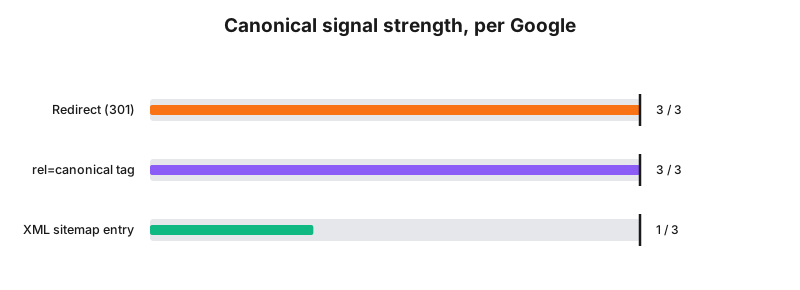
Takeaway: Google never bans overlapping pages. It quietly picks a winner and starves the rest, using signals you control.
What That Means for the Build
Translate that into field-level decisions and the fix is mechanical, not creative.
Give every treatment a single parent URL. A hub page for the treatment category (/treatments/anti-wrinkle-injections/), with child pages only for genuinely distinct sub-queries that carry their own search demand, such as a specific concern area (/treatments/anti-wrinkle-injections/forehead-lines/). If two pages would answer the same question with the same content, you do not need a child page, you need one page.
Self-reference the canonical tag on every page you intend to rank. Google explicitly recommends “adding this same self-referential rel="canonical" link element to the canonical page itself as well”, not only on the pages you are folding in. This stops a stray plugin or a staging copy from silently overriding your intended target.
301 the loser, do not leave it live. If two pages already exist for the same query and one has weaker rankings, redirect it. A redirect is a stronger signal than a canonical tag pointing at a page that is still independently accessible and still being linked to elsewhere on your own site.
Fix your own internal links first. This is the step clinics skip. Your navigation menu, your footer, your blog posts, and your booking widget all need to point at the canonical URL, never at the page you are trying to phase out. Google is specific about why this matters: inconsistent internal linking is read as an unresolved preference, and it will make its own choice instead.
Route by directory, not by flat URL. Google’s Starter Guide notes that “using directories to group similar topics can help Google learn how often the URLs in individual directories change.” A /treatments/ directory containing the whole hierarchy, rather than treatment pages scattered flat off the root alongside blog posts and campaign landing pages, gives Google an obvious structural signal about what belongs together.
Never specify conflicting canonical signals. Google’s warning is unambiguous: “don’t specify different URLs as canonical for the same page using different canonicalisation techniques.” A redirect pointing one way and a canonical tag pointing another, on the same pair of pages, is the fastest route to Google ignoring both and picking for itself.
Decision Matrix: Merge, Keep Separate, or Redirect
| Scenario | Same core treatment | Different search intent | Recommended action |
|---|---|---|---|
| Two pages both target “lip filler Perth” | Yes | No | Merge into one page, 301 the weaker URL |
| ”Lip filler” and “lip filler cost” | Yes | Yes, service vs price research | Keep both, self-canonical each, link hub to child |
| ”Teeth whitening” and “Zoom whitening” | Related, not identical | Yes, general vs branded product | Keep as hub and spoke, cross-link both directions |
| Two suburb landing pages, same treatment | Yes | Yes, geographic intent | Keep both, unique local content, no shared canonical |
| Old campaign landing page and current service page | Yes | No | 301 the campaign page to the service page |
Takeaway: the test is intent, not topic. Same intent means one page. Different intent means two pages that link to each other, never one linking to nothing.
Worked Example: Cosmetic Clinic and Cosmetic Dentistry
Cosmetic clinic. A clinic had three live URLs for anti-wrinkle treatment: /services/botox/, /treatments/anti-wrinkle-injections/, and a 2024 campaign page at /frown-lines-special/ still linked from an old email footer. None carried a canonical tag. In Search Console, all three showed impressions for “anti-wrinkle injections Perth” in the same week, with average position swinging between 6 and 14 as Google alternated which one it treated as canonical. The fix: keep /treatments/anti-wrinkle-injections/ as the hub, self-canonical it, 301 the other two into it, and update the email template and every internal link that still pointed at the old URLs.
Cosmetic dentistry. A dental practice ran /cosmetic-dentistry/ as a broad overview page and /porcelain-veneers/ as a specific service page, both containing near-identical paragraphs about “improving your smile” copied from the same source document. Because the paragraphs were near-duplicate rather than the pages being duplicates outright, Google indexed both but the overview page outranked the dedicated veneers page for “veneers cost Perth”, a query the overview page barely addressed. The fix was content, not redirects: strip the duplicated paragraphs from the overview page, replace them with a short summary and a link to /porcelain-veneers/ as the spoke, and let the veneers page carry the pricing and procedure detail Google was already trying to reward it for.
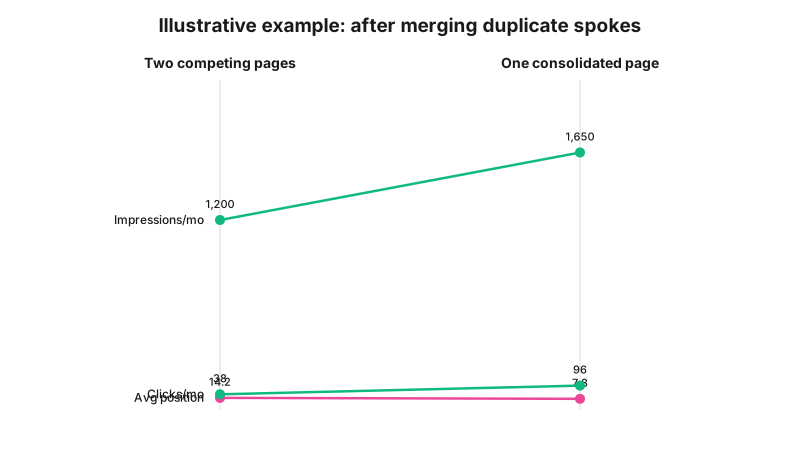
These figures are an illustrative example built from a typical before-and-after pattern, not measured results from a specific named clinic. Your own numbers live in your own Search Console property.
What to Check on Your Own Site
- List every URL on your site that mentions your top three treatments, including campaign and legacy pages you have half-forgotten about.
- Open Search Console’s Performance report, group by query, and filter for any query where two or more of your own URLs both show impressions.
- Check whether every treatment page has a self-referential
rel="canonical"tag. View source and search forcanonicalif you are not sure. - Search your navigation, footer, and blog posts for internal links to any URL you have already redirected. A redirect does not fix a link still pointing at the old address.
- Confirm your XML sitemap lists only the canonical version of each treatment page, not both the hub and a duplicate.
- Check that your CMS is not auto-generating a second URL for the same page, a common source with WordPress category archives and some booking-widget plugins that create their own landing pages.
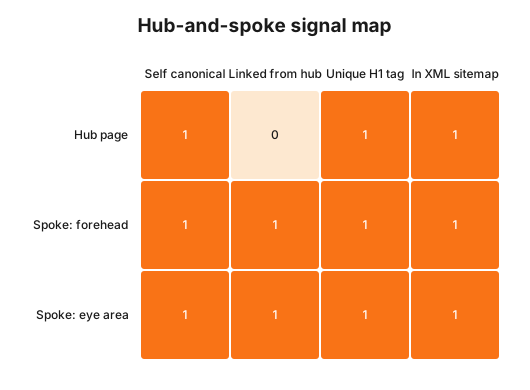
The hub page’s own “linked from hub” cell reads zero because a page cannot meaningfully link to itself as its own hub, every other cell across the hierarchy should read as present.
Takeaway: this is a checklist you run yourself. Nothing external tells you when it is wrong, so nobody else is going to check it for you.
The Enforcement Anchor
There is no infringement notice, determination, or published penalty to cite here, and it would be wrong to imply one exists. Cannibalisation is not a compliance breach and Google does not run an enforcement process against it. The closest thing to an official statement on consequence is the SEO Starter Guide’s own wording: duplicate or overlapping pages are “inefficient, but it’s not something that will cause a manual action.”
That sentence is doing real work. It rules out the fear some site owners have of a penalty, and it replaces it with something less dramatic and, for a business relying on organic bookings, arguably worse: quietly reduced visibility with no notification and no appeal.
Where This Gets Hard
The honest limit is that Google’s own documentation tells you what signals it uses, not the exact threshold at which two pages tip from “related content, both useful” into “duplicate content, one gets picked.” Two pages covering the same treatment from genuinely different angles, one clinical and one pricing-focused, can sit comfortably apart. The same two pages with lazily rewritten opening paragraphs can collapse into one competing pair. There is no character count or similarity score published anywhere that draws that line for you.
The regulator here is Google’s own ranking system, not a statutory body, so there is no lawyer or medical defence organisation to call. The practical equivalent is treating Search Console’s query data as the ground truth and rebuilding around what it actually shows, rather than around what your site map says it should show.
Status
Google’s canonicalisation and duplicate-URL guidance is live, current operational guidance as of the pages’ own last-updated dates, 10 July 2026 for the canonicalization and consolidate-duplicate-URLs pages and 10 December 2025 for the SEO Starter Guide. It is not law, it is not a scheme with a commencement date, and Google can and does revise it without notice, so treat the dates above as “current as checked”, not as a fixed rule you can rely on indefinitely.
Frequently Asked Questions
What is keyword cannibalisation on a clinic website?
It is when two or more pages on the same site target the same search query closely enough that Google treats them as competing rather than complementary, splitting the ranking signal instead of concentrating it on one canonical URL.
Should a location page and a treatment page ever compete for the same keyword?
Not if they are built correctly. A treatment page answers “what is this procedure” and a location page answers “where can I get it near me”, so they target different query intent and each carries its own self-referential canonical tag rather than compete for one ranking slot.
How do I check whether my own treatment pages are cannibalising each other?
Open Search Console’s Performance report, group by query, and look for a single query with impressions split across two or more of your own URLs whose average position moves around from week to week. That pattern, not a manual penalty, is the signal to look for.
Get Your Treatment Page Hierarchy Reviewed
Get in touch and RockingWeb will map every treatment page on your site against the queries it actually earns impressions for, then show you exactly which pages should merge, redirect, or stay separate.
Sources and References
- Google Search Central - Consolidate duplicate URLs: canonicalization overview. Checked 15 August 2026.
- Google Search Central - Consolidate duplicate URLs. Checked 15 August 2026.
- Google Search Central - SEO Starter Guide. Checked 15 August 2026.
Last reviewed: 15 August 2026.
Vikas Thakur
Founder of RockingWeb. 16 years of experience from working at TPG, iiNet and Monadelphous, now building websites, software and digital marketing for local businesses in Rockingham and Perth.