5 AHPRA Rules AI Chatbots Still Get Wrong
Five documented errors keep showing up in AI-generated summaries of AHPRA's cosmetic advertising rules, most of them traced to web content that has not caught up with the 2 September 2025 guideline changes.
 Vikas Thakur Founder, RockingWeb 13 min read
On this page 11
Ask a general-purpose AI assistant whether AHPRA’s cosmetic advertising rules apply to your dental practice the same way they apply to a nurse injector clinic down the road. There is a decent chance the answer blends two documents that used to be separate, misapplies an exception meant for one profession to another, or quotes a penalty figure that has never been correct. None of that is a hypothetical risk. It is the predictable result of a rule set that changed substantially on 2 September 2025, sitting on top of a web index that mostly has not caught up.
Since 2 September 2025, AHPRA runs one performance guideline covering every registered health practitioner except medical practitioners, plus a separate advertising guideline covering anyone who advertises a higher risk non-surgical cosmetic procedure. Both documents replaced older, more fragmented guidance, and both are already in force. An assistant trained or indexed before that date, or one pulling from a source that was never updated, has a structural reason to get the details wrong.
Key facts for this piece:
- AHPRA’s Guidelines for practitioners who perform non-surgical cosmetic procedures and Guidelines for practitioners who advertise higher risk non-surgical cosmetic procedures both came into effect on 2 September 2025.
- The performance guideline covers every registered health practitioner except medical practitioners, who remain under the Medical Board of Australia’s own 2023 cosmetic guidelines instead.
- AHPRA investigated about 360 notifications concerning non-surgical cosmetic procedures between September 2022 and March 2025, closing around 300, alongside more than 1,500 calls to its cosmetic surgery hotline in the same period.
- The advertising guideline explicitly bans the use of automated apps, websites, tools or programs that predict a person’s appearance after a procedure, a rule written specifically with AI-generated prediction tools in mind.
- Maximum penalties under section 133 of the Health Practitioner Regulation National Law are commonly cited as $60,000 for an individual and $120,000 for a body corporate, though $30,000 and $60,000 also circulate in secondary sources.
- The Privacy Act’s small business exemption removal is not legislated, but a separate, enacted automated decision-making transparency obligation commences 10 December 2026, and AI-generated summaries frequently mix the two up.
What The Rules Actually Say
AHPRA and the National Boards published two documents that took effect together on 2 September 2025: the Guidelines for practitioners who perform non-surgical cosmetic procedures and the Guidelines for practitioners who advertise higher risk non-surgical cosmetic procedures (ahpra.gov.au, 2 September 2025). The regulator’s own June 2025 announcement is explicit about scope: the new performance guideline “bring[s] all registered health practitioners in line with medical practitioners, who already have their own guidelines,” and it “build[s] on the safeguards put in place by the Medical Board of Australia in 2023” (ahpra.gov.au, 3 June 2025). In plain terms, medical practitioners were already covered by their own 2023 guideline. The new September 2025 performance guideline extends similar coverage to every other registered health practitioner, nurses, dentists, and the rest, rather than replacing the medical guideline.
The separate advertising guideline applies more broadly, to any person or business advertising a higher risk non-surgical cosmetic procedure performed by a registered health practitioner, not just to the practitioner themselves (ahpra.gov.au advertising guidelines). It restates the National Law’s ban on testimonials, sets rules for before and after images, including a requirement that images be genuine, unedited, and accompanied by a warning that results vary, and it bans a specific category of tool that is directly relevant to this post: “advertising of higher risk cosmetic procedures must not use automated apps, websites, tools or programs that predict an individual’s appearance post-procedure or predict a person’s appearance without a procedure.” That is not a rule about chatbots answering questions. It is a rule about AI-driven prediction tools embedded in advertising itself, and it sits in the same document that assistants routinely summarise imprecisely.
Takeaway: two documents, two different scopes, one shared effective date of 2 September 2025, and a specific ban on AI prediction tools inside advertising itself.
Why AI Assistants Get This Wrong
General-purpose assistants generate answers by pattern-matching across indexed web content, and a large share of that content on this topic predates September 2025. Marketing blogs, old clinic FAQ pages, and syndicated compliance summaries written before the guideline changes are still online, still ranking, and still being read by crawlers that feed both search indexes and AI training pipelines. An assistant answering a scope question does not know which of those sources is current unless the page itself carries a clear, machine-readable date.
That is the build consequence for a clinic or dental practice. If your own compliance content does not carry an explicit “last reviewed” date, a citation to the specific AHPRA document by name, and structured data an assistant can parse, you are competing for citation against pages that are two or three years stale and were never updated. Concretely:
- Add a visible “last reviewed” line near the top of any page that states a compliance rule, and update it whenever the underlying rule changes, not just when you touch the page for other reasons.
- Name the specific guideline document in your page copy, “Guidelines for practitioners who advertise higher risk non-surgical cosmetic procedures,” rather than the vaguer “AHPRA’s advertising rules.” Specific document names are what an assistant can match against a specific, dated source.
- Mark up FAQ content with
FAQPagestructured data (JSON-LD) so the question and answer pair is extractable independently of the surrounding page design. - Link outbound to the primary AHPRA or legislation.gov.au source for any rule you state, rather than to a secondary summary, since assistants weight primary regulator citations differently from marketing content.
- If you maintain a
robots.txt, consider whether anllms.txtfile naming your compliance pages as authoritative sources is worth adding, since some assistants now check for it.
Takeaway: an assistant cannot tell a current rule from a stale one unless your page tells it, in dated, structured, specifically-named text.
Five Documented Errors In Circulation
| Claim you’ll see repeated | Why it’s wrong or outdated | Current position |
|---|---|---|
| AHPRA runs two separate performance guidelines, one for nurses and one shared | Predates the 2 September 2025 merger | One performance guideline covers every registered health practitioner except medical practitioners, who stay under the Medical Board’s 2023 guideline |
| Advertising penalties are $30,000 for an individual, $60,000 for a body corporate | Circulates widely in secondary sources but understates the current maxima | National Law section 133 maxima are commonly cited as $60,000 and $120,000, check your state’s adopting Act directly |
| The Privacy Act’s small business exemption has been removed | Conflates a stalled proposal with a different, enacted obligation | The exemption removal is not legislated; a separate automated decision-making transparency obligation commences 10 December 2026 |
| WCAG 2.2 AA is a legal accessibility requirement for clinic websites | Overstates advisory guidance as statute | The Australian Human Rights Commission’s guidance is advisory under the Disability Discrimination Act, and names WCAG 2.2 AA as the benchmark a court would likely apply, not a standalone requirement |
| The TGA advertising code is being changed in a specific, named direction | Reads a consultation paper as a decision | The TGA’s advertising code consultation presents options only and states no preferred approach, closing 3 September 2026 |
Takeaway: every error in this table has the same root cause, a claim that was once true, or nearly true, and never got corrected once the underlying rule moved.
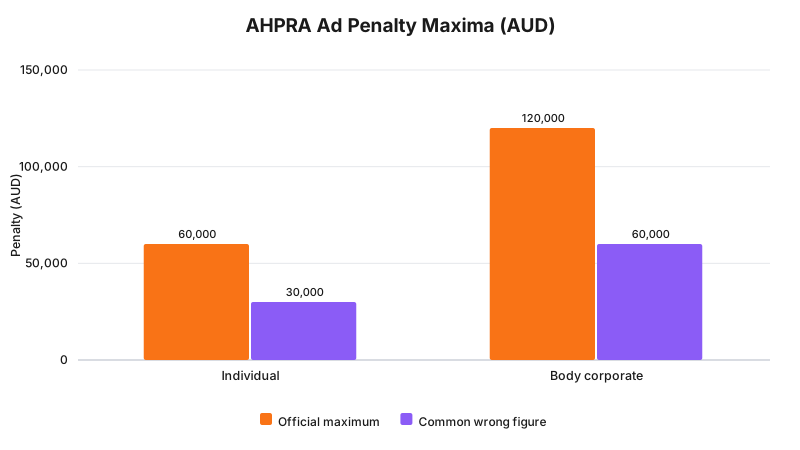
Figures per Health Practitioner Regulation National Law section 133 maxima. The lower figures are commonly cited in secondary sources and should be checked against the current legislation rather than repeated.
Two Worked Examples
Cosmetic clinic. A nurse injector clinic publishes a compliance FAQ page asking “Does the new AHPRA guideline apply to my nurse injector?” A correct, dated answer reads: “Yes. Since 2 September 2025, AHPRA’s performance guideline for non-surgical cosmetic procedures applies to nurse injectors along with every other registered health practitioner except medical practitioners.” Marked up as FAQPage JSON-LD, with the answer text matching what is visible on the page, that block becomes a specific, citable source an assistant can pull from directly, instead of averaging across older blog posts.
Cosmetic dentistry. A dental practice offering porcelain veneers publishes the equivalent page asking “Is my dentist covered by the same AHPRA guideline as a cosmetic clinic?” A correct answer reads: “Yes, for the performance guideline. Dentists are registered health practitioners and are not medical practitioners, so the September 2025 non-surgical cosmetic procedures guideline applies to them the same way it applies to nurses. The advertising guideline, which governs marketing rather than who can perform the procedure, applies separately and covers anyone advertising the treatment.” That second sentence matters, because a common error in AI-generated summaries is treating dentists as an edge case the rules forgot, when the regulator’s own June 2025 release explicitly lists dentists among the professions AHPRA already receives cosmetic procedure complaints about.
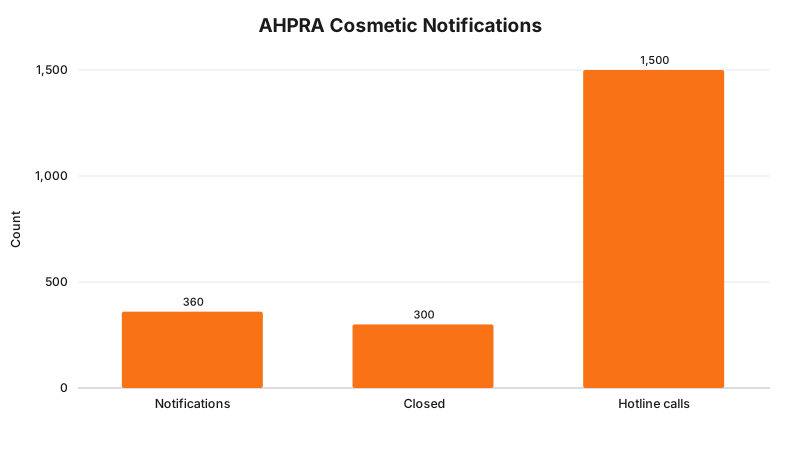
Figures cover September 2022 to March 2025, drawn from AHPRA’s own reporting.
Audit Checklist For Your Own Site
- Search your published compliance pages for a “last reviewed” date. If there is none, add one and set a calendar reminder to check it every time AHPRA, the TGA, or the OAIC issues an update.
- Check whether your compliance copy names the specific guideline document, or only says “AHPRA rules” in general terms. Specific names help both human readers and assistants match your page to the current source.
- Check that any FAQ content on your site is marked up with FAQPage JSON-LD and that the marked-up text matches what a visitor actually sees, since mismatched schema risks being ignored or penalised.
- Check that outbound citations in your own compliance copy point to AHPRA or legislation.gov.au directly, not to a secondary summary that may itself be stale.
- If you use an AI writing tool to draft compliance copy, run every date, scope claim, and dollar figure back against a primary source before publishing. The same failure pattern documented in this piece can appear inside your own site if you copy an assistant’s answer without checking it.
- Confirm you are not running an appearance-prediction or “virtual try-on” tool inside your advertising for a higher risk procedure without checking it against AHPRA’s specific ban on automated outcome-prediction tools.
Takeaway: the fix on your own site is the same fix that would stop an assistant from getting your rules wrong in the first place, dated, specific, and directly sourced.
Does This Get Enforced?
A specific infringement notice or determination tied to an AI-generated compliance answer was not available in the sources checked for this piece, and none should be assumed. What is documented is that AHPRA actively investigates this category: about 360 notifications concerning non-surgical cosmetic procedures between September 2022 and March 2025, around 300 already closed, and more than 1,500 calls to its cosmetic surgery hotline in the same period (ahpra.gov.au, 3 June 2025). AHPRA’s CEO was direct about intent in the September 2025 release: “Practitioners have been warned. If we find practitioners prioritising profits over patient care, we will not hesitate to act.” That is a statement about enforcement of the underlying advertising and performance rules, not about AI accuracy specifically, but it confirms the rules an assistant might misstate are not sitting unenforced.
Takeaway: no case yet ties directly to a chatbot’s wrong answer, but the rules underneath that wrong answer are actively investigated and enforced.
Where This Gets Hard
Assistants change their answers over time, across providers, and sometimes between two queries on the same day, so no single audit of “what ChatGPT says” stays accurate for long. A clinic cannot force a correction into a specific assistant’s cached answer, and there is no formal process for disputing an AI-generated summary the way there is for a search result. The most reliable lever available is making your own site the clearest, most specifically dated primary source on the topic, and accepting that some readers will still see a stale answer from somewhere else first.
The scope question itself is also genuinely harder than a single sentence can capture. A practice with both a dentist and a visiting cosmetic physician on staff can have two different practitioner types sitting under two different guidelines, on the same website, for procedures that look similar to a patient. Getting that split right requires knowing exactly who performs what, not just which document AHPRA published.
The regulator says AHPRA’s guidelines set specific scope and advertising requirements; the build consequence is that your own compliance content needs to be dated, specifically named, and structured for extraction; whether a particular claim applies to your circumstances is a question for your medical defence organisation or your lawyer.
Is This Rule In Force Right Now?
Status: AHPRA’s performance and advertising guidelines have both been in force since 2 September 2025. The Privacy Act small business exemption removal remains an unlegislated proposal. The automated decision-making transparency obligation is enacted and commences 10 December 2026. The TGA’s advertising code consultation is open for submissions only, closing 3 September 2026, with no preferred option yet stated.
Frequently Asked Questions
Does AHPRA’s new cosmetic guideline apply to dentists the same way it applies to nurse injectors?
Yes, for the performance guideline that governs who can perform a procedure. It covers every registered health practitioner except medical practitioners, and dentists sit in that same non-medical group alongside nurses. Only medical practitioners follow the Medical Board’s separate 2023 guideline.
Why do AI assistants sometimes get AHPRA’s cosmetic rules wrong?
Assistants generate answers from web content, and much of that content has not caught up with the guideline changes that took effect on 2 September 2025. The result is answers that repeat the old two-guideline structure or apply the medical exception to the wrong document.
Can I trust an AI-generated summary of AHPRA’s advertising rules for my own site copy?
Treat it as a first draft only. Check every date, scope claim, and penalty figure against the primary AHPRA and legislation.gov.au sources before publishing, since this specific topic has documented, repeatable failure patterns in AI-generated answers.
Fixing This On Your Site
If keeping compliance pages dated, specifically sourced, and correctly structured is not something your team has time to maintain page by page, RockingWeb builds and audits clinic and dental practice websites for this exact category of AHPRA compliance mechanics. Sign up to get your compliance pages reviewed, or if you already have an account, log in to your dashboard.
Sources and References
- AHPRA news release, New guidelines for cosmetic procedures, 2 September 2025. ahpra.gov.au. Date checked: 15 August 2026.
- AHPRA news release, Booming billion-dollar cosmetic industry on notice with new cosmetic procedures guidelines, 3 June 2025. ahpra.gov.au. Date checked: 15 August 2026.
- AHPRA, Guidelines for advertising higher risk non-surgical cosmetic procedures. ahpra.gov.au. Date checked: 15 August 2026.
- Health Practitioner Regulation National Law, section 133. Federal Register of Legislation. Date checked: 15 August 2026.
- Medical Board of Australia, cosmetic procedures guidelines (2023). medicalboard.gov.au. Date checked: 15 August 2026.
- OAIC, automated decision-making transparency requirement guidance. oaic.gov.au. Date checked: 15 August 2026.
- Australian Human Rights Commission, Guidelines on equal access to digital goods and services, 2 April 2025. humanrights.gov.au. Date checked: 15 August 2026.
- TGA, Improvements to the Therapeutic Goods Advertising Code, consultation paper. consultations.tga.gov.au. Date checked: 15 August 2026.
Last reviewed: 15 August 2026.
Vikas Thakur
Founder of RockingWeb. 16 years of experience from working at TPG, iiNet and Monadelphous, now building websites, software and digital marketing for local businesses in Rockingham and Perth.