12% of Australians Search With AI First: 2026 Data
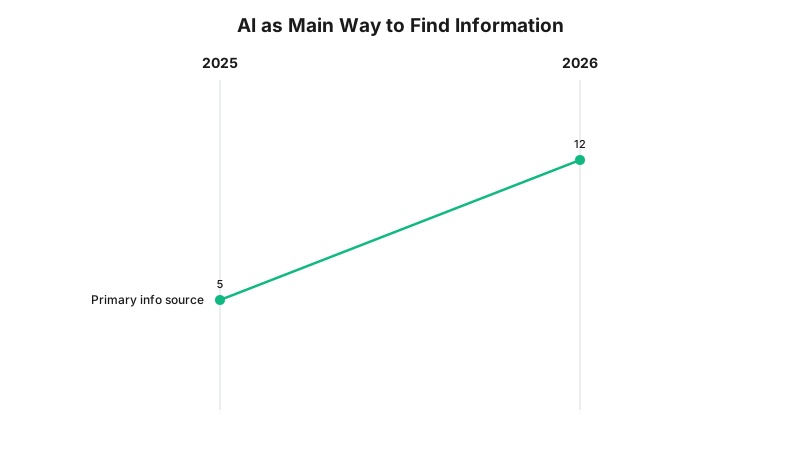
12% of Australians now name an AI tool as their main way of finding information online, up from 5% a year earlier, according to Telsyte's 2026 Australian AI Study. Only half of those AI answers send a click back to a website. Here is the adoption and referral traffic data behind the shift, with sources.
 Vikas Thakur Founder, RockingWeb 8 min read
Key takeaways
- 12% of Australians now name an AI tool as their main way of finding information online, up from 5% a year earlier (Telsyte, 2026)
- 13.6 million Australians (58% of those aged 14+) use an AI tool in an average four weeks (Roy Morgan, March 2026 quarter)
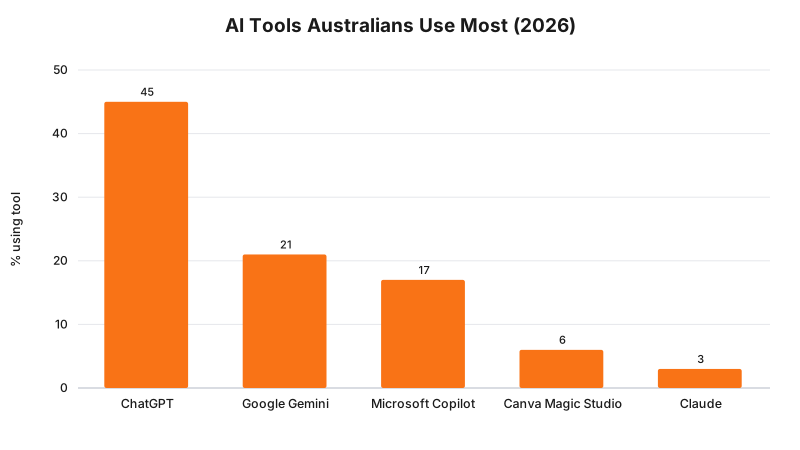
- ChatGPT reaches 10.5 million Australians (45%), ahead of Google Gemini’s 5 million (21%) and Microsoft Copilot’s 4 million (17%) (Roy Morgan, 2026)
- Only 16% of Australian online searchers use AI as their primary starting point, even though 72% use AI assistants to some degree (YouGov, 2026)
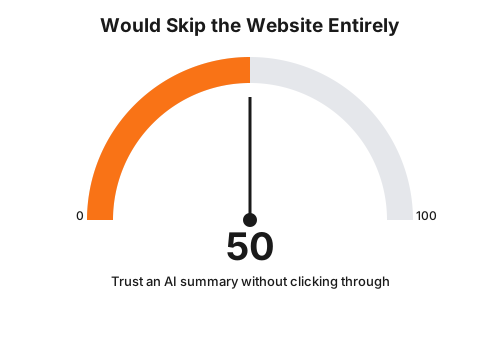
- 50% of Australians would rely on an AI summary without clicking through to the source website (Telsyte, 2026)
- Google’s referral rate to websites sits at 17% to 19%, against 1.6% to 2.5% for AI platforms combined, roughly a ten to one gap (Similarweb, 2026)
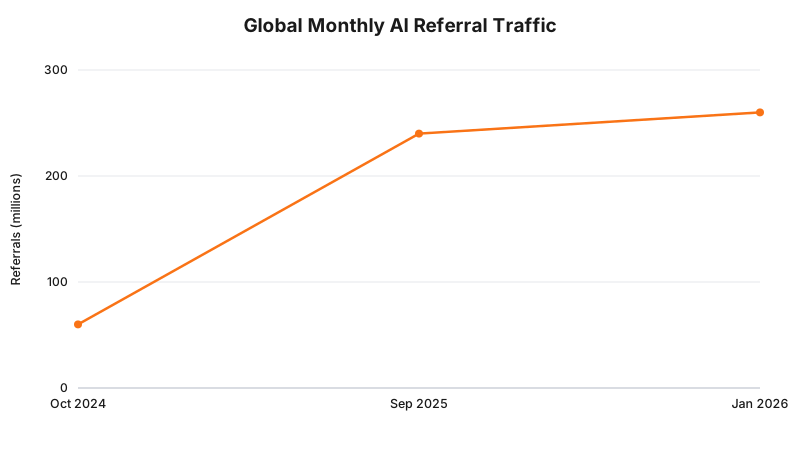
- Global monthly referral traffic from AI platforms to websites went from about 60 million to about 240 million between October 2024 and September 2025, then flattened at 240 million to 280 million by January 2026 (Similarweb, 2026)
12% of Australians now use AI as their main way to find information online, up from 5% in 2025, per Telsyte’s 2026 study. Roy Morgan counts 13.6 million Australian AI users in the March 2026 quarter. AI platforms still send far fewer visits than Google, at 1.6% to 2.5% referral versus Google’s 17% to 19% (Similarweb, 2026).
12% of Australians now say an AI tool, not Google, is their main way of finding information online. A year ago that figure sat at 5%. Telsyte tracked the jump across 2,023 Australians surveyed in April and May 2026, and the shift is not slowing down. Roy Morgan separately counts 13.6 million Australians using an AI tool in an average four weeks, with ChatGPT alone reaching 10.5 million people. Here is the catch for anyone running a website: usage is climbing fast, but referral traffic is not keeping pace. Half of Australians told Telsyte they would trust an AI summary enough to skip the source website altogether. This post breaks down what the adoption numbers mean for traffic to your business, section by section, with the exact source behind every figure.
Australians Are Switching Their Default Search Habit
Google search still handles most of the volume in Australia. What changed in 2026 is how many people reach for AI first instead.
Roy Morgan’s latest research, covering the January to March 2026 quarter, found 13.6 million Australians aged 14 and over used an AI tool in an average four weeks. That is 58% of the population in that age group, drawn from a sample of 14,646 respondents. ChatGPT leads by a wide margin, reaching 10.5 million Australians. Google Gemini sits second with 5 million users, followed by Microsoft Copilot at 4 million, Canva Magic Studio at 1.4 million, and Claude at 777,000.
| AI Tool | Australians Reached (4-week) | Share of Population 14+ |
|---|---|---|
| ChatGPT | 10.5 million | 45% |
| Google Gemini | 5 million | 21% |
| Microsoft Copilot | 4 million | 17% |
| Canva Magic Studio | 1.4 million | 6% |
| Claude | 777,000 | 3% |
Source: Roy Morgan, “Artificial Intelligence (AI) Tools Usage,” March 2026 quarter, n=14,646.
These figures come from active tool use, not embedded AI features inside a search box. YouGov’s separate survey of 1,002 Australian adults, run between April and May 2026, found 72% of Australian online searchers use AI assistants to some degree during a search session. Most people are not replacing Google outright. They are stacking an AI tool on top of it: 43% use AI alongside other search platforms, and 25% check AI only after trying a traditional search engine first.
Takeaway: AI tool use in Australia has gone mainstream, but most people still treat it as a second stop, not the first one.
Why More Users Doesn’t Mean More Clicks
Adoption numbers only tell half the story. The part that matters for a business website is what happens after someone gets an AI answer, and that is where the picture changes.
Telsyte’s Australian Artificial Intelligence Study 2026, an online survey of 2,023 representative Australians aged 16 and over run in April and May 2026, found that 12% of respondents now name an AI tool as their main way of finding information online. A year earlier, in the equivalent 2025 study, that figure sat at 5%. The share has more than doubled in twelve months. Set against that growth, the same study found 81% of Australians are now aware that AI summaries appear directly in search results, and 50% said they would rely on that summary without clicking through to the website it came from.
| Metric | Value | Source |
|---|---|---|
| Name AI as their main way to find information online (up from 5% in 2025) | 12% | Telsyte, 2026 |
| Aware AI summaries now appear in search results | 81% | Telsyte, 2026 |
| Would rely on an AI summary without clicking through | 50% | Telsyte, 2026 |
| Use AI as their primary starting point for a search | 16% | YouGov, 2026 |
| Use AI assistants to some degree during search | 72% | YouGov, 2026 |
YouGov’s data backs this up from another angle. Only 31% of Australians who use AI for search said they generally click the links an AI response provides. 26% said they cross-check the answer against another website before trusting it, and 15% said they end the search the moment they get an AI response, without visiting anywhere else.
Takeaway: the people naming AI as their go-to information source doubled in a year, but half of them are happy to never leave the AI tool at all.
The Referral Traffic Math: AI Platforms vs Google
Australian survey data explains the behaviour. Global traffic data from Similarweb shows the scale of the gap it creates for website owners.
Similarweb’s 2026 Generative AI report puts Google’s referral rate, the share of searches that result in a click to an external website, at 17% to 19%. AI platforms combined sit at 1.6% to 2.5%. That is roughly a ten to one difference in how often a query turns into an actual website visit. This is global data, not Australia-specific, since no comparable Australian panel study covers referral rate at that level of detail yet.
| Source | Referral Rate (2026) |
|---|---|
| Google Search | 17% to 19% |
| AI Platforms (combined) | 1.6% to 2.5% |
Source: Similarweb, Generative AI Report, 2026.
The volume tells a second part of the story. Monthly referral traffic from generative AI platforms to external websites grew from about 60 million in October 2024 to about 240 million by September 2025, close to a fourfold increase in a year. Growth then stalled. By January 2026, Similarweb recorded monthly referrals flat between 240 million and 280 million, even as total visits to AI platforms kept climbing toward 1.5 billion a month worldwide.
| Period | Global Monthly AI Referrals |
|---|---|
| October 2024 | about 60 million |
| September 2025 | about 240 million |
| January 2026 | 240 million to 280 million |
Source: Similarweb, Generative AI Report, 2026.
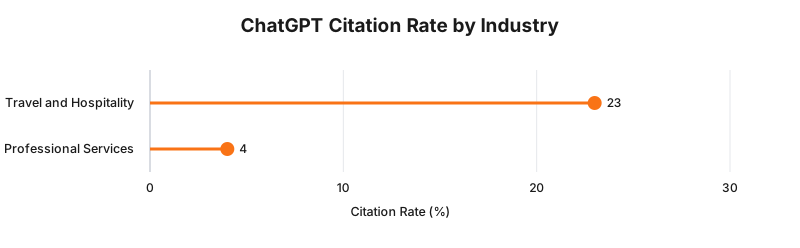
There is one bright spot in the same dataset for businesses that get cited. ChatGPT’s rate of citing external sources in its answers rose from about 1.6% in June 2025 to about 6.8% by May 2026, a more than fourfold jump. Travel and hospitality content gets cited close to 23% of the time, while professional services content sits under 4%.
Takeaway: AI referral traffic to websites grew fast for a year, then flattened, so getting cited inside an AI answer matters more than waiting for click volume to keep rising.
What This Means for Your Website
None of this means Google traffic is disappearing. It means a second channel now sits alongside it, one that answers questions directly and sends far fewer visits back to the source.
For a small business site, the practical shift is where you put your effort. Ranking on page one still earns the click when someone is ready to compare options or buy. But for the informational questions people used to Google, an AI tool is increasingly the first stop, and a growing share of those answers never turn into a visit at all. Structuring your site so ChatGPT, Perplexity, and Google’s AI Overviews can quote you accurately, with clear facts, named sources, and direct answers near the top of the page, is now part of the job, not an extra.
Watch your own Search Console data for the same pattern found here: impressions holding steady while clicks on informational pages slide. That gap is the AI referral effect showing up in your own numbers.
Takeaway: the AI search shift is real and it is fast, but it changes what you optimise for more than it changes whether SEO still matters.
RockingWeb’s free SEO audit checks your site’s structure against the patterns in this post and flags which pages are losing clicks to AI answers first. Get in touch if you want a second set of eyes on your own Search Console data.
Vikas Thakur
Founder of RockingWeb. 16 years of experience from working at TPG, iiNet and Monadelphous, now building websites, software and digital marketing for local businesses in Rockingham and Perth.