Mobile Search Statistics Australia: 44.7% Are Mobile
Just 44.7% of Australian search and web traffic happened on mobile in July 2026, per StatCounter, down from 51.2% in April 2025 and well short of the 60%+ figure often quoted for mobile search. Here is what the current data actually shows.
 Vikas Thakur Founder, RockingWeb 8 min read
On this page 10
- Key takeaways
- Answer Capsule
- Mobile Search in Australia Sits at 44.7%, Not 60%
- Where the 44.7% Figure Comes From
- Australia vs the Rest of the World
- The Access Gap: Everyone Has a Phone, Not Everyone Searches on One
- Google’s Grip Is Even Tighter on Mobile
- What This Means for Your Website
- Check Where Your Traffic Actually Comes From
- Sources
Key takeaways
- Only 44.7% of Australian web and search traffic came from mobile devices in July 2026, against 55.3% on desktop, per StatCounter
- That is down from 51.2% mobile in April 2025, a 6.5 percentage point drop in around 15 months
- Worldwide, mobile still holds a narrow majority at 52.6%, so Australia now sits below the global average
- 97% of Australian adults use a mobile phone to get online, and 92% do so daily, per ACMA’s 2025 survey data
- On mobile specifically, Google runs 97.4% of Australian searches, against 80.25% on desktop
- Bing’s Australian presence is almost entirely a desktop habit: 15.81% desktop share versus 0.54% on mobile
- The commonly quoted “60%+ of searches are mobile” figure has no clear surviving primary source; the closest verifiable ancestor is a 2017 BrightEdge study putting mobile at 57% of traffic (not search specifically), and it does not match Australia’s current numbers
Answer Capsule
Mobile devices accounted for 44.7% of Australian web and search platform traffic in July 2026, according to StatCounter, below the 55.3% share held by desktop. Australia’s mobile share has fallen from 51.2% in April 2025. This makes Australia one of the few developed markets where desktop still leads mobile.
Mobile Search in Australia Sits at 44.7%, Not 60%
44.7% of Australian search and web traffic happened on a mobile phone in July 2026. That is the current StatCounter figure, and it sits well under the 60%+ mobile share you’ll see quoted in SEO blogs and marketing decks. Here’s the thing: nobody can point to a single, clean source for that 60%+ figure. The closest verifiable ancestor is a 2017 BrightEdge study that put mobile at 57% of overall traffic, not search specifically, and even that number gets rounded up and reworded on its way through years of secondary blog posts and pitch decks. Nine years on, Australia’s own numbers moved the other way. Mobile’s share of Australian web traffic was 51.2% in April 2025. Fifteen months later it had dropped to 44.7%, while desktop climbed to 55.3%. If you’re planning a mobile-first redesign, a responsive-only strategy, or a marketing split based on “most people search on their phone,” the real device mix in Australia says otherwise. This post breaks down where the numbers actually sit, and what a business built on the outdated 60% figure could be getting wrong.
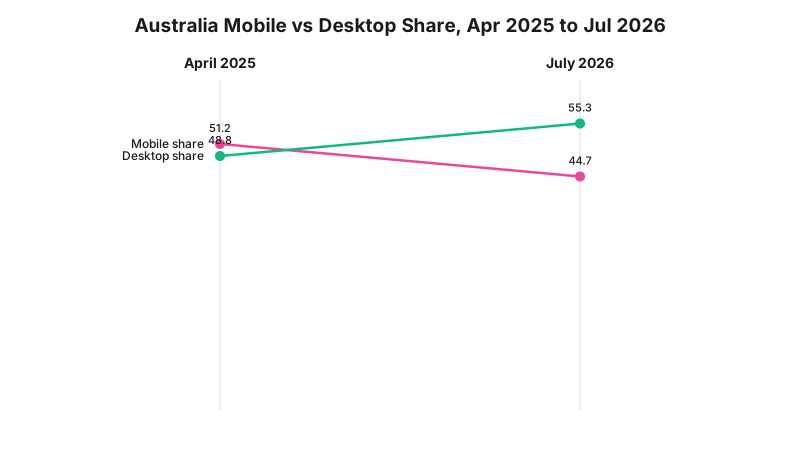
Takeaway: mobile’s share of Australian search and web traffic dropped 6.5 points in 15 months, while desktop gained the same ground.
Where the 44.7% Figure Comes From
The number traces to StatCounter’s platform market share data for Australia, which tracks page views across a large network of sites to estimate what share of traffic comes from each device type. It is the most widely cited device-share dataset in the SEO industry because it updates monthly and covers every country, not a one-off survey. StatCounter’s Australia figures for July 2026 put desktop at 55.3% and mobile at 44.7%, with the same two-way split showing 51.2% mobile back in April 2025.
| Period | Mobile share | Desktop share | Source |
|---|---|---|---|
| April 2025 | 51.2% | 48.8% | StatCounter |
| July 2026 | 44.7% | 55.3% | StatCounter |
That is not a rounding error or a one-month blip. Desktop has been closing the gap on mobile in Australia for over a year, and by mid-2026 it had opened a clear lead. Most global SEO content still assumes the opposite pattern.
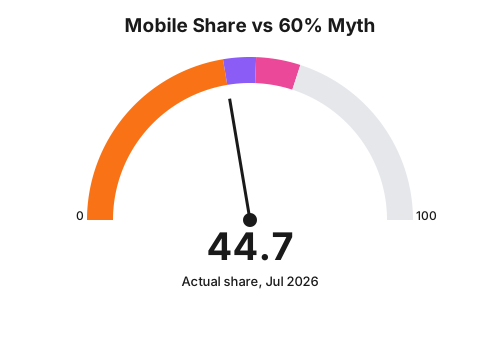
Takeaway: desktop has led mobile in Australian search and web traffic for over a year, the reverse of the pattern most SEO advice assumes.
Australia vs the Rest of the World
Here’s where it gets more interesting. Globally, mobile still edges out desktop, holding 52.6% of platform market share in July 2026 against 45.9% for desktop and 1.5% for tablet, also per StatCounter. Run the same three-way split for Australia in the same month and mobile sits at 43.5%, desktop at 53.8%, and tablet at 2.7%. Australia is not just below the “60%+” figure floating around online. It is below the actual current global average too.
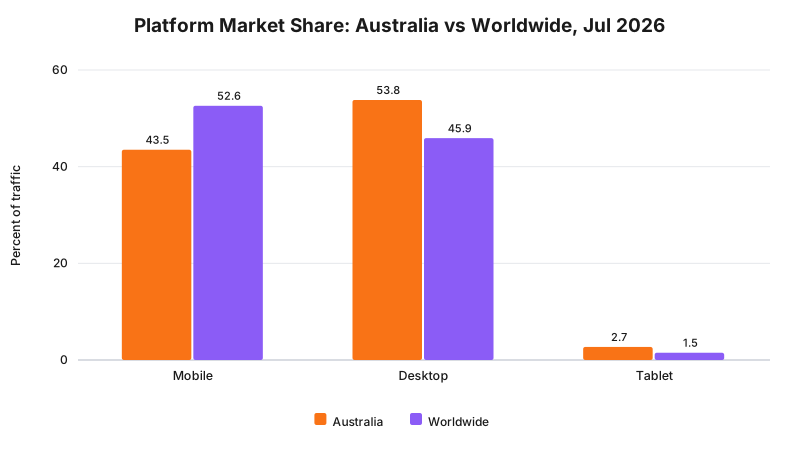
A few likely reasons sit behind the gap. Australia has high rates of remote and hybrid work, which keeps desktop and laptop sessions high during business hours. Broadband speeds are strong (a median fixed download speed of 77.9 Mbps, per DataReportal’s 2025 Australia report), which reduces the incentive to default to a phone for anything more involved than a quick lookup. Whatever the cause, the effect on a business’s traffic mix is the same: build for mobile first, but do not assume it accounts for 6 in 10 visits.
Takeaway: Australia’s mobile share sits below both the commonly quoted 60% figure and the actual current global average of 52.6%.
The Access Gap: Everyone Has a Phone, Not Everyone Searches on One
This is the part that trips people up. Access to mobile internet in Australia is close to universal. ACMA’s 2025 survey data, published in its Communications and Media in Australia report series in February 2026, found that 97% of Australian adults used a mobile phone to access the internet, up from 95% the year before. 92% did so daily, up from 90%. Those numbers are well above 60%, and they are still climbing.
| ACMA measure | 2024 | 2025 |
|---|---|---|
| Adults using mobile to access internet | 95% | 97% |
| Adults using mobile internet daily | 90% | 92% |
So nearly every Australian adult uses their phone to get online, and most do it every day. Yet when StatCounter measures actual page views, mobile still trails desktop. The two data points are not contradictory, they are measuring different things. Access is about whether a device is used at all. Platform share is about which device carries the bulk of session volume, and desktop sessions tend to run longer and cover more pages, especially for anything work-related or transaction-heavy.
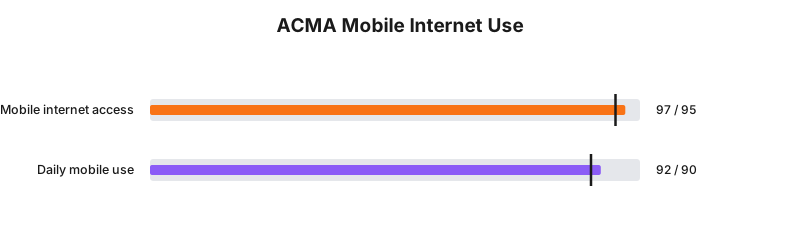
Takeaway: near-universal mobile access does not translate into a mobile majority of actual search and browsing sessions in Australia.
Google’s Grip Is Even Tighter on Mobile
Search engine choice splits by device too, and the gap is bigger than most people expect. In July 2026, Google ran 97.4% of mobile searches in Australia, against 80.25% of desktop searches. Bing, Google’s nearest competitor here, held 15.81% of desktop search but only 0.54% of mobile search.
| Search engine | Mobile share | Desktop share |
|---|---|---|
| 97.4% | 80.25% | |
| Bing | 0.54% | 15.81% |
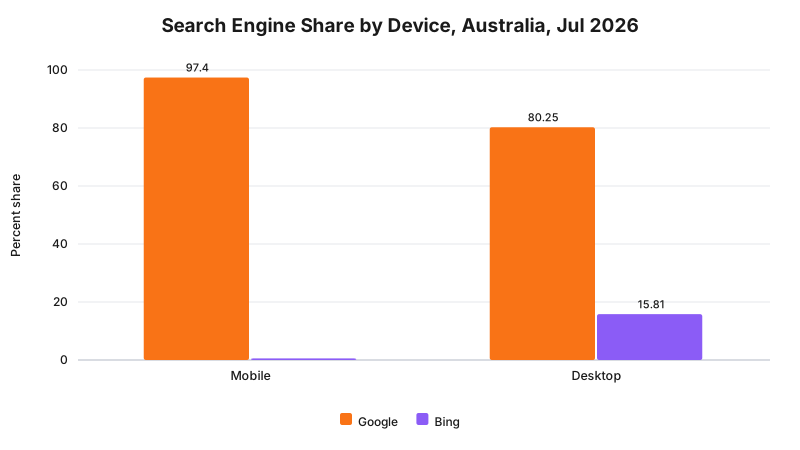
Bing’s Australian audience is, for practical purposes, a desktop audience. If your business runs paid search on Bing Ads expecting mobile reach, the inventory is thin. Google Search Console segments performance by device for exactly this reason, and this data confirms why the device breakdown is worth checking before assuming your Bing traffic behaves like your Google traffic.
Takeaway: Bing’s Australian presence is close to a desktop-only phenomenon, while Google dominates both devices near-equally.
What This Means for Your Website
Three things follow from the numbers above. First, mobile still matters. 44.7% is not a small share, and a site that fails on a phone screen loses close to half its potential traffic outright. Second, desktop is not a legacy channel to deprioritise in Australia the way some global playbooks suggest. It carries the majority of sessions here, and for anything involving longer research, comparison, or form-filling, that pattern is likely to hold. Third, do not plan a device strategy off a stat you cannot trace to its source and date. The “60%+ mobile” line still shows up in pitch decks and briefs today, and it has no clear primary source, only a years-old chain of secondary posts repeating a rounder, bigger number than any study actually measured.
Check your own site’s Google Search Console or analytics device breakdown before assuming either the old 60% figure or Australia’s 44.7% national average applies to your traffic. A trades business built around local phone enquiries will likely run more mobile-heavy than the national number. A B2B site selling to procurement teams will likely run more desktop-heavy. The national split is a benchmark to compare against, not a substitute for your own data.
Takeaway: use the national 44.7% figure as a benchmark, then check your own analytics, because your actual device mix depends on what you sell and who buys it.
Check Where Your Traffic Actually Comes From
A free SEO audit from RockingWeb pulls your site’s real device breakdown from Search Console data, checks how your pages perform on mobile versus desktop, and flags where a device gap is costing you rankings or conversions. Get in touch to see where your numbers actually sit.
Sources
- StatCounter Global Stats. Desktop vs Mobile Market Share, Australia, July 2026.
- StatCounter Global Stats. Desktop vs Mobile vs Tablet Market Share, Australia, July 2026.
- StatCounter Global Stats. Desktop vs Mobile vs Tablet Market Share, Worldwide, July 2026.
- StatCounter Global Stats. Mobile Search Engine Market Share, Australia, July 2026.
- StatCounter Global Stats. Desktop Search Engine Market Share, Australia, July 2026.
- Australian Communications and Media Authority. Mobile phone internet use soars as landline use keeps falling, February 2026 (Communications and Media in Australia report series, 2025 survey data).
- DataReportal. Digital 2025: Australia.
- Search Engine Journal. 57% of Search Traffic is Now Mobile, According to Recent Study (recapping BrightEdge, 2017).
Last reviewed: 10 August 2026.
Vikas Thakur
Founder of RockingWeb. 16 years of experience from working at TPG, iiNet and Monadelphous, now building websites, software and digital marketing for local businesses in Rockingham and Perth.