70% More Visits: Google Business Profile Statistics Australia
A complete Google Business Profile gets a business 70% more visits and 50% more purchase consideration, according to Google's own data. Here are the current, sourced Google Business Profile statistics that matter for Australian businesses in 2026, including how local profiles compare to the US, UK and Canada.
 Vikas Thakur Founder, RockingWeb 8 min read
Key takeaways
- A complete Google Business Profile gets a business 70% more visits and 50% more purchase consideration than an incomplete one (Google, 2026)
- Complete profiles also make a business 2.7 times more likely to be seen as reputable (Google)
- Australian businesses generate a median 67 actions a month per profile: 36 website clicks and 18 phone calls, the highest of any country BrightLocal has studied (BrightLocal, 2019)
- 42% of local searchers click a result inside the Google Map Pack before looking anywhere else on the page (Backlinko, 2024)
- 97% of consumers read reviews for local businesses, and 71% do that reading on Google (BrightLocal Local Consumer Review Survey, 2026)
- 68% of consumers now expect at least a 4 star rating before they will use a business, up from 55% a year earlier (BrightLocal, 2026)
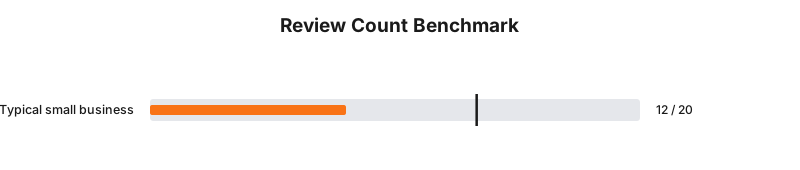
- 47% of consumers will not use a business with fewer than 20 reviews (BrightLocal, 2026)
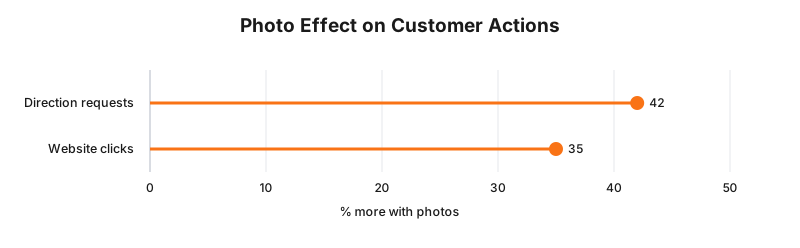
- Photos on a profile drive 42% more requests for directions and 35% more clicks through to the website (Google)
Answer Capsule
A complete Google Business Profile drives 70% more visits and 50% more purchase consideration, per Google’s own 2026 documentation. Australian profiles average 67 monthly actions, the highest among four countries BrightLocal studied in 2019. Most of the gain comes from photos, reviews and full profile completion, not paid ads.
Google says a complete Business Profile gets a business 70% more visits and 50% more purchase consideration than one with gaps. That single number sits inside Google’s own help documentation, not a marketing report trying to sell you something. Most Australian businesses never see that lift because their profile is half filled in: a phone number here, three photos there, no posts since last year. Here is the problem: your competitor down the road probably has the same gaps, so closing them is one of the few local search moves that still separates you from the pack. This guide pulls together the Google Business Profile statistics that matter in 2026, sourced from Google itself, BrightLocal and Backlinko, not recycled round-ups. You will see how Australian profiles compare to the US, UK and Canada, what actually moves a review score, and where photos change the outcome. Every figure below is credited to where it came from. Read it once and you will know which three things to fix first.
What “Complete” Actually Means
Google defines a complete profile as one with a category, address, phone number, opening hours, at least one photo, a website link and an up to date description. Miss any of those and Google’s own numbers say you are leaving customer action on the table.
The gap is not small. A complete profile makes customers 70% more likely to visit and 50% more likely to consider buying from you, and 2.7 times more likely to see the business as reputable in the first place. None of this needs a redesign or a developer. It needs someone to sit down with the Business Profile for twenty minutes and fill in every blank field Google gives you.
| Outcome for a complete profile | Effect | Source |
|---|---|---|
| Customer visits | 70% more likely | |
| Purchase consideration | 50% more likely | |
| Perceived reputation | 2.7x more likely to read as reputable |
A complete profile is the cheapest local search upgrade a business can make this month.
How Australian Businesses Compare
BrightLocal’s Google My Business Insights study looked at 45,264 businesses across 36 industries in Australia, the US, UK and Canada, tracking data from September 2017 through December 2018. It is an old dataset now, published in 2019, but it remains the largest cross-country comparison of Google Business Profile activity ever run, and nobody has repeated it at the same scale since.
The finding that held up: Australian businesses got more customer action from their profile than any other country in the study. The average Australian listing generated a median 67 actions a month, made up of 36 website clicks, 18 phone calls, and the rest split between direction requests and other actions. Canadian businesses pulled in more raw searches, but fewer of those searches turned into an action. Australians who found a business on Google were more likely to actually do something about it.
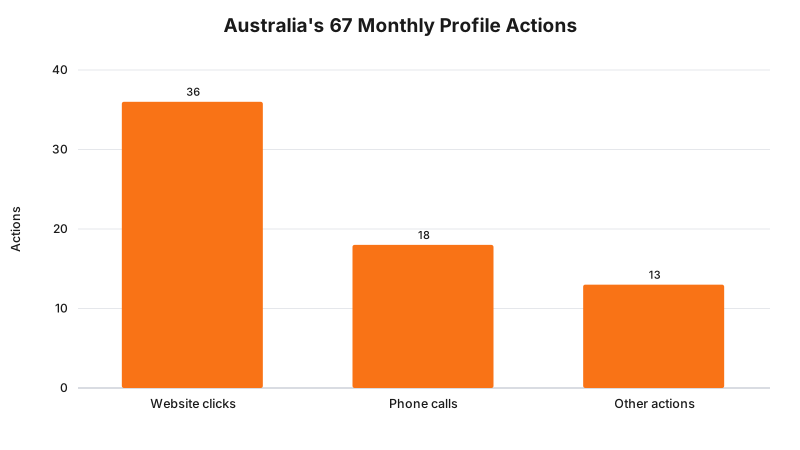
The takeaway for a Perth or Rockingham business today: your local audience is already primed to click through, call or ask for directions once they find you. The bottleneck usually is not demand. It is whether the profile gives them enough to act on.
Why The Map Pack Gets The Click
Local search results split into two zones: the Map Pack, three business listings with a map at the top of the page, and the organic list below it. Backlinko’s 2024 study found that 42% of people searching with local intent click a Map Pack result before they touch anything else on the page. For many search terms, that beats the entire organic list combined.
Local intent itself is not a small slice of search. The number that keeps getting quoted is 46%. At the Secrets of Local Search conference at Google’s Mountain View headquarters in October 2018, digital marketer Nick Wilsdon tweeted that a Google representative’s official presentation put local intent at 46% of all searches, up from the figure Google had cited before that. Search Engine Roundtable covered the claim at the time and flagged the same limitation worth repeating here: it traces back to one conference tweet, not a published Google study. Nobody has released an updated, sourced figure since, but 46% is still the most cited baseline in the industry, and search behaviour has only moved further toward local and mobile in the years since. Treat it as a widely repeated industry estimate, not an official Google statistic.
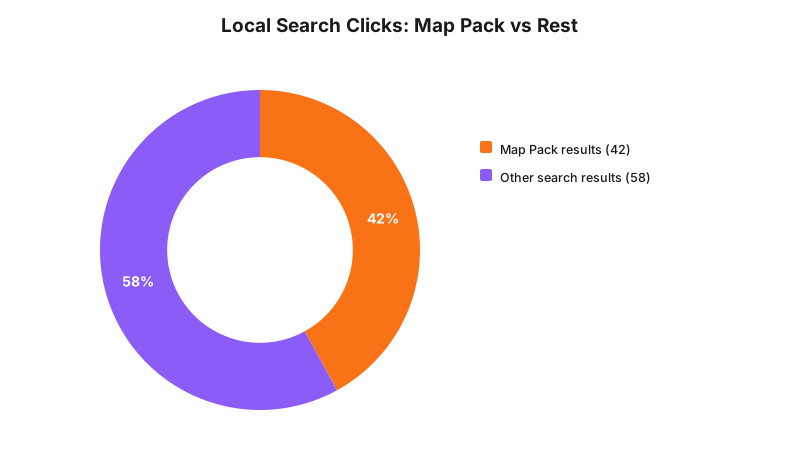
Put those two numbers together and the Map Pack becomes the highest value piece of digital real estate most small businesses will ever get for free. Ranking in it does not need a media budget. It needs the completeness, reviews and proximity signals covered in this guide.
If nearly half of your category’s searches are local and 42% of clicks go to the Map Pack, that is where the fight actually happens.
What Reviews Actually Move
BrightLocal’s Local Consumer Review Survey polls a representative panel of consumers every year, and the 2026 edition, 1,002 US adults on a SurveyMonkey panel, shows shoppers getting fussier about reviews, not more relaxed.
97% of consumers now read reviews for local businesses, and 41% say they always do it, up from 29% the year before. Google is still where most of that reading happens: 71% of consumers use Google for local business reviews, though that is down from 83% in 2025 as review reading spreads across more platforms and, increasingly, AI tools.
The bar for a good enough rating has also moved. 68% of consumers expect at least four stars before they will use a business, up from 55% last year, and 31% will not settle for less than 4.5 stars, nearly double the 17% who said the same in 2025. Volume matters too: 47% of consumers rule out a business with fewer than 20 reviews, no matter how good those reviews read.
| Rating expectation | 2025 | 2026 |
|---|---|---|
| Expect at least 4 stars | 55% | 68% |
| Require at least 4.5 stars | 17% | 31% |
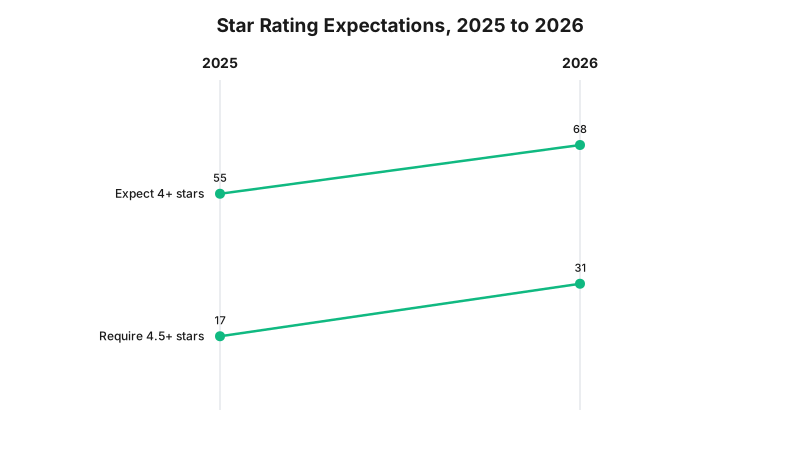
For a business sitting on 12 reviews and a 4.2 average, that is not a good news story. The bar moved up while most businesses stood still.
The Photo Effect
Photos are the cheapest lever on this whole list. Google’s own guidance for Business Profiles states that listings with photos get 42% more requests for driving directions and 35% more clicks through to the website than listings without them. No agency fee, no ad spend, just a phone camera and twenty minutes.
The catch is that most profiles stall at three or four photos: a logo, maybe a shopfront, done. Businesses that keep adding fresh photos of the team, the space, finished work or new stock give Google a reason to keep showing the profile as active, and give customers something to click through before they ever reach the website.
If a Business Profile has not had a new photo added in the last three months, that is the fastest fix on this whole list.
A Quick Benchmark Checklist
- Fill every field Google gives you: category, hours, phone, website, description. That alone earns the 70% and 50% lift covered above.
- Add at least one new photo a month, more if the business has a physical space customers will see before they arrive.
- Watch the review count, not just the star rating. 47% of consumers will not consider a business under 20 reviews regardless of the average score.
- Check the profile is claimed and complete before spending a dollar on ads. A complete profile pulls more from the traffic already searching for you.
- Compare your own monthly actions (calls, website clicks, direction requests, all visible in Business Profile performance data) against the 67 a month Australian average.
Get Your Profile Working Harder
Most of the gap between an average Google Business Profile and a fully optimised one is not creative, it is completeness: the fields filled in, the photos kept current, the reviews responded to and the category set correctly. If your profile is missing pieces or you are not sure how it stacks up against these benchmarks, see how we handle local SEO and Google Business Profile work for Rockingham and Perth businesses, or read the fuller Australian local SEO statistics roundup for the wider picture beyond Google Business Profile alone.
Vikas Thakur
Founder of RockingWeb. 16 years of experience from working at TPG, iiNet and Monadelphous, now building websites, software and digital marketing for local businesses in Rockingham and Perth.