Subscription Cancellation Rules 2027: Clinic Memberships
From 1 July 2027, a clinic membership or skin subscription that renews automatically must give the patient an easy, findable way to cancel, online if they signed up online. The Competition and Consumer Amendment (Unfair Trading Practices) Act 2026 passed Parliament and received Royal Assent on 2 July 2026 but has not yet commenced, and this guide covers what qualifies and what the build needs to do about it.
 Vikas Thakur Founder, RockingWeb 14 min read
Key takeaways
- The Competition and Consumer Amendment (Unfair Trading Practices) Act 2026 passed Parliament and received Royal Assent on 2 July 2026, and takes effect from 1 July 2027
- A new Division 4A of Part 3-1 of the Australian Consumer Law defines a subscription contract and creates a signup disclosure duty, an ongoing information duty, and an exit method duty
- The exit method duty requires cancellation to be easy to find, straightforward, and online if the subscriber signed up online
- A payment plan for a single procedure, paid off in instalments, is excluded from the definition. A recurring membership that renews automatically generally is not
- Existing memberships are not automatically caught. The new duties apply once a contract is renewed, extended, continued, or varied on or after commencement
- Corporate penalties for the Act’s general unfair trading practices prohibition reach $100 million per contravention, or three times the benefit, or 30% of turnover, whichever is greatest. Individual penalties reach $2.5 million
- As at 2 October 2026, the subscription contract rules are passed but not commenced. Nothing on your booking or membership portal changes today, but the transitional trigger means a renewal or a variation can bring an existing contract into scope early
As at 2 October 2026, the Competition and Consumer Amendment (Unfair Trading Practices) Act 2026 has passed Parliament but is not yet in force. From 1 July 2027, a clinic running a monthly skincare subscription, a laser package with automatic renewal, or any recurring membership that meets the Act’s definition of a subscription contract has to tell the patient upfront what they are signing, and give them a cancellation path that is easy to find and available online if they joined online. Sign up a patient today with a membership that auto-renews and no visible cancel button, and that gap becomes a live compliance problem the day the law commences, not something to fix later.
What the Law Actually Says
The Federal Register of Legislation record for the Act lists the Competition and Consumer Amendment (Unfair Trading Practices) Act 2026 (No. 64, 2026) as an Act to amend the Competition and Consumer Act 2010, showing Royal Assent on 2 July 2026. Section 2 of the Act sets a single commencement date for the whole Act: 1 July 2027.
Part 3 of Schedule 1 inserts a new Division 4A, Subscription contracts, into Part 3-1 of the Australian Consumer Law. Section 48B defines a subscription contract as one that meets any of four conditions and is not on the excluded list in section 48C: recurring supply for an indefinite period with automatic liability to pay, supply in a fixed period that continues automatically unless someone stops it, an initial free period that converts to automatic paid liability, or an initial discounted period that steps up automatically to a higher rate. Excluded contracts include a lease, a licence for real property, a hire-purchase contract, a contract for payment in instalments, childcare, and pre-school or school tuition.
Three operative duties follow. Section 48D requires a supplier to disclose, when making the offer, that the contract would be a subscription contract and information about payment liabilities, the contract period, renewal terms, notice required to end it, and how to end it, either audibly within a reasonable time before the person can agree, or legibly and prominently close to where they can agree. Section 48E requires ongoing information to be given while the contract is in effect, though the specific content and timing depend on regulations not yet made. Section 48F is the exit method duty: the supplier must provide a way to end the contract that is easy to find, straightforward, and requires only the steps reasonably necessary, and if the subscriber signed up online, or the supplier offers an online way to sign up for that kind of contract, at least one exit method must be online too.
Allens and DLA Piper both summarise the reform the same way: a specific fix for subscription traps and difficult cancellation, sitting alongside the Act’s broader, standalone unfair trading practices prohibition in section 28B, which separately bans conduct that manipulates a consumer or unreasonably distorts their decision-making environment, including through digital interface design.
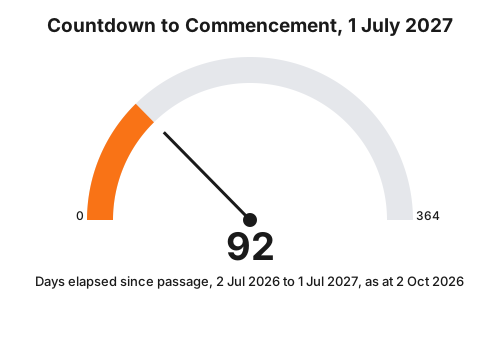
Days elapsed since the Act passed Parliament on 2 July 2026, against the full 364-day run to commencement, calculated as at 2 October 2026.
Takeaway: the rule names four ways a contract becomes a subscription contract and only one short, specific exclusion list, so most recurring clinic arrangements fall inside it by default.
What This Means for the Build
Reporting the definition is one thing. Working out which of your memberships it actually touches is another.
Find every recurring charge on your booking or CRM platform. Skin subscriptions, laser package top-ups, membership tiers, and standing appointment plans are the obvious candidates. A “buy now, pay later” instalment plan for a single procedure is not, on its own, because section 48C excludes payment-in-instalments contracts specifically.
Add a subscription flag to your data model. For each recurring product, record which of the four section 48B triggers applies (indefinite, fixed with auto-continuation, initial free period, or initial discount period), because the disclosure content in section 48D differs depending on the answer.
Build the signup disclosure into the checkout step, not the terms page. Section 48D requires the statement that this is a subscription contract, plus payment liability, period, renewal terms, notice period, and exit method, delivered close to where the patient agrees, not buried in a linked document they never open.
Give the exit path equal visibility to the signup path. If a patient can join a membership from a self-serve online form, section 48F requires at least one way to cancel that is also online, not phone-only. A “cancel” link inside an account portal, or a hosted form that confirms receipt immediately, satisfies the “easy to find and straightforward” test better than a support email address that may or may not get answered.
Tag existing memberships by renewal date, not by signup date. An existing membership is untouched under the Act’s application provisions until it is renewed, extended, continued, or varied. A 12-month package signed in March 2027 that auto-renews in March 2028 becomes subject to the new duties from that renewal date, so your renewal calendar is the real compliance trigger, not 1 July 2027 itself.
Takeaway: the build work is mostly data modelling, working out which recurring product is a subscription contract and when the new duties start biting on each one, rather than one single flag to flip on commencement day.
Which Membership Contracts the New Duties Reach
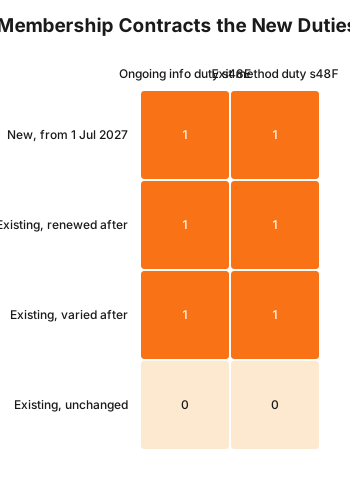
Built from the Act’s application provisions in Part 4 of Schedule 1. An existing contract that is never renewed, extended, continued or varied stays outside sections 48B, 48E and 48F, even after commencement.
| Recurring arrangement | Section 48B trigger | Likely subscription contract | Build priority |
|---|---|---|---|
| Monthly skincare product subscription | Indefinite period | Yes | Signup disclosure and online exit path |
| 12-month laser package, auto-renews | Fixed period, continues unless stopped | Yes | Renewal date tracking, exit path |
| Free trial membership converting to paid | Initial free period | Yes | Disclosure of conversion date and price |
| Introductory-rate membership stepping up | Initial discount period | Yes | Disclosure of the higher ongoing rate |
| Single-procedure “pay in 4” finance plan | Excluded, payment in instalments | No | None under Division 4A |
| Corporate wellness membership, small business buyer | Standard form, small business requirement | Yes, if under 100 staff or $10m turnover | Same duties as a consumer contract |
Takeaway: the table splits on one question. Does the arrangement keep supplying and keep charging until someone actively stops it, or does it end on its own once a fixed number of payments is made.
A Worked Example
Cosmetic clinic. A clinic sells a “Glow Membership” at $89 a month, billed automatically, covering one facial and a discount on injectables. Patients sign up through an online form embedded in the clinic’s booking widget. Cancelling currently requires calling the front desk during business hours. Under section 48B this is a subscription contract on the indefinite-period test: recurring supply, automatic liability to pay, and a right to end it. Because the patient signed up online, section 48F requires at least one online cancellation path once the duty applies to that contract. The fix is a “manage membership” link in the patient’s online account or a hosted cancellation form that confirms receipt immediately, sitting alongside the phone option rather than replacing it.
These figures are illustrative, built to show the mechanics of the section 48B test applied to a common clinic offer, not pricing drawn from any specific clinic.
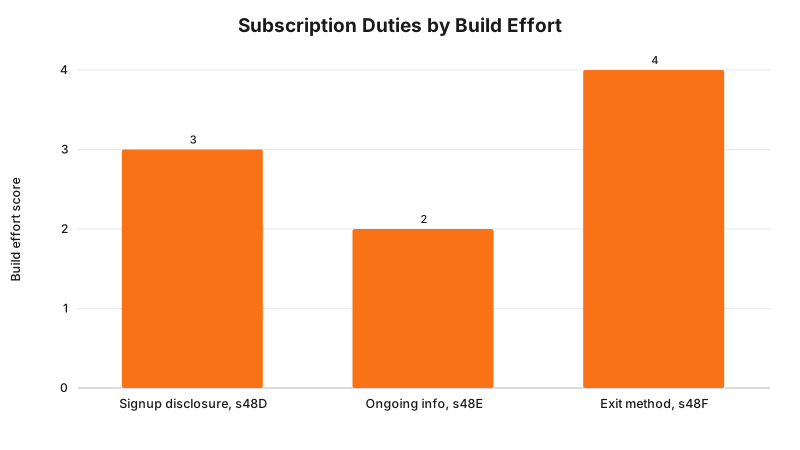
The scoring is a build assessment of typical implementation effort for a clinic membership portal, not a figure from the Act or a regulator. The exit method duty scores highest because it usually needs a genuine self-service cancellation flow, not just a paragraph of disclosure text.
What to Check on Your Own Site
- List every recurring product, membership, or package your booking and CRM platforms currently bill on autopilot.
- For each one, check which section 48B trigger applies, indefinite, fixed-with-continuation, free-period conversion, or discount-period step-up.
- Confirm any instalment finance plans are genuinely limited to payment for a single supply, so the section 48C exclusion actually fits.
- Test your current cancellation path as a patient would. Is there any way to end a membership without a phone call, if the patient joined online?
- Check your membership terms for the five items section 48D requires disclosed: liability to pay, period, renewal terms, notice period, and how to end it.
- Note each membership’s renewal date. That date, not 1 July 2027, is when the new duties start applying to an existing contract that renews.
The Enforcement Anchor
No infringement notice or determination exists yet under the new subscription contract provisions, because the Act is not in force. That is a fact about timing, not a reason to treat the underlying pattern as low-risk.
The ACCC is already pursuing the same underlying conduct, hard-to-find cancellation and a cheaper alternative hidden until late in the process, under existing law. On 27 October 2025, the ACCC commenced Federal Court proceedings against Microsoft, alleging Microsoft told around 2.7 million Australian Microsoft 365 subscribers they had to accept a Copilot-linked price rise or cancel, while a cheaper “Classic” plan that kept the old feature set was allegedly only revealed late in the cancellation process rather than disclosed upfront. That case relies on the existing misleading conduct provisions of the Australian Consumer Law, not the new subscription contract duties, and the allegations are contested and unproven. It shows the regulator is already active against a cheaper option surfaced only once someone is trying to leave, well before the specific 2027 rule gives it a second, more targeted tool.
Takeaway: the new subscription-specific duties have no enforcement record yet because they are not law. The conduct they target already draws court action under the law that exists today.
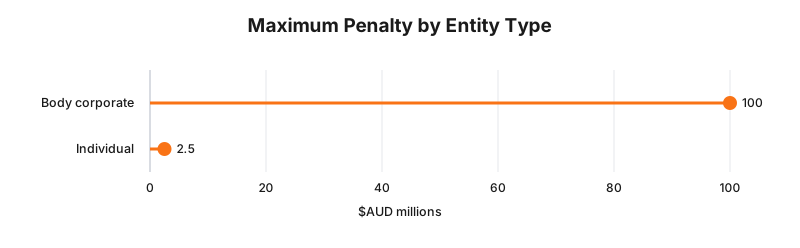
Maximum civil penalty per contravention of the Act’s general unfair trading practices prohibition once it commences on 1 July 2027, for a body corporate versus an individual. Sources: the Act, Allens, DLA Piper, cited below.
Where This Gets Hard
The Act notes that a pecuniary penalty may be imposed for a contravention of the signup disclosure, ongoing information, and exit method duties, but the specific maximum for those three provisions sits in the existing Part 3-1 penalty framework rather than the new row this guide verified directly. Treat the $100 million and $2.5 million figures above as confirmed for the Act’s standalone unfair trading practices prohibition, not as a stated figure for a Division 4A subscription contract breach specifically.
The ongoing information duty in section 48E is also not self-executing. It requires prescribed information at prescribed times, and both are left to regulations the Act does not itself make. Until those regulations are registered, there is no fixed content or schedule to build against for that specific duty, only the exit method and signup disclosure duties, which stand on their own wording.
The regulator’s own text says a supplier must give a way to end a subscription contract that is easy to find, straightforward, and requires only steps reasonably necessary; the build consequence is a genuine self-service cancellation path, live and tested, not a phone number buried in a terms document; whether a specific membership structure or a specific cancellation flow satisfies that test in your circumstances is a question for your medical defence organisation or your lawyer.
Status
Passed, not commenced. As at 2 October 2026, the Competition and Consumer Amendment (Unfair Trading Practices) Act 2026 has passed both Houses of Parliament, with Royal Assent recorded on 2 July 2026 on the Federal Register of Legislation. The whole Act, including the subscription contract provisions in Division 4A of Part 3-1, commences on 1 July 2027 and is not in force today. An existing membership contract only comes within sections 48B, 48E and 48F once it is renewed, extended, continued or varied on or after that date.
Frequently Asked Questions
Does a clinic’s monthly skincare subscription count as a subscription contract?
Almost always, yes. Section 48B of the Act catches a contract with terms providing for recurring or continuing supply for an indefinite period, where the patient automatically incurs liability to pay and has a right to end the contract. A monthly skincare product subscription or an ongoing treatment membership fits that description directly, provided it is not on the short excluded list in section 48C.
Is a payment plan for a single cosmetic procedure a subscription contract?
Usually not. Section 48C(1)(d) excludes a contract for payment in instalments, which covers a straightforward finance plan for one procedure paid off over several months. The picture changes if the arrangement also provides for ongoing, automatically continuing treatment after the instalments end. At that point it can meet the fixed-period or indefinite-period tests in section 48B in its own right.
Does a membership signed up before commencement need to change on 1 July 2027?
Not automatically. The Act’s application provisions, in Part 4 of Schedule 1, say sections 48B, 48E and 48F do not apply to a contract entered into before commencement. They start applying to that contract only if it is renewed, extended, continued or varied on or after 1 July 2027, from the date that renewal or variation takes effect.
Can a clinic still require a phone call to cancel a membership?
Not on its own, once the exit method duty in section 48F applies to that contract. The way to end the contract has to be easy to find and straightforward, and if the subscriber signed up online, or the clinic offers an online way to sign up for that kind of contract, at least one of the ways to cancel must also be online.
Does the exit method rule apply to a membership sold to a small business?
Yes, if the contract meets the Act’s small business requirement, being a standard form contract where the buyer employs fewer than 100 people or had turnover under $10,000,000 in its last income year. A corporate wellness membership sold to a small partner business is covered on the same terms as one sold to an individual patient.
Get Your Membership Flow Scoped
Turning a “call to cancel” membership into one that meets the section 48F exit method duty is a scoped, fixed-price build, not a guessing exercise: a self-service cancellation path in your patient portal, a disclosure step at signup, and a renewal calendar that tells you which contracts the new duties have already reached. If you would rather have that mapped and built than work it out clause by clause yourself, talk to us about your membership and booking flow.
Sources
- Federal Register of Legislation, record C2026A00064 - Competition and Consumer Amendment (Unfair Trading Practices) Act 2026 (No. 64, 2026), showing Royal Assent 2 July 2026. Checked 2 October 2026.
- Allens - Australia’s new unfair trading practices regime, what businesses need to know, July 2026.
- DLA Piper - Australia introduces new unfair trading practices laws, expanded drip pricing protections and changes for subscriptions, July 2026.
- ACCC - Microsoft in court for allegedly misleading millions of Australians over Microsoft 365 subscriptions, 27 October 2025.
- Parliament of Australia - Bills Digest, Competition and Consumer Amendment (Unfair Trading Practices) Bill 2026.
Last reviewed: 2 October 2026.
Vikas Thakur
Founder of RockingWeb. 16 years of experience from working at TPG, iiNet and Monadelphous, now building websites, software and digital marketing for local businesses in Rockingham and Perth.