Dark Patterns to Remove From Your Booking Funnel by 2027
From 1 July 2027, the Competition and Consumer Amendment (Unfair Trading Practices) Act 2026 prohibits conduct that manipulates a consumer or unreasonably distorts the environment in which they decide, and law firm analysis of the Act names false urgency, confirm shaming and hidden cancellation menus as the kind of conduct it targets. As at 30 September 2026 the Act has passed but not commenced, so this guide covers which booking funnel patterns to remove before then, and which are already a live enforcement risk under existing consumer law.
 Vikas Thakur Founder, RockingWeb 14 min read
On this page 12
Key takeaways
- The Competition and Consumer Amendment (Unfair Trading Practices) Act 2026 passed Parliament on 2 July 2026 and commences on 1 July 2027
- The general prohibition catches conduct that manipulates a consumer or unreasonably distorts the environment in which they decide, with no materiality threshold and no need to prove intent
- Law firm analysis names false urgency countdown timers, confirm shaming wording, and cancellation buried behind confusing menus as examples the prohibition targets
- Corporate penalties reach $100 million per contravention, or three times the benefit gained, or 30% of turnover, whichever is greatest
- The ACCC already fined Dendy Cinemas $19,800 in June 2025 for hiding a mandatory fee until the final booking step, under existing law, before the new prohibition even exists
- As at 30 September 2026, the Act is passed but not commenced. Ninety of the 364 days between passage and commencement have gone
As at 30 September 2026, the Competition and Consumer Amendment (Unfair Trading Practices) Act 2026 has passed Parliament but is not yet in force. From 1 July 2027, a general prohibition applies to conduct that manipulates a consumer or unreasonably distorts the environment in which they make a decision, and law firm commentary on the Act specifically identifies dark pattern design tactics, false urgency, confirm shaming, hidden cancellation options, as the kind of conduct it is built to catch. If your booking widget uses a countdown timer, a guilt-trip decline button, or a cancellation flow that only works over the phone, that pattern needs a rebuild before commencement, and in one case, hiding information until late in a purchase, the ACCC is already enforcing against the same underlying conduct today.
What the Law Actually Says
The Federal Register of Legislation lists the Competition and Consumer Amendment (Unfair Trading Practices) Act 2026 as passed, not yet in force. The exact passage date comes from a primary source neither law firm summary states outright: a media release from the Hon Dr Andrew Leigh MP, Assistant Minister for Productivity, Competition, Charities and Treasury, titled Unfair trading tricks and traps to be banned, published 2 July 2026, which states the Bill passed Parliament that day and that the new provisions commence 1 July 2027. Two independent law firm summaries of the Act, Allens and DLA Piper, describe the same core test. Conduct contravenes the new general prohibition if it does, or is likely to, manipulate the consumer, or unreasonably distort the environment in which the consumer makes a decision, and it causes or is likely to cause detriment, financial or otherwise. Neither firm reports a materiality threshold, and neither reports a requirement to prove the business intended to manipulate anyone.
Both firms apply the label dark patterns to conduct this general prohibition is built to catch, rather than the Act itself defining that exact phrase as a term of art. Allens names specific examples: misleading countdown timers or low stock cues used to create false urgency, confirm shaming language such as declining an offer through wording like “No thanks, I prefer to pay full price,” and cancellation options hidden behind confusing menus. DLA Piper adds a broader frame: obstructing a consumer’s ability to exercise legal rights or seek remedies, failing to disclose material information or disclosing it in a complex, unclear, ambiguous, untimely or overwhelming way, and creating an environment, including through digital interface design elements, that places a consumer under unreasonable pressure. DLA Piper is explicit that scarcity indicators are not automatically a problem: the issue arises “if used to pressure consumers and create a false sense of urgency, particularly in combination with other sales tactics.”
The same Act separately tightens subscription contract rules: an easy-to-find, straightforward cancellation path, available online if the customer signed up online, no more steps than reasonably necessary. For a clinic running a treatment membership or skin subscription, that clause and the general dark patterns prohibition both apply to the same cancellation flow.
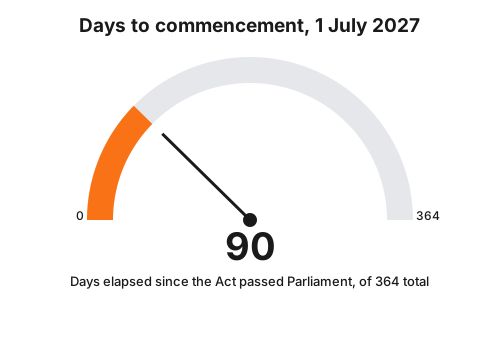
Days elapsed since the Act passed Parliament on 2 July 2026, against the full run to commencement on 1 July 2027, calculated as at 30 September 2026.
Takeaway: the Act names the design tactics, not just the pricing outcome, which is a wider net than most drip pricing coverage suggests.
What This Means for the Build
Reporting the prohibition is one thing. Finding it in a live booking widget is another, and most clinic websites carry at least one of these patterns without anyone having chosen it deliberately, often because a booking platform’s default template ships with it.
Audit every countdown, low stock badge, or “spots remaining” indicator for whether it reflects real data. A static image or a timer that resets on page refresh is a misleading countdown by the Act’s own example. Connect the display to your actual appointment calendar so the number is genuinely live, or remove it if your platform cannot wire that up honestly.
Give every decline option equal visual weight to the accept option. A modal offering an add-on with a large “Yes, add this” button and a small, greyed-out, guilt-worded “No thanks, I’ll skip this” link is confirm shaming by Allens’ own example wording. Use two buttons of the same size and style, with neutral decline copy, “No thanks,” rather than a sentence designed to make the reader feel they are choosing worse care.
Match the cancellation path to the signup path. If a patient can join a treatment membership in under two minutes online, the subscription clause requires a cancellation path that does not force a phone call, an in-person visit, or a multi-step settings hunt. That usually means a visible “Cancel membership” action inside the same patient account area used for booking, not a contact form routed to reception.
Separate a genuine capacity constraint from a decorative one. If your booking software already knows real-time availability, because it is the same system blocking a slot once booked, showing “2 appointments left this week” pulled from that live count is a different build to hard-coding the same sentence into a page template. The second version is the pattern DLA Piper flags.
Do not stack pressure tactics on a single screen. A countdown timer plus a low stock badge plus a “3 people are viewing this treatment” notice on one booking step is exactly the combination DLA Piper calls out. Even where each element is defensible alone, do not add a second and third pressure element to the same screen a patient is trying to decide on.
Takeaway: almost none of this requires new functionality. It requires auditing what a booking platform’s default template already does and turning off or rewriting the parts that manipulate rather than inform.
Decision Matrix: Booking Funnel Patterns and Their Status
| Pattern | Where it typically appears | Source for the label | Status |
|---|---|---|---|
| Countdown timer or low stock badge not tied to real data | Treatment or service page | False urgency, Allens | Prohibited from 1 July 2027 |
| Guilt-worded decline wording on an upsell or membership offer | Payment or confirmation step | Confirm shaming, Allens | Prohibited from 1 July 2027 |
| Cancellation only reachable by phone when signup was online | Patient account area | Subscription cancellation clause and hidden cancellation options, Allens/DLA Piper | Prohibited from 1 July 2027 |
| Multiple stacked pressure elements on one booking screen | Any step | Unreasonable pressure via design elements, DLA Piper | Likely prohibited from 1 July 2027, exact threshold untested |
| Mandatory fee revealed only at the final payment step | Payment step | Existing single price rule, ACCC v Dendy Cinemas | Already risky under existing law |
| Accurate, live “spots left” count tied to real availability, shown once | Treatment or service page | Genuine scarcity, DLA Piper | Outside scope if genuinely accurate |
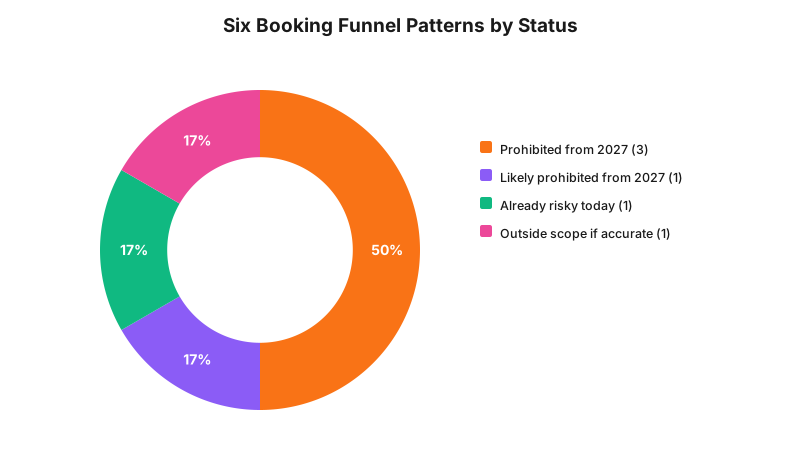
Tally of the six pattern rows from the decision matrix above, split by whether the general unfair trading prohibition or an existing rule applies. The stacked-pressure-elements row is marked “likely” rather than “prohibited” outright, since neither law firm names a specific threshold for how many elements crosses the line.
Takeaway: four of the six patterns above are not risky today and become risky, or likely become risky, the day the Act commences. One is already a live enforcement target. One is not a dark pattern at all if it is honest.
A Worked Example
Cosmetic clinic. A clinic’s booking widget shows “Only 2 spots left today!” as a fixed graphic on the anti-wrinkle treatment page, unrelated to the calendar underneath. After a patient selects a time, a modal offers a skincare add-on with one prominent button, “Yes, add to my order,” and the only way to skip it is closing the modal via a small corner icon with no text label at all. That combination, a static false urgency badge plus an add-on flow with no visible decline path, is the pattern Allens and DLA Piper both describe. The fix: connect the spots-left figure to the real calendar or remove it, and add an equally weighted “No thanks” button next to the add-on button.
Cosmetic dental practice. A practice sells a teeth whitening top-up membership through its website, signup takes ninety seconds online, card details included. Cancelling requires calling the practice during business hours, being placed on hold, and confirming identity with a staff member. Signup was instant and online; cancellation is slow and phone-only. That mismatch is exactly what the Act’s subscription clause and the hidden-cancellation example both target. The fix: a “Cancel membership” action inside the same online account area used to sign up, requiring no more steps than joining did.
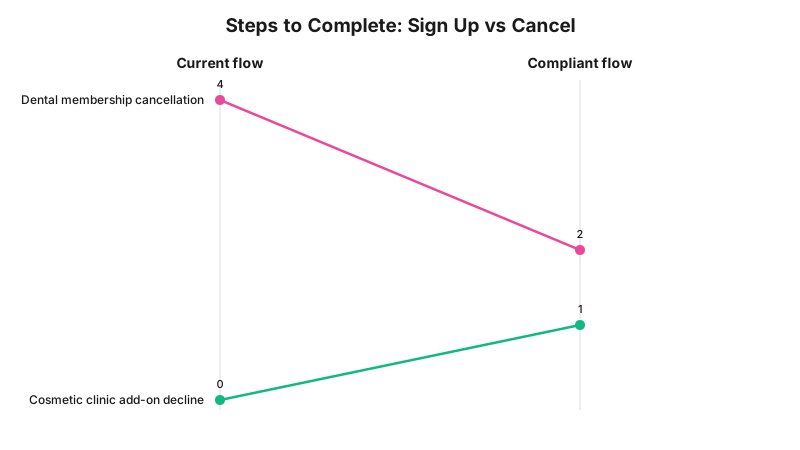
Illustrative worked-example figures only, showing the gap between how many steps a current flow takes versus a flow with an equally weighted decline option and an online cancellation path.
Takeaway: in both examples, the fix is adding a step the business currently skips, not removing a step the patient currently has.
What to Check on Your Own Site
- Load your booking widget twice, a few minutes apart. If a countdown or stock indicator has not changed in a way that reflects real bookings, it is not tied to live data.
- Screenshot every modal or upsell offer and check whether a decline option exists, sized and worded the same as the accept option.
- Cancel a membership yourself using only the account area, no calls or emails, and time it against how long signup took.
- Count how many pressure elements, timers, stock counts, “others are viewing” notices, appear on a single booking screen at once.
- Check whether your booking platform vendor has published anything about updating default templates ahead of 1 July 2027. Some of these patterns are the platform’s default, not a choice your clinic made.
The Enforcement Anchor
No infringement notice or determination exists yet under the Act’s general unfair trading prohibition, because it is not in force. That covers most of the patterns above, false urgency, confirm shaming, and stacked pressure tactics specifically.
One pattern already has a real enforcement outcome under existing law. In June 2025, the ACCC issued an infringement notice against Dendy Cinemas Pty Ltd, and Dendy paid a $19,800 penalty after the regulator alleged the business displayed prices that excluded an unavoidable per-ticket booking fee, and did not show a total price until consumers reached the final stages of the online booking process. ACCC Deputy Chair Catriona Lowe said “by initially only displaying part of the total price for a movie ticket, Dendy has reduced the ability of consumers to make an informed purchasing decision.” Payment of an infringement notice is not an admission of wrongdoing and the matter did not proceed to court, but it shows the regulator already treating late disclosure of material information, one of DLA Piper’s named dark pattern categories, as an active target under existing law.
Takeaway: the standalone dark patterns prohibition has no enforcement record yet, because it does not exist yet. The specific pattern of hiding information until late in a purchase already does.
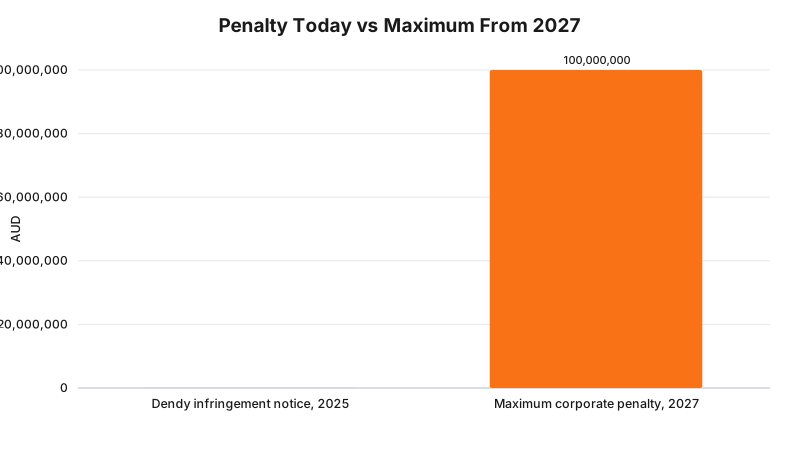
The Dendy Cinemas infringement notice penalty against the maximum civil penalty available for a corporation once the general unfair trading prohibition commences. Sources: ACCC and Allens, cited above.
Where This Gets Hard
Neither Allens nor DLA Piper’s analysis states exactly how many pressure elements on one screen crosses from a single defensible tactic into unreasonable distortion, and no court decision or ACCC guidance specific to a booking funnel exists yet, because the prohibition has not commenced. The line between a genuine, accurate scarcity indicator and a false one is comparatively clear on paper. The line between one acceptable nudge and a combination that unreasonably distorts a decision is not, and will likely only get sharper once the regulator starts issuing guidance or taking cases closer to 2027.
The regulator’s own commentary says a design pattern that manipulates a consumer or unreasonably distorts their decision-making environment is prohibited; the build consequence is that any timer, badge, or decline flow not tied to genuine, real-time data needs to be fixed or removed before 1 July 2027; whether a specific combination on your specific booking flow crosses that line is a question for your medical defence organisation or your lawyer.
Status
Passed, not commenced. As at 30 September 2026, the Competition and Consumer Amendment (Unfair Trading Practices) Act 2026 has passed both Houses of Parliament, with passage recorded on 2 July 2026. The general unfair trading prohibition and the subscription cancellation clause take effect from 1 July 2027 and are not in force today. The Australian Consumer Law’s existing misleading conduct and single price rules already apply and already cover some of the same underlying conduct, as shown by the Dendy Cinemas enforcement action above.
Frequently Asked Questions
Are dark patterns illegal in Australia right now, before the new law commences?
Not under a standalone dark patterns prohibition, since the Competition and Consumer Amendment (Unfair Trading Practices) Act 2026 does not commence until 1 July 2027. Some dark pattern conduct is already enforceable today under the Australian Consumer Law’s existing misleading conduct and single price rules, particularly hiding a mandatory fee until late in a purchase, which is the basis for the ACCC’s 2025 action against Dendy Cinemas.
What counts as a dark pattern under the new Act?
The Act itself does not use the phrase dark pattern as a defined term. Law firm analysis of the legislation, including from Allens and DLA Piper, applies that label to conduct caught by the general unfair trading prohibition, which covers manipulating a consumer or unreasonably distorting the environment in which they make a decision. Named examples in that analysis include misleading countdown timers or low stock cues, confirm shaming wording, and cancellation options hidden behind confusing menus.
When does the dark patterns prohibition start, and what applies before then?
The Act passed both Houses of Parliament on 2 July 2026 and its provisions, including the general unfair trading prohibition, commence on 1 July 2027. As at 30 September 2026, nothing in the Act is in force yet. The existing Australian Consumer Law’s misleading conduct and single price rules already apply and already cover some of the same conduct.
What penalty applies if a booking funnel still uses a dark pattern after commencement?
Once the Act commences, a body corporate faces a maximum penalty of the greater of $100 million, three times the benefit obtained, or 30% of adjusted turnover during the breach period, per contravention. An individual faces up to $2.5 million. These are the existing Competition and Consumer Act penalty settings applied to the new prohibition.
Does an honest “only 2 appointments left today” message count as a dark pattern?
Not on its own, according to DLA Piper’s analysis of the Act. Scarcity indicators become a problem when they are used to create a false sense of urgency, particularly combined with other pressure tactics, so a genuine, real-time count differs from a static badge that never changes. Whether a specific implementation would be found to unreasonably distort a consumer’s decision is a question for your lawyer to assess against your actual build, not something a general guide can certify.
Fix Your Booking Funnel Before 1 July 2027
Finding every countdown timer, guilt-worded decline button, and phone-only cancellation flow across a booking widget, a payment gateway, and a patient portal usually takes longer than a clinic expects, because most of these patterns arrived by default rather than by choice. If you would rather have your booking funnel mapped against this list and fixed as a scoped, fixed-price piece of work than find each pattern yourself, talk to us about your booking funnel.
Sources
- Federal Register of Legislation, Competition and Consumer Amendment (Unfair Trading Practices) Act 2026, status as passed, not yet in force. Checked 30 September 2026.
- Allens, Australia’s new unfair trading practices regime, what businesses need to know, July 2026. Checked 30 September 2026.
- DLA Piper, Australia introduces new unfair trading practices laws, expanded drip pricing protections and changes for subscriptions, July 2026. Checked 30 September 2026.
- ACCC, Dendy pays penalties for alleged drip pricing practices, 25 June 2025. Checked 30 September 2026.
- The Hon Dr Andrew Leigh MP, Assistant Minister for Productivity, Competition, Charities and Treasury, Unfair trading tricks and traps to be banned, 2 July 2026. Checked 30 September 2026.
Last reviewed: 30 September 2026.
Vikas Thakur
Founder of RockingWeb. 16 years of experience from working at TPG, iiNet and Monadelphous, now building websites, software and digital marketing for local businesses in Rockingham and Perth.