Drip Pricing Rules 2027: What Your Checkout Must Show
From 1 July 2027, any mandatory booking or transaction fee must sit next to the price you display, not appear for the first time at checkout. The Competition and Consumer Amendment (Unfair Trading Practices) Act 2026 passed Parliament on 2 July 2026 but has not yet commenced, and this guide covers what to change in your booking flow before it does.
 Vikas Thakur Founder, RockingWeb 13 min read
Key Takeaways
- The Competition and Consumer Amendment (Unfair Trading Practices) Act 2026 passed Parliament on 2 July 2026 and takes effect from 1 July 2027
- From that date, a mandatory booking, transaction, or facility fee must sit next to the price you display, not appear for the first time at the payment screen
- Corporate penalties reach $100 million per contravention, or three times the benefit gained, or 30% of turnover, whichever is greatest
- Individual penalties reach $2.5 million
- The ACCC already fined Dendy Cinemas $19,800 in June 2025 for a near-identical drip pricing pattern, under existing law
- The disclosure duty covers your price listing, your ads, and every step of your booking checkout, not just the final page
- As at 25 August 2026 the law is passed but not commenced. Nothing changes on your site yet, but the build work does not wait for commencement day
As at 25 August 2026, the Competition and Consumer Amendment (Unfair Trading Practices) Act 2026 has passed Parliament but is not yet in force. From 1 July 2027, any business that displays a price for a treatment or service online has to show mandatory transaction fees, booking fees, and similar charges next to that price, not reveal them for the first time at the payment screen. If your booking widget adds a fee partway through checkout, that flow needs rebuilding before commencement, because the ACCC already treats this pattern as a live enforcement target under the law as it stands today.
What the Law Actually Says
The Federal Register of Legislation lists the Competition and Consumer Amendment (Unfair Trading Practices) Act 2026 as passed, not yet in force. Multiple law firm summaries of the Act, including Allens and DLA Piper, agree on the same dates: the Bill passed both Houses on 2 July 2026, and the operative provisions commence on 1 July 2027.
The Act amends Part 3-1 of the Australian Consumer Law in two ways that matter for a booking checkout.
First, it introduces a new, standalone prohibition on unfair trading practices, a broader concept covering conduct that materially distorts a consumer’s decision through commercial pressure or manipulation.
Second, and more specifically, it adds a transaction-based charge disclosure duty. Where a business displays a price for goods or services and a transaction-based charge applies, meaning a charge tied to completing that specific purchase, the business must show, at the same time and in close proximity to the base price: the amount of the charge, or the method for working it out if a fixed figure is not possible; that the charge applies per transaction; whether the charge will or may apply; and whether the displayed base price already includes it. The disclosure has to be legible, prominent, and unambiguous, not buried in a tooltip or a terms page.
The same Act also tightens subscription contract rules: a supplier has to give an easy-to-find, straightforward way to cancel, available online if the customer signed up online, using no more steps than are reasonably necessary. That matters for any clinic running a treatment membership or skin subscription, though the disclosure duty above is the part that hits a one-off booking checkout hardest.
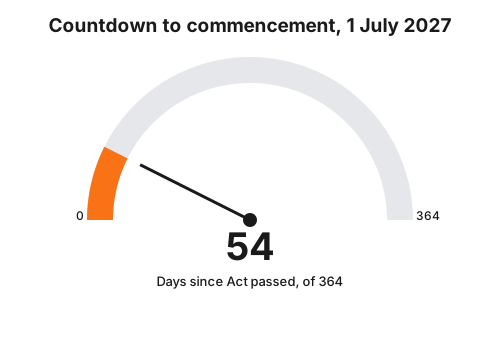
Days elapsed since the Act passed Parliament on 2 July 2026, against the full 364-day run to commencement on 1 July 2027, calculated as at 25 August 2026.
Takeaway: the rule is specific about where a fee must appear, not just whether it can be charged at all.
What This Means for the Build
Reporting the requirement is one thing. Turning it into a checkout is another, and this is where most existing booking widgets fall short.
Rename the price field wherever a mandatory fee applies. A field labelled service_price that only ever shows the treatment cost, with a separate booking_fee line injected by the payment gateway at the last step, fails the “same time, close proximity” test even if both figures are technically visible somewhere. The fix is a single displayed figure, total_price, built from service_price + mandatory_fees, shown at every point the base price currently shows.
Show the fee at three checkpoints, not one. The service or menu page, the date and time selection step, and the payment confirmation step should all show the same total. If your booking platform’s default behaviour is to add a “platform fee” or “convenience fee” only on the payment screen, that is exactly the pattern the disclosure duty targets, and it is worth checking your platform’s settings for a “show fee upfront” or “include fee in displayed price” toggle before assuming a rebuild is needed.
Separate mandatory from conditional charges in your markup. A charge that applies to every booking, for example a clinic-wide facility fee, is mandatory and needs the full disclosure treatment everywhere the price appears. A charge that only applies in some cases, for example a card surcharge that a bank transfer avoids, is conditional, and the Act’s wording (“will or may apply”) means you still have to flag it next to the price, worded as conditional rather than presented as included.
Match your structured data to what the customer actually pays. If your service pages carry schema.org/Offer markup with a price property, that figure needs to match the fully loaded total shown at the final step whenever a mandatory fee applies. A lower number in your structured data than in your checkout is the same problem in a different place, since it is often what surfaces first in a search result or an AI answer.
Sequence the reveal correctly for genuinely optional add-ons. Not every extra needs this treatment. An opt-in numbing cream add-on, chosen by the customer rather than imposed by the business, sits outside the transaction-based charge definition and can be priced and shown wherever it is offered, subject to the ordinary misleading conduct rules that already apply.
Takeaway: the build fix is almost never “add a disclaimer”. It is making one number the source of truth and showing it everywhere the price currently appears.
Decision Matrix: Which Checkout Fees Need Disclosure
| Checkout charge | Mandatory or conditional | Disclosure needed from 1 July 2027 | Where it must appear |
|---|---|---|---|
| Treatment or service price | Base price | Already required under existing law | Wherever the price is shown |
| Booking or platform fee, charged to every booking | Mandatory | Yes, full amount or method | Same screen as the base price |
| Card payment surcharge, avoidable by bank transfer | Conditional | Yes, flagged as “may apply” | Same screen as the base price |
| Clinic-wide facility or compliance fee | Mandatory | Yes, full amount or method | Same screen as the base price |
| Opt-in add-on chosen by the customer | Optional | No, outside the transaction-charge definition | Wherever the add-on is offered |
| Cancellation or no-show fee, only triggered later | Conditional on a future event | Untested against a regulator decision | Terms shown before booking is confirmed |
Takeaway: the matrix splits cleanly around one question, does this charge apply to most people who complete the booking, or only to a choice or a later event.
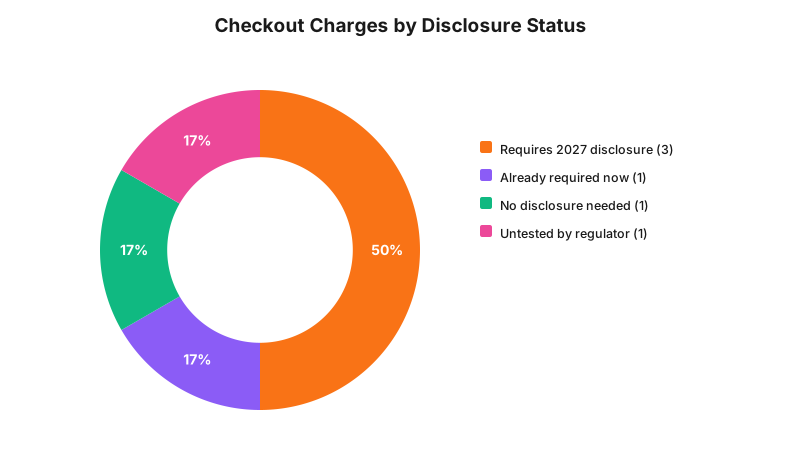
Tally of the six checkout charge rows from the decision matrix above, split by whether the transaction-based charge disclosure duty applies.
A Worked Example
Cosmetic clinic. A clinic’s service page lists “Anti-wrinkle treatment from $199”. The patient picks a time, enters their details, and reaches the payment page, where a “$47 clinic booking fee” appears for the first time, taking the total to $246. That fee is charged on every booking regardless of treatment or payment method. Under the pre-2027 pattern, the $199 figure is the only number a shopper compares against a competitor’s; the $246 figure is what they actually pay. The fix is a single displayed total, “$246 total, including $47 booking fee”, shown on the service page, the time-selection step, and the payment step alike.
Cosmetic dental practice. A practice advertises “Teeth whitening $349”. At the final payment screen, a “$50 mandatory hygiene compliance fee” appears, applied to every patient regardless of treatment, bringing the total to $399. The same fix applies: the advertised figure becomes the total figure, itemised if useful, but never lower than what the patient is asked to pay at the end.
These figures are illustrative, built to show the mechanics of the gap, not pricing drawn from any specific clinic or practice.
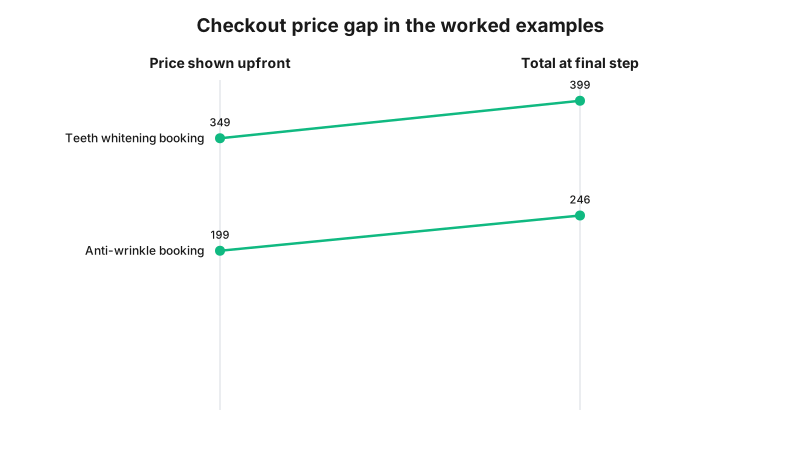
Illustrative worked-example figures only, showing where a checkout price grows between the listing page and the final payment step.
Takeaway: the shopper-facing number and the pay-facing number are meant to be one number, not two.
What to Check on Your Own Site
- Open your booking flow in a private or incognito browser window and complete a test booking without submitting payment. Note whether any figure changes between the first screen and the last.
- Search your CMS and booking platform settings for every charge that is not shown on the initial price display: booking fee, platform fee, card surcharge, facility fee, compliance fee.
- Check whether a fee is added automatically by your payment gateway’s default surcharge setting. Many clinics do not realise their platform injects this without any content change on their part.
- Check your
schema.org/Offeror product structured data. Confirm thepricevalue matches the fully loaded total shown at the final step, wherever a mandatory fee applies. - If you run a treatment membership or skin subscription, confirm an online cancellation path exists if signup happened online, and that it does not require a phone call or an in-person visit.
- Check your deposit wording. Does it state clearly when a deposit is required, how much it is, and whether it is refundable.
The Enforcement Anchor
No infringement notice or determination exists yet under the new Act, because it is not in force. That is a fact about timing, not a reason to treat the pattern as low-risk.
The ACCC has already acted against the same underlying practice under existing law. In June 2025, Dendy Cinemas Pty Ltd paid a $19,800 penalty after the ACCC issued an infringement notice alleging Dendy failed to prominently display the total single price of movie tickets, including an unavoidable per-ticket booking fee that was disclosed only at the final stage of the online booking process. Payment of an infringement notice is not an admission of wrongdoing, and the matter did not proceed to court, but it shows the ACCC treating a late-revealed mandatory fee as an active compliance target, using the ACL’s existing single-price rule, well before the 2027 disclosure duty gives it a more detailed tool to work with.
Takeaway: the specific new law has no enforcement record yet. The pattern it targets already does.
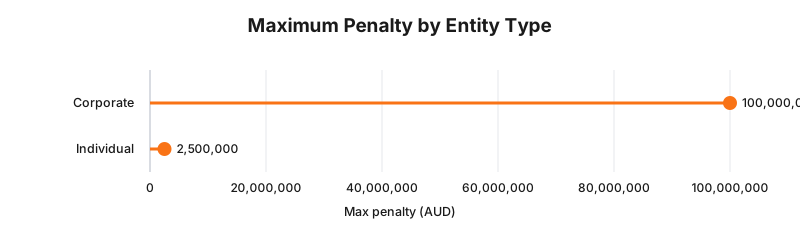
Maximum civil penalty per contravention once the unfair trading prohibition commences on 1 July 2027, for a body corporate versus an individual.
Where This Gets Hard
The Act does not define exactly how large a minority of bookings can avoid a charge before that charge stops being “mandatory” for disclosure purposes. Guidance from the ACCC aimed specifically at clinics or dental practices does not exist yet, and the law firm commentary published so far reads the general drafting, not a sector-specific application of it.
The regulator says a transaction-based charge covers an amount that is, or may be, payable as part of most transactions of that kind; the build consequence is that a fee only a small minority of patients avoid should be shown next to the treatment price rather than revealed at the final step; whether that test applies to your specific fee structure is a question for your medical defence organisation or your lawyer.
Status
Passed, not commenced. As at 25 August 2026, the Competition and Consumer Amendment (Unfair Trading Practices) Act 2026 has passed both Houses of Parliament, with passage recorded on 2 July 2026. The unfair trading prohibition and the transaction-based charge disclosure duty take effect from 1 July 2027 and are not in force today. Keep this separate from the ACL’s existing single-price and misleading conduct rules, which already apply and are the basis for the Dendy Cinemas enforcement action above.
Frequently Asked Questions
Is drip pricing already illegal in Australia?
Yes, in a general sense. The existing Australian Consumer Law already prohibits displaying a partial price when a mandatory charge is unavoidable, through the misleading conduct and single price provisions the ACCC used against Dendy Cinemas in June 2025. The 2027 changes add a specific, more detailed disclosure obligation for transaction-based charges on top of that existing rule. They do not create drip pricing liability from nothing.
When does the drip pricing disclosure rule actually start?
The Competition and Consumer Amendment (Unfair Trading Practices) Act 2026 passed both Houses of Parliament on 2 July 2026. The transaction charge disclosure and unfair trading provisions commence on 1 July 2027. As at 25 August 2026, nothing in the Act is in force yet.
Does this apply to a refundable deposit a clinic takes to hold a booking?
It depends on whether the deposit is a charge most patients end up paying as part of the transaction, or a genuinely optional amount only some patients are asked for. That distinction has not been tested by a regulator decision, so treat it as a question for your own legal advice rather than something a general guide can answer for your specific booking terms.
What penalty applies if a booking checkout breaches the new rule?
Once the Act commences, a body corporate faces a maximum penalty of the greater of $100 million, three times the benefit obtained, or 30% of adjusted turnover during the breach period, per contravention. An individual faces up to $2.5 million. These are the existing Competition and Consumer Act maximum penalty settings, applied to the new prohibition once it takes effect.
Do I need to change my booking widget now, in August 2026?
Not for this specific law, since it is not in force yet. The ACCC is already enforcing the same total-price principle under existing law, so a checkout that reveals fees late is already a live enforcement risk today, well before 2027 gives the ACCC a second, more detailed tool to use against it.
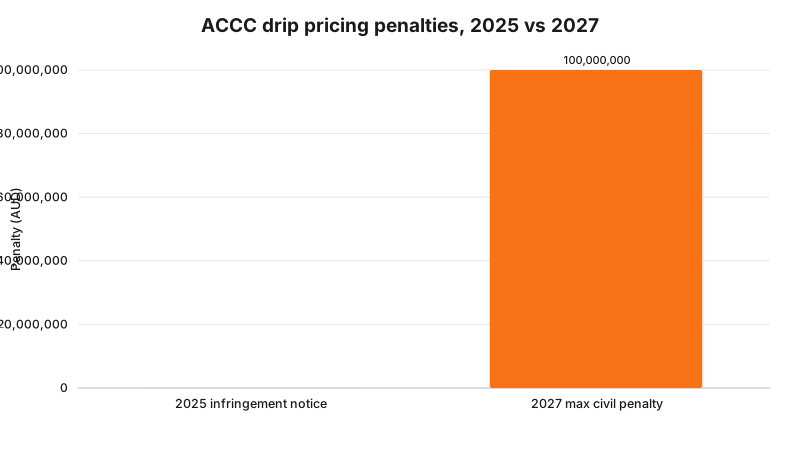
The Dendy Cinemas infringement notice penalty against the maximum civil penalty available for a corporation once the new unfair trading prohibition commences. Sources: ACCC, Allens, DLA Piper, cited above.
Fix Your Checkout Before 1 July 2027
Rebuilding a booking checkout so the total price is the only price a patient ever sees takes more than swapping a label. It usually means tracing how your booking platform, payment gateway, and structured data each independently decide what number to show, then making one of them the source of truth for the rest. If you would rather have that mapped and fixed as a scoped, fixed-price piece of work than guess at it yourself, talk to us about your booking checkout.
Sources
- Federal Register of Legislation - Competition and Consumer Amendment (Unfair Trading Practices) Act 2026, status as passed, not yet in force. Checked 25 August 2026.
- Allens - Australia’s new unfair trading practices regime, what businesses need to know, July 2026.
- DLA Piper - Australia introduces new unfair trading practices laws, expanded drip pricing protections and changes for subscriptions, July 2026.
- ACCC - Dendy pays penalties for alleged drip pricing practices, 25 June 2025.
- Parliament of Australia - Bills Digest, Competition and Consumer Amendment (Unfair Trading Practices) Bill 2026.
Last reviewed: 25 August 2026.
Vikas Thakur
Founder of RockingWeb. 16 years building for companies like TPG, iiNet and Monadelphous, now focused on websites and marketing that comply with AHPRA's advertising guidelines and still book patients.