88% of Health Queries Now Trigger an AI Overview
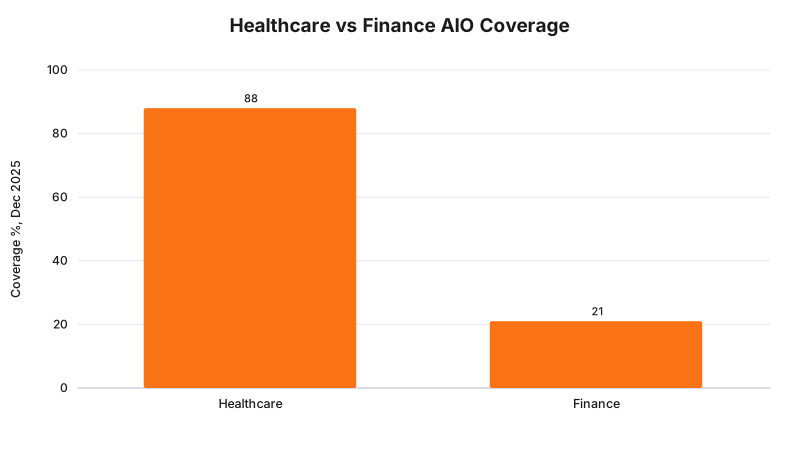
Healthcare AI Overview coverage hit 88% of tracked keywords by December 2025, the highest of any vertical BrightEdge measures. Here's what that saturation level changes about how a cosmetic clinic or dental practice needs to build its treatment and FAQ pages.
 Vikas Thakur Founder, RockingWeb 14 min read
On this page 12
- Key Takeaways
- What BrightEdge’s Tracking Shows
- What Saturation Means for Your Clinic’s Build
- Which Query Types on Your Site Are Already Saturated
- A Worked Example: Two Clinic Pages, Two Outcomes
- What to Check on Your Own Site
- Is There Anything Forcing This Change?
- Where This Gets Hard
- Status
- Frequently Asked Questions
- Get Your Treatment Pages Checked Against This Data
- Sources
Search “how long does lip filler last” and there is a good chance Google answers the question before you ever reach a website. Search “what does teeth whitening feel like” and the same thing happens. That is not a hunch. BrightEdge’s Generative Parser tracked 2,760 healthcare keywords from May 2024 through December 2025 and found AI Overview coverage climbed from 72% to 88%, the highest saturation rate of any vertical the tool measures, well ahead of finance at 21% over the same window.
Key Takeaways
- Healthcare AI Overview coverage reached 88% of tracked keywords by December 2025, up from 72% in May 2024, according to BrightEdge’s Generative Parser tracking of 2,760 keywords
- Healthcare is the most AI Overview saturated vertical BrightEdge tracks, well ahead of finance at just 21% coverage in the same December 2025 snapshot
- Treatment and procedure queries, the kind a cosmetic clinic’s service pages target, reached 100% AI Overview coverage in December 2025, up from 45% in 2023
- Specialty coverage varies widely: BrightEdge’s Genetic/Genomic category sits at 97% saturation while Mental Health and Eating Disorders sit at 63%
- Local “near me” healthcare searches are the exception, climbing from 0% AI Overview coverage in May 2024 to only 11% by December 2025
- Ranking in the organic top 10 does not guarantee an AI Overview citation: healthcare citations overlapped with top-10 rankings only 24% of the time as of BrightEdge’s February 2026 report, against 11.3% for finance
- Monthly volatility in healthcare AI Overview coverage has settled, down from roughly 20 percentage points of swing in early 2024 to about 5 percentage points by late 2025
Healthcare AI Overview coverage reached 88% of tracked keywords by December 2025, the highest of any vertical BrightEdge measures, up from 72% in May 2024. This is BrightEdge’s own keyword panel, not an Australia-specific study, so treat the exact figure as directional for an Australian clinic rather than a local measurement.
For a cosmetic clinic or cosmetic dental practice, that 88% figure is not a curiosity to file away. It is the search environment your treatment pages, FAQ pages, and blog posts now sit inside, and most clinic websites are still built for a results page that stopped working the way it used to. This post uses BrightEdge’s published tracking data to explain what “saturated” means for a clinic’s build, which query types on your own site are already caught in it, and what to change so the site still earns a click when the answer box is already full.
What BrightEdge’s Tracking Shows
BrightEdge is a paid enterprise SEO platform, and its 18 Months of AI Overviews report (29 January 2026) uses its Generative Parser tool to track how often a Google AI Overview appears against a fixed set of 2,760 healthcare keywords, checked at six points between May 2024 and December 2025. The headline number: healthcare AI Overview coverage moved from 72% to 88% over that period. The same report states the comparison plainly: “Healthcare sits at 88% AI Overview coverage. Finance is at 21%.” No other vertical in BrightEdge’s tracking comes close to healthcare’s saturation level.
A separate BrightEdge report, Healthcare and AI Overviews: How Google Sharpened Its Approach Over Three Years (24 December 2025), runs a longer three-year snapshot and reports healthcare keyword coverage at 59% in 2023, 84% in 2024, and 89% in 2025. The exact figures differ slightly from the 18-month report because the two reports use different equivalent-snapshot methodologies, but the direction and the scale of the change are the same: healthcare AI Overview coverage roughly kept climbing, or at minimum stayed in the high 80s, across three straight annual checkpoints.
| Period | Healthcare educational-query coverage | Source |
|---|---|---|
| May 2024 | 82% | BrightEdge, January 2026 |
| September 2024 | 75% | BrightEdge, January 2026 |
| December 2024 | 91% | BrightEdge, January 2026 |
| May 2025 | 92% | BrightEdge, January 2026 |
| September 2025 | 90% | BrightEdge, January 2026 |
| December 2025 | 93% | BrightEdge, January 2026 |
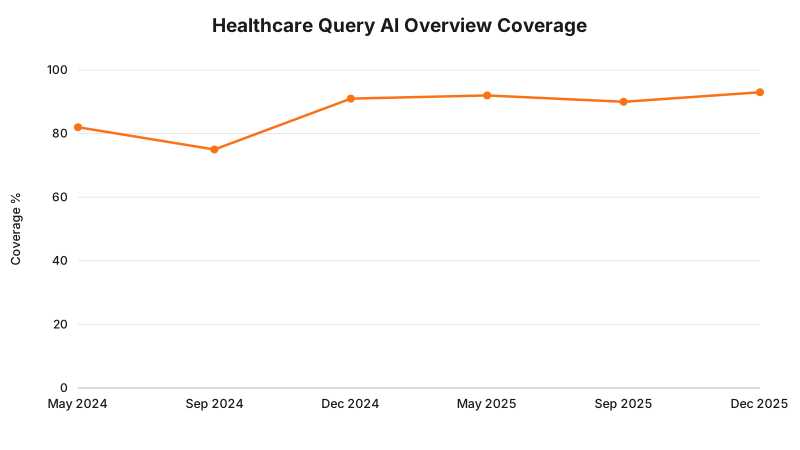
Notice the dip in September 2024 before the climb resumed. BrightEdge’s own methodology note says monthly variance ran as high as roughly 20 percentage points in early 2024 and settled to about 5 percentage points by late 2025. Coverage did not rise in a straight line, and a single month’s reading is not the whole story.
Takeaway: healthcare AI Overview coverage sits in the high 80s to low 90s as of the most recent BrightEdge snapshot, and it got there through an uneven climb, not a steady ramp.
What Saturation Means for Your Clinic’s Build
An 88% coverage rate changes what “ranking well” is worth. If Google is already answering the question inside the search page itself, the job of a treatment page is not just to rank, it is to be the source Google’s summary pulls from and links back to. That is a build problem, not a copywriting problem, and it comes down to three concrete changes.
First, put the direct answer first. Most clinic treatment pages open with a hero image, a paragraph about the clinic’s history, or a general introduction to the procedure before ever answering the exact question in the page’s target query. If your page targets “how long does lip filler last,” the first two sentences of visible body copy should state the answer plainly: a specific duration range and what affects it. Push the clinic backstory and the booking widget further down. An AI Overview extracts short, self-contained factual statements, and a page that buries its answer under three paragraphs of introduction gives it nothing clean to lift.
Second, add FAQPage schema that matches a visible FAQ section on the same page, not just in the frontmatter of a blog post. Most booking-platform templates (Cliniko, Dental4Windows-integrated sites, and similar) do not add this by default on a service page, only on blog posts if at all. A treatment page with three to five genuinely common questions, each with a two-to-three-sentence answer, wrapped in FAQPage structured data, gives Google’s crawler and its Generative Parser-equivalent tooling a second, cleanly marked-up source for the same information the prose already states.
Third, check whether MedicalWebPage or MedicalProcedure schema.org markup is present on procedure pages. It is not a requirement anywhere BrightEdge’s data touches on, and it will not force a citation on its own, but it is a low-cost, unambiguous signal about what kind of page Google is looking at, and most clinic sites built on a generic web template skip it entirely.
Takeaway: at 88% coverage, the fix is not writing more content, it is restructuring the content you already have so the answer sits at the top and is marked up in a way both a human skimmer and an AI parser can lift cleanly.
Which Query Types on Your Site Are Already Saturated
Not every page on a clinic site carries the same saturation risk. BrightEdge’s December 2025 breakdown of clinical query types shows a wide spread, and the spread maps closely onto the kind of pages a cosmetic clinic or dental practice publishes.
| Query type BrightEdge tracks | AI Overview coverage, Dec 2025 | Coverage in 2023 | Build priority for a page in this category |
|---|---|---|---|
| Treatment/procedure queries | 100% | 45% | Highest: answer-first paragraph and FAQPage schema, no delay before the direct answer |
| Pain-related queries | 98% | 58% | High: state discomfort and recovery expectations near the top |
| Symptoms/conditions queries | 93% | 57% | High: lead with the plain-language definition, detail after |
| Medical coding queries | 90% | 67% | Moderate: mostly relevant to billing and insurance-facing pages |
| Local “near me” queries | 11% | 0% | Low for AI Overview work: prioritise Google Business Profile completeness instead |
A cosmetic clinic’s treatment-explainer pages, the ones answering “how does the procedure work” or “what does recovery look like,” sit in the most saturated category BrightEdge tracks: 100% coverage in December 2025, up from 45% just two years earlier. That is the steepest jump in the dataset, and it is exactly the content type most clinic sites lean on for organic traffic.
BrightEdge’s specialty-level breakdown, drawn from its general healthcare taxonomy rather than a cosmetic-specific one, shows the same pattern holds across medical fields generally: definitional, procedural specialties saturate hardest, while sensitive or highly individualised topics saturate less.
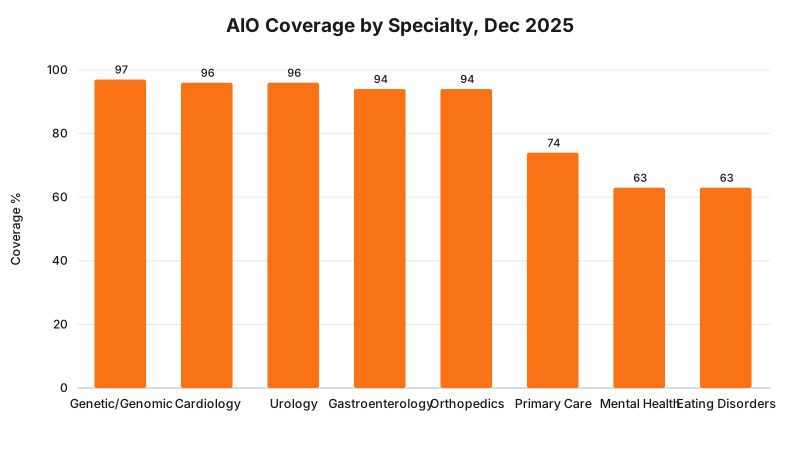
The gap between Genetic/Genomic at 97% and Mental Health or Eating Disorders at 63% is not a fluke. A query like “what causes an eating disorder” has no single clean factual answer Google can safely summarise, while “what is a genetic test for” does. Cosmetic procedure queries sit closer to the high-coverage end of that spectrum: they are largely factual and procedural, which is exactly the kind of query an AI Overview is built to answer.
Takeaway: procedure and pain-related pages face the steepest AI Overview competition on your site, while general enquiry and locality-qualified pages face the least, and your content priorities should follow that split rather than treat every page the same.
A Worked Example: Two Clinic Pages, Two Outcomes
A cosmetic injectables clinic
Picture a Perth cosmetic clinic’s page targeting “how long does lip filler last.” The current version opens with a paragraph about the clinic’s philosophy, a photo carousel, and a booking button above the fold, with the actual duration answer three paragraphs down, unmarked by any structured data. Under an 88% baseline coverage rate for healthcare generally, and 100% for treatment/procedure queries specifically per BrightEdge’s tracking, that page is very likely to see an AI Overview appear for its target query. Whether the clinic’s own site gets cited inside that Overview, rather than a competitor’s or a general health publisher’s, depends on whether the page gives Google’s summary tooling a short, specific, extractable answer to lift. The build fix: move a direct two-sentence answer (“Lip filler typically lasts 6 to 18 months, depending on the product and injection site. Most patients need a top-up around the 9 to 12 month mark.”) to the top of the page, and add FAQPage schema for the three or four questions patients ask at consultation, each with a matching visible answer on the page.
A cosmetic dental practice
A cosmetic dentistry practice’s page for “do veneers hurt” faces the same structural problem from a different angle. Pain-related queries sat at 98% AI Overview coverage in December 2025, per BrightEdge, up from 58% in 2023, one of the steepest jumps in the dataset alongside treatment/procedure queries. If the practice’s current page spends its opening paragraphs on the dentist’s qualifications before addressing the pain question directly, it is handing Google’s Overview nothing to extract except a generic reassurance, easy to summarise from a competitor’s page instead. The fix mirrors the clinic example: a direct opening statement about what patients typically feel during and after preparation, followed by the credentials and booking content further down the page.
Takeaway: in both cases the treatment itself does not change, only the order and markup of the same information, and that reordering is the entire build fix.
What to Check on Your Own Site
- For every treatment or procedure page, confirm a direct, specific answer sits within the first two sentences of visible body copy, not below a hero image, video, or clinic history paragraph
- Add FAQPage schema, matched to a visible FAQ section, on every treatment page carrying three or more commonly asked patient questions
- Check whether MedicalWebPage or MedicalProcedure structured data is present on your procedure pages; most booking-platform templates skip it by default
- Search your five highest-traffic informational queries in an incognito browser and note whether an AI Overview appears, and which domain it cites, not just where your page ranks
- For any page targeting a “near me” or locality-qualified query, check Google Business Profile completeness first; near-me AI Overview coverage sits at only 11%, so local pack visibility still matters more there
- Re-check quarterly rather than once. BrightEdge’s own tracking shows swings of up to 20 percentage points month to month in earlier periods, so a single snapshot is not the end of the story
Is There Anything Forcing This Change?
No. This is not a compliance rule, and no regulator issues an infringement notice for a page that fails to earn an AI Overview citation. There is no enforcement anchor to point to here, and it would be dishonest to dress up an unrelated regulatory case as one.
What does have real, measurable teeth is the commercial consequence BrightEdge’s own citation data shows. Healthcare pages that rank in the organic top 10 were cited inside the matching AI Overview only 24.0% of the time as of BrightEdge’s February 2026 citation report, close to flat on the prior year’s 23.9%, against 11.3% for finance (up from 7.6%). Healthcare has the highest citation overlap of the nine verticals BrightEdge tracked in that report, but “highest” still means roughly three out of every four top-10-ranking healthcare pages were not the page an AI Overview chose to cite. Ranking is necessary but nowhere near sufficient, and that gap between ranking and citation is the actual competitive ground a clinic’s build sits on.
Where This Gets Hard
Three honest limits apply to everything above.
BrightEdge is a commercial SEO vendor selling a platform built on this same tracking, and its Generative Parser methodology is proprietary. No independent, publicly auditable dataset confirms these exact percentages; they are BrightEdge’s own reported figures from a fixed panel of 2,760 healthcare keywords, not a full census of every possible clinic-relevant search.
None of BrightEdge’s published reports break healthcare coverage out by country. The tracking almost certainly weights heavily toward US search behaviour, and an Australian clinic’s actual query mix, and its actual AI Overview exposure with it, could sit meaningfully above or below the 88% headline figure depending on how closely local patient search habits match BrightEdge’s tracked keyword set.
There is no published recipe that guarantees a citation. The build changes in this post, answer-first structure and matching structured data, are the patterns BrightEdge’s own reporting and Google’s stated approach to AI Overviews both point toward, not a documented cause-and-effect rule. A page can do everything in the checklist above and still not be the one Google’s Overview chooses to cite for a given search.
Status
This is a documented search-behaviour trend, not a law or regulation, so there is no in-force, passed-but-not-commenced, or proposal status to report the way there would be for a compliance rule. What can be stated as of 15 August 2026: BrightEdge’s healthcare coverage figures run through December 2025, and its citation-overlap figures run through February 2026. Both are the most recent published snapshots at the time of writing, and BrightEdge has not stated whether or how often it will keep updating this specific healthcare series.
Frequently Asked Questions
What percentage of healthcare searches trigger a Google AI Overview?
BrightEdge’s Generative Parser tracked 2,760 healthcare keywords and found 88% carried an AI Overview by December 2025, up from 72% in May 2024. That is the highest coverage rate of any vertical BrightEdge tracks.
Does a high AI Overview rate mean a clinic will lose website traffic?
Not automatically. BrightEdge’s separate citation data shows healthcare pages that rank in the organic top 10 are cited inside the AI Overview only 24% of the time, so the real risk is losing the citation, not simply having an AI Overview appear above your listing.
How does a clinic get its treatment pages cited inside a healthcare AI Overview?
Put a direct, specific answer in the first two sentences of the page, back it with matching FAQPage schema, and check the page in an incognito search to see which domain the AI Overview cites for that query. There is no published guarantee, only patterns BrightEdge’s tracking has observed.
Get Your Treatment Pages Checked Against This Data
Get in touch with RockingWeb and we will review your highest-traffic treatment and FAQ pages against the patterns in this post, check whether an AI Overview currently appears for your target queries and which domain it cites, and return a written list of the pages worth restructuring first. If you would rather see the platform first, create a RockingWeb account.
Sources
- BrightEdge - 18 Months of AI Overviews: What Healthcare Tells Us About Where Finance Is Headed, 29 January 2026. Checked 15 August 2026.
- BrightEdge - Healthcare and AI Overviews: How Google Sharpened Its Approach Over Three Years, 24 December 2025. Checked 15 August 2026.
- BrightEdge - AI Overviews at the One-Year Mark: Presence, Size, and What They’re Citing, 12 February 2026. Checked 15 August 2026.
- BrightEdge - company homepage. Checked 15 August 2026.
Last reviewed: 15 August 2026.
Vikas Thakur
Founder of RockingWeb. 16 years building for companies like TPG, iiNet and Monadelphous, now focused on websites and marketing that comply with AHPRA's advertising guidelines and still book patients.

![Backlinks Needed to Rank Google 2025: ChatGPT Era Analysis [SEO Data]](/assets/backlinks-google-chatgpt-ranking-BI-djUvw.png)