Get Cited in AI Overviews Without an AHPRA Breach
Healthcare pages get cited inside a Google AI Overview only 24% of the time even when they rank in the organic top 10, and the content AI Overviews prefer to quote is the same confident, superlative language AHPRA bans in cosmetic advertising.
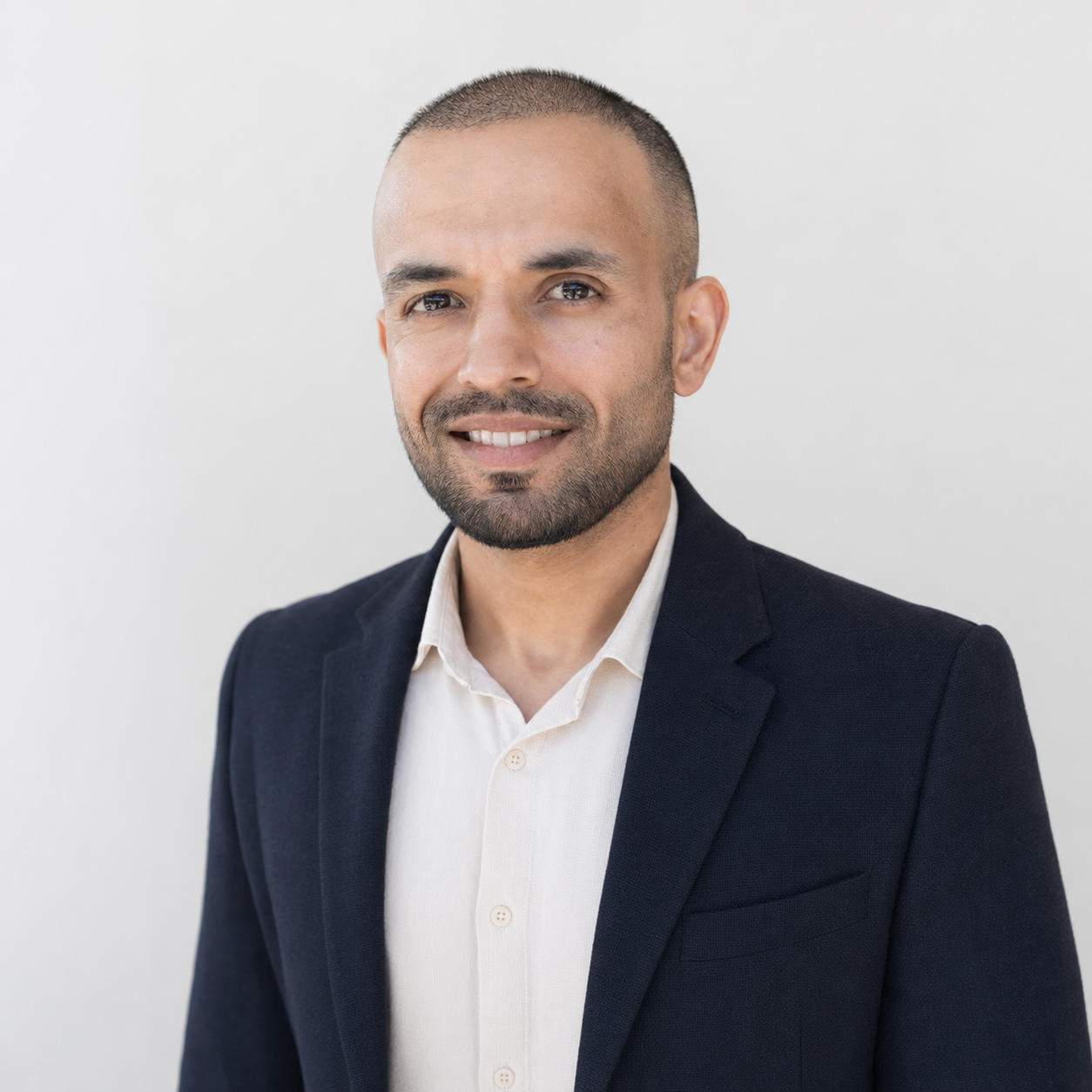 Vikas Thakur Founder, RockingWeb 11 min read
On this page 13
- Key takeaways
- What the Rule Actually Says
- What That Means for the Build
- Compliant Phrasing Decision Matrix
- Worked Example: Cosmetic Clinic
- Worked Example: Cosmetic Dentistry
- What to Check on Your Own Site
- Enforcement Anchor
- Where This Gets Hard
- Status Line
- Frequently Asked Questions
- Need a hand with your website?
- Sources and References
A cosmetic clinic page that says “the safest, most effective lip filler in Perth” reads well to a language model and badly to AHPRA. Healthcare pages ranking in Google’s organic top 10 get cited inside an AI Overview only 24% of the time, according to BrightEdge’s Generative Parser tracking published in its 18 Months of AI Overviews report, dated 29 January 2026. Getting into that 24% usually means writing the kind of confident, specific, superlative-heavy content AI systems like to quote. For a clinic advertising a higher risk non-surgical cosmetic procedure, several of the phrasing choices that help win a citation are the same phrasing choices AHPRA’s advertising guidelines restrict. This post explains where that conflict sits on the page and how to write around it without losing the citation.
Key takeaways
- Healthcare pages ranking in the organic top 10 are cited inside a Google AI Overview only 24% of the time, per BrightEdge’s Generative Parser tracking (18 Months of AI Overviews, 29 January 2026)
- Across all verticals, only about 17% of AI Overview citations come from a page that also ranks in the organic top 10, per BrightEdge’s Generative Parser Research, February 2026
- AHPRA’s guidelines for advertising higher risk non-surgical cosmetic procedures took effect 2 September 2025 and ban minimising words such as gentle, simple, safe, quick or easy unless risk information sits alongside them
- Section 133 of the Health Practitioner Regulation National Law names five grounds for unlawful health service advertising: false or misleading content, an undisclosed inducement, a testimonial, an unreasonable expectation of benefit, and encouragement of unnecessary use
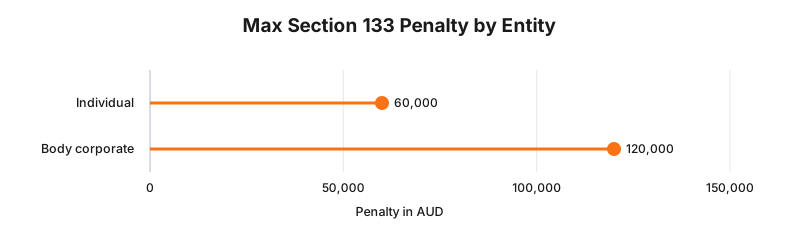
- Breaching section 133 carries a maximum penalty of $60,000 for an individual and $120,000 for a body corporate, following a 2022 amendment to the National Law
- Medical practitioners are not covered by the September 2025 guidelines and instead remain under the Medical Board of Australia’s own 2023 cosmetic procedure guidelines
- AHPRA logged 380 advertising complaints and found 65 non-compliance cases in a targeted cosmetic surgery audit in the 2022/23 financial year
What the Rule Actually Says
AHPRA’s Guidelines for advertising higher risk non-surgical cosmetic procedures took effect on 2 September 2025 and apply to every registered health practitioner except medical practitioners, who stay under the Medical Board of Australia’s own 2023 cosmetic procedure guidelines. Section 6 of AHPRA’s guidelines, headed “Risk, recovery, and idealising,” bans minimising words including gentle, simple, safe, quick and easy unless clear risk information appears next to them. Where a format cannot fit full risk information, the guideline requires a link to where that information can be found rather than dropping it.
That sits alongside section 133 of the Health Practitioner Regulation National Law, which names five specific grounds for unlawful health service advertising: content that is false, misleading or deceptive; an undisclosed gift, discount or other inducement; a testimonial; a statement creating an unreasonable expectation of beneficial treatment; and a statement encouraging unnecessary use of a health service. A breach carries a maximum penalty of $60,000 for an individual and $120,000 for a body corporate, following a 2022 amendment that raised both caps twelvefold. These are the National Law maxima. Some secondary sources still circulate the older $30,000/$60,000 figures, so check the current legislation directly rather than a marketing blog before quoting a number, and confirm the cap that applies in your own state or territory, since each jurisdiction adopts National Law amendments through its own local Act.
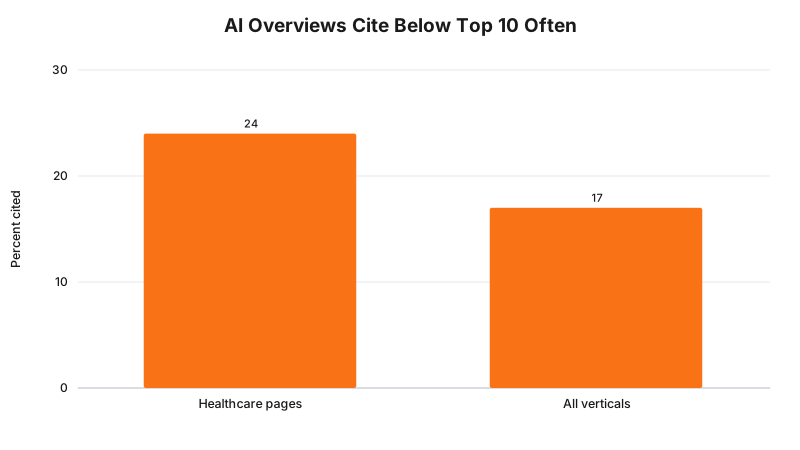
BrightEdge’s tracking shows this pattern is not unique to healthcare. Cited healthcare pages held a top-10 ranking only 24% of the time, and across every vertical BrightEdge tracks, only about 17% of AI Overview citations came from a page that also ranked in the organic top 10. Neither figure supports treating organic rank as a proxy for citation odds.
None of that is new regulatory ground. What is new is the collision with how AI Overviews select what to quote. BrightEdge’s research shows AI Overviews favour direct, specific, confidently stated answers over hedged or vague ones, the exact writing style that section 133 and AHPRA’s guidelines restrict for higher risk cosmetic procedures. A clinic page can still win a citation. It just cannot win one the way an unregulated industry would.
What That Means for the Build
The fix is not writing less specifically. It is being specific about facts that carry evidence, and hedged or omitted on facts that carry a claim.
Split every treatment page into two content classes before you write a word:
- Verifiable, sourced facts: TGA product approval status, active ingredient, typical dose range, recovery window as stated in product information, cooling-off period length, GP referral requirement. Write these plainly and specifically. Specificity here is compliant and it is exactly what an AI Overview wants to quote.
- Outcome and quality claims: how good the result looks, how safe or comfortable the procedure is, how it compares to a competitor’s service. Write these only with the required risk information attached, or leave the superlative out and replace it with a sourced fact instead.
On the page itself:
- Put the answer to the query in the first two sentences of the section, not the last. AI Overviews extract from the top of a well-scoped block, not from a full page.
- Never use “safe”, “gentle”, “quick” or “easy” as a bare adjective. If you use one, the next sentence must carry the matching risk statement, per AHPRA’s Rule 6.2.
- Do not publish a patient testimonial, a star-rating widget pulling in outcome-referencing text, or a “best in [suburb]” comparative line. All three risk a section 133 breach independent of the AI Overview question.
- Match FAQPage schema to a visible, on-page FAQ section using the same question wording. A mismatch between schema and visible content is itself a lint failure on this site and a red flag for any assistant checking source reliability.
- Cite AHPRA, the TGA or the product’s Australian product information directly, by name, with a link. That is a source citation an AI system can trust and forward, and it doubles as your own evidence trail if a complaint is ever raised.
Compliant Phrasing Decision Matrix
| Claim type | AI Overview appeal | AHPRA/National Law status | What to write instead |
|---|---|---|---|
| ”The safest filler available” | High: confident superlative | Banned minimising word without risk info attached (Rule 6.2) | “[Product] is TGA-approved for [indication]; common risks include bruising and swelling" |
| "Results last up to 12 months” | High: specific number | Compliant if sourced to product information, not a guarantee | Keep, but cite the product information document by name |
| Patient testimonial quote | High: social proof language models like | Banned outright, testimonial under section 133 | Replace with a sourced fact or an AHPRA-compliant real, unedited before/after image with a results-vary warning |
| ”Best cosmetic clinic in Perth” | Medium: comparative claim | Risks an unreasonable-expectation-of-benefit breach | State a verifiable fact instead, such as years operating or AHPRA registration number |
| ”7-day cooling-off period applies” | Medium: procedural fact | Compliant and required disclosure under the September 2025 guidelines | Keep as written |
| ”Quick, easy procedure, back to work same day” | High: reassurance language | Two banned minimising words in one line, no risk info attached | ”Typical downtime is [X] days; individual recovery varies” |
Worked Example: Cosmetic Clinic
A Perth cosmetic clinic’s anti-wrinkle injection page currently opens with: “Get the safest, most natural-looking results in Perth. Quick appointments, zero downtime.” Every clause in that sentence risks a section 133 issue: “safest” is a bare minimising word, “most natural-looking” implies an outcome comparison, and “zero downtime” is an outcome claim with no risk information attached.
Rewritten to hold the citation appeal and drop the exposure: “Anti-wrinkle injections use a TGA-approved botulinum toxin product. Most patients see results within 3 to 5 days, with effects that typically last 3 to 4 months, according to the product’s Australian product information. Common side effects include bruising, swelling and headache; a full risk summary is available on request.” Every number is sourced, every hedge is deliberate, and the sentence structure still puts a specific, citable fact in the first line.
Worked Example: Cosmetic Dentistry
A cosmetic dental practice’s veneer page currently reads: “Simple, pain-free veneers that transform your smile in one visit.” Three problems: “simple” and “pain-free” are bare minimising words, and “transform” implies an outcome guarantee that section 133’s unreasonable-expectation-of-benefit ground covers.
Rewritten: “Porcelain veneers are typically fitted over 2 to 3 appointments. The fitting process involves removing a thin layer of enamel, which some patients find sensitive; your dentist will discuss anaesthetic options at your consultation. Veneers are a permanent alteration to the tooth.” That version keeps the specific appointment count an AI Overview can quote, while replacing the outcome guarantee with a procedural fact plus the required risk framing.
What to Check on Your Own Site
- Search your treatment pages for “safe”, “gentle”, “simple”, “quick” and “easy” and confirm each instance sits next to a risk statement, not alone
- Check every before/after image for a visible results-vary warning and confirm the images are real, unedited photographs
- Search for any embedded review widget, testimonial slider, or quoted patient comment referencing an outcome, symptom or treatment, and remove it
- Confirm your FAQPage schema questions match the visible on-page FAQ text word for word
- Run your top 10 treatment queries in an incognito Google search and note whether an AI Overview appears and which domain it cites, then check whether that domain is yours
- Confirm every specific claim on the page (dose, duration, recovery time, cooling-off period) is traceable to a named, linked source: the TGA, AHPRA, or the product’s Australian product information
Enforcement Anchor
AHPRA ran a targeted cosmetic surgery advertising audit in the 2022/23 financial year, logging 380 advertising complaints and finding 65 non-compliance cases, figures the regulator published in its own reporting on the cosmetic guidelines rollout. That audit predates the September 2025 guidelines and shows enforcement activity against exactly this category of advertising claim before the newer, stricter rule set even existed. No published AHPRA determination naming a specific clinic over an AI-Overview-optimised claim exists as at this writing; the audit figures above are the closest verified evidence that non-compliant claim language in this category draws regulatory attention rather than only theoretical exposure.
Where This Gets Hard
There is no published rule that tells you exactly which phrasing an AI Overview will choose to quote, and no AHPRA guidance written with AI search in mind at all. The advice in this post is a reasonable inference from two separate, real data sets: what BrightEdge’s tracking shows AI Overviews tend to favour, and what section 133 and AHPRA’s guidelines say is or is not permitted. Whether a specific sentence on your specific page crosses the line into an unreasonable expectation of benefit, or whether a specific piece of phrasing would in practice draw an AI Overview citation, are two different judgement calls, one legal and one algorithmic, and neither can be answered with certainty in advance. The regulator says what section 133 and the guidelines require; the build consequence is the phrasing choices set out above; whether a specific claim on your site meets that standard is a question for your medical defence organisation or your lawyer.
Status Line
AHPRA’s Guidelines for advertising higher risk non-surgical cosmetic procedures, and section 133 of the Health Practitioner Regulation National Law with its 2022 penalty increase, are both currently in force as at the date of this post, 9 October 2026.
Frequently Asked Questions
Can a cosmetic clinic use words like safe, gentle or quick to get cited in an AI Overview?
Not on their own. AHPRA’s guidelines for advertising higher risk non-surgical cosmetic procedures ban minimising words such as gentle, simple, safe, quick or easy unless clear risk information sits next to them, so a page can still use those words if it pairs them with the required risk disclosure.
Does ranking in the organic top 10 guarantee a healthcare page gets cited in an AI Overview?
No. BrightEdge’s Generative Parser tracking found healthcare pages that rank in the organic top 10 are cited inside the AI Overview only 24% of the time, and across all verticals only about 17% of AI Overview citations come from an organic top-10 page.
Is a testimonial or patient review the same problem as an AI Overview claim?
They sit under the same rule but are not identical. Section 133 of the Health Practitioner Regulation National Law bans testimonials outright in health service advertising, while unsubstantiated outcome claims and banned minimising words are a separate, related restriction under AHPRA’s guidelines. Both carry the same penalty exposure.
Need a hand with your website?
If you want a second pair of eyes on how this applies to your own site, request a callback and we will talk it through.
Sources and References
- BrightEdge, 18 Months of AI Overviews, 29 January 2026, healthcare citation-overlap data. brightedge.com. Date checked: 15 August 2026.
- BrightEdge, Generative Parser Research, February 2026, cross-vertical citation-to-top-10 overlap data. brightedge.com/optimize-for-google-ai-overviews. Date checked: 15 August 2026.
- AHPRA, Guidelines for advertising higher risk non-surgical cosmetic procedures, effective 2 September 2025. ahpra.gov.au. Date checked: 15 August 2026.
- Health Practitioner Regulation National Law, section 133. legislation.gov.au. Date checked: 15 August 2026.
- AHPRA, News: New cosmetic procedure guidelines, cosmetic surgery audit complaint and non-compliance figures for 2022/23. ahpra.gov.au. Date checked: 15 August 2026.
Last reviewed: 15 August 2026.
Vikas Thakur
Founder of RockingWeb. 16 years of experience from working at TPG, iiNet and Monadelphous, now building websites, software and digital marketing for local businesses in Rockingham and Perth.