One Practitioner, One Profile: Google's GBP Rule
Google's own guidelines say a solo practitioner should share one Business Profile with the practice, and only add a separate practitioner profile once two or more public-facing practitioners work from the same address. Here is the exact rule, the naming format Google requires, and how to check which structure your clinic or practice actually has.
 Vikas Thakur Founder, RockingWeb 12 min read
Key takeaways
- Google’s guidelines say there should be one Business Profile per business, with a stated exception for individual practitioners and departments at shared locations
- Two or more public-facing practitioners at one address: the organisation creates its own profile, and each practitioner gets a separate profile named after them only, not the organisation
- One public-facing practitioner at a branded location: Google’s guidance says to share a single profile, named “[Brand or company]: [Practitioner name]”, for example “Allstate: Joe Miller”
- The practitioner profile title must not include the organisation’s name, per Google’s own naming rule for this profile type
- A solo dentist needs one profile. A two-practitioner clinic needs three. A five-injector cosmetic clinic needs six, one for the practice plus one per public-facing practitioner
- This is Google’s current, live policy as at 15 August 2026, checked directly on Google’s own support page, not a proposal or a legal requirement
As at 15 August 2026, Google’s own Business Profile guidelines set a clear rule: a business gets one profile, full stop, except practitioners and departments at shared locations such as clinics, hospitals, and universities, which may run separate pages. Inside that exception sits a second rule that trips up most multi-practitioner clinics. Whether you need one shared profile or several separate ones depends entirely on how many public-facing practitioners work from the same address, and Google spells out the naming format for each case. Get the structure wrong and you are not just leaving visibility on the table. You are running duplicate listings Google’s own policy says it does not allow.
Picture a cosmetic clinic with a principal doctor, three injecting nurses, and a laser technician, all listed under one shared Google profile with the clinic’s name as the title. Or the opposite: a solo dental practice where the principal dentist has set up a second, personal profile alongside the practice one, both showing the same address, both fighting each other for the local pack. Both setups violate the same rule in opposite directions, and both are fixable in an afternoon once you know which structure applies to your team size.
What Google’s Guidelines Actually Say
Google publishes the rule in its Guidelines for representing your business on Google, the same document that governs every field on a Business Profile. The starting position is strict: “There should only be one profile per business, as this can cause problems with how your information displays on Google Maps and Search.” Google then carves out one specific exception: “Individual practitioners and departments within businesses, universities, hospitals, and government buildings may have separate pages.”
That exception is not a blanket permission to duplicate listings. It splits into two distinct scenarios, and Google names both under a section headed “Multiple practitioners at one location.” Where a practitioner is one of several public-facing practitioners at the address, Google’s guidance is direct: “The organization should create a Business Profile for this location, separate from that of the practitioner,” and “The title of the Business Profile for the practitioner should include only the name of the practitioner, and shouldn’t include the name of the organization.”
The second scenario covers the solo case, and it runs the other way. Where one practitioner represents a branded organisation on their own, Google’s guidance says: “It’s best for the practitioner to share a Business Profile with the organization,” named using the format “[brand/company]: [practitioner name]”, with Google’s own worked example being “Allstate: Joe Miller.” Google adds two eligibility conditions for this shared-profile path: the practitioner must operate in a public-facing role, and must be directly contactable at the verified location during stated hours.
Takeaway: the deciding factor is not whether you are a clinic or a solo practice. It is whether two or more public-facing practitioners answer patients at the same street address today.
What That Means for the Build
On the Business Profile side, this comes down to two admin-panel decisions: how many locations you create in Business Profile Manager, and what you type into the “Business name” field for each one.
For a multi-practitioner clinic, create the organisation’s profile first, category “Cosmetic clinic,” “Dental clinic,” or whatever fits, with the practice’s registered trading name as the business name. Then create one profile per public-facing practitioner, each verified separately, each business name field containing the practitioner’s name and nothing else. No “at [Clinic Name]” suffix, no clinic branding in the title. Google’s ranking systems associate the location and category fields on the practitioner’s profile with the practice, so the connection still shows on the map pin and in the knowledge panel without needing the practice name inside the title string itself.
For a solo practitioner, the fix runs the opposite way. If a second, standalone profile already exists for the individual dentist alongside the main practice profile, that second profile is the one to close, not the one to keep. Merge everything into a single profile with the business name field set to the brand-colon-practitioner format Google specifies, verify the surviving profile, and request removal of the duplicate through Google’s “Suggest an edit” or “Report a problem” flow on the profile you are retaining.
On the website side, the structure should mirror the profile split. A multi-practitioner clinic with individual practitioner pages should mark each one up with Physician or Dentist schema (nested under MedicalOrganization) carrying its own name, url, and sameAs link to that practitioner’s own Business Profile, distinct from the organisation-level MedicalOrganization or Dentist schema on the homepage. A solo practice only needs the one organisation-level schema block, since there is only one profile for its structured data to point at. Matching the schema structure to the profile structure keeps the sameAs links resolving to the correct, non-duplicate listing, rather than pointing search engines at a profile you are trying to retire.
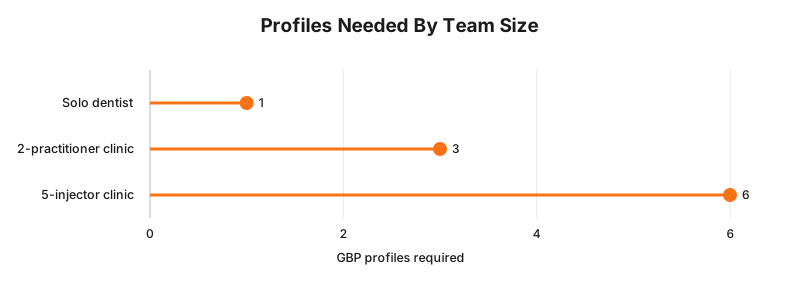
That chart is arithmetic straight from Google’s own rule, not a market statistic: one profile for the practice, plus one for every public-facing practitioner once there are two or more of them. A solo dentist needs one. Add a second practitioner and the count jumps to three, not two, because the practice now needs its own profile as well as the two practitioners.
Decision Matrix
| Your situation | Profiles needed | Practitioner profile name | Practice profile category |
|---|---|---|---|
| Solo dentist, own practice, no other public-facing staff | 1 shared profile | ”[Practice name]: [Dentist name]“ | Dental clinic |
| Solo cosmetic injector, sole public-facing practitioner | 1 shared profile | ”[Clinic name]: [Practitioner name]“ | Cosmetic clinic |
| Two dentists, both patient-facing, same address | 3 profiles | Dentist’s own name only, no practice name | Dental clinic |
| Principal doctor plus 3 injecting nurses, same clinic | 5 profiles | Each practitioner’s own name only | Cosmetic clinic |
| Associate dentist covering one day a week, not otherwise public-facing | Practice judgement call, confirm against Google’s eligibility wording | N/A unless verified separately | Dental clinic |
Takeaway: count your public-facing practitioners first. That number, not your business type, decides whether you run one profile or several.
A Worked Example
Cosmetic clinic. A five-practitioner cosmetic clinic in Perth had one Business Profile, verified under the clinic’s brand name, with every injecting nurse’s name crammed into the profile’s services and posts to try to capture branded searches for each individual. None of them ranked for their own name searches, because none had their own profile. Applying Google’s guidance meant creating four new profiles, one per nurse plus the laser technician, each named with the practitioner’s name alone, each verified at the same street address as the existing clinic profile. The clinic profile kept its own name, its own category, and its own review stream. Within the first review cycle, two of the five practitioner profiles had started appearing in branded local pack results for searches combining a specific nurse’s name with “cosmetic injector,” results the shared clinic profile had never captured on its own.
Cosmetic dentistry. A solo principal dentist had two active Business Profiles at the same address: one under the practice’s trading name, created when the practice first registered, and a second under the dentist’s own personal name, added later by a marketing contractor trying to capture “Dr [Name] dentist” searches. Both profiles were showing in Maps, splitting reviews between them and occasionally showing conflicting opening hours. Since there was only one public-facing practitioner, Google’s guidance called for one shared profile, not two. The practice merged the review history where Google’s tools allowed it, closed the personal-name profile, and renamed the surviving profile to the brand-colon-practitioner format, so it now reads as “[Practice name]: Dr [Name]” rather than either name alone.
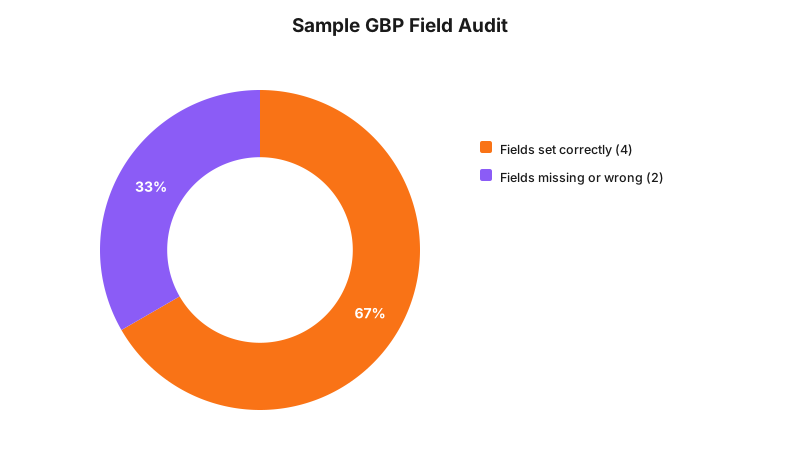
The chart above is an illustrative example from the audit checklist below, showing what a typical first pass finds on a clinic profile before a fix, not a published statistic about the industry as a whole.
What to Check on Your Own Site
- Search your practice’s name in Google and count how many separate listings appear at your address, including any under an individual practitioner’s own name.
- Confirm how many of your practitioners are genuinely public-facing, meaning patients can search for and book them by name, not just staff members who happen to work there.
- If you have two or more public-facing practitioners, check the practice has its own profile separate from any practitioner profile, and that every practitioner profile’s business name field contains only that person’s name.
- If you are a solo practitioner, check whether a second personal-name profile exists alongside your main practice listing. If it does, that is the one to close.
- Open each practitioner profile’s category field and confirm it matches the practice’s specialty, not a generic default category left over from setup.
- On the website, check that each practitioner’s schema markup carries a
sameAslink to their own Business Profile URL, not the practice’s profile URL, and vice versa for the organisation schema. - Diarise a repeat check whenever a practitioner joins or leaves. A profile structure that was correct for four practitioners is wrong the day a fifth one starts seeing patients.
The Enforcement Anchor
There is no infringement notice, court determination, or published penalty register for this rule, and it would be misleading to claim one exists. This is Google’s own platform policy, not a law, so there is no regulator publishing enforcement outcomes the way the OAIC publishes privacy determinations. What Google’s guidelines do state, in the same document, is the consequence for ignoring the one-profile rule: duplicate listings “can cause problems with how your information displays on Google Maps and Search,” and Google reserves the right to merge, suspend, or remove duplicate profiles once flagged, either by a competitor, a patient, or its own automated detection. That is a platform risk, not a legal one, but it is a real one: a merged or suspended profile can strip a practice of years of accumulated reviews overnight.
Where This Gets Hard
The genuinely hard case is the practitioner who sits between the two categories: a locum, a part-time associate, or a practitioner who sees patients two days a week under their own name but is not the clinic’s main public identity. Google’s wording turns on “public-facing,” and it does not define an hours threshold or a booking-volume cutoff for what counts. A reasonable reading is that if patients can search for and book that specific person, they are public-facing regardless of how many days a week they work, but Google has not published a bright-line test, and reasonable clinics could land on different calls for the same locum.
The second hard case sits outside Google’s policy entirely. A practitioner’s own separate profile collects its own reviews, and reviews that read as before-and-after outcome claims or unprompted testimonials about a cosmetic procedure sit inside the same advertising rules that apply to the practice’s main profile. Google’s rule tells you whether to create the practitioner profile. It says nothing about what shows up in that profile’s reviews once patients start leaving them, and separating a practitioner’s listing does not separate that practitioner from Australia’s testimonial advertising rules under the Health Practitioner Regulation National Law. Google says X, the build consequence is Y: whether a specific review on a specific practitioner profile crosses into advertising you are responsible for is a question for your medical defence organisation or your lawyer.
Status
In force now, current Google policy, not a proposal. As at 15 August 2026, the practitioner-versus-practice profile rule described here reflects Google’s live, published Business Profile guidelines, checked directly on Google’s own support page for this article. Nothing here is pending a future change. Google can update its own platform policy at any time without notice, which is a standing risk with any platform-dependent process, but there is no announced or scheduled change to this specific rule.
Frequently Asked Questions
Do I need a separate Google Business Profile for each dentist at my practice?
Only if two or more of your practitioners are public-facing at the same address. Google’s guidelines say the practice creates its own profile and each practitioner gets a separate profile named after them alone. If you are a solo practitioner, Google’s guidance says to share one profile with the practice instead, using the format “[Practice]: [Practitioner name]“.
What should a practitioner’s Google Business Profile be named?
Google’s guidelines say the practitioner profile title should include only the practitioner’s name and should not include the organisation’s name. Adding the practice name to a practitioner listing goes against Google’s own naming rule for this profile type.
Can I get in trouble for creating duplicate Google Business Profiles?
Google’s guidelines state there should only be one profile per business, because duplicates cause problems with how the listing displays on Maps and Search. Google does not publish a fine or a public enforcement register for this, but it can suspend or merge duplicate profiles without notice.
Need a hand with your website?
If you want a second pair of eyes on how this applies to your own site, request a callback and we will talk it through.
Sources
- Google Business Profile Help - Guidelines for representing your business on Google, including the one-profile-per-business rule and the multiple-practitioners-at-one-location exception. Checked 15 August 2026.
- Federal Register of Legislation - Health Practitioner Regulation National Law, section 133, the testimonial and misleading advertising provision referenced in “Where This Gets Hard.” Checked 15 August 2026.
Last reviewed: 15 August 2026.
Vikas Thakur
Founder of RockingWeb. 16 years of experience from working at TPG, iiNet and Monadelphous, now building websites, software and digital marketing for local businesses in Rockingham and Perth.