Zirconia Veneers Hit 904 MPa vs Porcelain's 488 (2026)
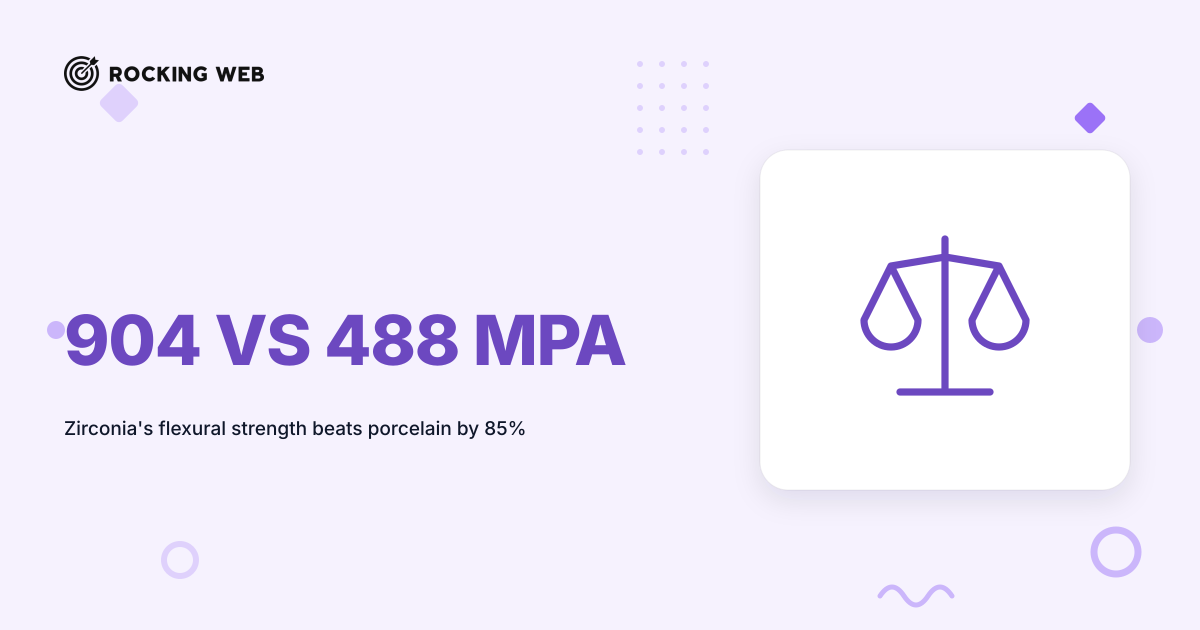
Zirconia veneers measure 904 MPa in flexural strength against 488 MPa for lithium disilicate porcelain, an 85% gap confirmed by peer-reviewed testing. One Gold Coast practice charges the same $1,477 per tooth for both materials in its 2026 price list.
 Vikas Thakur Founder, RockingWeb 10 min read
On this page 10
- Key takeaways
- The Strength Numbers: 904 MPa vs 488 MPa
- Same Price, Different Material: What Zirconia Costs in Australia
- What a Full Smile Makeover Costs by Material
- The Trade-off: Translucency and When Zirconia Makes Sense
- What AHPRA’s Advertising Rules Mean for a Zirconia Veneer Case Study
- How This Should Shape Your Practice’s Website and Booking Flow
- FAQ
- Get a Compliant Cosmetic Dentistry Website Built Around Real Data
- Sources and References
Key takeaways
- Zirconia veneers measure 904 MPa in flexural strength against 488 MPa for lithium disilicate porcelain (e.max), an 85% strength gap, per a 2018 peer-reviewed materials study
- A Gold Coast practice’s own marketing figures round to a near-identical gap: 900 MPa for zirconia versus 500 MPa for porcelain
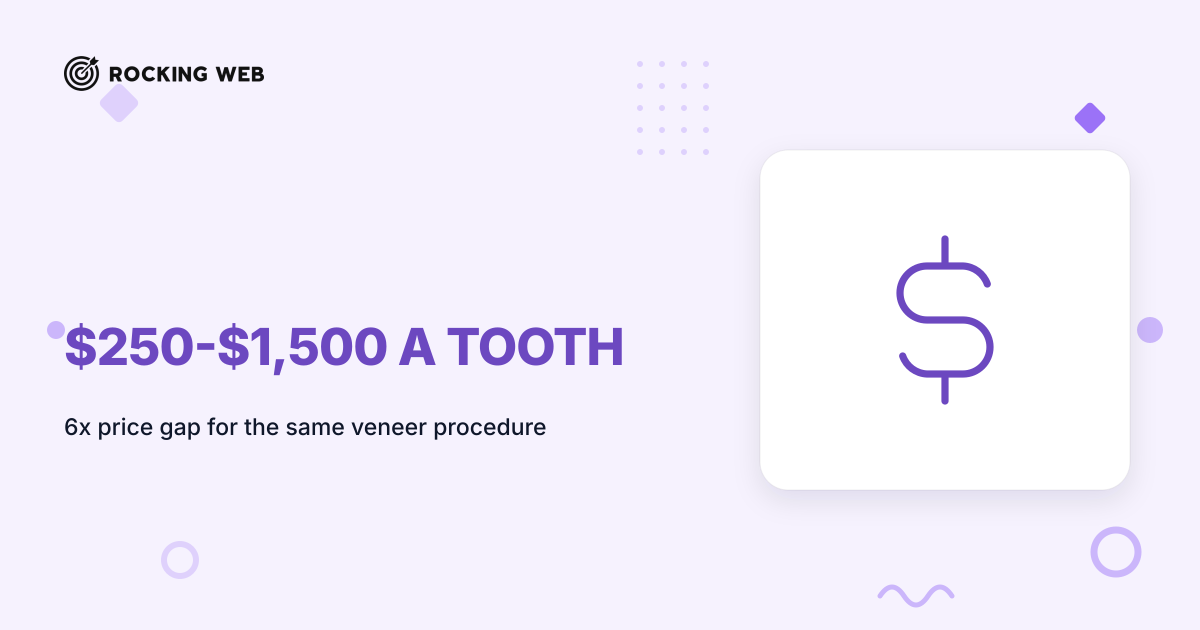
- At ArtSmiles, the only Australian practice we found publishing zirconia-specific pricing, both zirconia and porcelain veneers cost $1,477 per tooth under its 2026 club pricing, an identical price for the stronger material
- A 6-tooth porcelain or zirconia smile makeover starts at $8,862; a 10-tooth case starts at $14,770, both exact multiples of the same per-tooth rate
- ArtSmiles rates zirconia’s overall “Aesthetic Detail” as Very Good against Excellent for porcelain, consistent with a known translucency trade-off behind why zirconia is not the default choice for every tooth
- AHPRA’s advertising guidelines for registered health practitioners took effect 2 September 2025 and apply to every dentist through the Dental Board of Australia
- We could not find an independent, peer-reviewed longevity study specific to zirconia veneers (as opposed to zirconia crowns); the 15-plus-year figure circulating in practice marketing is not clinical trial data
Zirconia veneers measure 904 MPa in flexural strength. Porcelain veneers, made from lithium disilicate ceramic (e.max), measure 488 MPa. That gap comes from a 2018 peer-reviewed materials study, not a marketing brochure, and a Gold Coast cosmetic dental practice’s own 2026 price list cites a near-identical rounded gap: 900 MPa against 500 MPa. Here’s the part that changes the decision: that practice charges exactly the same price for both materials, $1,477 per tooth. If the stronger ceramic doesn’t cost more, the choice stops being about budget and starts being about translucency, bite force and which tooth is actually being treated. This guide breaks down the verified strength and price data behind zirconia veneers in Australia, where the trade-offs actually sit, and what a dental practice’s website needs to get right before publishing either material as a treatment option.
The Strength Numbers: 904 MPa vs 488 MPa
Flexural strength measures how much force a thin ceramic shell can take before it cracks, the exact failure mode that matters for a veneer bonded onto the front of a tooth. In 2018, researchers Jing Yan, Marina Kaizer and Yu Zhang tested this directly, publishing biaxial flexural strength results for a 3Y-TZP zirconia ceramic and an IPS e.max CAD lithium disilicate ceramic in the Journal of the Mechanical Behavior of Biomedical Materials. Using the piston-on-three-balls method under ISO 6872, with ten specimens per material, they measured 904 MPa for zirconia and 488 MPa for lithium disilicate, a difference of roughly 85%.
That academic figure lines up closely with what one Australian practice tells its own patients. ArtSmiles, a cosmetic dental practice in Southport on the Gold Coast, publishes 900 MPa for its multilayer zirconia veneer and 500 MPa for its e.max porcelain veneer on its own pricing page, last updated 8 July 2026. Two independent sources, an academic materials lab and a commercial dental practice, land within a few MPa of each other on the same comparison.
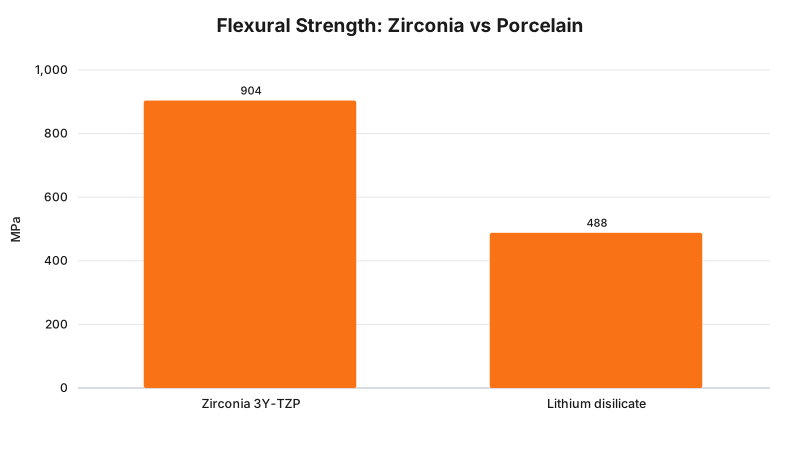
Takeaway: the strength gap between zirconia and porcelain veneers is not a sales pitch rounding error. It shows up consistently whether you’re reading a peer-reviewed materials study or a practice’s own price list.
Same Price, Different Material: What Zirconia Costs in Australia
Here’s what makes the strength gap worth paying attention to: at ArtSmiles, it doesn’t cost anything extra. The practice’s 2026 club pricing lists porcelain (e.max) veneers and zirconia veneers at the same $1,477 per tooth. A hybrid ceramic veneer (Cerasmart) sits below both at $995 per tooth, and a composite veneer starts at $600 per tooth.
| Material | Price Per Tooth (ArtSmiles, 2026) | Flexural Strength | Aesthetic Detail (ArtSmiles rating) |
|---|---|---|---|
| Composite | $600 | 120-170 MPa (ArtSmiles, not independently peer-reviewed) | Good |
| Hybrid ceramic (Cerasmart) | $995 | 270 MPa (ArtSmiles, not independently peer-reviewed) | Very Good |
| Porcelain (e.max / lithium disilicate) | $1,477 | 488 MPa (peer-reviewed) | Excellent |
| Zirconia (3Y-TZP) | $1,477 | 904 MPa (peer-reviewed) | Very Good |
That’s the only Australian dental practice we could find publishing a zirconia-specific per-tooth price. Every other pricing page we checked, including our own breakdown of veneers cost data across Australia, quotes “porcelain” as a single category covering feldspathic porcelain, e.max and zirconia together, typically $1,200 to $2,500 per tooth. If a dentist’s website only shows one “porcelain veneer” price, ask which ceramic that figure actually covers. It can change the strength number by close to double.
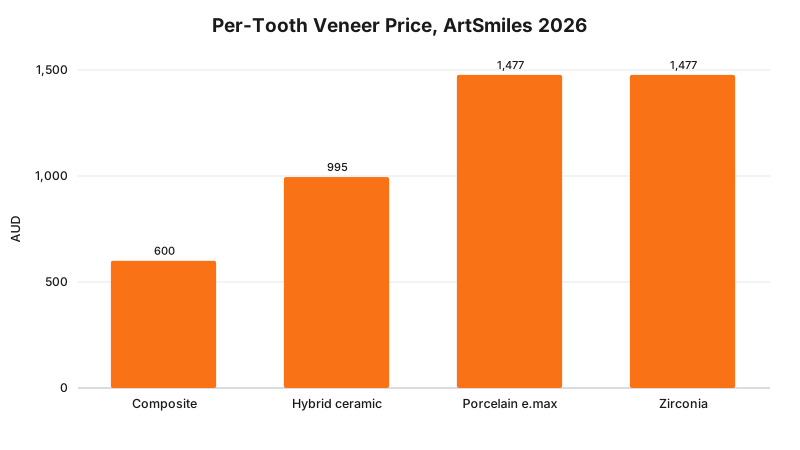
Takeaway: identical pricing for zirconia and porcelain at one practice doesn’t prove that’s the market norm everywhere, but it does prove a “premium material” price gap isn’t guaranteed. Ask for the material name, not just the word “porcelain.”
What a Full Smile Makeover Costs by Material
A single tooth is one data point. Most patients considering veneers are looking at a full smile makeover, typically the 6 to 10 teeth visible when they smile. ArtSmiles publishes exact starting prices for its combined porcelain and zirconia tier at three case sizes: $8,862 for 6 veneers, $11,816 for 8 veneers, and $14,770 for 10 veneers.
Do the maths and each package is an exact multiple of the $1,477 per-tooth rate: 6 times $1,477 is $8,862, 8 times $1,477 is $11,816, and 10 times $1,477 is $14,770. There’s no published volume discount in these starting figures, at least not at this practice.
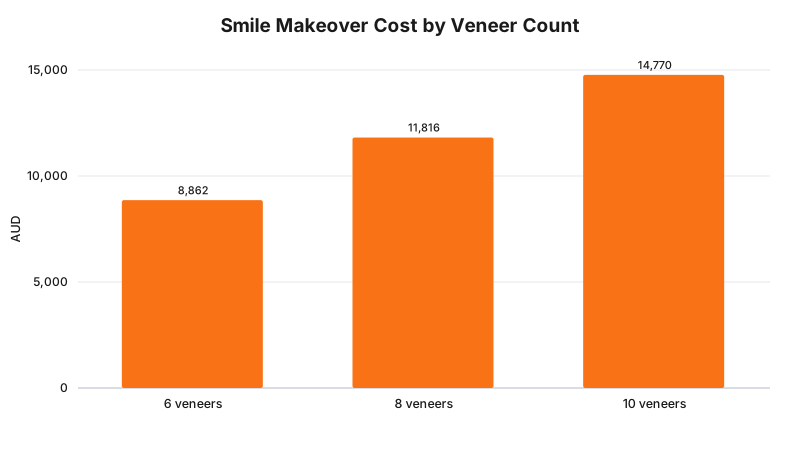
Takeaway: a full smile makeover in porcelain or zirconia starts in five-figure territory at this practice, and the published per-tooth rate holds steady whether a patient needs 6 veneers or 10.
The Trade-off: Translucency and When Zirconia Makes Sense
Strength isn’t free. ArtSmiles does not publish a translucency-specific rating; its comparison table rates overall “Aesthetic Detail” as Very Good for zirconia against Excellent for its e.max porcelain veneer. That gap is consistent with a well-documented pattern in dental ceramics: the denser crystal structure that gives zirconia its fracture resistance also tends to scatter more light than a glass-ceramic like lithium disilicate. Front teeth need to mimic the light-scattering properties of natural enamel, so a small translucency deficit is a real aesthetic cost, not a footnote.
That’s why ArtSmiles frames zirconia as suited especially for patients with bruxism (teeth grinding) or a heavier bite, rather than as a universal upgrade over porcelain. For a premolar carrying more bite force, the strength advantage matters more than the last few percentage points of translucency. For a front central incisor under close inspection, the reverse can be true.
We could not find an independent, peer-reviewed clinical trial tracking zirconia veneer survival specifically, as opposed to zirconia crowns, which are more widely studied in the dental literature. The 15-plus-year longevity figure quoted by ArtSmiles is a practice estimate, not a published cohort study, and should be read that way.
Takeaway: zirconia’s strength advantage is real and measured, but it’s a trade against translucency, not a straightforward upgrade. The right material depends on which tooth and which patient habit you’re solving for.
What AHPRA’s Advertising Rules Mean for a Zirconia Veneer Case Study
None of this strength and price data is a green light to run a before and after gallery. AHPRA’s guidelines for registered health practitioners advertising cosmetic procedures took effect 2 September 2025, and every dentist in Australia advertises under those rules through the Dental Board of Australia. A “zirconia veneer transformation” post showing a patient’s teeth before and after treatment sits inside the same restrictions covered in our breakdown of AHPRA’s advertising rules for cosmetic dentistry: no before and after imagery, no outcome language implying a guaranteed result, no patient testimonials.
Material strength and price data, the kind covered in this article, sits in a different category. Publishing a verified MPa figure or a per-tooth price isn’t a testimonial and isn’t an outcome claim, which is exactly why data-led content is a safer, and more citable, way for a dental practice to demonstrate expertise than a photo gallery is.
If you’re not sure where your practice’s current site or social content sits against the current rules, talk to RockingWeb and we will review every page against the specific provision it falls under.
Takeaway: a material comparison page like this one is compliant content a practice can publish directly. A before and after gallery of the same cases is not.
How This Should Shape Your Practice’s Website and Booking Flow
When a practice publishes exact material names and per-tooth prices instead of a vague “veneers from $X” figure, enquiry quality improves in a specific, structural way: a patient who has already read that zirconia costs $1,477 per tooth and suits a heavier bite arrives at the consultation asking about their specific case, not the price itself. A vague price page does the opposite. It generates volume, then wastes chair time re-explaining basic material differences that a page like this one could have covered upfront.
The booking flow matters as much as the pricing page. A treatment enquiry form that asks which material a patient is interested in, composite, e.max or zirconia, routes the enquiry to the right consultation length and the right dentist, rather than a generic “book a veneer consultation” button that treats a $600 composite case and a $14,770 smile makeover as the same appointment. That distinction should show up in the form itself, not get discovered halfway through a phone call.
RockingWeb builds cosmetic clinic and dental practice websites that present exactly this kind of material and pricing detail without drifting into the outcome claims AHPRA’s guidelines restrict.
Takeaway: transparent material and price data isn’t just a compliance-safe content choice. It pre-qualifies enquiries before they reach the phone.
FAQ
What is the flexural strength difference between zirconia and porcelain veneers?
Peer-reviewed biaxial flexural strength testing found 3Y-TZP zirconia measures 904 MPa against 488 MPa for IPS e.max lithium disilicate ceramic, a difference of roughly 85%, according to a 2018 study in the Journal of the Mechanical Behavior of Biomedical Materials. A Gold Coast practice’s own marketing materials cite a similar rounded gap of 900 MPa versus 500 MPa.
Do zirconia veneers cost more than porcelain veneers in Australia?
Not necessarily. At ArtSmiles, a Gold Coast cosmetic dental practice, both zirconia and porcelain (e.max) veneers are priced at $1,477 per tooth under its published 2026 club pricing. That is the only Australian practice we could find publishing a zirconia-specific per-tooth price. Broader porcelain veneer pricing across the market ranges from $1,200 to $2,500 per tooth.
Are zirconia veneers less translucent than porcelain veneers?
Generally, yes. ArtSmiles does not publish a translucency-specific rating; its comparison table rates overall “Aesthetic Detail” as Very Good for zirconia against Excellent for its e.max porcelain veneer. That gap is consistent with a known trade-off in dental ceramics, where higher zirconia crystal density improves fracture resistance but tends to reduce light transmission compared with glass-ceramics like lithium disilicate.
Can a dental practice website legally show before and after photos of zirconia veneer cases?
No, not under AHPRA’s current advertising guidelines. AHPRA’s rules for registered health practitioners advertising cosmetic procedures took effect from 2 September 2025 and apply to every dentist through the Dental Board of Australia. Before and after imagery for cosmetic dental outcomes, including veneer cases, falls under the same restrictions covered in RockingWeb’s breakdown of AHPRA’s advertising rules for cosmetic dentistry.
Get a Compliant Cosmetic Dentistry Website Built Around Real Data
RockingWeb builds AHPRA-compliant websites for Australian cosmetic dental practices, the kind that can publish exact material names, MPa figures and per-tooth prices without drifting into the outcome claims the current guidelines restrict. If your practice is weighing zirconia against porcelain in its own marketing, or your booking flow doesn’t yet separate a $600 composite case from a $14,770 smile makeover, talk to us about a compliant rebuild.
Talk to RockingWeb about your practice’s website
Sources and References
Yan, Kaizer & Zhang, Journal of the Mechanical Behavior of Biomedical Materials (2018) - peer-reviewed biaxial flexural strength testing: 904 MPa for 3Y-TZP zirconia, 488 MPa for IPS e.max CAD lithium disilicate
ArtSmiles Cosmetic Dentistry - published per-tooth pricing for composite, hybrid ceramic, porcelain (e.max) and zirconia veneers, and material strength/aesthetic detail figures, updated 8 July 2026
AHPRA - “Putting patients first: New guidelines for cosmetic procedures,” confirming the 2 September 2025 effective date for advertising restrictions on registered health practitioners
AHPRA Advertising Rules for Cosmetic Dentistry Australia 2026 - full breakdown of how the guidelines apply to dental practices
Related reading:
Vikas Thakur
Founder of RockingWeb. 16 years of experience from working at TPG, iiNet and Monadelphous, now building websites, software and digital marketing for local businesses in Rockingham and Perth.