12% vs 70%: AI in Dentistry Australia's Adoption Gap
Only 12% of Australian dental practices currently use AI tools, while 70% of dentists want to deploy them for patient education, according to BDO Australia. Here is what that gap means for a dental practice's website, chatbot, and marketing copy, not the clinical AI getting most of the attention.
 Vikas Thakur Founder, RockingWeb 11 min read
On this page 9
- Key takeaways
- How Many Australian Dental Practices Actually Use AI
- Australia Is Behind Comparable Markets
- What Australian Dentists Actually Think About AI
- The AI Risk AHPRA Actually Cares About: Your Website, Not Your Chairside Tools
- AI Chatbots on Booking Pages: What They Can and Cannot Say
- How to Evaluate a Website AI Tool Without Tripping an AHPRA Complaint
- What This Means for Your Practice’s Website
- Talk to RockingWeb About Your Dental Practice’s Website
Key takeaways
- Only 12% of Australian dental practices currently use AI tools, according to BDO Australia’s September 2025 healthcare sector report
- 70% of dentists want AI for patient education, and nearly two-thirds (about 66%) want it for data analysis, diagnostics, and practice management, per the same report
- Australia trails comparable markets: 32% of dentists in Canada, the US, and the UK already use AI, according to a 2026 survey of 300 licensed dentists by Dental Reviewed
- 54.8% of Australian dentists and dental students say they are aware of dental AI applications, but 70.3% could not name a specific product, per a 155-respondent survey in the European Journal of Dental Education (Hegde et al., 2025)
- 91.6% of that same 155-person sample see AI as a supportive tool, and 69% think it will be beneficial for clinical tasks
- AHPRA’s guidelines for advertising cosmetic procedures, effective 2 September 2025, ban AI-generated images of treatment results, and this applies to dental advertising the same as medical cosmetic procedures
- 40% of Australian dentists and dental students expect AI to be in routine use within 5 to 10 years, per Hegde et al.
Only 12% of Australian dental practices currently use AI tools. That is the number BDO Australia published in September 2025, and it sits next to a much bigger one: 70% of dentists say they want AI for patient education, and nearly two-thirds want it for data analysis, diagnostics, and practice management. That is a 58-point gap between interest and action, on a technology every software vendor selling to dental practices is now pitching.
Most of the coverage of that gap talks about chairside tools: AI reading X-rays, AI writing clinical notes, AI flagging cavities a dentist might miss. None of that is what this post is about. The gap between 12% and 70% is going to close through marketing tools first, not clinical ones, because a website chatbot or an AI copywriting subscription is a five-minute sign-up with no clinical governance attached. That is exactly where AHPRA’s rules and a dental practice’s digital presence are about to collide, and most practices evaluating an AI tool for their site have not thought about it yet.
How Many Australian Dental Practices Actually Use AI
BDO Australia’s healthcare team put the figure at “only ~12 per cent” of practices currently using AI tools, in a report published 8 September 2025 covering trends across the Australian dental sector. The same section of the report found demand running far ahead of adoption: about 70% of dentists want to deploy AI for patient education specifically, and close to two-thirds are keen on it for data analysis, diagnostics, and practice management. BDO’s report does not publish an underlying survey name or sample size for those figures, so treat them as an industry estimate from a professional services firm working across the sector, not a peer-reviewed study.
| Measure | Figure | Source |
|---|---|---|
| Practices currently using AI tools | 12% | BDO Australia, September 2025 |
| Dentists wanting AI for patient education | 70% | BDO Australia, September 2025 |
| Dentists wanting AI for diagnostics, analysis, practice management | ~66% (nearly two-thirds) | BDO Australia, September 2025 |
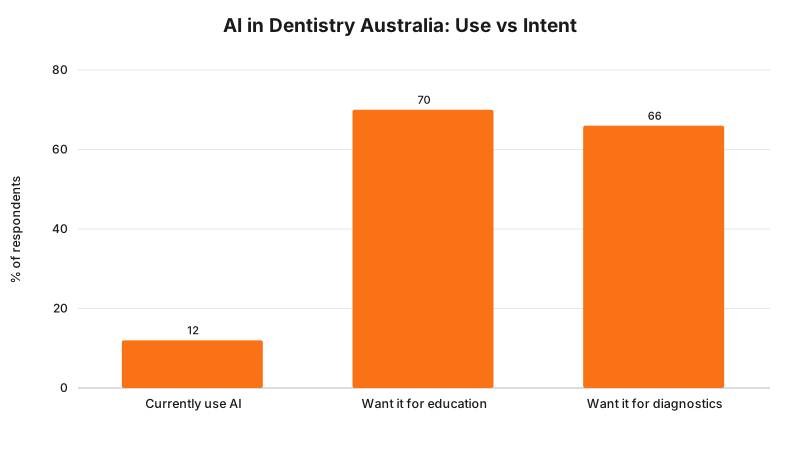
A 58-point gap between current use and stated intent is not unusual for a new technology category. What makes it worth watching closely in dentistry is who is going to close it. Software vendors selling AI chatbots, AI-written web copy, and AI review-response tools move faster than clinical AI vendors, because there is no equipment to install and no clinical sign-off required. A practice can add an AI chatbot to its booking page this afternoon.
Takeaway: the 12% adoption figure understates how fast this changes, because the tools most likely to get adopted first, marketing and front-desk AI, carry the fewest barriers to switching on.
Australia Is Behind Comparable Markets
Australia’s 12% adoption rate looks low next to dentistry overseas. A 2026 survey of 300 licensed dentists across Canada, the US, and the UK, run by Dental Reviewed between February and April 2026, found 32% already using at least one AI tool, with a further 38% actively considering adoption. Only 2% of that surveyed group said they trust AI more than their own clinical judgement, while 52% treat it as a helpful second opinion. Radiograph interpretation was the leading AI use case among adopters, at 82%.
| Market | Currently using AI | Considering adoption | Source |
|---|---|---|---|
| Australia | 12% | Not separately published | BDO Australia, 2025 |
| Canada, US, UK | 32% | 38% | Dental Reviewed, 2026 (n=300) |
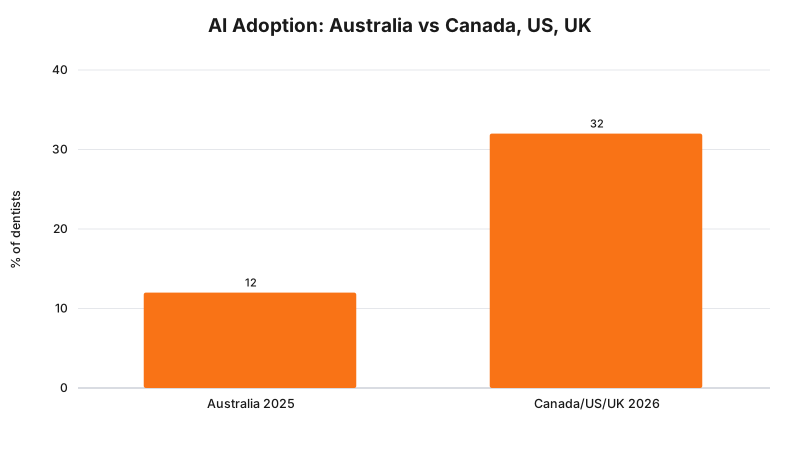
Comparing a firm’s industry estimate to a 300-respondent survey run a year later is not a perfect like-for-like measure, and the two figures come from different methodologies. What the comparison does show reliably is direction: Australian dentistry is not leading this shift, and every month it stays behind is another month a competitor’s practice website gets there first.
Takeaway: almost three times as many dentists overseas have already switched an AI tool on, which means the practices in Australia that move now are moving into open ground, not a crowded market.
What Australian Dentists Actually Think About AI
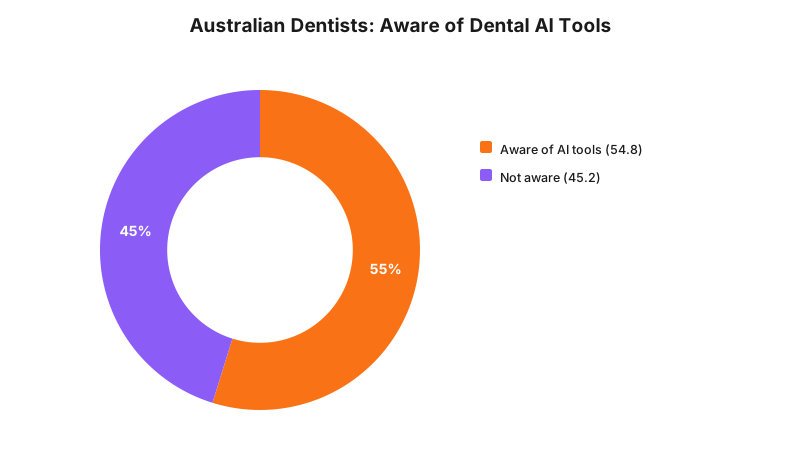
The clearest Australian-specific data on attitudes, not just adoption, comes from a peer-reviewed survey published in the European Journal of Dental Education. Hegde and colleagues surveyed 155 Australian dentists and dental students and found 54.8% aware of AI applications in dentistry, but 70.3% of that same group could not name a specific AI product when asked. Awareness, in other words, is not the same as familiarity.
| Finding | Figure |
|---|---|
| Aware of dental AI applications | 54.8% |
| Could not name a specific AI product | 70.3% |
| See AI as a supportive tool for clinicians | 91.6% |
| Believe AI will be beneficial for clinical tasks | 69% |
| Expect routine AI use in dentistry within 5 to 10 years | 40% |
Source: Hegde S, Nanayakkara S, Jordan A, Jeha O, Patel U, Luu V, Gao J, “Attitudes and Perceptions of Australian Dentists and Dental Students Towards Applications of Artificial Intelligence in Dentistry: A Survey,” European Journal of Dental Education, 2025;29(1):9-18 (n=155).
91.6% of the same 155 respondents see AI as a supportive tool for clinicians, and 69% believe it will be beneficial for clinical tasks. Yet only 40% expect it to be in routine use within 5 to 10 years. That is a sample that broadly likes the idea of AI and is not in a hurry to build it into daily practice, which lines up with BDO’s 12% adoption figure rather than contradicting it.
Takeaway: Australian dentists are not sceptical of AI, they are unfamiliar with it, and a practice that can name and demonstrate a specific, compliant AI tool is ahead of most of its peers before it has done anything else.
The AI Risk AHPRA Actually Cares About: Your Website, Not Your Chairside Tools
AHPRA’s guidelines for advertising cosmetic procedures, in force since 2 September 2025, ban AI-generated images of treatment results outright. That rule applies to any registered health practitioner advertising a cosmetic procedure, and a Dental Board of Australia registrant sits under exactly the same National Law as a cosmetic clinic doctor or nurse. We cover the full set of restrictions, testimonials, before-and-after imagery, outcome claims, in our breakdown of the AHPRA advertising rules for cosmetic dentistry, and every one of them applies whether a human or an AI tool produced the content.
That last point is the one most practices evaluating a website AI tool miss. An AI image generator producing a “preview” of veneer results is banned outright under the September 2025 rules, full stop, regardless of a disclaimer. An AI copywriting tool is not banned, but it does not know AHPRA’s rules unless it is told, and it will happily draft language like “guaranteed results,” a fabricated patient quote, or an outcome claim that reads exactly like the testimonials AHPRA has already restricted. The registered practitioner carries responsibility for what goes on the practice’s website under the National Law, whether a marketing agency, a staff member, or a chatbot generated the copy that got published.
Takeaway: the AI risk for a dental practice’s website is not a chairside diagnostic tool overstepping, it is an unsupervised AI writing or image tool publishing something the registered dentist is legally accountable for.
AI Chatbots on Booking Pages: What They Can and Cannot Say
An AI chatbot on a booking page is not automatically a compliance problem. It becomes one the moment it starts doing a dentist’s job in text form: promising an outcome, describing what a treatment will look like on a specific patient, or generating anything that reads like a review or testimonial to close a booking. A booking chatbot should stick to logistics: appointment availability, opening hours, what documents to bring, how to reach the practice, and simple triage questions that route a patient to a human before anything clinical gets discussed.
| A booking chatbot can | A booking chatbot cannot |
|---|---|
| Show appointment slots and confirm bookings | Diagnose a condition or recommend a specific treatment |
| Answer opening hours and location questions | Promise or imply a treatment outcome |
| Collect basic intake details before a visit | Generate a “preview” image of a treatment result |
| Escalate urgent queries to a human at the practice | Use testimonial-style or review-style language |
A website built for a cosmetic dental practice needs this booking logic designed around AHPRA’s rules from the start, not patched in after a complaint. Websites built for cosmetic clinics and dental practices need a booking flow that converts without ever putting words in the practice’s mouth that a registered dentist could not say themselves.
Takeaway: a chatbot that books appointments is a convenience, a chatbot that answers clinical or outcome questions is a liability, and the line between the two is exactly where most off-the-shelf chatbot scripts fall down.
How to Evaluate a Website AI Tool Without Tripping an AHPRA Complaint
Most AI tools marketed to dental practices for their website, copywriting assistants, chatbot builders, review-response generators, were not built with AHPRA’s National Law in mind. Before switching one on, a practice should check four things.
- Does a human review every output before it publishes? An AI tool that auto-publishes blog posts, chatbot replies, or social captions without a review step is the single biggest source of non-compliant copy on a dental practice’s site.
- Does it generate images? Under the September 2025 rules, any AI-generated image depicting a treatment result is banned outright. If an AI tool offers “smile preview” or “before/after simulation” features, that feature cannot be used in advertising, full stop.
- Does it know what a testimonial-style claim looks like? Most general-purpose AI writing tools will draft language that reads exactly like a banned testimonial or outcome guarantee unless explicitly instructed and checked against AHPRA’s current rules.
- Who is accountable if it gets something wrong? Under the National Law, that is the registered dentist, not the software vendor. A tool’s terms of service do not change who AHPRA holds responsible.
If any of that already sounds like it describes copy or a chatbot script currently live on a practice’s website, that is worth checking properly rather than guessing. A compliance review from RockingWeb covers exactly this: testimonials, before-and-after imagery, outcome claims, and now AI-generated content, before a patient complaint or an AHPRA notification does it first.
Takeaway: the safest AI tool for a dental practice’s website is not the most advanced one, it is the one that keeps a human reviewing every word and image before it goes live.
What This Means for Your Practice’s Website
A 58-point gap between 12% adoption and 70% intent does not stay a gap for long. The practices moving into that gap now, with a chatbot, an AI-assisted copy workflow, or an AI-supported review process, are doing it without much AHPRA-specific guidance built into the tools they are buying. That is a genuine first-mover advantage for a practice that gets the compliance side right early, and a genuine liability for one that does not check what its new AI tool actually publishes.
None of this requires waiting for clinical AI to mature. A compliant, well-built website with a properly scoped chatbot and human-reviewed AI-assisted copy is available today, and it is a smaller, cheaper project than most practices assume.
Takeaway: the 12% of practices already using AI on their website have a head start, but only the ones checking their output against AHPRA’s September 2025 rules are actually ahead, rather than one complaint away from a step back.
Talk to RockingWeb About Your Dental Practice’s Website
RockingWeb builds AHPRA-compliant websites for dental and cosmetic clinics across Australia, including booking flows, chatbot logic, and content review processes that hold up against the current advertising rules. If an AI tool is already drafting copy or answering patient questions on your site, it is worth confirming what it is actually saying before AHPRA or a competitor flags it first.
Get in touch to talk through what a compliant, AI-aware website looks like for your practice.
Data sources: BDO Australia, “Navigating the future: Trends, challenges and opportunities for Australian dental practices” (8 September 2025); Dental Reviewed, 2026 Dentist AI Adoption Survey (n=300 licensed dentists, Canada/US/UK, February-April 2026); Hegde S, Nanayakkara S, Jordan A, Jeha O, Patel U, Luu V, Gao J, “Attitudes and Perceptions of Australian Dentists and Dental Students Towards Applications of Artificial Intelligence in Dentistry: A Survey,” European Journal of Dental Education, 2025;29(1):9-18; Australian Health Practitioner Regulation Agency and National Boards, Guidelines for advertising cosmetic procedures (effective 2 September 2025).
Vikas Thakur
Founder of RockingWeb. 16 years of experience from working at TPG, iiNet and Monadelphous, now building websites, software and digital marketing for local businesses in Rockingham and Perth.