Dental Website Cost in Australia: $10K to $25K (2026)
A custom dental practice website in Australia runs $10,000 to $25,000 as a one-off agency build, or from $4,900 a month on a compliance-included retainer. Here is what sets that price and what a compliant build actually has to include.
 Vikas Thakur Founder, RockingWeb 12 min read
On this page 12
- Key takeaways
- What the Rules Say About a Dental Website
- What That Means for the Build
- Cost by Build Type
- A Worked Example: A Cosmetic Dentistry Practice Rebuilding Its Veneers Page
- What to Check on Your Own Quote
- The Enforcement Anchor
- Where This Gets Hard
- Status
- Frequently Asked Questions
- Get a Scoped Quote, Not a Guess
- Sources and References
Key takeaways
- A custom dental practice website in Australia costs $10,000 to $25,000 as a one-off agency build, plus $200 to $800 a year in hosting and domain fees and $100 to $500 a month in maintenance, as at 2026
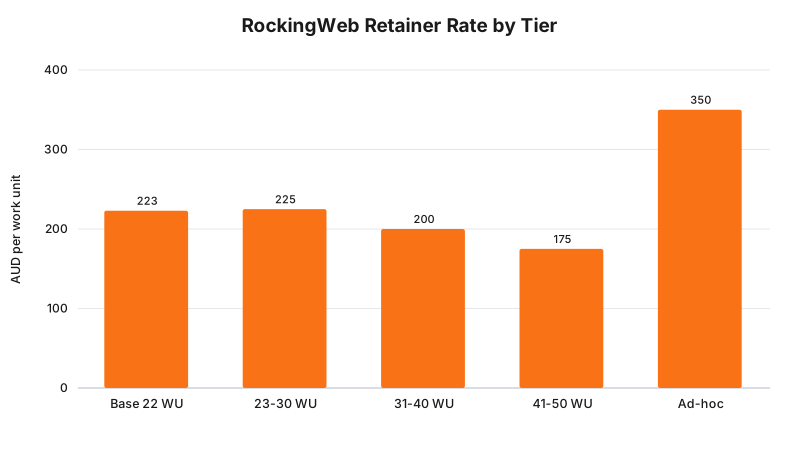
- RockingWeb’s own ongoing retainer starts at $4,900 a month for a base allocation of 22 work units, an effective rate of about $223 per work unit, checked 15 August 2026
- Work units bought outside the base allocation are priced on a sliding scale: $225 per WU from 23 to 30, $200 per WU from 31 to 40, and $175 per WU from 41 to 50, against an ad-hoc project rate of $350 per WU
- Since 2 September 2025, AHPRA’s consolidated cosmetic procedure guidelines cover dentists directly, because dentists are registered health practitioners, not medical practitioners, who instead sit under the separate Medical Board guidelines
- AHPRA’s own visual examples resource names veneers among the higher-risk non-surgical cosmetic procedures the September 2025 guidelines apply to, alongside injectables and thread lifts
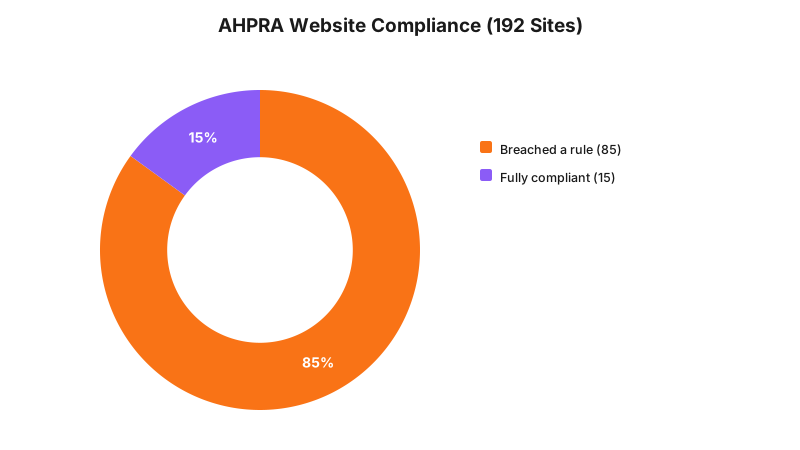
- A 2023 peer-reviewed audit in the Australian Dental Journal found 85% of 192 Australian dental practice websites breached at least one of 17 legal advertising criteria, most commonly false or misleading content
- A new compliant build takes 4 to 6 weeks; remediating an existing site takes 2 to 3 weeks; a standalone compliance audit is delivered within 5 business days
A custom dental practice website in Australia costs $10,000 to $25,000 for a one-off agency build in 2026, or from $4,900 a month on a retainer model that bundles the build with SEO, content and compliance work. Three agency quotes can land anywhere between those numbers with almost no explanation of the gap, and a practice manager staring at that spread has no independent rate card to check it against. So instead of guessing at a market average, this guide prices out what actually drives the number: the AHPRA rule that applies specifically to dentists, the build items a compliant site has to include, and one real, checkable pricing structure you can hold any quote up against.
If you run a general or cosmetic dentistry practice and you are trying to work out why one quote is a third of another, this is the framework for closing that gap yourself.
What the Rules Say About a Dental Website
Dentists are registered health practitioners under the Health Practitioner Regulation National Law, and since 2 September 2025, AHPRA’s consolidated Guidelines for registered health practitioners who perform non-surgical cosmetic procedures apply to every registered health practitioner except medical practitioners. Medical practitioners sit under a separate document, the Medical Board of Australia’s guidelines in force since 1 July 2023. Dentists are not medical practitioners, so the September 2025 guideline is the one a cosmetic dentistry website has to be built against, not the Medical Board’s.
That distinction matters because AHPRA’s own visual examples resource for advertising higher-risk non-surgical cosmetic procedures names veneers directly, alongside injectables, thread lifts, PRP and hair transplants, as procedures the guidelines cover. Veneers are one of the most commonly marketed treatments on a general dental practice website. A veneers page built before September 2025, or built off a generic small-business template, was very likely written before this rule existed and has not been checked against it since.
The same National Law also carries the advertising provision (section 133) that bans false, misleading or deceptive advertising and testimonials for regulated health services, and that provision sits behind the Dental Board of Australia’s own registration standards, not just AHPRA’s cosmetic-specific guidelines.
Takeaway: the rule that sets your dental website’s compliance requirements is AHPRA’s September 2025 guideline, not the Medical Board’s, and it names veneers by name.
What That Means for the Build
Four items show up in almost every compliant dental website quote, and each one is something you can ask a vendor to point to directly.
Testimonial content type removed, not hidden. A patient review carousel commented out in the template still exists in the CMS and gets switched back on the next time someone edits the homepage. The compliant version removes the content type entirely, so there is nothing left to accidentally re-enable.
Veneers and other higher-risk before/after pairs gated behind a disclosure block. Since AHPRA’s visual examples resource names veneers specifically, a before/after gallery for veneer cases needs the same disclosure treatment as an injectables gallery. The build fix is a component that will not render an image pair without the disclosure text populated, not a photo gallery with a disclaimer buried somewhere else on the page.
Procedure pages built around clinical information and item codes, not outcome claims. The Australian Dental Journal audit found the most common breach across 192 sites was false or misleading content, not a missing disclosure. A page written around what a treatment involves and its item number carries less of that risk than a page written around “the smile you deserve”.
A structured content review against the current AHPRA guideline before launch. Not a general proofread. A page-by-page check against the specific bans (testimonials, time-limited offers, language that trivialises risk) with each finding mapped to the rule it breaches.
Skip any of these and the “finished” site is not a finished compliant product. It is a site that will need the same work done again later, on top of whatever the first build already cost.
Cost by Build Type
The table below separates the market range for a one-off agency build from RockingWeb’s own published, fixed-price structure, so you can match your situation to a row and ask any vendor you are comparing whether their quote covers the same scope.
| Build type | What it covers | Typical timeframe | Cost |
|---|---|---|---|
| Template or DIY build | Generic small-business template, no dental-specific or AHPRA-specific structure | Days | A few hundred dollars |
| Custom agency build (market range) | One-off site with online booking, patient forms, procedure and item-code page architecture | Weeks (vendor-dependent) | $10,000 to $25,000 |
| RockingWeb compliance audit | Page-by-page review against the current AHPRA guideline, each finding mapped to the specific rule | 5 business days | Fixed-price scoped quote |
| RockingWeb remediation | Remove non-compliant content, gate veneer/before-after imagery, restructure affected pages | 2 to 3 weeks | Fixed-price scoped quote |
| RockingWeb new compliant build | Full site built from a clean structure, compliant copy, gated imagery, correct registration details | 4 to 6 weeks | Fixed-price scoped quote |
| RockingWeb ongoing retainer | Build, SEO, content and compliance work across eight disciplines, continuous monthly cycles | Continuous | From $4,900/month for 22 work units |
Sources for the market range and running costs: RockingWeb’s dental practice startup cost guide, checked 15 August 2026. Sources for the RockingWeb rows: RockingWeb’s monthly retainer page, checked the same date.
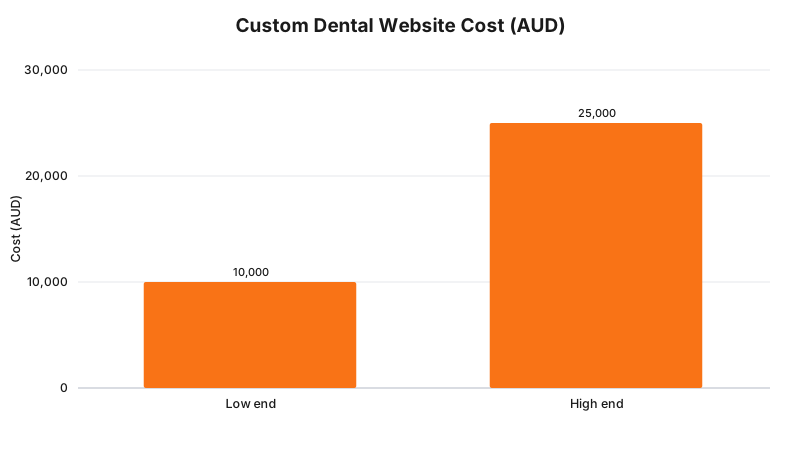
Once a site is live, the spend does not stop. Hosting and domain fees typically run $200 to $800 a year, and ongoing maintenance adds $100 to $500 a month on top of the build cost. A quote that only states the build number and says nothing about either of those is an incomplete quote.
Takeaway: a build cost with no stated maintenance line is not the whole price. Ask what happens after launch before you sign.
A Worked Example: A Cosmetic Dentistry Practice Rebuilding Its Veneers Page
Here is an illustrative scenario built from the build items above, not a real client’s figures. A general dental practice offering veneers, teeth whitening and Invisalign had a site built in 2022, before the September 2025 guideline existed. The veneers page carried a before/after gallery with no disclosure text, a homepage testimonial slider quoting patients by first name, and generic copy promising “a smile you’ll love” with no procedure detail underneath it.
Two quotes came back for the fix. One was a template refresh: new photography and copy, no mention of AHPRA anywhere in the scope. The other itemised the same four build items covered above: the testimonial slider removed as a content type, the veneers gallery rebuilt behind a mandatory disclosure block, the copy rewritten around procedure and item-code detail, and a page-by-page compliance review before launch mapped to specific rules.
The template refresh looked cheaper on the invoice. It fixed the photography and the words, but it did not touch the testimonial content type, the gallery component, or the compliance review, which meant the practice would be paying for the same fix twice once a complaint or an internal review caught what the first quote missed. The itemised remediation matched the remediation row in the table above: 2 to 3 weeks, fixed-price, because the site’s structure and voice did not need rebuilding, only the compliance-relevant components did.
If all you need first is clarity on where your current veneers page and testimonial slider stand, an audit is a smaller, faster piece of work than a full remediation quote.
What to Check on Your Own Quote
- Does the quote name AHPRA’s September 2025 consolidated guideline as the compliance basis, and does it correctly note that dentists sit under that guideline, not the Medical Board’s separate 2023 document?
- Is the testimonial content type removed from the CMS, or just hidden from the template?
- Does the veneers (or other higher-risk procedure) before/after component require a disclosure block to render, or is disclosure left to a separate page?
- Is procedure page copy built around clinical information and item codes, or around outcome and lifestyle claims?
- Is there a stated compliance review step before launch, with findings mapped to specific rules, not a general proofread?
- Does the quote separate the one-off build cost from ongoing hosting, maintenance and monitoring, so nothing is a surprise after launch?
- If the quote is a retainer, does it state the base allocation and the marginal rate for work above it, the way RockingWeb’s does?
The Enforcement Anchor
AHPRA’s September 2025 announcement of the consolidated guidelines included an on-the-record statement that practitioners had been given advance notice to prepare, and that the regulator would act where practitioners were found to be prioritising commercial interests over patient protection. That is the regulator’s stated posture, published in the same announcement that introduced the guideline this post is built around.
We could not locate a published AHPRA infringement notice, determination or complaint outcome tied specifically to a dental practice’s choice of website vendor or build cost. The compliance risk itself is documented, not speculative: the Australian Dental Journal’s 2023 audit found 85% of 192 practice websites breached at least one of 17 legal advertising criteria. But that is an academic audit, not a regulatory enforcement action, and we are not going to present it as one.
Where This Gets Hard
Two honest limits. First, there is no independent, publicly verified market survey of dental website pricing across Australia, so a quote that looks high or low has to be judged on scope against the table above, not against a published rate card that does not exist. Even the count of dental practices in Australia is not a clean number: IBISWorld’s 2026 Dental Services in Australia report counts 20,919 dental services businesses, which is a business count, not a count of physical practice premises, and no official register of the latter is published.
Second, “compliant” is not a fixed target. The September 2025 guideline could be revised again, and the TGA’s separate advertising code consultation, open until 3 September 2026 at the time of writing, could change adjacent rules before this post is a year old. A build that is compliant today needs a maintenance plan, not just a launch date.
The regulator says testimonials, before/after imagery and false or misleading content are governed by specific, named rules; the build consequence is a defined set of removed fields, gated components and a documented review pass your developer can quote against directly; whether your particular site’s current state discharges those obligations is a question for your medical defence organisation or your lawyer, not a website audit.
Status
In force. AHPRA’s consolidated guidelines have applied to dentists, alongside every registered health practitioner except medical practitioners, since 2 September 2025. RockingWeb’s retainer and market-range pricing quoted in this post is current as at 15 August 2026 and, like any commercial pricing, is subject to change; check the current retainer page for the live figure before budgeting against it.
Frequently Asked Questions
How much does a dental practice website cost in Australia?
A custom agency build typically costs $10,000 to $25,000 as a one-off project, plus $200 to $800 a year in hosting and domain fees and $100 to $500 a month in maintenance. RockingWeb’s own ongoing retainer model starts at $4,900 a month for a base allocation of 22 work units, covering build, SEO, content and compliance monitoring together rather than as a single upfront fee.
Is a cheap DIY dental website cheaper in the end?
The upfront number is lower, but a template site missing AHPRA-compliant fields, such as a removable testimonial type or a gated before/after component for veneers, is not a finished compliant product. It usually needs the same compliance work done later, on top of what the template already cost.
How long does a new compliant dental website take to build?
A new build typically takes 4 to 6 weeks from brief to launch. Remediating an existing site that already has content and structure in place takes 2 to 3 weeks, and a standalone compliance audit is delivered within 5 business days.
Get a Scoped Quote, Not a Guess
Get in touch with your current site’s URL and RockingWeb will map what a compliant build or remediation needs, item by item, before you sign anything. See the full ongoing engagement structure on the monthly retainer page or the build-specific detail on the cosmetic clinic and dental website page.
Sources and References
- AHPRA - Putting patients first: New guidelines for cosmetic procedures, 2 September 2025. Checked 15 August 2026.
- AHPRA - Resources for advertising higher-risk non-surgical cosmetic procedures (visual examples), naming veneers among the covered procedures. Checked 15 August 2026.
- Medical Board of Australia - Guidelines for registered medical practitioners who perform cosmetic surgery and procedures, in force 1 July 2023 (the document dentists are not covered by). Checked 15 August 2026.
- Dental Board of Australia - registration standards and the shared Health Practitioner Regulation National Law. Checked 15 August 2026.
- Jensen, E. et al., “Advertising and general dental practice: how compliant are practice websites in Australia with legal requirements?”, Australian Dental Journal, 2023, DOI 10.1111/adj.12953.
- RockingWeb - Monthly Retainer pricing and work unit structure. Checked 15 August 2026.
- RockingWeb - $146K-$929K Dental Practice Startup Cost Australia, source of the custom-build market range and ongoing hosting/maintenance figures. Checked 15 August 2026.
- IBISWorld - Dental Services in Australia industry report, 2026 (commercial estimate of business count, not a count of physical premises).
Last reviewed: 15 August 2026.
Vikas Thakur
Founder of RockingWeb. 16 years of experience from working at TPG, iiNet and Monadelphous, now building websites, software and digital marketing for local businesses in Rockingham and Perth.