14.4% No-Show Rate: The Closest Verified Australian Clinic Data
No published Australian dataset tracks no-show rates for cosmetic clinics specifically. The closest verified figure is 14.4%, the control-group no-show rate from a NSW Government hospital outpatient trial, alongside RACGP polling showing wide swings between GP practices.
 Vikas Thakur Founder, RockingWeb 8 min read
On this page 9
- Key takeaways
- Why No Cosmetic Clinic No-Show Dataset Exists
- The NSW Hospital Trial: 14.4% Down to 11.6%
- What RACGP’s GP Poll Adds
- Booking Friction Is a Related, Separate Problem
- What This Means for a Clinic Website and Booking System
- FAQ
- Get Your Booking Flow and Website Reviewed Together
- Sources and References
Key takeaways
- No Australian dataset publishes a no-show rate specifically for cosmetic clinics. The closest verified figure is 14.4%, the control-group rate in a NSW Government hospital outpatient trial
- Each missed appointment cost St Vincent’s Hospital Sydney $125, totalling roughly $500,000 a year
- A randomised controlled trial tested 8,143 reminder text messages over a 5-month period
- The best-performing reminder message cut the no-show rate to 11.6%, projected to save $67,000 a year if rolled out hospital-wide
- With full patient phone number coverage, the projected saving rose to $97,000 a year
- Separately, a RACGP poll of 1,122 GPs (published 28 November 2024) found 21% report no-show rates of 5% to 10%, and 9% report rates of 20% or higher
- Two-thirds of the same GPs said no-shows affect fewer than 5% of their appointments, showing how much the rate varies practice to practice
- In 2024-25, 26.4% of Australians who saw a medical specialist said they waited longer than felt acceptable, per the ABS, a separate but related booking-friction figure
No study has ever measured the cosmetic clinic no-show rate in Australia. The closest verified figure comes from a NSW Government trial of public hospital outpatient clinics, where 14.4% of booked patients simply didn’t turn up. That’s the number a cosmetic clinic has to work with until better data exists.
Here’s what the same trial found: reminder text message wording alone moved that 14.4% down to 11.6%, worth a projected $67,000 a year at one hospital. A separate poll of 1,122 GPs shows no-show rates swinging from under 5% at some practices to over 20% at others. Neither dataset was built for cosmetic clinics. Both are the best public evidence available, and both point at the same lever: what a clinic’s booking system actually does after someone clicks “book”.
Why No Cosmetic Clinic No-Show Dataset Exists
AHPRA tracks advertising complaints. The ABS tracks patient wait-time satisfaction. IBISWorld tracks industry revenue. None of them track the share of booked cosmetic procedure appointments where the patient doesn’t show. Booking software vendors publish no-show “benchmarks” on their marketing pages, but the figures usually cite no study, no sample size, and no year, so they don’t meet the bar for a factual claim here.
The nearest real, sourced Australian figures sit in two places: a NSW Government Behavioural Insights Unit trial of public hospital outpatient clinics, and RACGP’s own polling of general practice. Neither is a cosmetic clinic. Both are still the most defensible starting point available, and worth understanding in detail before assuming a number for your own practice.
Takeaway: treat any cosmetic-clinic-specific no-show percentage you see quoted elsewhere as unverified unless it names a study, a sample size and a year.
The NSW Hospital Trial: 14.4% Down to 11.6%
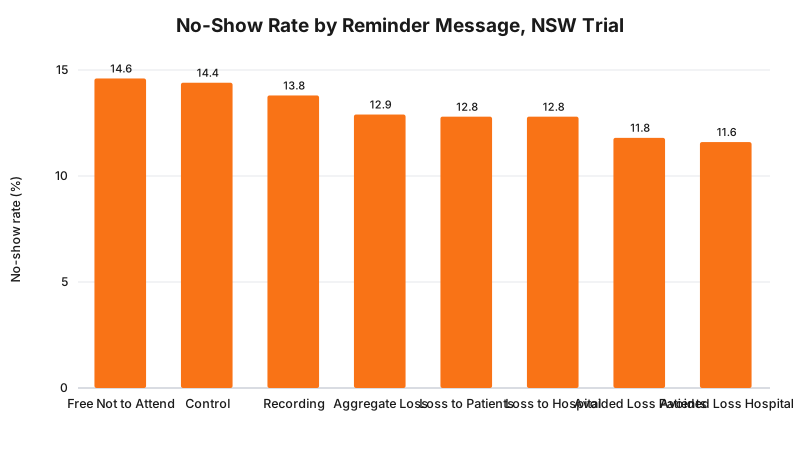
The NSW Government’s Behavioural Insights Unit, working with St Vincent’s Hospital Sydney, ran a randomised controlled trial testing seven different reminder text message formats against a control group. Over five months, the trial sent 8,143 messages. The control group, which received a plain appointment reminder with no behavioural framing, had a no-show rate of 14.4%.
Each missed appointment cost the hospital $125, adding up to roughly $500,000 a year in lost capacity across the hospital. The trial’s best-performing message told patients the hospital would avoid losing $125 if they attended. That single change in wording cut the no-show rate to 11.6%, a result the researchers projected would save $67,000 a year if rolled out across the hospital, rising to $97,000 a year if every patient’s phone number was on file.
Takeaway: the single most evidence-backed lever for reducing no-shows isn’t a policy or a fee, it’s the exact wording of the reminder message a booking system sends.
What RACGP’s GP Poll Adds
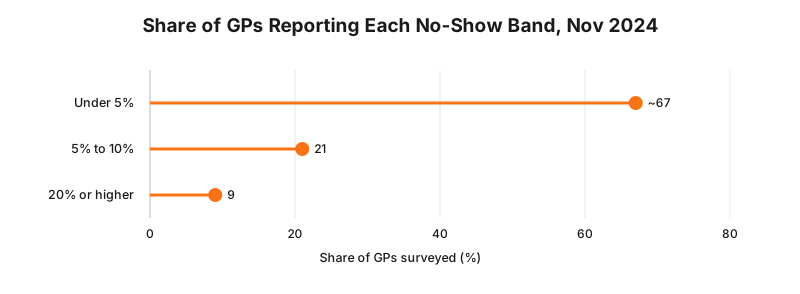
A newsGP poll of 1,122 GPs, published 28 November 2024, gives a second angle: how much no-show rates vary practice to practice, outside a hospital setting. Around two-thirds of respondents said no-shows affected fewer than 5% of their appointments. Another 21% reported a rate between 5% and 10%. At the other end, roughly 9% reported rates of 20% or higher, describing a meaningfully different business problem than the practices sitting under 5%.
That spread matters for a cosmetic clinic more than a single average would. It suggests the rate is driven by practice-level factors, booking friction, reminder systems, deposit policy, rather than being fixed by the type of appointment alone.
Takeaway: a clinic’s own no-show rate is more likely to sit somewhere on this spread than at any single published average, which is exactly why a clinic should track its own figure rather than importing someone else’s.
Booking Friction Is a Related, Separate Problem
The ABS Patient Experiences survey for 2024-25 found 26.4% of people who saw a medical specialist felt they waited longer than acceptable, down from 28.6% the year before. GP wait times told a similar story: 26.0% felt the wait was too long, down from 28.0%. This isn’t a no-show statistic. It measures the reverse problem, patients who wanted an appointment and had to wait for one, and it’s a reminder that supply and demand friction in booking systems is a wider issue than missed appointments alone.
Takeaway: a clinic optimising its booking system is solving two adjacent problems at once, reducing no-shows on one end and reducing wait friction on the other, and the same online booking flow touches both.
What This Means for a Clinic Website and Booking System
The trial evidence points at one specific place to act: the confirmation and reminder sequence triggered when someone books online. That sequence is operational communication about appointment logistics, not marketing copy, so it sits outside the advertising restrictions that apply to a clinic’s public-facing pages. A reminder message can reference cost and consequence in a way a homepage claim never could, because it isn’t describing a clinical outcome or creating an expectation of benefit for anyone reading it.
That distinction matters because it’s tempting to solve a no-show problem with a landing page, adding urgency copy, a deposit callout, or a cancellation policy banner to the page a patient books from. A compliant page still needs to follow the same rules as the rest of a cosmetic clinic’s website, no outcome claims, no unreasonable-expectation language, regardless of what it’s trying to reduce. Getting the booking flow reviewed as part of a wider compliance check catches both problems in one pass, rather than treating no-shows as purely a scheduling fix.
A booking system built for a cosmetic clinic, not adapted from generic salon software, is where that reminder sequence, deposit logic and confirmation copy actually live. See how a compliant cosmetic clinic website is built around exactly this kind of booking flow.
Takeaway: the fix that has trial evidence behind it lives in the booking confirmation sequence, not in a new banner on the homepage.
FAQ
What percentage of cosmetic clinic appointments in Australia end in a no-show?
There is no published Australian dataset that isolates a no-show rate for cosmetic clinics specifically. The closest verified figure is 14.4%, the control-group no-show rate from a NSW Government Behavioural Insights Unit trial of hospital outpatient appointments at St Vincent’s Hospital Sydney. A separate RACGP poll of 1,122 GPs found no-show rates vary widely between practices, from under 5% to over 20%.
How much does a missed appointment cost a clinic?
The only verified Australian figure comes from the same NSW hospital trial, where each missed outpatient appointment cost St Vincent’s Hospital Sydney $125, totalling roughly $500,000 a year across the hospital. No equivalent published figure exists for cosmetic or aesthetic clinics, where per-appointment revenue and fixed costs differ from a public hospital outpatient clinic.
Do reminder text messages actually reduce no-shows?
Yes, according to the same NSW Government randomised controlled trial. Testing 8,143 messages over five months, the best-performing version cut the no-show rate from 14.4% in the control group to 11.6%, a result the researchers projected would save the hospital $67,000 a year if rolled out, or $97,000 a year with full patient phone number coverage.
What does this mean for a cosmetic clinic’s website and booking system?
The evidence points at the booking flow, not the marketing copy. A confirmation and reminder sequence triggered by an online booking form is standard business communication, not an AHPRA-regulated advertising claim, provided it describes appointment logistics rather than clinical outcomes. Building that sequence into the booking system is the one change with trial evidence behind it.
Get Your Booking Flow and Website Reviewed Together
RockingWeb builds cosmetic clinic websites with the booking, reminder and compliance layers reviewed as one system, not three separate problems. A compliance review covers the public-facing pages; the booking flow review covers what happens after someone clicks “book”.
Talk to us about your clinic’s booking system
Sources and References
NSW Government, Behavioural Insights Unit - the 14.4% control-group no-show rate, $125 per-appointment cost, $500,000 annual loss, 8,143-message trial and the 11.6% result with projected $67,000 to $97,000 annual savings
RACGP newsGP - the 1,122-GP poll on practice-level no-show rates, published 28 November 2024
Australian Bureau of Statistics - Patient Experiences in Australia, 2024-25, the 26.4% specialist and 26.0% GP unacceptable-wait-time figures
Related reading:
- Simple Copy Converts 56% Higher on Clinic Landing Pages: what changes on the booking page itself
- Cosmetic Clinic Website Booking Conversion Australia: the booking flow conversion benchmark
- Cosmetic Clinic Websites: compliant website builds for AHPRA-regulated clinics
Vikas Thakur
Founder of RockingWeb. 16 years of experience from working at TPG, iiNet and Monadelphous, now building websites, software and digital marketing for local businesses in Rockingham and Perth.