Simple Copy Converts 56% Higher on Clinic Landing Pages
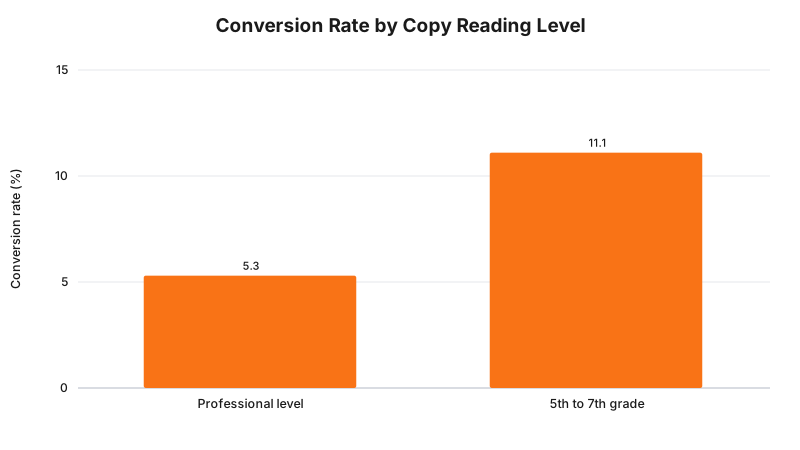
Landing pages written at a 5th to 7th grade reading level convert at 11.1%, 56% higher than 8th to 9th grade copy and more than double the 5.3% rate of professional-level writing, per Unbounce's 2024 Conversion Benchmark Report. Here is what that means for a cosmetic clinic's booking pages.
 Vikas Thakur Founder, RockingWeb 8 min read
On this page 9
- Key takeaways
- Why Plain Language Beats Professional Copy
- What Actually Drives Traffic That Converts
- Mobile Brings the Traffic, Desktop Does the Booking
- Which Treatments Justify a Dedicated Landing Page
- What AHPRA Allows You to Say While You Optimise
- FAQ
- Get Your Clinic’s Booking Flow Checked
- Sources and References
Key takeaways
- Landing pages written at a 5th to 7th grade reading level convert at 11.1%, per Unbounce’s 2024 Conversion Benchmark Report
- That is 56% higher than 8th to 9th grade copy, and more than double the 5.3% rate of professional-level writing
- The median landing page conversion rate across all industries analysed is 6.6%, ranging from 3.8% to 12.3%
- Email-driven traffic converts at 19.3%, 77% higher than paid search (10.9%) and 60% higher than paid social (12%)
- Mobile drives 83% of landing page visits, yet desktop still converts 8% better
- The report covers 464 million visitors and 57 million conversions across 41,000+ landing pages, analysed over the past year
- AHPRA’s advertising guidelines for higher risk cosmetic procedures, in force since 2 September 2025, require real, unedited images and strengthened the testimonial ban to cover social media influencers
- No Australian-specific dataset publishes a booking-conversion benchmark for cosmetic clinics. This global figure is the closest verified proxy in 2026
Landing pages written at a 5th to 7th grade reading level convert at 11.1%. Pages written like a clinical brochure convert at 5.3%, less than half as well. That comes from Unbounce’s 2024 Conversion Benchmark Report, built from 57 million tracked conversions across more than 41,000 landing pages. For a cosmetic clinic that cannot lean on testimonials or before-and-after imagery to build trust, the words on the page carry more of the conversion job than usual. This guide breaks down what actually moves that number, reading level, traffic source, and device, then covers what AHPRA’s current advertising rules let a clinic put on a booking page while chasing it.
Why Plain Language Beats Professional Copy
Unbounce’s exact wording: landing pages written at a 5th to 7th grade level convert at 11.1%, 56% higher than pages written at an 8th and 9th grade level, and more than 2x higher than professional-level writing, which converts at 5.3%. Difficult, three-syllable-plus words carry a negative correlation with conversion rate, and longer reading time and higher word count both correlate with lower conversion.
For a clinic, “professional-level” copy usually means procedure names lifted straight from a training manual, aimed at a first-time visitor who has never heard the term before. None of that is wrong information. It is pitched at the wrong reader for a page whose only job is to get someone to request a consultation.
Takeaway: rewriting a booking page from clinical language to plain, 5th to 7th grade English is a copy edit, not a redesign, and it is tied to the largest single conversion gap in the dataset.
What Actually Drives Traffic That Converts
Not every visitor arrives with equal intent, and the channel someone arrived through changes what a realistic conversion rate looks like. The table below breaks down the gap, with Google (11.3%) and Instagram (17.9%) leading their respective channels.
| Channel | Conversion Rate | Notes |
|---|---|---|
| 19.3% | 77% higher than paid search, 60% higher than paid social | |
| Paid social (average) | 12% | Instagram 17.9%, Facebook 13% lead the category |
| Paid search (average) | 10.9% | Google 11.3%, 41% ahead of Bing, 95% ahead of Yahoo |
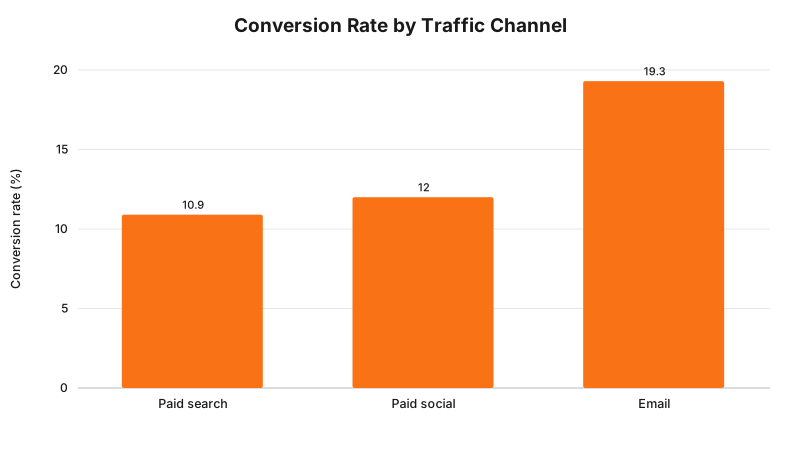
For a clinic, this is the case for building a recall and referral email list rather than treating every campaign as a paid-acquisition problem. A patient who already has a relationship with the clinic converts inside the highest-performing channel in the entire dataset.
Takeaway: a clinic’s existing patient list, emailed with the same plain-language standard as the booking page itself, outperforms paid channels by a wide margin.
Mobile Brings the Traffic, Desktop Does the Booking
Mobile devices drive 83% of the visits recorded in the report, yet desktop visitors convert 8% better. That gap between where the traffic is and where the bookings happen points to friction in the mobile experience: a booking form with fields too small to tap accurately, a slow-loading page, or paragraphs that read fine on a laptop and become a wall of text on a phone.
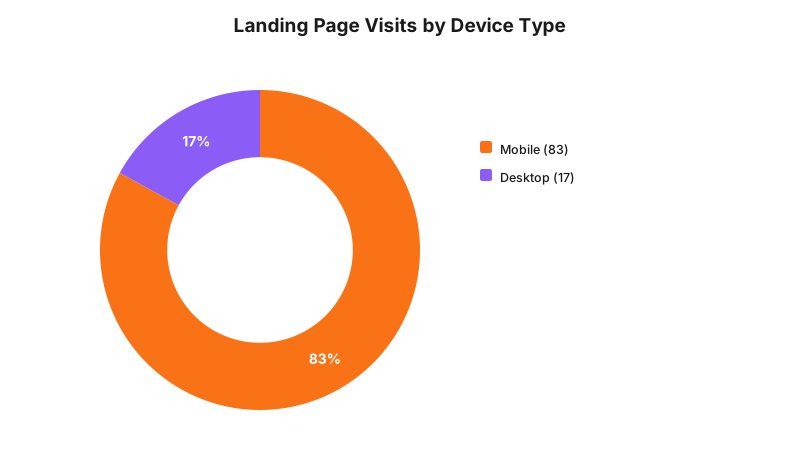
Four out of five visitors to a clinic’s landing pages are almost certainly arriving on a phone. A booking form that has not been tested field by field on an actual mobile device is the most likely single place a clinic is losing enquiries it already paid to attract.
Takeaway: the channel and copy work above only pays off if the booking form at the end of it actually works on the device most visitors are using.
Which Treatments Justify a Dedicated Landing Page
Not every procedure needs its own page, and cramming five treatments onto one page works against the reading-level finding above. A shared page explaining injectables, skin treatments, and a surgical referral pathway in one scroll cannot hold a consistent, plain-language standard for any of them. It ends up written at whatever level covers the most complex procedure on the page, dragging every other treatment down with it.
The procedures worth a dedicated page are the ones with the longest research phase before a patient enquires: higher-cost treatments, anything involving a course of sessions, and anything a patient is likely to compare across providers. A single-treatment page can go deep on the procedure and consultation, in plain language, without competing for space against an unrelated treatment three scrolls down.
This also affects enquiry quality, not just volume. A visitor who reads a clear, honest explanation before enquiring arrives better informed than one who filled in a form off a page that told them almost nothing. That is a reasonable inference from the readability findings, not a separately measured statistic; no dataset here isolates lead quality by reading level.
Takeaway: if a treatment takes weeks of research before someone books a consultation, it has earned its own page, written in plain language, not a paragraph on a shared services page.
What AHPRA Allows You to Say While You Optimise
None of the tactics above override AHPRA’s advertising rules. AHPRA’s guidelines for practitioners who advertise higher risk non-surgical cosmetic procedures took effect on 2 September 2025. They require real, unedited images with no misleading editing, plus a warning that results vary wherever images appear. The same guidelines strengthened the testimonial ban to explicitly capture social media influencers, and added a mandatory seven-day cooling-off period between a first consultation and any procedure for patients under 18, alongside a ban on advertising targeted at under-18s.
None of that stops a clinic writing a clear, plain-language explanation of a procedure. It stops a clinic substituting a testimonial, an edited image, or an outcome promise for that explanation. RockingWeb can check a clinic’s current pages against these rules before a rewrite starts, so the plain-language version is compliant from the first draft.
Takeaway: the readability gain above has to be built inside AHPRA’s current rules, not around them. Get the compliance check done first.
Put together, the tactics above give a build order: fix the mobile booking flow first, since that is where 83% of visitors are; rewrite treatment pages to a 5th to 7th grade reading level, starting with the highest-consideration procedures; then build the email list, checked against AHPRA compliance throughout, not bolted on afterwards. A compliant, conversion-focused cosmetic clinic website applies that build order directly.
FAQ
What conversion rate should a cosmetic clinic landing page aim for?
There is no published Australian-specific booking-conversion benchmark for cosmetic clinics. The closest verified figure is Unbounce’s 2024 Conversion Benchmark Report, putting the median landing page conversion rate at 6.6% across all industries, ranging from 3.8% to 12.3%. Use that as context, not a target, since it covers every industry, not clinics specifically.
Does simpler website copy really convert better than professional clinical language?
Yes, per the same report. Landing pages written at a 5th to 7th grade reading level convert at 11.1%, 56% higher than 8th to 9th grade copy and more than double the 5.3% professional-level rate. This is a general finding, not one isolated to healthcare pages, so treat it as a copy principle rather than a guaranteed clinic result.
Which treatments justify a dedicated landing page instead of a shared treatments page?
This is a judgement call the data can inform but not answer directly. A page covering five procedures at once cannot hold a 5th to 7th grade reading level for any of them. Higher-cost, higher-consideration procedures benefit most from a dedicated page that goes deep in plain language without competing against unrelated treatments.
What can a clinic actually say on a booking page under AHPRA’s advertising rules?
AHPRA’s guidelines for advertising higher risk cosmetic procedures, in effect since 2 September 2025, require real, unedited images and a warning that results vary, and strengthened the testimonial ban to explicitly cover social media influencers. A booking page can describe the procedure, the practitioner’s qualifications, and the consultation in plain language without relying on any of that banned content.
Get Your Clinic’s Booking Flow Checked
RockingWeb builds cosmetic clinic websites around plain-language copy, mobile-first booking flows, and current AHPRA rules, then benchmarks them against data like this, not guesswork.
Talk to us about your clinic’s website
Sources and References
- Unbounce - 2024 Conversion Benchmark Report: reading-level, channel, and device conversion rates cited throughout, from 464 million visitors and 57 million conversions across 41,000+ landing pages, analysed over the past year
- AHPRA - Putting patients first: New guidelines for cosmetic procedures: the 2 September 2025 effective date, image and testimonial rules, and under-18 protections
Related reading:
- Cosmetic Clinic Website Booking Conversion Australia: a closer look at booking-flow friction specific to AHPRA-regulated clinics
- 4.3% Conversion Rate: Dental Website Benchmark: the healthcare-and-wellness-specific slice of the same Unbounce report
- CRO Statistics Australia 2026: broader Australian conversion rate data across industries
- Cosmetic Clinic Websites: compliant website builds for AHPRA-regulated clinics
Vikas Thakur
Founder of RockingWeb. 16 years of experience from working at TPG, iiNet and Monadelphous, now building websites, software and digital marketing for local businesses in Rockingham and Perth.