15.2 Million Australians Use Instagram: What Clinics Can Post
Instagram reached 15.2 million Australians, 56% of the population, by late 2025. AHPRA's guidelines for advertising higher risk cosmetic procedures treat every one of those posts the same as a paid ad, including comments, Stories and private groups.
 Vikas Thakur Founder, RockingWeb 9 min read
On this page 9
- Key takeaways
- Instagram’s Reach Among Australians, Late 2025
- Why AHPRA Doesn’t Care If the Post Was Free
- What Still Counts as a Testimonial on Instagram
- The Under 18 Problem AHPRA Is Trying to Close
- What This Means for Your Clinic’s Website
- FAQ
- Get Your Instagram Content Checked Against AHPRA’s Guidelines
- Sources and References
Key takeaways
- Instagram reached 15.2 million users in Australia by late 2025, equal to 56.0% of the population, according to data published in Meta’s own advertising tools
- Instagram’s Australian ad audience grew by 1.20 million (+8.6%) between October 2024 and October 2025
- Instagram reaches 66.1% of Australians aged 13 and over and 69.2% of adults aged 18 and over
- AHPRA’s guidelines state that content on public and private social media profiles or groups can count as advertising, including a practitioner’s own comments
- A testimonial published through Instagram’s Stories function still counts as a testimonial under AHPRA’s guidelines, even though it disappears after 24 hours
- Advertising for higher risk cosmetic procedures on social media must be identified as adult content so it cannot reach under 18s
- Practitioners must not use hashtags or metadata to target a vulnerable patient demographic
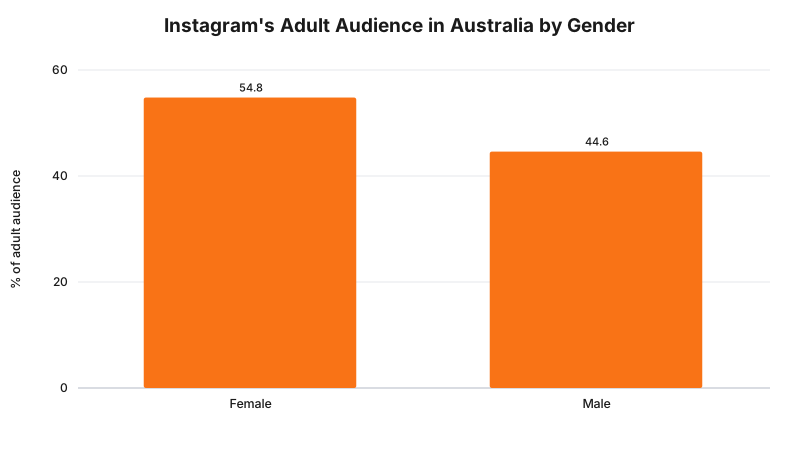
- Instagram’s adult audience in Australia splits 54.8% female to 44.6% male
Instagram reached 15.2 million people in Australia by late 2025, or 56.0% of the entire population, according to data published in Meta’s own advertising tools. AHPRA’s guidelines for advertising higher risk non-surgical cosmetic procedures do not treat that reach as a bonus channel with looser rules. Content on a practitioner’s public or private social media profile can count as advertising, comments included, with no exception for a post that cost nothing to publish.
That single fact catches out more clinics than any paid ad ever will. A boosted post goes through a review queue before it runs. An organic caption goes live the moment you hit post, with no compliance check in between. This guide covers what AHPRA’s guidelines say counts as advertising on Instagram, what still trips the testimonial and targeting rules, and what that means for your own website.
Instagram’s Reach Among Australians, Late 2025
Instagram is not a niche channel for a cosmetic clinic’s audience. By late 2025 it reached 15.2 million people in Australia, 56.0% of the population and 57.7% of the country’s internet users. Among people aged 13 and over, Instagram’s own minimum sign-up age and the group that includes the under-18s AHPRA’s guidelines are designed to protect, reach climbs to 66.1%. Among adults 18 and over it reaches 69.2%.
| Audience segment | Instagram reach, late 2025 |
|---|---|
| Total population | 56.0% (15.2 million people) |
| Internet users | 57.7% |
| People aged 13 and over | 66.1% |
| Adults aged 18 and over | 69.2% |
| Year-on-year ad audience growth (Oct 2024 to Oct 2025) | +8.6% (+1.20 million) |
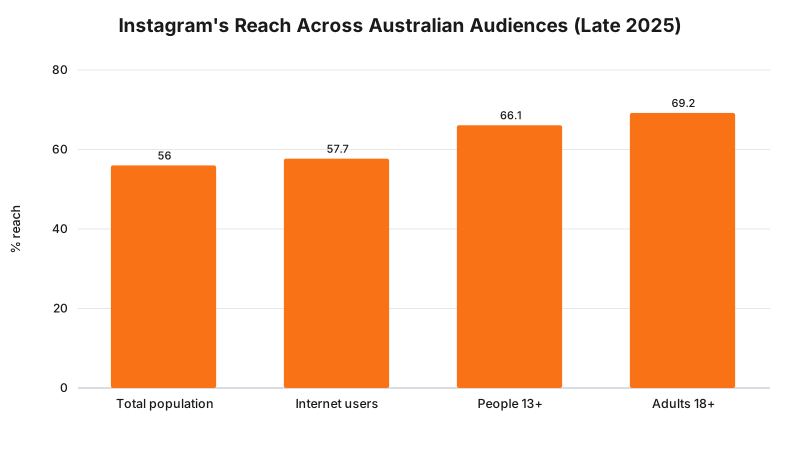
Takeaway: Instagram now reaches more than two in three Australians aged 13 and over, the age group that includes the under-18s AHPRA’s guidelines are designed to protect.
Why AHPRA Doesn’t Care If the Post Was Free
AHPRA’s guidelines define advertising broadly: all forms of verbal, printed and electronic communication that promotes a provider or seeks to attract a person to use one. Content on public and private social media profiles or groups may constitute advertising under the National Law if it relates to a regulated health service, and this includes comments by the practitioner.
A comment you leave on your own post can be assessed the same way as a billboard. There is no dollar threshold, no distinction between an ad you paid Meta to boost and a caption you typed for free. The National Law’s advertising restrictions, set out in section 133, apply to all advertisers, and the guidelines apply that standard to every format social media can produce.
Takeaway: treat every piece of clinic-branded content on Instagram, paid or not, as if it will be assessed under the same rule as a billboard, because it can be.
What Still Counts as a Testimonial on Instagram
The National Law bans testimonials in advertising for higher risk cosmetic procedures, and AHPRA’s guidelines spell out how far that reaches on a platform built around ephemeral content. A practitioner is considered to have used a testimonial even where it is published in a time restricted way, such as through a Stories function. A vanishing 24 hour Story is not a loophole.
The guidelines go further. A practitioner is also considered to have used a testimonial where they link to testimonials on third party advertising, reshare a patient’s positive post, or interact with a review by liking it. Practitioners are not responsible for testimonials patients post independently, but they are expected to avoid interacting with them, and the guidelines suggest disabling reviews, comments or tagging on social pages to manage that risk.
Social media influencers and ambassadors get their own risk category. Content from an influencer or ambassador is considered to pose a particular risk to younger people, given the audience on some platforms, and any practitioner who arranges that content is responsible for it meeting the same testimonial rules as their own posts.
Takeaway: liking, resharing or archiving a patient’s Story into a Highlight is not a passive act under these guidelines. It is treated the same as publishing the testimonial yourself.
The Under 18 Problem AHPRA Is Trying to Close
Instagram’s own reach data is part of why AHPRA’s guidelines single out age targeting. Advertising for higher risk cosmetic procedures must not be targeted or directed at people under 18, and advertisers must limit young people’s exposure to media likely to have a significant under 18 audience. On social media specifically, the guidelines require this advertising to be identified as adult content, so platforms can stop young people accessing it.
The guidelines also close an obvious workaround: practitioners must not exploit or target at risk groups, including by leveraging social media algorithms to boost posts toward vulnerable groups, or using metadata or hashtags to target a vulnerable patient demographic. A hashtag chosen because it reaches a younger, more image conscious audience is itself a compliance problem, independent of what the caption says.
Takeaway: the adult content label and the hashtag targeting ban exist because the platform’s own audience skews toward exactly the age group AHPRA is trying to protect.
What This Means for Your Clinic’s Website
AHPRA’s guidelines acknowledge a real constraint of the format: it may not be possible in some advertising, particularly social media, to include full details about risks. Their answer is not to excuse the shortfall, it is to require a link, directing the public to the section of the practitioner’s website that contains it.
That single line is the clearest brief a clinic will get for its own site. An Instagram caption cannot carry full risk disclosure, timing of results, recovery expectations and eligibility criteria, and it should not try. That detail belongs on a dedicated page for the procedure, one your Instagram content links to rather than tries to replace. A treatment that gets regular organic or paid attention, injectables, thread lifts and laser treatments among them, is a strong candidate for its own page rather than a paragraph in a general services list. A visitor who clicks through from Instagram to that page arrives asking a specific, informed question, not chasing an image they saw for three seconds in a feed.
RockingWeb checks whether your site carries the risk and eligibility detail your Instagram content depends on. A cosmetic clinic website built with a dedicated page per higher risk procedure gives Instagram somewhere compliant to send people.
Takeaway: Instagram is where a patient notices you. Your website is where AHPRA expects the actual detail to live, in its own words.
FAQ
Does AHPRA’s advertising guidelines apply to a free Instagram post, or only paid ads?
Both. AHPRA’s guidelines state that content on public and private social media profiles or groups may constitute advertising under the National Law if it relates to a regulated health service, including comments by the practitioner. There is no carve out for organic, unpaid content.
Does an Instagram Story count as a testimonial if it disappears after 24 hours?
Yes. AHPRA’s guidelines specifically state a practitioner is considered to have used a testimonial in advertising even where it is published in a time restricted way, including through a social media platform’s Stories function.
How many Australians use Instagram, and why does that matter for a clinic’s compliance risk?
15.2 million, or 56.0% of the population, as of late 2025, according to data published in Meta’s own advertising tools. A platform that size means a non-compliant post is not a private mistake, it is visible to a meaningful share of the country.
What should go on my clinic’s Instagram versus my website?
AHPRA’s guidelines acknowledge social media cannot always carry full risk information and direct advertisers to link through to the relevant section of the practitioner’s website instead. Treatment specific detail, pricing, eligibility and full risk disclosure belong on a dedicated landing page your Instagram content can link to.
Get Your Instagram Content Checked Against AHPRA’s Guidelines
RockingWeb reviews cosmetic clinic Instagram accounts, Stories and Highlights against AHPRA’s current advertising guidelines, flags every post that has drifted into testimonial or targeting territory, and builds the treatment landing pages your Instagram content should be linking to.
Talk to us about your clinic’s marketing
Sources and References
DataReportal - “Digital 2026: Australia” (Simon Kemp, Kepios, published 5 November 2025): Instagram’s Australian user count, population and age-band reach, ad audience growth, and adult gender split
AHPRA - “Putting patients first: New guidelines for cosmetic procedures,” 2 September 2025: the effective date and the real image, results-may-vary and strengthened influencer testimonial requirements
AHPRA, via MDA National (advance copy) - Guidelines for advertising higher risk non-surgical cosmetic procedures: the definition of advertising covering social media, the testimonial rules covering Stories and reviews, the influencer provisions, the adult content and hashtag targeting rules, and the guidance to link through to a website for full risk information
Related reading:
- AHPRA Social Media Rules for Cosmetic Clinics: a platform by platform breakdown covering Facebook and TikTok alongside Instagram
- AHPRA Strengthened Its Influencer Ad Ban on 2 September 2025: the separate federal rule covering paid and gifted influencer testimonials
- AHPRA Before and After Advertising Rules: the specific requirements for genuine, unedited before and after images
- Cosmetic Clinic Websites: compliant website builds with a dedicated page per treatment
Vikas Thakur
Founder of RockingWeb. 16 years of experience from working at TPG, iiNet and Monadelphous, now building websites, software and digital marketing for local businesses in Rockingham and Perth.