Two WA Dentists Fined $5,328 Each for Injectables
The TGA has fined two Western Australian dentists $5,328 each, in separate cases in 2021 and 2022, for allegedly importing injectable products that were never listed on the ARTG. A dentist offering dermal filler or anti-wrinkle treatment sits under the exact same TGA importation and AHPRA advertising rules as a cosmetic-clinic nurse, and a dental practice website carries the same exposure.
 Vikas Thakur Founder, RockingWeb 14 min read
On this page 13
- Key takeaways
- What the Regulator Said
- What That Means for the Build
- Decision Matrix: TGA Import Rule vs National Law Advertising Rule
- A Worked Example: A Dental Practice’s “Facial Aesthetics” Page
- What to Check on Your Own Dental Practice Website
- The Enforcement Anchor
- Where This Gets Hard
- Status
- Get a Direct Answer on Your Practice’s Site
- Frequently Asked Questions
- Need a hand with your website?
- Sources and References
Key takeaways
- The TGA fined a Western Australian dentist $5,328 in June 2021 over unregistered hyaluronic acid dermal filler syringes
- A separate Western Australian dentist was fined $5,328 in April 2022 over 21 vials of unregistered Dysport 500U Botulax (botulinum toxin type A)
- Both cases used the same mechanism as the 2026 nurse infringement notices: products seized at the border because they were never listed on the Australian Register of Therapeutic Goods (ARTG)
- AHPRA’s September 2025 guidelines cover every registered health practitioner except medical practitioners, so a Dental Board registrant offering injectables sits under the same rule as a nurse injector
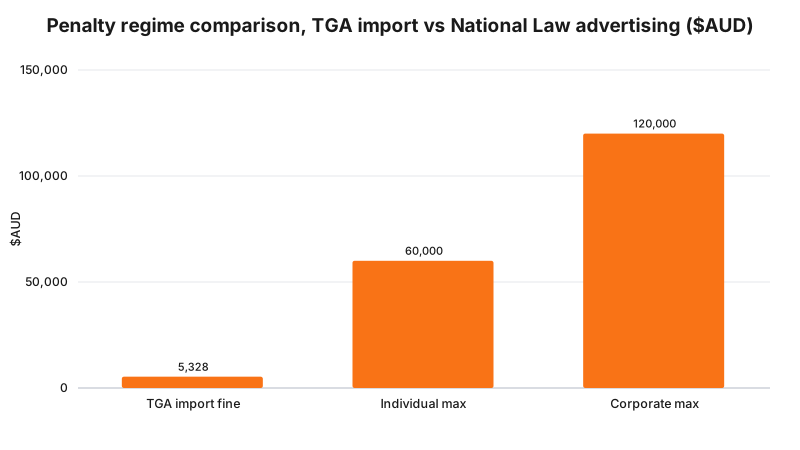
- Separately, section 133 of the Health Practitioner Regulation National Law caps advertising breach penalties at $60,000 for an individual and $120,000 for a body corporate, a different regime from the TGA’s fixed infringement figures
- Dental sites commonly bundle facial injectables inside a “cosmetic dentistry” or “smile makeover” page, which is where a brand-name reference is most likely to survive a routine site audit
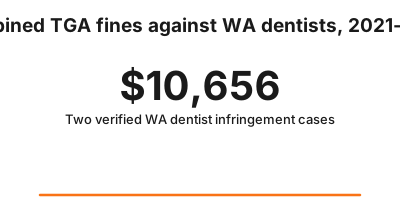
As at 21 September 2026, the TGA’s own published record shows two Western Australian dentists, in two separate cases two years apart, each fined the identical $5,328 for importing injectable products that were never listed on the ARTG. Neither case is from the current 2026 enforcement wave that has already caught four cosmetic-clinic nurses. Both predate it by years. That gap matters, because it shows this is not a new rule written for nurses that happens to sweep up a dentist. It is the same rule, enforced against the same conduct, regardless of which AHPRA-registered board issued the practitioner’s registration. If your dental practice offers dermal filler or anti-wrinkle treatment, or is thinking about adding it, the exposure below applies to your website exactly as it applies to a cosmetic clinic’s.
What the Regulator Said
The TGA’s own media release, published 3 June 2021, states it issued two infringement notices totalling $5,328 to a dentist from Western Australia for the alleged unlawful importation of medical devices. The dentist allegedly imported syringes containing hyaluronic acid that were not included in the ARTG. Pre-filled hyaluronic acid syringes are classified as medical devices, used to change how parts of the skin look and often used to reduce facial lines and wrinkles. The release states plainly that the TGA “is concerned that there has been an increase in importing therapeutic goods, such as medical devices, not included in the ARTG for in-clinic use, and will be taking a strong enforcement approach to deal with breaches of this nature.”
A second, separate TGA media release, published 13 April 2022, states the TGA issued two infringement notices totalling $5,328 to a Western Australian-based dentist for allegedly importing unregistered therapeutic goods on two occasions. It is alleged the dentist imported 21 vials of Dysport 500U Botulax, a botulinum toxin type A product, not included on the ARTG at the time of importation. The products were seized at the border and the release states they will not be released.
The two releases give no indication of whether this is the same practitioner appearing twice or two different WA-based dentists. Nothing in either release names the individual, cross-references the other case, or states a repeat offence. Treat them as two separate, independently reported enforcement actions rather than one case reported twice, since that is what the public record actually shows.
Under the Therapeutic Goods Act 1989, a therapeutic good must be entered on the ARTG before it can be lawfully imported into Australia, unless a specific exemption, approval or authority applies. That single requirement covers both cases above: one a medical device (hyaluronic acid filler), the other a prescription medicine (botulinum toxin type A). The product category differs. The rule that caught both does not.
What That Means for the Build
Read on its own, an ARTG import requirement sounds like a supply-chain problem, not a website one. It becomes a website problem the moment a practice’s own pages, schema or booking flow start making claims about the product a patient will receive.
A dental practice offering facial injectables typically builds that content differently to a dedicated cosmetic clinic, and that difference is exactly where risk hides. A cosmetic clinic usually has a standalone “Anti-Wrinkle Injections” or “Dermal Filler” treatment page. A dental practice more often folds the same treatment into a broader “Cosmetic Dentistry,” “Facial Aesthetics,” or “Smile Makeover” page alongside veneers, whitening and Invisalign, because that is how the practice’s own service menu is organised internally. A compliance review that only checks the pages with “injectable” in the URL will miss the exact page where the risk actually sits.
The same checks that apply to a cosmetic clinic’s treatment page apply here, just in a less obvious location. Page headings, body copy, meta titles and meta descriptions on that bundled page should describe the treatment category, not a specific product or supplier. Structured data on the page, typically a MedicalProcedure or Service schema block, often carries a free-text field populated straight from whatever the practice’s internal treatment list calls the item, a field no content editor proofreads by eye. Downloadable PDF fee guides that cover a dental practice’s full service range, not just injectables, are a common place for a brand name to sit unreviewed for years. And a practice management or booking system such as Dental4Windows, Core Practice, Praktika, EXACT or Dentally may list the service by supplier or brand in a dropdown a patient sees before any clinical consultation has happened.
None of this changes what a compliant dental practice can offer. It changes what the words on the page, in the schema, and in the booking dropdown are allowed to say about it.
Decision Matrix: TGA Import Rule vs National Law Advertising Rule
| Regime | What it covers | Who enforces it | Penalty in this case type | Named on a dental site |
|---|---|---|---|---|
| Therapeutic Goods Act 1989, ARTG requirement | Importing a therapeutic good never registered, listed or included on the ARTG | TGA | Fixed infringement notice, $5,328 total across 2 notices in both dentist cases reviewed here | Not directly visible on a website, sits in supply-chain records |
| TGA advertising restriction on prescription-only substances | Naming a prescription-only good or its trade name in health-service advertising | TGA | Compliance action, separate from import infringement notices | Treatment page copy, meta tags, alt text, PDFs, schema |
| Health Practitioner Regulation National Law, section 133 | False, misleading or deceptive advertising of a regulated health service | AHPRA, via the relevant state or territory board (here, the Dental Board of Australia) | Up to $60,000 for an individual, up to $120,000 for a body corporate | Any public-facing advertising, including the website |
| AHPRA Guidelines for registered health practitioners who perform non-surgical cosmetic procedures (September 2025) | Practitioner conduct standards for non-surgical cosmetic procedures | AHPRA and the relevant board | Notification and disciplinary process, not a fixed dollar figure | Practitioner-facing, indirectly shapes what a compliant page can claim |
Four separate regimes, two separate regulators, and only one of the four dollar figures in that table is the $5,328 the two dentist cases actually paid. The other numbers belong to a different rule entirely.
A Worked Example: A Dental Practice’s “Facial Aesthetics” Page
A fictional but representative West Australian dental practice runs a “Cosmetic Dentistry” landing page covering veneers, teeth whitening, Invisalign and, three sections down, “Facial Aesthetics.” That section reads: “Our dentist is trained in anti-wrinkle and dermal filler treatments using premium Allergan and Galderma products, TGA registered for your safety.” One sentence, three separate problems: two supplier brand names named in public-facing advertising, an unqualified “TGA registered” claim about a service (the TGA registers or lists goods, not clinical services), and a page URL of /cosmetic-dentistry/facial-aesthetics-botox-filler/ that keeps a prescription-only trade name live in a permanent, indexable address regardless of what the visible copy says.
The fix does not touch what the practice actually offers. The paragraph becomes “Our dentist is trained in anti-wrinkle and dermal filler treatments, delivered using ARTG-listed products.” The URL moves to /cosmetic-dentistry/facial-aesthetics/, with a 301 redirect from the old path. The page’s MedicalProcedure schema drops the free-text supplier field. The PDF fee guide linked from the same page gets the same pass, since it is the document most likely to have been last edited before anyone thought to check it against these rules.
A standalone cosmetic clinic’s equivalent treatment page faces the identical exposure under the identical rules, TGA import and advertising restrictions plus the same National Law penalty ceiling. The only practical difference is that a clinic’s dedicated injectables page is easier to find during an audit than a dental practice’s bundled “cosmetic dentistry” page, which is exactly why the dental version needs the closer look.
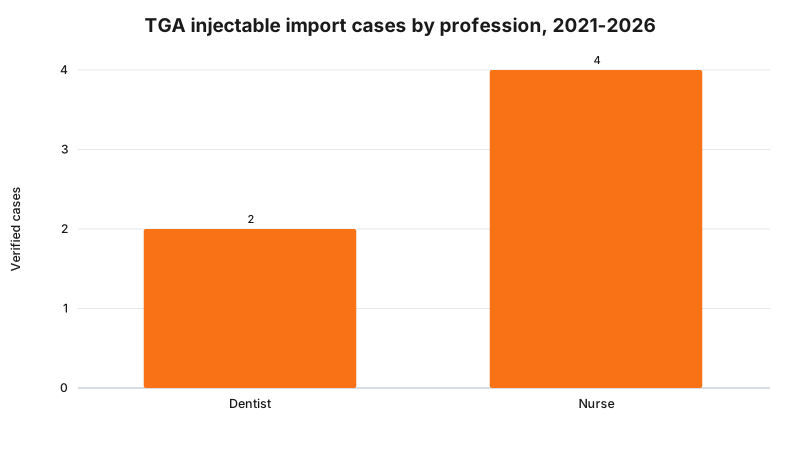
The dentist figure covers 2021 and 2022. The nurse figure covers four verified cases through 2026, detailed in our breakdown of the July 2026 nurse infringement notice. Different windows, same underlying rule, same regulator.
What to Check on Your Own Dental Practice Website
- Find every page that mentions anti-wrinkle injections, dermal filler or facial aesthetics, including pages where that is a subsection rather than the page’s main topic
- Search page titles, meta descriptions and body copy for a supplier or product brand name, not just the visible treatment description
- Check the URL slug of every page that names or has ever named a product brand
- Check structured data output on treatment pages for a free-text product or supplier field
- Check every downloadable PDF fee guide or treatment brochure linked from the site, especially ones covering multiple services
- Check your practice management or booking system’s public-facing service list, as it appears before a patient reaches a consultation step
- Check any “TGA registered” or “ARTG listed” claim against the current register entry, since it can be varied, suspended or cancelled after the page was written
The Enforcement Anchor
The two WA dentist cases above are the enforcement anchor for this row: real, dated, TGA-published infringement notices with named dollar figures, not a hypothetical risk. The 3 June 2021 release covers the hyaluronic acid syringe case, two infringement notices, $5,328 total. The 13 April 2022 release covers the Dysport 500U Botulax case, 21 vials, two infringement notices, $5,328 total. Both releases are published on tga.gov.au under Media releases, and both were fetched and read directly for this guide.
Neither release states what, if anything, either dentist’s website said about the products involved. This guide does not claim the website played a role in either case, because the public record does not say so.
Where This Gets Hard
Be precise about what is and is not verified here. Two things are confirmed: the TGA has fined a dentist over unregistered injectable imports, twice, and dentists sit under the same September 2025 AHPRA cosmetic procedure guidelines as nurses. One thing is not confirmed: whether either dentist’s website or advertising contributed to either infringement notice, or whether the two cases involve the same individual. Both releases are import-only actions. Treating them as proof that dental website copy caused a TGA fine would be an invented link this guide has not made.
The harder ongoing question is whether a dental practice’s bundled service page reads, to a regulator or an AI answer engine indexing it, as advertising a prescription-only good rather than a treatment category. A “Facial Aesthetics” section folded into a “Cosmetic Dentistry” page is a normal way to structure a dental site’s information architecture, and nothing about that structure is itself a problem. The regulator says an advertisement for a health service should not refer, directly or indirectly, to a prescription-only substance or its trade name; the build consequence is that every page carrying that content, however deep in the site or however small a section it occupies, needs the same review a dedicated treatment page would get; whether a specific page of your practice’s site crosses that line is a question for your medical defence organisation or your lawyer.
Status
In force. The ARTG import requirement under the Therapeutic Goods Act 1989 and section 133 of the Health Practitioner Regulation National Law are both standing law, not proposals and not pending commencement. The September 2025 AHPRA Guidelines for registered health practitioners who perform non-surgical cosmetic procedures are current guidance, in effect since 2 September 2025. As at 21 September 2026, nothing in this guide describes a scheme awaiting a start date.
Get a Direct Answer on Your Practice’s Site
If your dental practice offers injectables, or is planning to, talk to us about your site and we will tell you exactly what your treatment pages, schema and booking flow currently say, and what it takes to fix it. For the full AHPRA advertising framework as it applies to dental practices, see our AHPRA advertising rules for cosmetic dentistry guide.
Frequently Asked Questions
Has the TGA ever fined a dentist over injectables?
Yes, at least twice. The TGA issued two infringement notices totalling $5,328 to a Western Australian dentist in June 2021 over pre-filled hyaluronic acid syringes not listed on the ARTG, and a separate two infringement notices totalling $5,328 to a Western Australian dentist in April 2022 over 21 vials of Dysport 500U Botulax (botulinum toxin type A), also not on the ARTG at the time of import.
Are dentists bound by the same AHPRA cosmetic procedure guidelines as nurses?
Yes. AHPRA’s September 2025 Guidelines for registered health practitioners who perform non-surgical cosmetic procedures cover every registered health practitioner except medical practitioners, and a dentist registered with the Dental Board of Australia is not a medical practitioner. A Dental Board registrant offering anti-wrinkle injections or dermal filler sits under the same single guideline as an AHPRA-registered nurse doing the same treatment.
Are the $5,328 TGA fines and the $60,000 to $120,000 AHPRA advertising penalties the same thing?
No, and conflating them is a common mistake. The $5,328 figures are Therapeutic Goods Act 1989 infringement notices for importing an unregistered product, a fixed statutory amount unrelated to advertising content. The $60,000 (individual) and $120,000 (body corporate) figures are separate maximum penalties under section 133 of the Health Practitioner Regulation National Law for a false, misleading or deceptive advertisement, a different regulator, different law, different trigger.
What should a dental practice check on its website before offering injectables?
Search every treatment page, meta tag, structured data field, PDF fee guide, and booking-widget dropdown for a specific product or brand name, not just the dedicated injectables page. Dental sites commonly bundle facial injectables into a broader “cosmetic dentistry” or “smile makeover” package page, which is exactly where a brand-name reference tends to survive an otherwise-clean site audit.
Is this a new 2026 enforcement trend against dentists specifically?
No, and this guide does not claim that. Both verified dentist cases are from 2021 and 2022, years before the TGA’s Compliance Principles 2026-27 named cosmetic injectables a stated priority. What is current is the underlying rule and the TGA’s active enforcement posture in the same product category against other professions in 2026, not a fresh wave of dentist-specific cases.
Need a hand with your website?
If you want a second pair of eyes on how this applies to your own site, request a callback and we will talk it through.
Sources and References
TGA
- Dentist fined $5,328 for alleged unlawful importation of injectables, published 3 June 2021, the hyaluronic acid syringe case. Fetched directly 11 August 2026.
TGA
- Dentist fined $5,328 for alleged unlawful importation of Botox, published 13 April 2022, the 21-vial Dysport 500U Botulax case. Fetched directly 11 August 2026.
TGA
- Infringement notices register. Checked 11 August 2026.
Federal Register of Legislation
- Therapeutic Goods Act 1989, the ARTG import requirement both dentist cases were fined under. Checked 11 August
Queensland Legislation
- Health Practitioner Regulation National Law Act 2009 (the base Act, adopted by application in Western Australia via the Health Practitioner Regulation National Law (WA) Act 2010), section 133, the source of the $60,000 individual and $120,000 body corporate advertising penalty maxima. Checked 11 August 2026.
Hall Payne Lawyers
- Health Practitioners’ Advertising Obligations in Australia, corroborating the section 133 penalty figures. Some other secondary and marketing sources circulate a lower $30,000 / $60,000 figure; this guide follows the legislation and the law-firm corroboration, not the lower figure. Checked 11 August 2026.
AHPRA
- New guidelines for cosmetic procedures, confirming the single consolidated guideline applies to all registered health practitioners except medical practitioners. Checked 11 August 2026.
- RockingWeb - the July 2026 nurse infringement notice, source for the four verified nurse cases referenced in the profession comparison above.
- RockingWeb - TGA Compliance Principles 2026-27, confirming cosmetic injectables remain a stated enforcement priority through the two-year window that follows the dentist cases covered here.
Last reviewed 11 August 2026. Regulator sources checked 11 August 2026.
Vikas Thakur
Founder of RockingWeb. 16 years of experience from working at TPG, iiNet and Monadelphous, now building websites, software and digital marketing for local businesses in Rockingham and Perth.