Australian Digital Skills Gap 2025: 51% Lack Basics
51% of Australian workers outside the tech sector say they lack sufficient capacity in at least one digital skill, according to ACS's 2025 Digital Pulse report. The gap spans frontline staff to the C-suite and carries a real economic cost.
 Vikas Thakur Founder, RockingWeb 9 min read
Key takeaways
- 51% of Australian workers outside the tech industry report insufficient capacity in at least one digital skill their job needs (ACS Digital Pulse 2025)
- 77% of technology workers themselves report the same gap in at least one of their own digital capabilities (ACS Digital Pulse 2025)
- 45% of C-suite executives rate their own capability as only “basic” in at least one of five core digital skills (ACS Digital Pulse 2025)
- Closing the gap could add $25 billion to the Australian economy by 2035 (ACS Digital Pulse 2025)
- 150,000 Australian businesses are already dealing with a serious or severe digital skills shortage (ACS Digital Pulse 2025)
- 51% of small businesses say they could not operate without the internet in 2025, up from 44% in 2021 (auDA Digital Lives of Australians 2025)
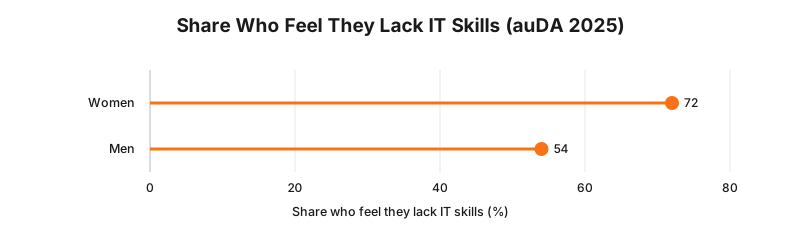
- 72% of women and 54% of men say they lack the technical IT skills they need at work (auDA Digital Lives of Australians 2025)
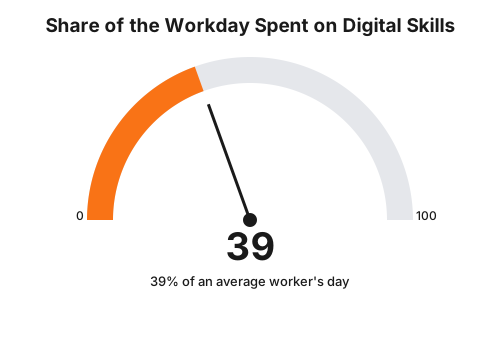
- Digital skills now occupy 39% of the average Australian worker’s day, close to three hours (ACS Digital Pulse 2025)
51% of Australian workers outside the tech sector lack sufficient capacity in at least one digital skill, per ACS’s 2025 Digital Pulse report. The shortfall spans every level, including 45% of C-suite executives. ACS estimates closing it would add $25 billion to Australia’s economy by 2035.
Fifty-one percent of Australian workers outside the tech industry say they do not have enough capacity in at least one digital skill their job needs. That is not a fringe finding from a niche survey. It comes from ACS’s 2025 Digital Pulse report, built on responses from 1,200 workers and 300 C-suite executives across the country. The gap is not confined to the shop floor either: 45% of those C-suite executives rated their own capability as only “basic” in at least one of five core digital skills. Even inside tech teams, 77% of workers admitted a shortfall somewhere in their own toolkit. ACS puts a number on what this costs Australia: $25 billion in lost economic growth by 2035 if the gap stays where it is. At the same time, the ground is shifting under every business. auDA’s newest research found 51% of small businesses could not operate without the internet in 2025, up from 44% just four years earlier. Here is where the shortfall actually sits, who feels it hardest, and what closing it is worth.
The Numbers Behind Australia’s Digital Skills Gap
ACS, the professional body for Australia’s tech sector, published its 2025 Digital Pulse report on 30 July 2025. The survey covered 1,200 workers (roughly 800 from technology roles and 400-plus from other industries) plus 300 C-suite executives, asking each group to rate their own digital capability against the skills their role actually needs.
The results cut against the assumption that the skills gap is a “someone else’s problem” issue. Just over half (51%) of workers outside the tech industry said they lacked sufficient capacity in at least one digital skill. Inside tech teams, the number was worse: 77% of technology workers said the same thing about their own skill set, most commonly in artificial intelligence, cybersecurity, robotics, and automation. And at the top of the business, 45% of C-suite executives rated their own capability as only “basic” in at least one of five core digital skills ACS tested for.
| Group | Share reporting a digital skills gap | Sample | Year |
|---|---|---|---|
| Workers outside the tech industry | 51% | 400+ workers | 2025 |
| Technology workers | 77% | ~800 workers | 2025 |
| C-suite executives | 45% (basic capability only) | 300 executives | 2025 |
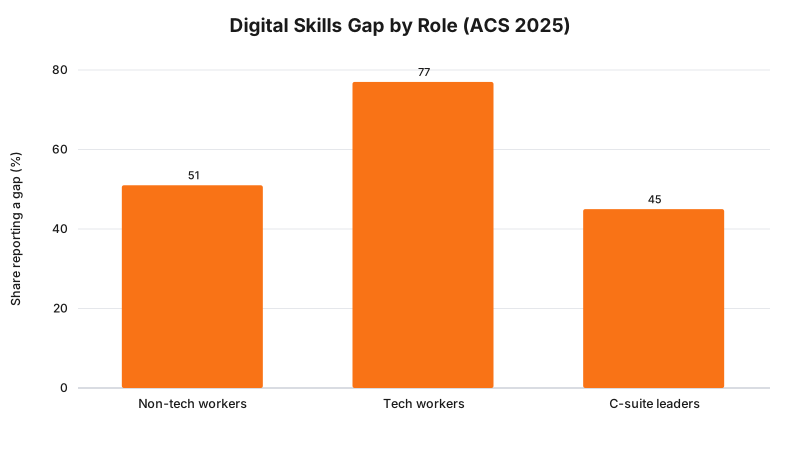
The pattern holds across every group ACS surveyed: nobody in an Australian business is exempt from this gap, not the frontline worker, not the specialist, not the person signing off on the technology budget.
Takeaway: a slim majority of non-tech workers, most tech workers, and almost half of C-suite executives all report a real digital skills shortfall, so this is a workforce-wide problem, not a training issue for junior staff alone.
Why the Gap Costs the Economy $25 Billion
A skills gap this wide has a price tag. ACS estimates digital technology already contributes $134 billion to the Australian economy and supports more than 1 million jobs. Closing the skills gap identified above would add a further $25 billion in economic growth by 2035, according to the same report.
The near-term cost of leaving the gap open shows up elsewhere too. ACS puts the annual cost of cyber attacks to the Australian economy at $63 billion, and estimates the country will need 54,000 additional cyber security professionals by 2030 just to keep pace. Right now, ACS reports 150,000 Australian businesses are already dealing with a serious or severe digital skills shortage, and the same report found digital skills now occupy 39% of the average worker’s day, close to three hours.
| Metric | Figure | Source year |
|---|---|---|
| Digital economy’s current contribution | $134 billion | 2025 |
| Jobs supported by the digital economy | 1 million+ | 2025 |
| Potential growth if the gap closes by 2035 | $25 billion | 2025 |
| Annual cost of cyber attacks | $63 billion | 2025 |
| Extra cyber professionals needed by 2030 | 54,000 | 2025 |
| Businesses with a serious or severe skills shortage | 150,000 | 2025 |
Takeaway: the digital skills gap is not an abstract HR concern, it already costs the economy tens of billions of dollars a year and stands between Australian businesses and another $25 billion in growth.
The Digital Dependency Gap Is Widening
Skills shortfalls matter more each year because Australian businesses depend on digital tools more each year too. auDA, the operator of Australia’s .au domain registry, tracks this shift in its Digital Lives of Australians report, based on a survey of 2,000 consumers and 400 small businesses. The 2025 edition, published in October 2025, found 51% of small businesses said they could not operate without the internet, up from 44% in 2021. Regional small businesses moved even further: from 47% in 2021 to 57% in 2025. Among working Australians generally, 64% now say they cannot do their job without internet access, up from 58% in 2021, with regional workers showing the sharpest jump of all: 49% to 60% over the same four years.
| Metric | 2021 | 2025 | Change |
|---|---|---|---|
| Small businesses that cannot operate without the internet | 44% | 51% | +7 points |
| Regional small businesses saying the same | 47% | 57% | +10 points |
| Working Australians who cannot do their job without the internet | 58% | 64% | +6 points |
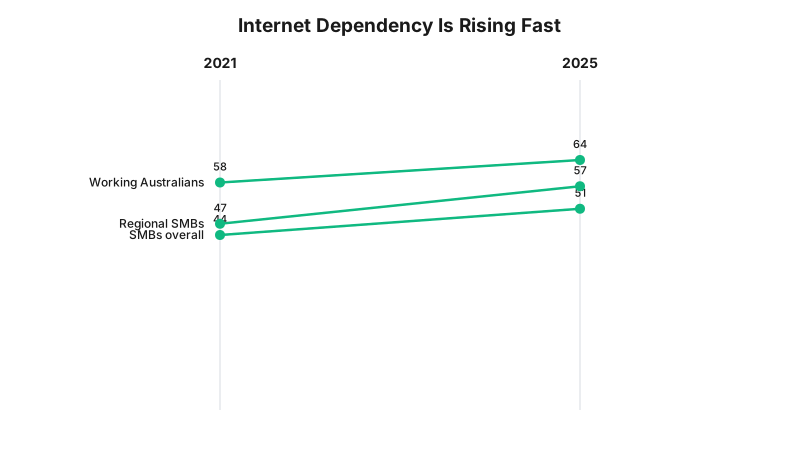
Every one of those lines is moving in the same direction, and none of them are moving slowly. A business that could get by with patchy digital skills in 2021 is now leaning on the internet for a bigger share of its daily operation, at the exact moment ACS finds half its own workforce underprepared for it.
Takeaway: Australian businesses are becoming more dependent on digital tools every year, which means a skills gap that was manageable in 2021 is a bigger liability in 2025.
The Gender Gap in Digital Confidence
The skills gap is not evenly spread by gender either. auDA’s 2025 research found 72% of women say they lack the technical IT skills they need, compared with 54% of men, a 18-point gap. Among younger women aged 18 to 34, that confidence gap narrows: 52% question whether IT is the right career fit for them, against 64% to 68% among older cohorts of women, suggesting the gap is closing generationally even if it has not closed yet.
The same report found only 20% of small businesses maintain formal cybersecurity policies or staff training, even though 81% rate cybersecurity skills as important to running the business. That gap between what businesses value and what they actually train for runs through almost every number in this report.
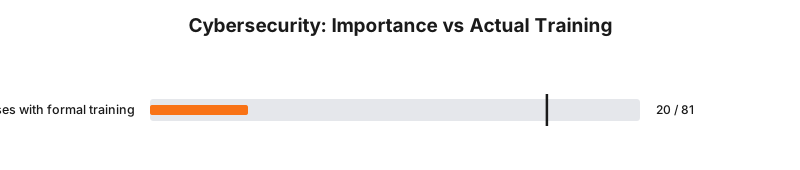
Takeaway: women report a bigger digital confidence gap than men by 18 points, and the shortfall is not limited to technical skills, most small businesses know cybersecurity training matters and still are not doing it.
Where the Gap Actually Shows Up in a Small Business
None of this stays theoretical for long. A skills gap this size shows up as a website nobody on staff can update without calling someone, a booking system that still runs on a shared inbox, a social media account with no one confident enough to run ads through it properly, or a business with no one who can tell whether last month’s traffic drop was a Google update or a broken tracking tag. ACS found the most common shortfalls sit in artificial intelligence, cybersecurity, and automation, three areas that now sit underneath almost every tool a small business runs day to day, from its website analytics to its email marketing platform.
The businesses closing this gap fastest are not necessarily hiring more technical staff. They are choosing systems and partners that do not require every staff member to become a developer, and putting a small, defined slice of digital work in the hands of someone who already has the skills ACS found missing in half the workforce.
Takeaway: the skills gap is not solved by training everyone in-house, it is solved by picking where you need in-house skill and where you need a partner who already has it.
Get Digital Work Off Your Team’s Plate
If your team is spending time fighting the website, the booking system, or the tracking setup instead of running the business, that is the 51% showing up in your own operation. A local web partner can take the parts of the digital skills gap that are eating staff hours off your plate, without you needing to hire or retrain for it.
Book a no-obligation consultation with the RockingWeb team, or see how we approach ongoing digital work for Western Australian businesses on our web design and development page.
Sources
- Australian Computer Society. (2025). “$25b boost for Australia if skills gap closes”. ACS Digital Pulse 2025, surveying 1,200 workers and 300 C-suite executives.
- Australian Computer Society. (2025). “$25bn digital plan to boost Australia’s tech future unveiled”. Media release, 30 July 2025.
- Australian Computer Society. (2025). Western Australia media release citing 150,000 businesses facing significant or severe digital skills shortages.
- auDA. (2025). “Digital Lives of Australians 2025”. Survey of 2,000 consumers and 400 small businesses, published October 2025.
Data current as of October 2025. Figures cited from ACS Digital Pulse 2025 and auDA’s Digital Lives of Australians 2025 report.
Vikas Thakur
Founder of RockingWeb. 16 years of experience from working at TPG, iiNet and Monadelphous, now building websites, software and digital marketing for local businesses in Rockingham and Perth.