Web Hosting for Patient Data: The APP 8 Onshore Test
APP 8 does not require an Australian web host. It requires that before your website discloses a patient's details to an overseas recipient, you take reasonable steps, and the OAIC treats some hosting arrangements as a use rather than a disclosure at all. This guide explains that test and what to check before you sign a hosting agreement.
 Vikas Thakur Founder, RockingWeb 13 min read
The Privacy Act does not require an Australian clinic to host its website in Australia. What it requires is that before your website discloses a patient’s personal information to an overseas recipient, whoever runs your web host, your form handler or your database, you take reasonable steps to make sure that recipient will not breach the Australian Privacy Principles with it. The OAIC’s Chapter 8 guideline on cross-border disclosure (October 2025, version 1.3) draws a real distinction here: some hosting arrangements count as a disclosure that triggers this duty, and some count as a mere use that does not, depending on how much control your contract gives you over the host. As at 22 September 2026, that distinction, not the country printed on your host’s marketing page, is what decides whether an overseas web host creates a compliance problem for a clinic or dental practice.
Health service providers reported more data breach notifications to the OAIC than any other sector in the 2025 calendar year: 225 notifications, ahead of financial services on 157 and the Australian Government on 118. A clinic’s website, specifically its booking form and its contact form and wherever that enquiry data lands, sits squarely inside that exposure. Where the host is, and who can reach the data once it lands there, is one of the few parts of that exposure a clinic controls at the point of building or rebuilding a site.
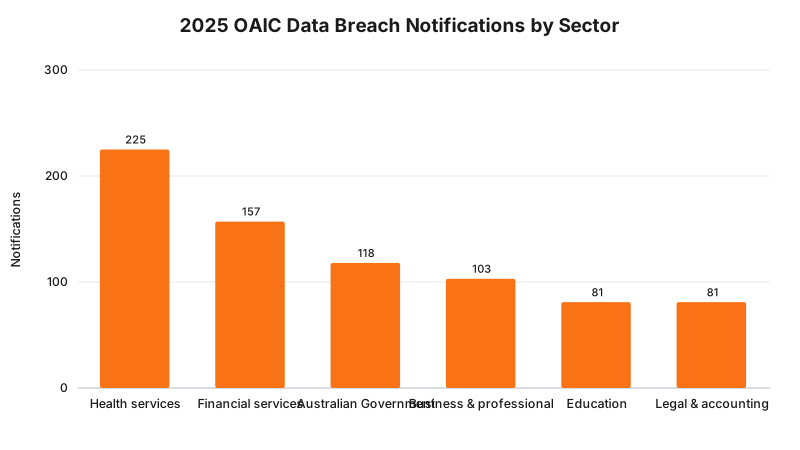
Health services led every sector named in the OAIC’s 2025 Notifiable Data Breaches figures, the same regulator that assesses whether your website’s hosting arrangement counts as a cross-border disclosure.
What APP 8 Says About Hosting
“Before an APP entity discloses personal information about an individual to an overseas recipient, the entity must take such steps as are reasonable in the circumstances to ensure that the recipient does not breach the [Australian Privacy Principles] in relation to that information,” the OAIC’s Chapter 8 guideline states. That duty only switches on if what happens to your website’s data counts as a disclosure to an overseas recipient in the first place, and the same guideline spends several paragraphs, 8.10 to 8.15, on exactly when it does and does not.
Routing personal information in transit through servers located outside Australia, the guideline says, “would usually be considered a use” rather than a disclosure. A hosting provider that simply stores your website’s database and makes it available to you can sit in the same category. Paragraph 8.14 sets out the test: the arrangement is more likely to be a use, not a disclosure, where a binding contract limits the host to the single purpose of storing the information and making it available to you, that contract requires any subcontractor the host uses to accept the same limits, and the terms leave your clinic with what the guideline calls effective control of how the personal information is handled.
Get any one of those three conditions wrong and the arrangement flips back to a disclosure. A host whose standard terms let it use customer data for its own purposes, or that hands data to an offshore support contractor with no matching contract clause, has taken effective control away from your clinic. That is what triggers APP 8.1’s reasonable steps duty and, behind it, section 16C’s accountability rule: your clinic answers for what an overseas recipient does with the data, not the host.
None of this changes what APP 11 requires. Whether your host counts as a disclosure or a use, you still need to take reasonable steps to protect the personal information it holds from misuse, loss and unauthorised access, and that duty does not care which country the server sits in.
What That Means for the Build
Turn the effective control test into things you can check before you sign a hosting agreement or migrate a site.
Get the literal data centre location in writing. A host’s registered business address is not the same as where the database physically sits. Ask which country the production database is in, which country backups replicate to, and which country support access logs live in.
Ask who can read the raw records, not just where they sit. A host whose support staff have blanket account access from anywhere breaks the effective control test even if the server never leaves Australia. Ask for the support access policy in writing: ticketed, logged, geographically restricted, or none of those.
Get the purpose limitation clause. The contract, not the sales page, needs to state that the host may only use your data to provide the hosting service, plus a subcontractor flow-down clause. Without both, paragraph 8.14’s test is not met even if the first two answers are good.
Separate the web host from everything plugged into it. A form handler, a transactional email service, a live chat widget and a content delivery network are each their own potential overseas recipient, assessed on their own terms, even where the web host itself is squarely onshore. Moving your hosting to Australia does not fix an overseas email API still firing on every form submission.
Lock the region if you use a global cloud platform. Microsoft Azure, for one, publishes four dedicated Australian regions: Australia East, Australia Southeast, Australia Central and Australia Central 2. Selecting that region in the provisioning console is not the same as confirming it in the contract: check that backups, disaster recovery replicas and any edge caching are also pinned to the Australian region, not left on a default global setting.
| Hosting arrangement | Where the data sits | Use or disclosure under APP 8 | What you need on file |
|---|---|---|---|
| Australian host, Australian data centre, Australian support only | Australia, no overseas recipient | Neither: APP 8 does not engage | Standard APP 11 security terms in the hosting agreement |
| Global cloud platform, Australian region selected and locked | Australia, provided backups and support access are also locked | Neither, if the lock covers backups and support | Written confirmation the region lock covers backups, replicas and support access |
| Overseas host, contract meets the effective control test | Overseas, but under contractual control | Likely a use, not a disclosure | Signed contract with purpose limitation and subcontractor flow-down clauses |
| Overseas host, standard shared hosting terms, broad support access | Overseas, host can use or share the data | Disclosure: APP 8.1 applies | A documented APP 8.2(a) or 8.2(b) exception, or reasonable steps evidence |
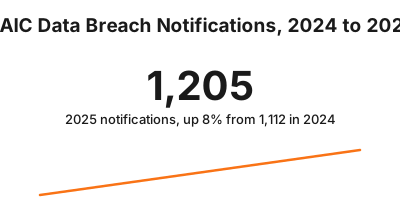
Total OAIC data breach notifications rose to 1,205 in the 2025 calendar year, an 8 percent increase on the 1,112 notifications recorded in 2024 and the highest total since the scheme began. The direction of that trend is the argument for settling the hosting question before a rebuild, not after an incident.
A Worked Example
A cosmetic injectables clinic
A Perth cosmetic injectables clinic is quoting two options for a site rebuild: an overseas budget host running pooled shared hosting with support spread across several countries, and a smaller Australian host on a dedicated Australian server. The overseas host’s standard terms let it use customer data for its own service analytics and give no subcontractor flow-down clause. That fails paragraph 8.14’s test on two of three conditions, which makes the arrangement a disclosure, so the clinic would need a documented APP 8.2 exception or a rewritten contract before going live. The Australian host raises none of this: no overseas recipient exists, APP 8 does not engage, and the obligation reduces to the standard APP 11 security terms any hosting agreement should carry regardless of location.
A cosmetic dental practice
A cosmetic dental practice already hosts its website in Australia and assumes the data residency question is closed. It is not. Its appointment reminder emails run through a US-based transactional email API, and its live chat widget, added later by a marketing contractor, routes chat transcripts, sometimes including a patient describing a cosmetic concern in their own words, through a server in another country. Neither service is covered by the hosting decision. The practice needs to assess the email API and the chat widget separately against the paragraph 8.14 use test, and document an APP 8.2(a) or 8.2(b) exception for each where it fails. Fixing the web host and stopping there would have left two active overseas disclosures unassessed.
What to Check on Your Own Site
- Ask your current host, in writing, which country your production database and backups are stored in.
- Ask whether backups replicate to a second region, and where that region is.
- Request the host’s support access policy: who can read raw records, from where, and whether that access is logged.
- Check your hosting agreement for a purpose limitation clause and a subcontractor flow-down clause. If neither exists, your host’s use of your data is not contractually restricted.
- List every service connected to your contact and booking forms separately from the web host itself: form handler, transactional email service, live chat widget, content delivery network, and check each one’s country on its own terms.
- If you use a global cloud platform, confirm the Australian region selection is set at the account level, not just for the primary compute instance, so it also covers backups and any edge caching.
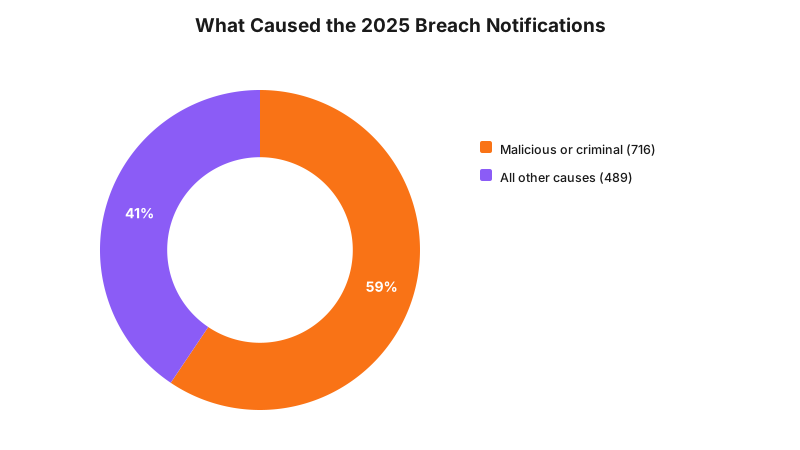
Location is not the only variable. Malicious or criminal attacks caused 716 of the 1,205 breach notifications reported to the OAIC in 2025, the largest single cause by a wide margin, with the remaining 489 split between human error, system faults and other causes. An Australian-hosted database with weak access controls is not automatically safer than a well-secured overseas one. The effective control test and the security question are related, but they are not the same question, and a host worth choosing needs to pass both.
The Enforcement Anchor
No published OAIC determination names a cosmetic clinic or cosmetic dental practice specifically for a hosting choice that breached APP 8. That absence is worth stating plainly rather than dressing up an unrelated case as a precedent for this exact scenario.
What is verified and current is the penalty regime sitting behind the rule and the scale of the health sector’s exposure. Under section 13G of the Privacy Act, the OAIC’s own Guide to Privacy Regulatory Action confirms the maximum civil penalty for a body corporate found to have seriously interfered with privacy is the greater of $50 million, three times the value of any benefit obtained from the contravention, or 30 percent of adjusted turnover during the breach period. Health services led every other sector in the 2025 Notifiable Data Breaches figures cited throughout this guide, with 225 notifications. A hosting arrangement that fails the effective control test, or that skips the reasonable steps duty once it applies, sits inside that same penalty regime and that same sector-level scrutiny, even though no single hosting-choice case has been published yet.
Where This Gets Hard
Effective control is a judgement about a specific contract, not a checkbox a hosting company ticks on its marketing page. Two hosts can use near-identical sales language, cloud infrastructure and even the same underlying data centre, and still land on opposite sides of the use-versus-disclosure line depending on what their actual terms of service say about purpose limitation and subcontractor access. Reading that clause correctly, and checking it against what the host’s support team can do in practice rather than what the contract claims, is not something a hosting comparison table can settle for you.
The regulator says an overseas hosting arrangement is a use, not a disclosure, only where a binding contract limits the host to a single purpose, binds its subcontractors to the same limits, and leaves the clinic with effective control of how the data is handled; the build consequence is that a clinic needs the actual hosting agreement reviewed against those three conditions, not just a country confirmed; whether your specific contract, host and support arrangement meets that test is a question for your medical defence organisation or your lawyer.
Status
In force. APP 8 and section 16C have applied since the Australian Privacy Principles commenced under the Privacy Act 1988 on 12 March 2014, and the OAIC’s Chapter 8 guideline explaining the use-versus-disclosure test for hosting arrangements was updated to its current version 1.3 in October 2025. Nothing in this guide depends on the proposed removal of the small business exemption, which remains unlegislated as at 22 September 2026, and health service providers stay covered by the Privacy Act regardless of turnover no matter how that separate proposal proceeds.
Frequently Asked Questions
Does APP 8 require an Australian clinic to use an Australian web host?
No. The Privacy Act does not mandate an Australian host. APP 8 requires reasonable steps before disclosing personal information to an overseas recipient, and OAIC guidance treats a hosting arrangement as a use rather than a disclosure where a binding contract gives the clinic effective control over how the host handles the data. Choosing an Australian host is the simplest way to avoid the analysis, not a legal requirement.
Is storing website data with an overseas hosting company always a disclosure under the Privacy Act?
No. The OAIC’s Chapter 8 guideline distinguishes a disclosure from a mere use. Paragraph 8.14 treats a hosting arrangement as a use, not a disclosure, where a binding contract limits the host to a single purpose, binds any subcontractor to the same limits, and leaves the clinic with effective control of how the information is handled.
Does selecting an Australian region on a global cloud platform avoid APP 8 obligations?
Generally yes, provided the region lock covers backups, disaster recovery replicas and any content delivery network caching, not just the primary compute instance. APP 11’s security obligations still apply regardless of where the data sits.
What does a hosting agreement need to support the use, not disclosure, position?
A purpose limitation clause restricting the host to providing the hosting service, a subcontractor flow-down clause requiring any subprocessor to accept the same limits, and terms that leave the clinic, not the host, with effective control over how the data is handled. All three conditions from OAIC guideline paragraph 8.14 need to be met.
If my current web host is overseas and does not meet the effective control test, what are my options?
Migrate to an Australian host or a locked Australian cloud region, or document one of the APP 8.2 exceptions: a reasonable belief the host is subject to a substantially similar law with accessible enforcement mechanisms, or express informed consent from patients that APP 8.1 protections will not apply to that disclosure.
Get Your Hosting Arrangement Checked
Talk to RockingWeb about your hosting setup and we will review your web host, booking form and every connected service against the APP 8 use-versus-disclosure test, and give you a written answer on which parts of your stack need a documented exception and which do not.
Sources
- OAIC - APP Guidelines Chapter 8: Cross-border disclosure of personal information, October 2025, v1.3. Checked 22 September 2026.
- OAIC - APP 8 Cross-border disclosure of personal information, including the use versus disclosure test at paragraphs 8.10 to 8.15 and the effective control conditions at paragraph 8.14. Checked 22 September 2026.
- OAIC - Data breach notifications increase to all-time high in 2025, new NDB stats show. Checked 22 September 2026.
- OAIC - Guide to Privacy Regulatory Action, Chapter 7: civil penalties under section 13G of the Privacy Act. Checked 22 September 2026.
- Microsoft Azure - Global infrastructure geographies, confirming the four Australian Azure regions. Checked 22 September 2026.
Last reviewed: 22 September 2026.
Vikas Thakur
Founder of RockingWeb. 16 years of experience from working at TPG, iiNet and Monadelphous, now building websites, software and digital marketing for local businesses in Rockingham and Perth.