Cosmetic Clinic Website Speed: A 26x Weight Gap in 2026
RockingWeb tested 21 real, live Australian cosmetic clinic homepages in August 2026 and found a 26.3x gap in page weight, from 6.9KB to 181.0KB. No official Australian benchmark exists for cosmetic clinic website speed, so here is our own data plus the closest verified global research on what that gap costs in lost enquiries.
 Vikas Thakur Founder, RockingWeb 9 min read

On this page 9
- Key takeaways
- What We Tested, and Why No Australian Benchmark Exists
- The Page-Weight Range We Found
- Which Cities Carried the Heaviest Pages
- Why Page Weight Still Predicts Lost Enquiries
- What This Means for Your Clinic’s Landing Pages
- FAQ
- Get Your Clinic’s Website Speed and Compliance Checked Together
- Sources and References
Key takeaways
- RockingWeb tested 21 real, live Australian cosmetic clinic homepages in August 2026 and found a 26.3x gap between the lightest and heaviest page
- The median homepage weighed just 30.9KB; the heaviest weighed 181.0KB
- 6 of 21 sites tested came in under 20KB, while 2 of 21 topped 100KB
- Adelaide clinics in the sample carried the heaviest average homepage, at 67.1KB; Sydney clinics were lightest, at 20.3KB
- No published Australian benchmark exists for cosmetic clinic website speed specifically, based on our research
- Globally, only 59% of mobile page loads pass Google’s “good” threshold for Largest Contentful Paint, per HTTP Archive’s 2024 Web Almanac
- Portent’s analysis of over 100 million page views found lead-generation conversion rates fall from about 40% at a 1-second load to about 29% at 6 seconds
- Google/SOASTA research found bounce probability rises 90% as load time goes from 1 to 5 seconds, cited in Deloitte Digital’s Milliseconds Make Millions report
RockingWeb tested 21 real, live Australian cosmetic clinic homepages in August 2026 and found a 26.3x gap between the lightest and heaviest page, from 6.9KB to 181.0KB. No government body or industry group publishes an Australian benchmark for cosmetic clinic website speed specifically, so we built our own. The median homepage in our sample weighed just 30.9KB. A few clinics carried six times that before a single image or booking widget had even started loading. That gap matters because heavier pages load slower, and slower pages lose enquiries before a prospective patient reads a single word about a treatment. This article sets out exactly what we tested, how the 21 sites compared, and what the closest verified global research says a heavy, slow clinic homepage actually costs in bounce rate and enquiry conversion.
What We Tested, and Why No Australian Benchmark Exists
We searched for real, currently operating Australian cosmetic injectable and aesthetic clinics across five state capitals: Sydney, Melbourne, Perth, Brisbane and Adelaide. Every site had to be a live, independently findable clinic business, not a directory listing or an aggregator page. We fetched each homepage directly with the compression a real browser requests, and measured the size of the HTML document the server delivered.
That is a narrower measurement than a full Lighthouse or Core Web Vitals audit. It does not include the images, fonts, scripts or booking widgets that load after the HTML arrives, so it is a floor on total page weight, not the whole number. We chose it because it is honestly measurable at this scale, from outside any single clinic’s hosting account, and because the HTML document is the one resource every visitor’s browser must download and parse before anything else on the page can start.
We also looked for an existing Australian dataset that benchmarks cosmetic clinic website speed specifically. There isn’t one. ABS, AIHW and IBISWorld publish data on the cosmetic procedures industry itself, not on the websites clinics use to book patients. HTTP Archive’s Web Almanac publishes global Core Web Vitals data with no country or industry breakdown. Google’s PageSpeed Insights reports one site at a time, not an aggregate. That gap is exactly why we ran our own test.
Takeaway: no one publishes a cosmetic-clinic-specific website speed benchmark for Australia, so our 21-site sample is the closest direct evidence currently available for this niche.
The Page-Weight Range We Found
| Metric | Value |
|---|---|
| Sites tested | 21 real, live Australian cosmetic clinic homepages |
| Median homepage weight | 30.9 KB |
| Mean homepage weight | 40.9 KB |
| Lightest homepage | 6.9 KB |
| Heaviest homepage | 181.0 KB |
| Weight gap, heaviest vs lightest | 26.3x |
Most of the sample clustered in a reasonable range. Eleven of the 21 sites came in between 20KB and 50KB, which is where a lean, well-built clinic homepage should sit. But six sites landed under 20KB, and two blew past 100KB, one of them reaching 181.0KB, more than 26 times the lightest site in the sample. A homepage that heavy is usually carrying unminified code, inline styles, or tracking and chat scripts stacked directly into the page rather than loaded efficiently. None of that is visible to a patient scrolling the page. All of it delays the moment the page becomes usable.
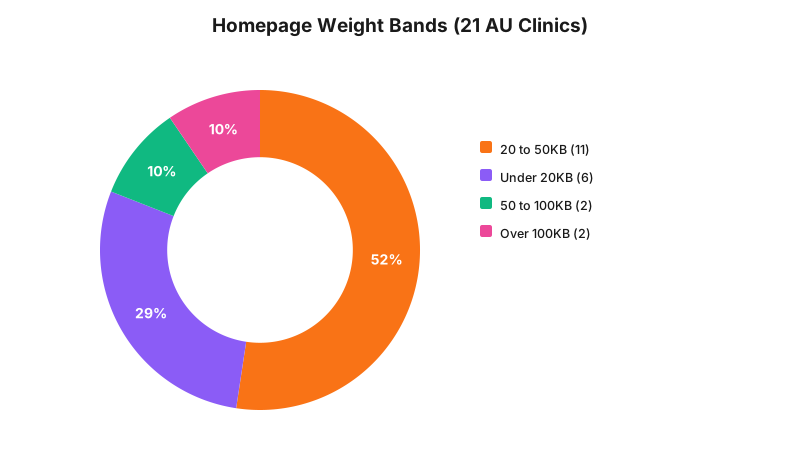
Takeaway: most clinic homepages we tested were a reasonable weight, but the heaviest 2 sites in the sample carried more than five times the median, with no visible benefit to the patient reading the page.
Which Cities Carried the Heaviest Pages
| City | Sites Tested | Average Homepage Weight |
|---|---|---|
| Sydney | 4 | 20.3 KB |
| Melbourne | 5 | 23.7 KB |
| Perth | 2 | 26.8 KB |
| Brisbane | 4 | 50.9 KB |
| Adelaide | 6 | 67.1 KB |
Adelaide clinics in our sample averaged more than three times the homepage weight of Sydney clinics. Read that as a signal worth checking on your own site, not as a fixed rule about any city. Our sample sizes range from 2 sites (Perth) to 6 (Adelaide), too small to call a genuine city-wide pattern. What it does show is that clinic websites within the same country, targeting the same regulator and a similar patient search, can differ by tens of kilobytes for no reason a patient would ever notice or benefit from.
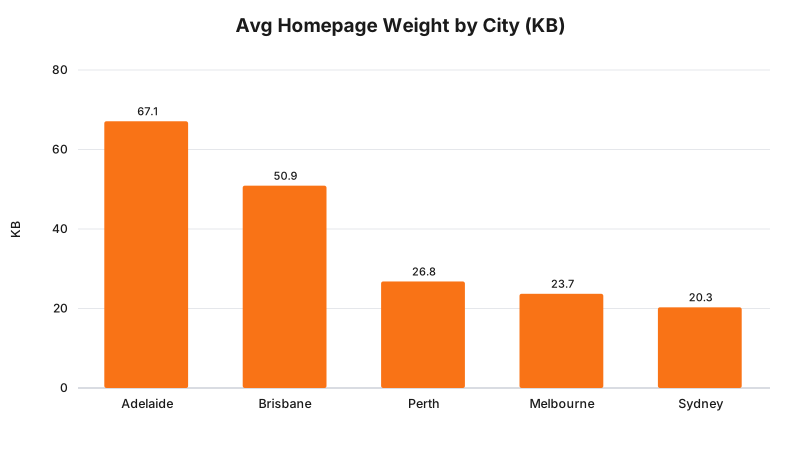
Takeaway: a clinic’s homepage weight is a build-quality question, not a location question. Any clinic, in any city, can end up carrying dead weight it doesn’t need.
Why Page Weight Still Predicts Lost Enquiries
No Australian study links clinic website speed to enquiry volume directly. The closest verified evidence is global, and it is consistent enough to take seriously. HTTP Archive’s 2024 Web Almanac, built from real Chrome user data, found only 59% of mobile page loads worldwide currently pass Google’s “good” threshold for Largest Contentful Paint, the point at which a page’s main content becomes visible to the visitor. On desktop, that figure rises to 72%.
| Metric | Mobile Good | Desktop Good |
|---|---|---|
| Largest Contentful Paint (LCP) | 59% | 72% |
| Interaction to Next Paint (INP) | 74% | 97% |
| Cumulative Layout Shift (CLS) | 79% | 72% |
On the conversion side, Portent’s analysis of more than 100 million page views across 20 B2B and B2C websites found lead-generation conversion rates fall from about 40% at a 1-second load time to roughly 29% at 6 seconds, the slowest bracket tested. Deloitte Digital’s Milliseconds Make Millions study, run across 37 retail, travel, luxury and lead-generation brands, found that even a 0.1-second mobile speed improvement lifted conversions by 8.4% for retail sites and 10.1% for travel sites. That same report cites Google and SOASTA’s 2017 research on bounce probability as load time increases.
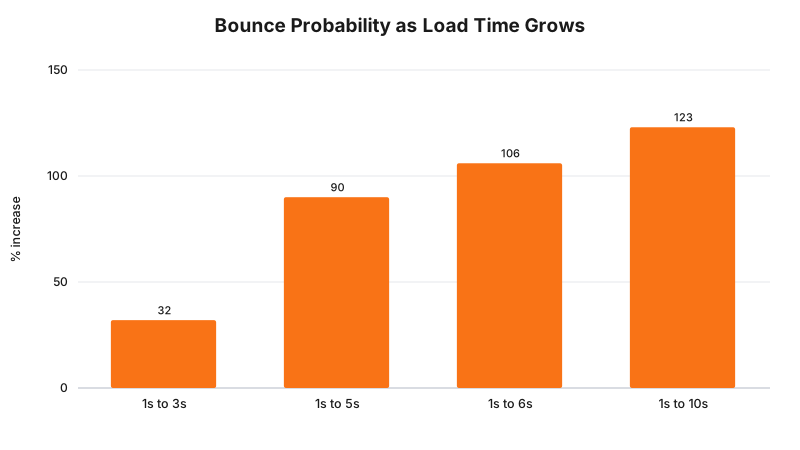
Takeaway: none of this research is Australian or clinic-specific, but the direction is the same across every dataset we found: heavier, slower pages lose visitors before they convert.
What This Means for Your Clinic’s Landing Pages
A heavy homepage is rarely one big mistake. It is usually a stack of small ones: an oversized script here, an unminified stylesheet there, a tracking pixel nobody has audited since the site launched. Fixing that is a technical job, and it is a separate job from writing AHPRA-compliant copy about a treatment.
The two do intersect on one point worth acting on. If a treatment gets its own dedicated landing page instead of a paragraph buried on a general services page, that page loads faster (less competing content on one document), targets a more specific enquiry, and gives you a single page to audit for advertising compliance rather than an entire site. A patient searching for one specific treatment, on a fast page built for exactly that search, is a better-qualified enquiry than one who bounced off a slow homepage before finding what they were looking for.
What a clinic is allowed to say about a treatment on that page, including rules around testimonials and result claims, is a separate question from page speed, and one worth checking against the current advertising guidelines rather than assuming. RockingWeb reviews both together: what your pages say, and how fast they deliver it. For clinics rebuilding a slow site from the ground up, see our work on cosmetic clinic websites built for AHPRA-regulated practices from the first line of code.
Takeaway: speed and compliance are different problems that show up on the same page, and a slow site with perfect copy still loses the enquiry before the copy gets read.
FAQ
Is there an official Australian benchmark for cosmetic clinic website speed?
No. There is no government body, industry association or published dataset that benchmarks Australian cosmetic clinic website speed specifically. The closest available context comes from global web performance research, such as HTTP Archive’s Web Almanac, and from RockingWeb’s own testing of 21 real Australian clinic homepages, set out in this article.
How heavy is the average Australian cosmetic clinic homepage?
In RockingWeb’s August 2026 test of 21 real, live Australian cosmetic clinic homepages, the median site’s HTML document weighed 30.9KB, with a mean of 40.9KB. This measures the base HTML document delivered before images, fonts and scripts load, so it is a floor on total page weight, not the full figure.
Does page weight actually affect how fast a clinic website loads?
Yes. A heavier HTML document takes longer to download and parse before a browser can start requesting images, fonts and scripts, which delays every later loading milestone. HTTP Archive’s 2024 Web Almanac found only 59% of mobile page loads worldwide currently pass Google’s “good” threshold for Largest Contentful Paint, the metric that measures when a page’s main content becomes visible.
Does a slow clinic landing page reduce enquiry quality, not just enquiry volume?
The clearest evidence is Portent’s analysis of over 100 million page views across 20 websites, which found lead-generation conversion rates fall from about 40% at a 1-second load time to about 29% at 6 seconds. That data is global, not Australia-specific or clinic-specific, but the mechanism, a slower page losing visitors before they finish an enquiry form, applies directly to a clinic’s treatment landing pages.
Get Your Clinic’s Website Speed and Compliance Checked Together
RockingWeb reviews cosmetic clinic websites for both build quality and AHPRA advertising compliance in one pass, with findings delivered as a walkthrough, not a jargon-heavy report.
Talk to us about your clinic’s website
Sources and References
RockingWeb original testing, August 2026: direct HTTP requests to the public homepage of 21 real, live Australian cosmetic clinic websites across Sydney, Melbourne, Perth, Brisbane and Adelaide, measuring the compressed HTML document size. Median, mean and range figures reported above are drawn from this dataset.
HTTP Archive, 2024 Web Almanac - global Core Web Vitals pass rates for Largest Contentful Paint, Interaction to Next Paint and Cumulative Layout Shift
Portent - conversion rate by page load time, drawn from more than 100 million page views across 20 B2B and B2C websites
Deloitte Digital, Milliseconds Make Millions - conversion lift from a 0.1 second mobile speed improvement across 37 brands, and Google/SOASTA 2017 bounce-probability research cited within it
Related reading:
- Cosmetic Clinic Websites: compliant, fast website builds for AHPRA-regulated clinics
- Website Costs in Australia: what a properly built clinic website should cost to build and host
Vikas Thakur
Founder of RockingWeb. 16 years of experience from working at TPG, iiNet and Monadelphous, now building websites, software and digital marketing for local businesses in Rockingham and Perth.