7 Doctors, 8 Clinics: The Lanzer Case and Your Web Records
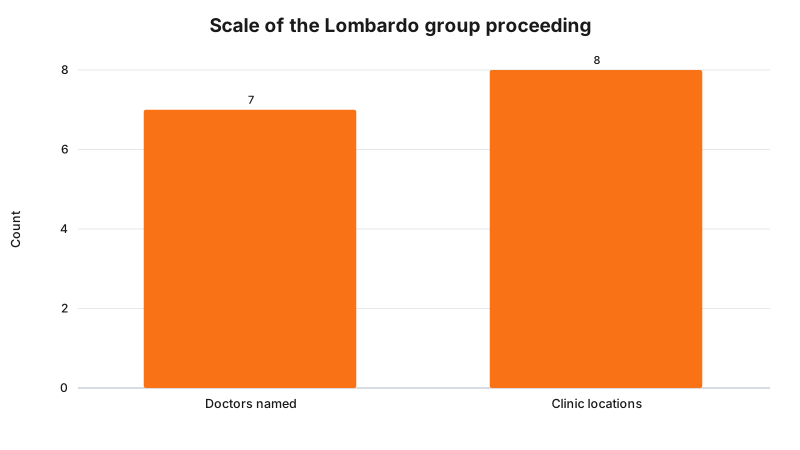
Victoria's Supreme Court lists the current pleading in the Dr Lanzer group proceeding as a Third Further Amended Statement of Claim, filed 16 July 2026, naming seven doctors and eight clinics. Misleading conduct claims are built from what a business actually published, and most clinics keep no dated record of their own website's past versions.
 Vikas Thakur Founder, RockingWeb 9 min read
On this page 9
Key Takeaways
- The Supreme Court of Victoria’s Dr Lanzer group proceeding page lists the current pleading as the Second Further Amended Writ and Third Further Amended Statement of Claim, filed 16 July 2026
- The proceeding covers seven named doctors and eight clinic locations across four Australian states
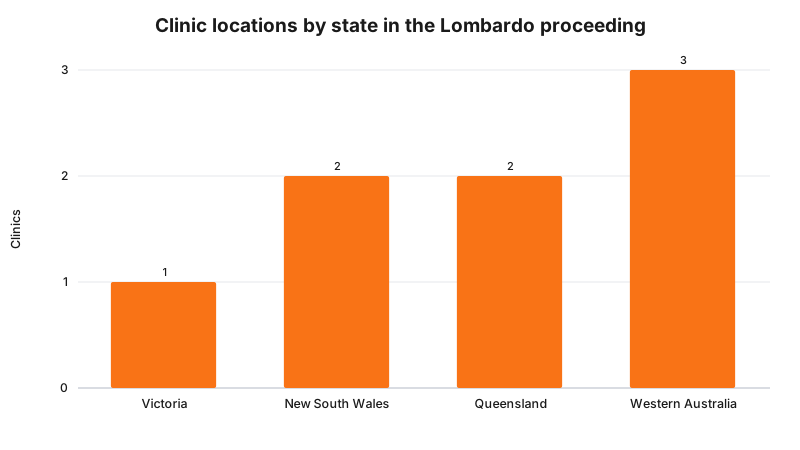
- Clinic locations break down as 1 in Victoria, 2 in New South Wales, 2 in Queensland and 3 in Western Australia
- The registration and opt-out deadline was 4:00pm AEST on 10 April 2026, and it has already passed
- If a settlement happens by 14 August 2026, plaintiffs intend to ask the court to stop unregistered group members claiming a share of it without the court’s permission
- The plaintiffs allege misleading or deceptive conduct, breach of statutory guarantees under Australian consumer protection laws, and negligence, exactly as worded on the court’s own page
On 16 July 2026, plaintiffs in the Dr Lanzer group proceeding filed a Third Further Amended Statement of Claim in the Supreme Court of Victoria, the latest pleading in a case naming seven doctors and eight clinics across four states. The claim alleges misleading or deceptive conduct, breach of statutory guarantees, and negligence, exactly as the court’s own page describes it. Claims like this are built on what a business published: web copy, ad claims, disclaimers, and the dates those things were live. Picture your own clinic’s homepage right now, then picture proving what it said two years ago. Most clinics cannot. This is not commentary on the Lanzer case itself. It is a warning that sits under every clinic regardless of who is named in court: nobody is keeping a dated record of your website’s history except you, and right now, you probably are not either.
What the Court Record Actually Says
The case sits on the Supreme Court of Victoria’s website under the citation Lombardo v Dermatology & Cosmetic Surgery Services Pty Ltd & Ors, file number S ECI 2022 00739. The page names seven doctors: Dr Daniel Lanzer, Dr Daniel Aronov, Dr Daniel Darbyshire, Dr Ryan Wells, Dr Alireza Fallahi, Dr George Shu-Khim Wong, and Dr Candice Wainstein. It also covers surgery performed at eight medical clinics contracted to Dermatology & Cosmetic Surgery Services Pty Ltd, across Victoria, New South Wales, Queensland and Western Australia.
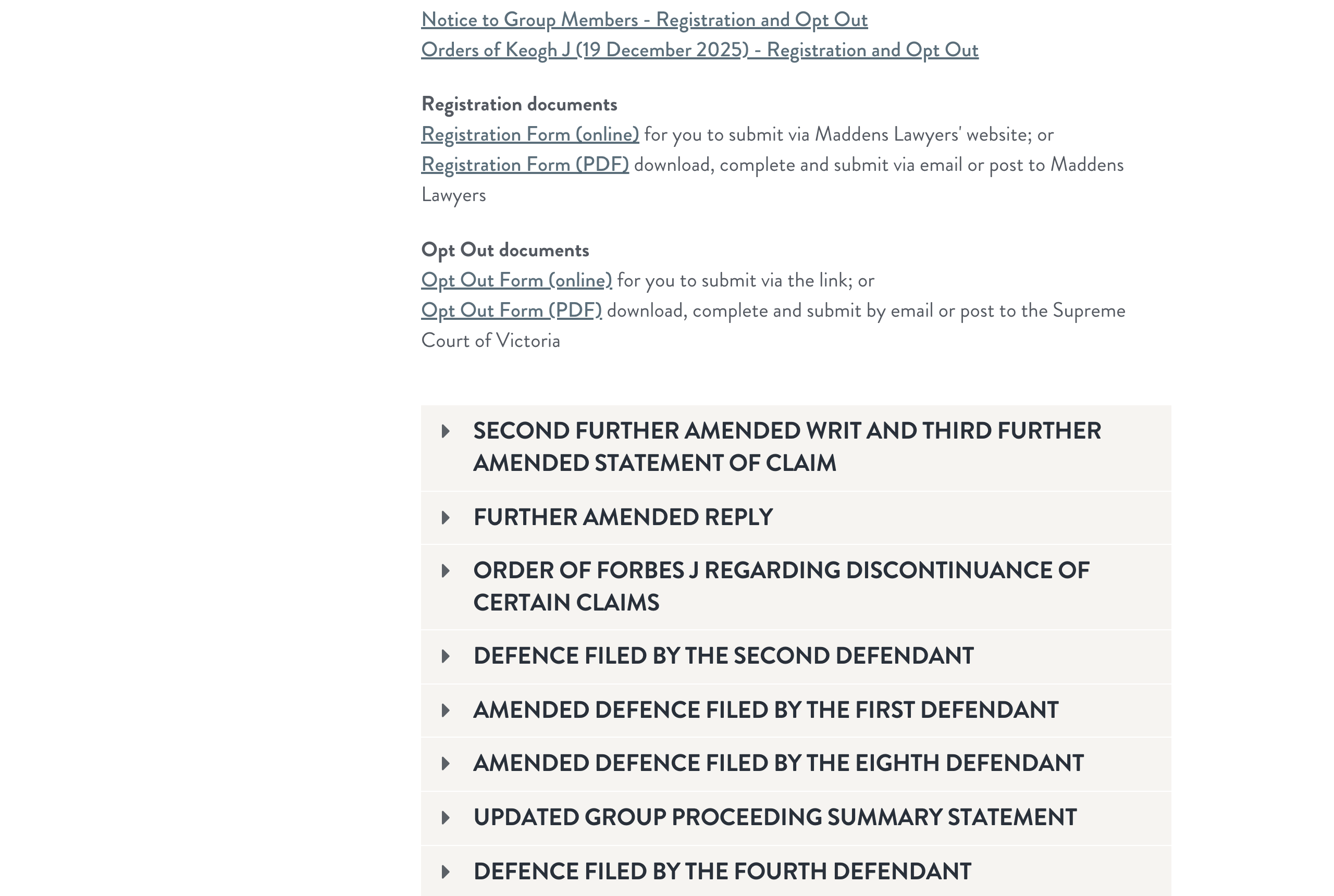
The plaintiffs’ claim, in the court’s own words, alleges “misleading or deceptive conduct and breach of statutory guarantees under the Australian consumer protection laws and negligence.” The current pleading is the Second Further Amended Writ and Third Further Amended Statement of Claim, filed 16 July 2026, inside a register that also lists orders from Justice Keogh on 19 December 2025.
None of that is a comment on who is right. It is a record of what a court page says today, exactly the kind of dated, versioned record most clinic websites do not keep about themselves.
Takeaway: the case’s own document register is a live example of dated, versioned record keeping. Most clinic websites have no equivalent for their own history.
Why Misleading Conduct Claims Live or Die on Old Content
A misleading or deceptive conduct claim, in general terms, turns on what a business represented to the public and when. That holds under Australian consumer protection law regardless of industry, whether the representation ran on a billboard, a paid ad, or a clinic’s own service page. The claim does not care what the page looks like today, it cares what the page said on the day someone read it and acted on it.
That is the part most businesses get wrong about their own websites. A service page gets rewritten, a price changes, a disclaimer gets added, and the old version disappears the moment the new one publishes. Content management systems overwrite, they do not archive. Unless a clinic has deliberately built a record, the version of its website from eighteen months ago is gone the second the next edit goes live.
This is not legal advice about what any specific clinic said or should say. It is an operational fact: publishing is destructive by default, and a claim built on what a business said back then needs someone to have kept a copy.
Takeaway: website publishing overwrites history by default. Proving what a page said on a specific date needs a system built for that, not a hope that nobody asks.
The Record You Don’t Control
Here is the part clinics do not think about until it matters: even when a business keeps no internal record of its own site, a version of it often still exists elsewhere. The Internet Archive’s Wayback Machine captures snapshots of websites across time, letting anyone see how a page appeared historically. A page quietly rewritten in 2024 can still turn up in a Wayback Machine snapshot in 2026, dated and outside anyone’s ability to edit after the fact.
Ad platforms run parallel records too. Meta operates a public Ad Library where anyone can search ads run on its platforms, and Instagram keeps its own post history unless something is manually deleted. None of these systems exist to protect a business, they exist for transparency. That is exactly why a business with no record of its own is at a structural disadvantage: someone else’s copy of your history is often easier to find than yours.
Takeaway: third parties already keep a version of what you published, whether you planned for it or not. Not having your own copy just means someone else’s is the only one available.
What 7 Doctors and 8 Clinics Means for the Record-Keeping Burden
Scale matters here, not for the case’s outcome, but for the sheer number of individual records a business with this footprint would need to have kept. Seven practitioners and eight clinic locations means, at minimum, eight sets of service pages and eight sets of location-specific disclaimers, plus whatever ad accounts and social profiles ran alongside them.
A single-location clinic has an easier version of this problem: one website, one set of ad accounts, one disclaimer to track. Scale that to eight locations and the job scales with it. “We’ll remember what we said” stops being a plan somewhere around location number two.
Takeaway: the bigger a clinic’s digital footprint, the more individual, dated records it needs, and the less realistic it is to keep them by memory alone.
What to Actually Log, Starting Today
Four habits close most of this gap, and none of them need a legal team:
- Version-control your marketing copy. Put service page content in a system that timestamps every change, so “what did this page say on that date” has a one-command answer.
- Keep a dated screenshot archive of every claim page and paid ad. A monthly capture of every live service page and running ad creative, stored with the date attached, costs almost nothing.
- Log which disclaimers were live on which dates. If a disclaimer, a price, or a claim changes, note when and why, in a place separate from the page itself.
- Stop silently editing service pages. A page can still change. What should not change is having no record that it did, or when.
None of this is about a specific clinic’s exposure in a specific case. It is about what running a website with any regulated claim on it requires: proof of what it said, on demand.
RockingWeb can check a clinic’s live pages against current advertising rules and flag which claims need that kind of dated record behind them. Building that discipline in from the start is part of what a website built for cosmetic clinics should do by default, not bolt on after the fact.
Takeaway: the fix is four boring habits, not a legal strategy, and every one of them is cheaper before a claim than after one.
FAQ
What is the Dr Lanzer group proceeding actually about?
It is a group proceeding in the Supreme Court of Victoria, cited as Lombardo v Dermatology & Cosmetic Surgery Services Pty Ltd & Ors, file number S ECI 2022 00739, covering people who had surgery from one of seven named doctors at one of eight clinic locations across Victoria, New South Wales, Queensland and Western Australia. This article reports what the court’s page says and what it means for your website records, not a comment on the case’s merits.
What happened on 16 July 2026?
Plaintiffs filed the Second Further Amended Writ and Third Further Amended Statement of Claim, the latest pleading on the court’s page. The allegations, as worded there, are misleading or deceptive conduct, breach of statutory guarantees under Australian consumer protection laws, and negligence.
What is the significance of 14 August 2026?
The court’s page states that if a settlement happens by that date, the plaintiffs intend to ask the court for an order stopping unregistered group members from claiming a share without the court’s permission. It is a conditional procedural step, not a trial date or a ruling on the claim.
How does a case like this affect my clinic’s website if I’m not involved in it?
It is a reminder that misleading conduct claims are built from what you actually published and when, and most businesses keep no dated record of their own website’s past versions even though archives like the Wayback Machine often do. A version-controlled, dated record of your site and ad content is a basic operational habit, regardless of whether your clinic is ever named in a proceeding.
Get Your Website’s Paper Trail in Order
RockingWeb builds and audits cosmetic clinic websites with dated version history built in, so “what did our site say on that date” has an answer instead of a guess.
Talk to us about your clinic’s website and ad record-keeping
Sources and References
Supreme Court of Victoria - primary source: pleading filing date, named doctors and clinics, registration and settlement dates
Maddens Lawyers - secondary source: plaintiff law firm’s public case summary
Internet Archive - the Wayback Machine’s website-archiving function
Related reading:
- AHPRA Advertising Complaints Hit 380 a Year: how complaints get lodged and investigated
- AHPRA Compliance Audit Checklist: what to check before someone else finds a gap
- Cosmetic Clinic Websites: compliant website builds for AHPRA-regulated clinics
Vikas Thakur
Founder of RockingWeb. 16 years building for companies like TPG, iiNet and Monadelphous, now focused on websites and marketing that comply with AHPRA's advertising guidelines and still book patients.