ACCC: Only 54.1% of Sellers Gave Written Agreements in 2026
The ACCC's 28 July 2026 review of unsolicited selling found only 54.1% of salespeople gave a written copy of the agreement, and recommended that online lead generation be explicitly brought inside the unsolicited selling rules. That puts your clinic's "get a quote" form on notice, even though nothing is law yet.
 Vikas Thakur Founder, RockingWeb 9 min read
On this page 9
- Key Takeaways
- What the ACCC’s 28 July 2026 Review Actually Found
- Why Online Lead Generation Is Now Explicitly in the ACCC’s Sights
- A Review With Recommendations, Not a Rule in Force
- Five Things to Check on Your Clinic’s Enquiry Form Now
- How This Fits Into a Compliant Clinic Website
- FAQ
- Get Your Clinic’s Enquiry Forms Checked Before This Becomes a Rule
- Sources and References
Key Takeaways
- The ACCC’s review, published 28 July 2026, found only 54.1% of salespeople gave a written copy of the agreement after an unsolicited sale
- Just 70.9% of salespeople identified themselves, and only 63.0% told the consumer about their termination period
- The ACCC states plainly that unsolicited sales are “increasingly driven by online lead generation practices” using data consumers gave up themselves or that businesses bought from data brokers
- The ACCC’s headline recommendation: “lead generation is explicitly included in the rules governing unsolicited selling”, not a rule change yet
- The full report is titled “Unsolicited selling and lead generation: a review of the consumer experience and business practices”
- No date has been set for any legislative change. This is lead time, not a compliance deadline
- A clinic’s “get a quote” or “download our price guide” form is exactly the kind of online lead generation the ACCC named in its review
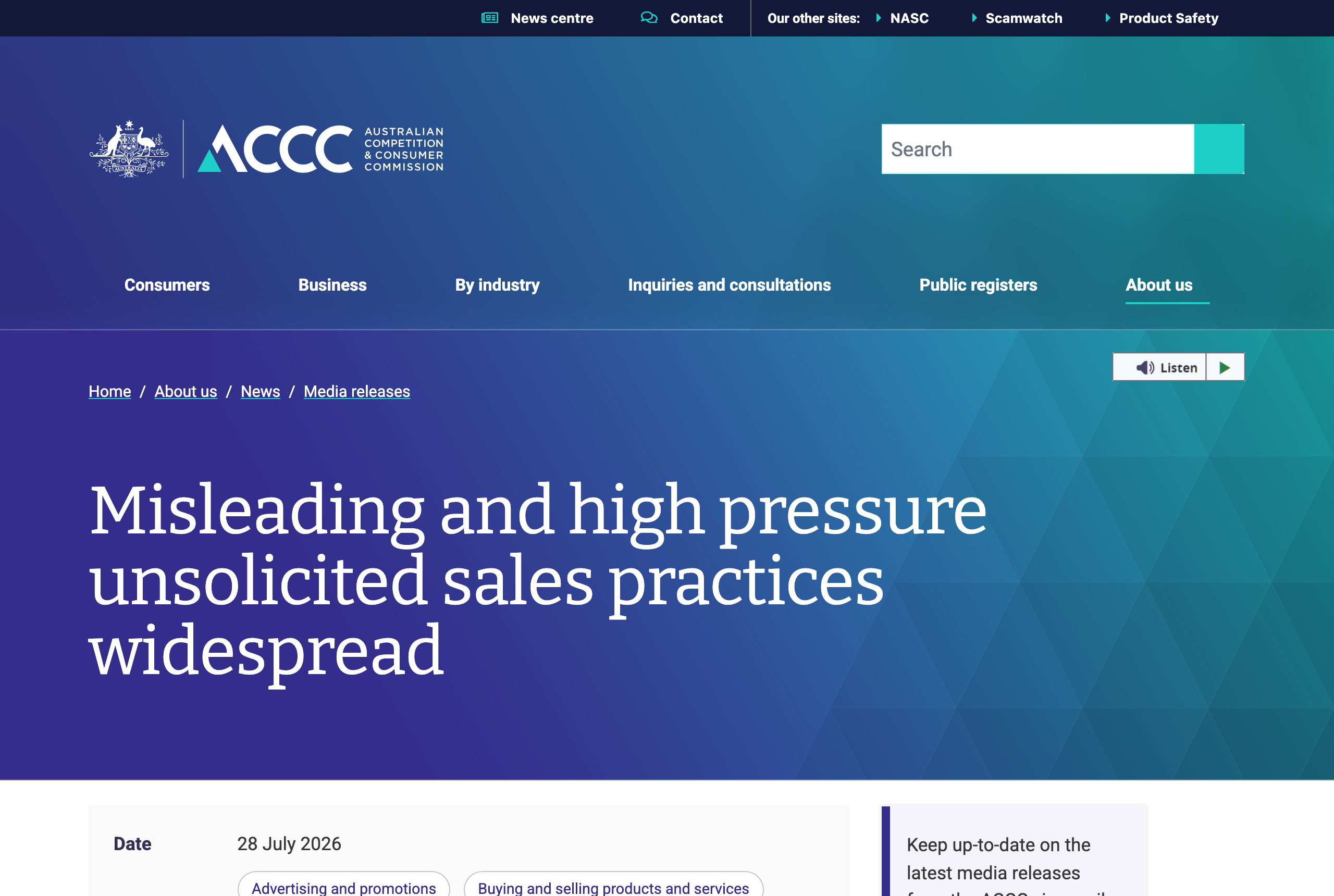
Only 54.1% of salespeople who made an unsolicited sale in the past two years gave the customer a written copy of the agreement, according to the Australian Competition and Consumer Commission’s review published 28 July 2026. Just 70.9% bothered to identify themselves at all. The ACCC’s review is not really about door knockers and cold callers though. It states plainly that unsolicited sales are “increasingly driven by online lead generation practices” where businesses use data consumers gave up on a form, or bought from a data broker, to make first contact. Its headline recommendation: bring lead generation explicitly inside the rules that already cover unsolicited selling.
That is not law. It is a recommendation sitting inside a government review, with no date attached to it. But every clinic running a “get a quote” or “download our price guide” form on its website is now on notice about where the regulator’s attention is heading, and what a form like that would need to prove if the rule ever lands. Here is what the ACCC found, what it is asking for, and what to fix on your own form today.
What the ACCC’s 28 July 2026 Review Actually Found
The ACCC’s review, titled “Unsolicited selling and lead generation: a review of the consumer experience and business practices,” looked at how salespeople behaved after an unsolicited approach turned into a sale. The compliance numbers are the reason it is getting attention.
Among consumers who bought something after an unsolicited sales contact in the last two years, less than three in four salespeople identified themselves, barely more than half provided a written copy of the agreement, and just under two in three disclosed the termination period the consumer was entitled to. Put another way, nearly half of these sales happened with no paper trail at all.
| Compliance measure | Share of unsolicited sales meeting it |
|---|---|
| Salesperson identified themselves | 70.9% |
| Written copy of agreement provided | 54.1% |
| Termination period disclosed | 63.0% |
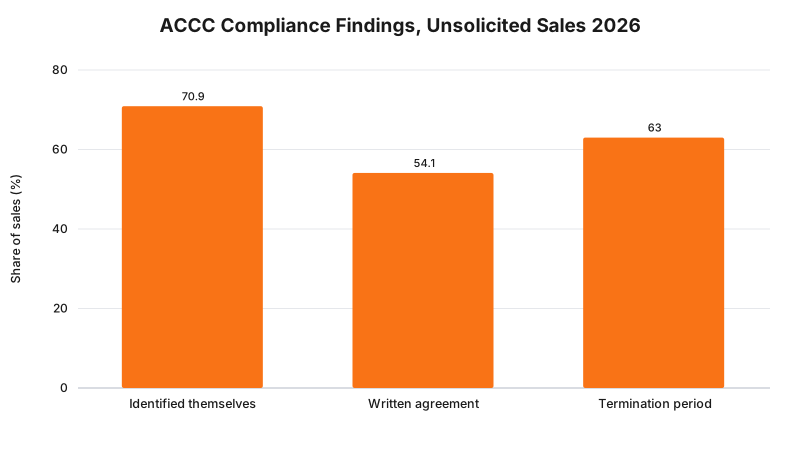
Takeaway: in more than four out of ten unsolicited sales the ACCC reviewed, the customer never got a written record of what they agreed to.
Why Online Lead Generation Is Now Explicitly in the ACCC’s Sights
Here is the sentence that matters for anyone running a website: unsolicited sales are “increasingly driven by online lead generation practices where businesses use consumers’ personal information they obtained themselves or bought from third parties including data brokers.” That is the ACCC’s own wording, not a paraphrase.
The ACCC’s Deputy Chair went further, recommending that “lead generation is explicitly included in the rules governing unsolicited selling.” The current unsolicited selling framework was written for door-to-door and telephone contact. It does not clearly address a scenario where a consumer fills in an online form, that submission gets treated as a lead, and a follow up sales call happens days or weeks later, sometimes from a business the consumer never directly gave their details to.
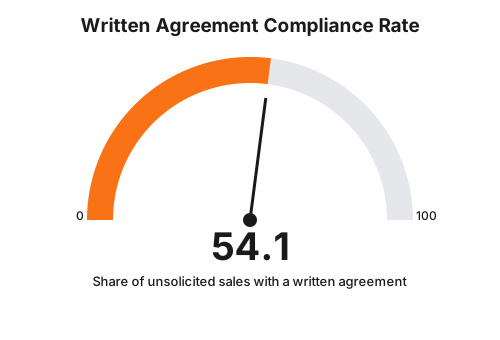
Takeaway: the ACCC is not describing a hypothetical. It is naming online form-driven lead generation as a live, growing source of the same non-compliance it just measured.
A Review With Recommendations, Not a Rule in Force
Be clear about what actually happened here. The ACCC published a review and a set of recommendations to government on 28 July 2026. It did not announce a new rule, and no commencement date exists for one. Recommending that lead generation be written into the unsolicited selling framework is a request for legislative change, and legislative change in Australia typically takes consultation, drafting, and parliamentary time before it takes effect.
That gap is lead time, not an excuse to wait. A review that names your exact business model, online forms that generate sales leads, is a strong signal about where scrutiny is heading next. Clinics that fix their forms now are the ones that will not be scrambling to retrofit consent language and record keeping once a rule actually lands.
Takeaway: nothing about your enquiry form is illegal today because of this review. The direction the regulator is pointing in should still change what you build next.
Five Things to Check on Your Clinic’s Enquiry Form Now
The ACCC’s concerns map onto specific, fixable choices in how a form is built and how a submission is handled afterwards.
- Unbundle your consent checkboxes. A single “I agree to be contacted” tickbox that covers marketing, third party sharing, and the enquiry itself is the kind of catch-all consent the ACCC’s report is aimed at. Split each purpose into its own checkbox.
- State who will contact the person, and how, on the form itself. Not buried in a privacy policy three clicks away. A plain sentence next to the submit button.
- Remove pre-ticked boxes and forced opt-ins. If consent is not a genuine, unforced choice, it is not the kind of consent that survives scrutiny.
- Log every submission with a timestamp and a form version number. If a consumer later disputes what they agreed to, “here is exactly what the form said and when they submitted it” is the only answer that holds up.
- Document where each lead actually goes. Kept in-house, sent to a call centre, sold to an aggregator: write it down. If you cannot answer that question in one sentence, neither can your form’s privacy notice.
A website review from RockingWeb checks a clinic’s forms line by line for advertising and privacy issues. Extending that review to flag consent-checkbox and data-destination gaps against this ACCC direction costs nothing extra and gets ahead of a rule that has not landed yet.
Takeaway: every one of these fixes is a form-engineering decision, not a legal reinterpretation. You do not need to wait for a rule to make them.
How This Fits Into a Compliant Clinic Website
Enquiry and booking forms are usually the single highest-traffic data collection point on a cosmetic clinic’s website, ahead of any contact page or newsletter signup. Cosmetic clinic websites built with consent, logging, and lead-destination documentation from the start do not need a redesign every time a regulator publishes a new review. They just need the underlying form data to already answer the questions this review is asking.
Takeaway: the fix here is architectural, not cosmetic. Build the record keeping into the form once, and every future review becomes a five-minute check instead of a rebuild.
FAQ
Is the ACCC’s lead generation recommendation already law?
No. It is a recommendation inside a review published 28 July 2026, titled “Unsolicited selling and lead generation: a review of the consumer experience and business practices.” The ACCC is recommending legislative change, not announcing one. No date has been set for any reform, and nothing about how clinic enquiry forms operate has changed yet.
What did the ACCC actually find about how unsolicited sellers handle consumers?
Among consumers who bought something after an unsolicited sales approach in the past two years, only 70.9% of salespeople identified themselves, only 54.1% provided a written copy of the agreement, and only 63.0% told the consumer about their termination period.
Does a “get a quote” or “download our price guide” form on my clinic website count as unsolicited selling?
Not under the law as it stands, because the consumer started contact by filling in your form. The ACCC’s recommendation targets exactly that grey area though, since a form collects details that then get used, or sold to a third party, to make a follow up sales contact. If lead generation is written into the rules the way the ACCC wants, how that follow up contact happens could matter more than who started it.
What should I change on my enquiry form now, before any rule takes effect?
Split one catch-all consent tickbox into separate, specific checkboxes. State in plain language on the form who will contact the person and how. Remove any pre-ticked box or forced opt-in pattern. Log every submission with a timestamp and a form version number. Document, in writing, where each lead goes after it is submitted, including whether it is ever sold or shared with a third party.
Get Your Clinic’s Enquiry Forms Checked Before This Becomes a Rule
RockingWeb reviews cosmetic clinic websites for exactly this kind of gap: consent language, form logging, and where a submitted lead actually ends up. Get ahead of a review that already named your business model, before it becomes a rule.
Talk to us about your clinic’s forms and marketing pipeline
Sources and References
- ACCC - media release “Misleading and high pressure unsolicited sales practices widespread”, published 28 July 2026, source of the 70.9%, 54.1% and 63.0% compliance figures and the lead generation quote
- ACCC - full report, “Unsolicited selling and lead generation: a review of the consumer experience and business practices”, published 28 July 2026
Related reading:
- Cosmetic Clinic Websites: compliant website builds for AHPRA-regulated clinics
- AHPRA Leaked 136 Clinicians’ Emails In One Webinar Invite: the same form-handling mistakes, seen from a data breach angle
Vikas Thakur
Founder of RockingWeb. 16 years building for companies like TPG, iiNet and Monadelphous, now focused on websites and marketing that comply with AHPRA's advertising guidelines and still book patients.