Why We Publish Our Research Method Before Our Findings
A research method published after the findings cannot be checked against anything, because the study already happened out of view. RockingWeb publishes its method first, the sample frame, the constraints and the scoring rules, before a single site gets crawled, and none of the five studies referenced on this page has been commissioned yet.
 Vikas Thakur Founder, RockingWeb 12 min read
On this page 12
Key takeaways
- RockingWeb commits to publishing its research method before fieldwork starts, not alongside or after the findings
- Five studies are planned, none commissioned, as at 6 October 2026: a compliance index, a booking flow teardown, a tracking pixel scan, a booking platform share count and an annual spend survey
- Every study is bound by four fixed constraints: public pages only, never a real booking or real patient data, aggregates and de-identified examples only, and our own report follows the rules it audits
- The legal backdrop is ordinary and already in force: the Australian Consumer Law’s misleading conduct provision and the Privacy Act’s Australian Privacy Principles, not a rule written for this niche specifically
- No infringement notice or determination exists that targets a research-methodology disclosure failure in this niche. This page says that plainly rather than manufacturing an enforcement story
- A method locked in advance cannot be adjusted later to make a disappointing result look better, which is the actual reason for the order
Publishing a compliance statistic without its method attached means nobody, including the people who ran the study, can check it against anything after the fact. RockingWeb’s answer, as at 6 October 2026, is to publish the method first: the sample frame, the constraints and the scoring approach for each planned study, before a single clinic website gets crawled. None of the five studies referenced on this page has been commissioned yet. This page exists to say that directly and to set out what we are bound by once they start.
What the Law Actually Says
Nothing in Australian law requires a business to publish its research method before its findings. That order is an editorial choice, not a statutory one, and this page does not claim otherwise. Two ordinary pieces of law shape why we made that choice.
The Australian Consumer Law’s misleading conduct provision, section 18, sits in Schedule 2 of the Competition and Consumer Act 2010. The ACCC’s own guidance states that “any information or claim that a business provides about its products or services must be accurate, truthful and based on reasonable grounds,” and that “a business must be able to prove any claim they advertise.” A published statistic about clinic website compliance is a claim under that same provision, whether the business publishing it sells cosmetic injectables or builds websites. (ACCC, False or misleading claims, checked 6 October 2026.)
The Privacy Act’s Australian Privacy Principles govern how personal information is collected, used and disclosed. Australian Privacy Principle 3 covers collection, and information already public on a clinic’s own website sits differently under that principle than information a person would need to submit, such as a name entered into a booking form. That distinction is why the constraint below exists: scan what is public, never submit what isn’t. (OAIC, Australian Privacy Principles, checked 6 October 2026.)
Neither provision was written with research methodology in mind. Section 18 supplies the reason a claim needs to be provable, and the Australian Privacy Principles supply the reason a study needs a bright line between public pages and submitted data. Method-first publishing is what we built on top of those two facts.
What That Means for the Build
Publishing a method before a finding is a commitment about sequence, and sequence has to be enforced somewhere concrete or it is just a sentence on a page. For every study on this list, four things happen before any data collection begins, not after: a versioned methodology note publishes the sample frame, the inclusion and exclusion criteria, and, where scoring is involved, the rubric used; every study page carries a status marker of planned, in field, or published; the crawl is scoped to publicly reachable pages only, with no account created and no booking flow taken past the point where it would need real patient details; and any finding that would only describe one identifiable business gets folded into a wider aggregate or dropped from that subgroup, not published as a named or de facto identifiable example.
The build consequence of skipping any of these four is not abstract. A study that starts crawling before its criteria are written down invites the kind of after-the-fact adjustment that makes a method meaningless: widen the sample until the number looks better, or narrow it until an inconvenient result disappears. Publishing the method first removes that option, because the criteria are on the record before the number exists.
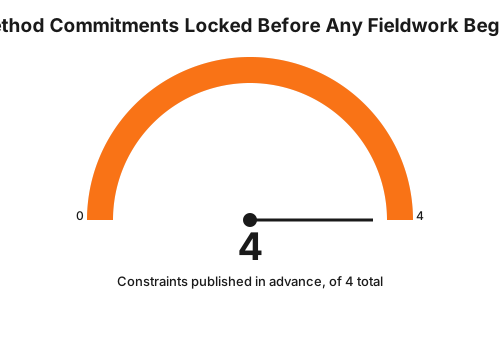
The four constraints in the gauge above, public pages only, no completed bookings, aggregate reporting only, and our own report following the same advertising rules it audits, are the ones set out in the paragraph above and repeated in the table below. All four are published now, before any of the five studies has started.
The Five Planned Studies
None of the five studies below has been commissioned. The sample sizes are the ranges from our internal planning document, not fieldwork totals, and the status column will change as each study moves from planned to in field to published.
| Study | Planned sample | Feeds | Status as at 6 October 2026 |
|---|---|---|---|
| Website Compliance Index | 300 to 500 sites, cosmetic and dental, WA oversampled | Advertising compliance and reviews content | Planned, not commissioned |
| Booking and Intake Flow Teardown | 100 to 150 clinics | Booking flow, consent sequencing and age gating content | Planned, not commissioned |
| Tracking Pixel and Data-Leakage Scan | 200 to 400 sites | Tracking and health-data leakage content | Planned, not commissioned |
| Booking Platform Share by Widget Signature | Same crawl as the Compliance Index or Pixel Scan | Booking software market content | Planned, incremental to another study |
| Annual Clinic Website Spend Survey | 150-plus responses via industry associations and trade press | Buying and briefing content | Planned, not commissioned |
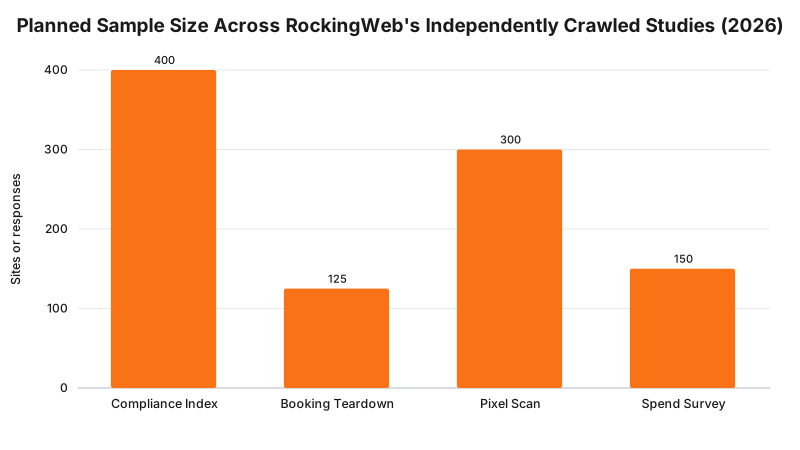
The figures above are the midpoint of each stated range, except the spend survey, where the plan states a minimum of 150-plus responses rather than a range, so 150 is shown as that stated floor rather than a midpoint. The Booking Platform Share study is left off this chart because it shares a crawl with the Compliance Index or the Pixel Scan rather than running its own.
A Worked Example
There is no finding to show yet, so the two examples below describe how the method will apply once a study is in field, not a result already produced.
Cosmetic clinic. When the planned Compliance Index reaches a clinic’s public injectables landing page, the crawl records the presence or absence of a fixed list of fields, such as a visible consent disclosure next to a before-and-after image, without creating an account or starting a booking. If that page is missing a field the rubric checks for, the published output describes the pattern across the sample, the share of scanned sites missing that disclosure, and does not name the clinic. A single missing field on one site changes a percentage in an aggregate; it never becomes a sentence about that site.
Dental practice. The same method applied to a cosmetic dentistry landing page, a veneers or whitening page carrying patient testimonials, records whether a testimonial appears alongside the disclosures the rubric checks for, again without contacting the practice or submitting an enquiry. Where a dental page and a cosmetic clinic page show the same gap at similar rates, the published finding says so as a cross-segment pattern, part of why this queue treats cosmetic clinics and cosmetic dentistry as one dataset.
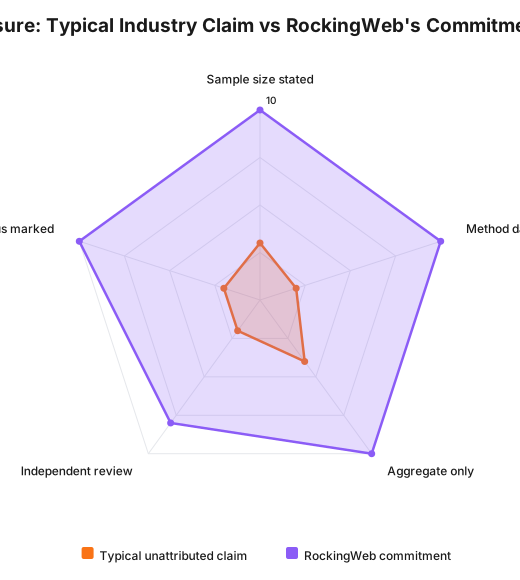
The scores in the radar chart above are our own illustrative self-assessment of common practice against our own commitment, not a measured survey of competitor content. They are shown to explain what “publish the method first” adds on each dimension, not as a claim about any named publisher.
What to Check Before You Trust a Published Clinic Statistic
The checklist below applies to any published industry statistic, not only ours. A number with none of these behind it is not automatically wrong, but it cannot be checked, which is a different problem.
- Is the sample size stated as a range or a count, rather than an unsupported round number.
- Is the method dated, so you can tell whether it reflects this year’s rules or an older version.
- Does the publisher report aggregates, or does a small subgroup effectively identify one business.
- Is there any description of how edge cases were resolved during scoring, or is the rubric invisible.
- Is there a status marker distinguishing a completed study from a planned one.
- Is the primary source named and linked, rather than attributed to “research shows” with nothing to click through to.
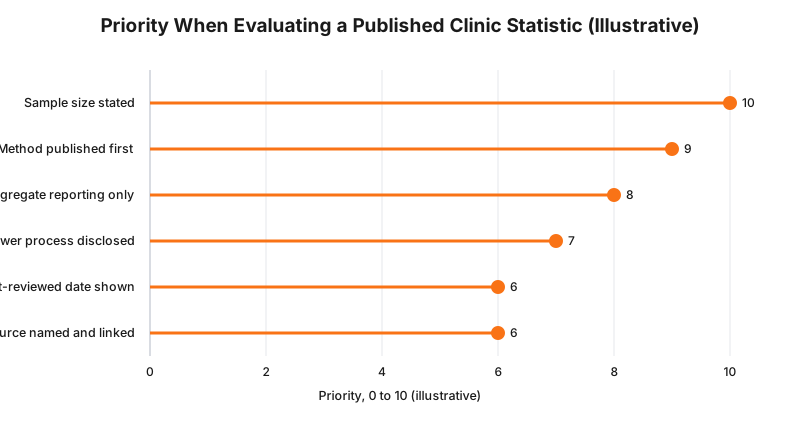
The ranking above is our own judgement of which gaps do the most damage to a claim’s credibility, not a scored survey of readers. A missing sample size undermines almost everything downstream of it; a missing last-reviewed date is a smaller problem on its own, but compounds quickly alongside the others.
The Enforcement Anchor
There is no infringement notice, determination or complaint outcome to point to here, and this page says that plainly rather than inventing one. Publishing a research method before findings is not a regulated category with its own enforcement body. The closest real teeth sit one layer down, in the Australian Consumer Law’s general prohibition on unsubstantiated claims, enforced broadly by the ACCC and applying to any business, including RockingWeb, that published a finding it could not back up. No enforcement action specific to an agency’s own published research methodology in this niche has been identified. If that changes, this page will be updated to reflect it.
Where This Gets Hard
Aggregation has a floor. In a geographically concentrated market, such as a regional town with one or two cosmetic clinics, a subgroup finding can still make a specific business identifiable even without naming it, and the honest response is to fold that subgroup into a wider one or leave it unpublished.
“Publicly available” is also a moving target. A clinic can change its website the day after a crawl, and a finding accurate at capture time can read as wrong weeks later if a reader checks the live page instead of the dated snapshot. Every capture needs its own timestamp, and a finding without one should be treated as unverifiable, including by us.
The commitment never to complete a real booking creates a genuine blind spot, not proof that everything downstream is fine. Consent flows that only appear after a booking is submitted, payment card handling and confirmation email content are all structurally invisible to a method that stops before a real booking begins. A clean result on the public-facing pages says nothing about what happens next.
There is also a boundary question around automated crawling itself. The Australian Privacy Principles permit collecting information already publicly available on a website; the build consequence is that a compliance crawl restricted to public pages does not need a clinic’s consent under privacy law to be crawled. Whether a specific clinic’s own website terms of service creates a separate contractual restriction beyond that is a question for your medical defence organisation or your lawyer.
Status
Legal backdrop in force, studies not yet started. The Australian Consumer Law’s misleading conduct provision and the Privacy Act’s Australian Privacy Principles are both standing law with no pending change relevant to this page, as at 6 October 2026. The five first-party studies described above are at the planning stage only. None has been commissioned and no fieldwork has begun.
Frequently Asked Questions
Has RockingWeb published any findings from these studies yet?
No. As at 6 October 2026, none of the five studies described on this page has been commissioned, and no data collection has begun. This page sets out the method we commit to before that happens, not a report of what we found.
Why publish a method with nothing to show for it yet?
Because a method published after the findings cannot be checked against anything. Publishing it first lets a reader see the sample frame, the constraints and the scoring rules before a single number exists, so the design cannot be adjusted later to fit a result we wanted.
Will any of these studies name individual clinics?
No. Every study on this page is scoped to report aggregates and de-identified examples only. Where a finding needs illustration, it will describe a pattern, not a business, and any subgroup too small to protect that will simply not be published as a subgroup.
Does completing a real booking as part of a study break a specific rule?
There is no single rule that names this scenario. We do not complete real bookings or submit real patient details because doing so would create a personal information record under the Privacy Act for a transaction that was never genuine, and because it risks disrupting a real clinic’s operations. That is a self-imposed constraint, not a statutory prohibition we are citing.
What happens if a study finds only one or two clinics in a small market?
It gets folded into a wider aggregate or left out of that subgroup for good. A finding that could only describe one identifiable business defeats the aggregate-reporting commitment on this page, so the threshold exists specifically to stop that from happening.
Read the Method, Not Just the Headline
If you read a clinic industry statistic anywhere, including one of ours once these studies start publishing, and cannot find the sample size, the date or the method behind it, treat it the same way we would want our own numbers treated: unverified until that gap is filled. If you want to talk about your clinic’s website, its compliance posture, or where it sits against what a study like this would check, get in touch and tell us what you are working with. We reply personally within 24 hours.
For the closest thing to a finding this queue has published so far, which is an honest account of a data gap rather than a study result, see why no one counts the number of cosmetic clinics in Australia. For what a compliant build looks like once a study like this has something to measure against, see Cosmetic Clinic Websites.
Sources
- ACCC - False or misleading claims, section 18 Australian Consumer Law substantiation standard. Checked 6 October 2026.
- OAIC - Australian Privacy Principles guidance, collection principle. Checked 6 October 2026.
- Federal Register of Legislation - Competition and Consumer Act 2010, Schedule 2, and Privacy Act 1988. Checked 6 October 2026.
- RockingWeb internal editorial and research methodology commitments, as described on this page. Not yet published in study-specific form as at 6 October 2026.
Last reviewed: 6 October 2026.
Vikas Thakur
Founder of RockingWeb. 16 years of experience from working at TPG, iiNet and Monadelphous, now building websites, software and digital marketing for local businesses in Rockingham and Perth.