How Many Cosmetic Clinics Are in Australia? No One Counts
No government body or regulator publishes an official count of cosmetic clinics operating in Australia. The closest defensible figures are IBISWorld's 499 Plastic Surgeons businesses (2025) and 632 Health & Wellness Spas (2026), and neither one is a clean answer.
 Vikas Thakur Founder, RockingWeb 13 min read
Key Takeaways
- No government body or regulator publishes a national count of cosmetic clinics. The Australian Bureau of Statistics has no industry classification built to isolate the category
- The closest defensible business-count figures are IBISWorld’s 499 Plastic Surgeons businesses (2025) and 632 Health & Wellness Spas (2026), and each measures something narrower than “cosmetic clinic”
- IBISWorld’s Dental Services count, 20,919 businesses in 2026 with a $15.2 billion market size, is an adjacent market figure, not a cosmetic clinic proxy, and using it as one overstates the true number
- AHPRA registers 920,535 health practitioners nationally across all professions (30 June 2024), a practitioner count with no clinic or premises breakdown
- The Cosmetic Nurses Association’s estimate of 2,000 to 3,000 cosmetic nurse injectors is a self-reported membership estimate with acknowledged attrition, not a formal practitioner register or count
- This is a standing data gap, not a pending reform. No agency has signalled it intends to build a dedicated classification
No government body, regulator or industry association publishes an official count of cosmetic clinics operating in Australia, as at 27 August 2026. The closest defensible business-count figures are IBISWorld’s Plastic Surgeons industry (499 businesses, 2025) and Health & Wellness Spas industry (632 businesses, 2026), and both measure a narrower or differently-shaped market than the term “cosmetic clinic” covers. Every other number circulating, including dental services counts and practitioner registration totals, answers a related but different question. This post reports what each real source measures, so you can cite one correctly instead of repeating a number that does not mean what it looks like it means.
What the Data Says
Start with the Australian Bureau of Statistics, the body you would expect to hold this number. The ABS classifies every registered business against the Australian and New Zealand Standard Industrial Classification, and ANZSIC has no class called “cosmetic clinic”. The closest classes sit in different divisions: Class 8539, Other Allied Health Services, and Class 9511, Hairdressing and Beauty Services, which the ABS describes as covering nail care, facials, make-up application and skin care alongside hairdressing. A clinic performing anti-wrinkle injections might be coded under general medical services if a doctor owns it, allied health services if a nurse practitioner runs it independently, or personal care services if it registered as a beauty business. The ABS’s own ANZSIC classification structure confirms no class isolates the category, and its Counts of Australian Businesses release inherits that same limitation.
Market research firms fill the gap with proprietary industry definitions instead. IBISWorld’s Plastic Surgeons report, one such definition, currently counts 499 businesses in Australia as of 2025, up 2.7% on 2024 and growing at an average 2.5% a year since 2020. That industry is built around surgical and non-surgical cosmetic and reconstructive procedures led by medical specialists, so it captures surgical cosmetic practices well and non-surgical, nurse-led injectable clinics poorly. IBISWorld’s separate Health & Wellness Spas report, the closest match to a medispa, counts 632 businesses in 2026, down 3.8% on 2025. That industry catches day-spa-style and medispa venues but was never built to exclude wellness and beauty operators with no cosmetic medical service at all. Two industry definitions, two different business populations, and a gap between them that no single source resolves.
AHPRA’s registration data answers a related question in a different unit. Its 2023/24 annual report puts the national total at 920,535 registered health practitioners across all AHPRA-regulated professions as at 30 June 2024, roughly 3.4 practitioners per 100 Australians. That is a practitioner headcount, not a business or premises count. It spans every regulated profession from nursing to podiatry, and AHPRA publishes no cosmetic-specific subset of it. A single clinic can employ five registered practitioners; a single practitioner can hold consulting rights at three clinics. Neither direction of that relationship is knowable from the registration total.
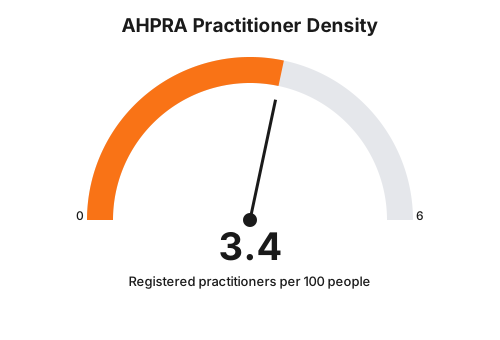
920,535 registered health practitioners across every AHPRA-regulated profession, as at 30 June 2024. This is a national practitioner headcount with no cosmetic-specific breakdown, not a clinic count.
A fourth figure circulates alongside those three, and it needs the same discipline. The Cosmetic Nurses Association, an industry membership body rather than a regulator, puts the number of cosmetic nurse injectors nationally at 2,000 to 3,000, and says openly that attrition makes the figure move. That is a self-reported membership estimate, not a register or a census, and it should never be quoted as a precise practitioner count the way AHPRA’s registration total can be.
Takeaway: three real, citable regulator and market-research sources exist, plus one association estimate that needs its own caveat: ABS confirms no dedicated classification exists, IBISWorld’s two closest industry definitions disagree with each other by 133 businesses, AHPRA counts people, not premises, and the Cosmetic Nurses Association’s 2,000 to 3,000 figure is a membership estimate, not a formal count.
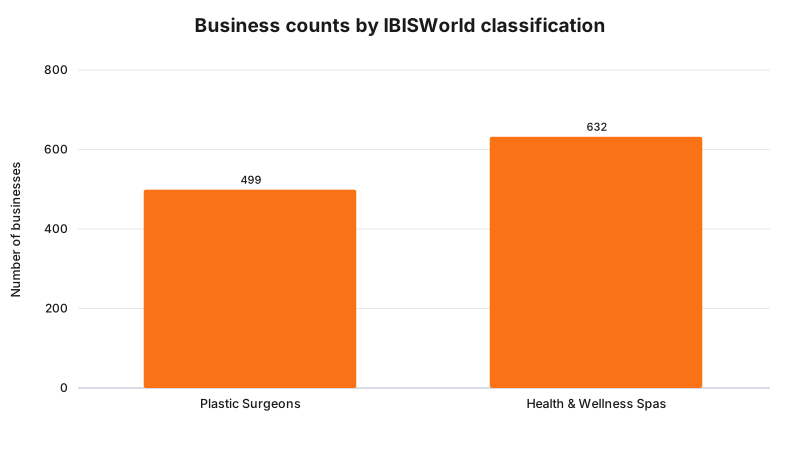
Plastic Surgeons figure is 2025. Health & Wellness Spas figure is 2026. The two reports were not published in the same year and should not be added together.
What That Means for the Build
If your clinic’s website, media kit or investor deck cites a “number of cosmetic clinics in Australia” figure, the fix is not a better number. It is sourcing the one you use the way this post does.
Never hardcode an unsourced total in your site’s structured data. A common pattern on clinic and franchise websites is an Organization schema block or an AggregateOffer claim referencing “one of Australia’s leading cosmetic clinic networks” or a specific competitor count, with no source attached. A stat in JSON-LD should trace to the same named, dated source you would cite in body copy. An invented figure in schema markup is still a misleading claim, just one a search engine reads before a person does.
Attach a visible source to any market-size claim in hero copy or an About page. Use an inline citation, not a bare number: “one of around 500 Australian businesses IBISWorld classifies as Plastic Surgeons (2025)” reads slower than “one of Australia’s leading clinics”, but it is the version you can defend when a competitor, journalist or regulator asks where the number came from.
Date-stamp every cited figure and revisit it at each content refresh. IBISWorld revises its business counts with every report edition. The Health & Wellness Spas figure alone dropped 3.8% year on year, a swing large enough that a number copied from an old PDF or a competitor’s page is already stale by the time you publish it.
Treat “how many clinics compete with us” as a sourced range for internal planning, not a marketing claim. For lease negotiations, franchise disclosure documents or investor materials, cite the specific classification and year behind any figure. A landlord or bank that has seen more than one of these reports will ask which classification you mean.
Classification Comparison
| Source | What it counts | Latest figure | Period | Use it for |
|---|---|---|---|---|
| ABS ANZSIC structure | Confirms no dedicated cosmetic clinic class exists | Not applicable | Current | Explaining why no clean number exists |
| IBISWorld, Plastic Surgeons | Surgical and non-surgical cosmetic and reconstructive procedure businesses, specialist-led | 499 businesses | 2025 | The narrowest defensible business-count floor |
| IBISWorld, Health & Wellness Spas | Medispa and day-spa-style venues offering non-surgical treatments | 632 businesses | 2026 | A broader but still incomplete business-count figure |
| IBISWorld, Dental Services | All dental services businesses nationally | 20,919 businesses, $15.2bn market | 2026 | Adjacent market context only, never a cosmetic clinic proxy |
| AHPRA annual report | Registered health practitioners, all regulated professions nationally | 920,535 practitioners | 30 June 2024 | Practitioner supply context, not a clinic or premises count |
| Cosmetic Nurses Association | Self-reported membership estimate of cosmetic nurse injectors, not a formal register | 2,000 to 3,000 (estimate) | Association estimate | A directional practitioner estimate, never cited as a register total |
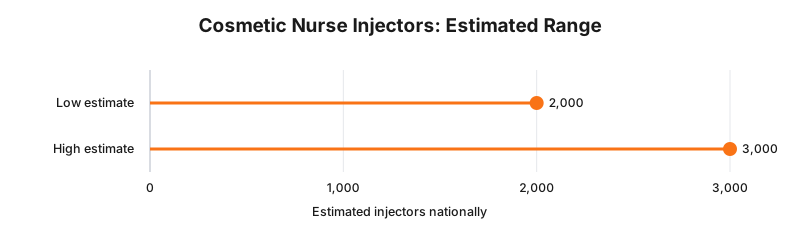
The Cosmetic Nurses Association’s own figure is a self-reported membership range, not a formal practitioner register, and it says openly that attrition moves the number within that range.
A Worked Example
A Perth cosmetic clinic preparing a bank loan application for a second site wanted to cite “the number of competing clinics in WA” on its market-sizing slide. The draft deck used a rounded 3,000 figure lifted from a competitor’s blog post, with no source attached.
The defensible version looked different. The clinic cited IBISWorld’s national Plastic Surgeons count (499 businesses, 2025) as the narrowest verifiable floor, noted that Western Australia’s population share of the national total is roughly 11% (per ABS National, State and Territory Population figures), a rough order of magnitude rather than a precise count, and flagged that non-surgical, nurse-led competitors sit largely outside that classification and are not separately counted anywhere. The bank’s credit team accepted the revised slide because every number on it named its source and year, and the gaps were stated rather than papered over with an invented total.
Takeaway: a sourced range with named caveats is more persuasive to a lender, investor or journalist than a single confident number with no citation, because it survives the first follow-up question.
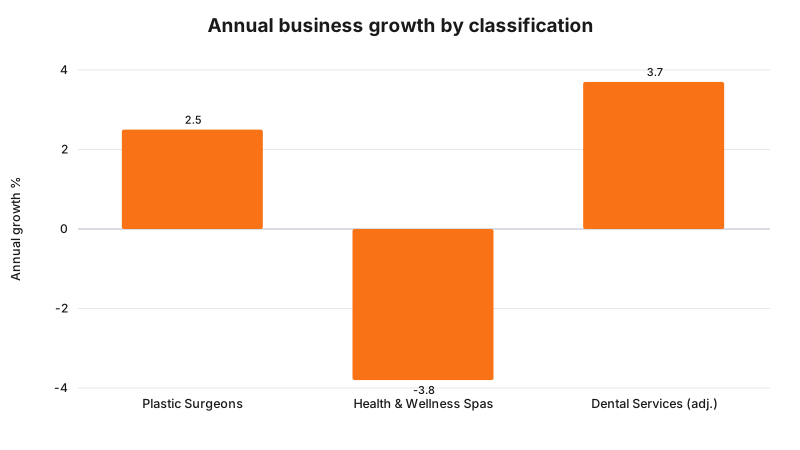
The third bar above, Dental Services, is shown only for growth-rate comparison. It is an adjacent market, not a cosmetic clinic figure, and the two should never be added together or presented as one total.
What to Check on Your Own Site
- Search your site, media kit and investor deck for any “number of clinics”, “leading network” or “trusted by” claim and identify its source.
- Check your
OrganizationorLocalBusinessJSON-LD for a hardcoded competitor count, market size, or ranking claim with no citation. - If a market-size figure appears in hero copy, confirm it names the classification (Plastic Surgeons, Health & Wellness Spas, Dental Services or otherwise) and the year, not just a bare number.
- Check whether any cited figure has been updated since the report it came from was last revised. IBISWorld reports move year to year.
- If your business plan or franchise disclosure document cites a “total addressable market” clinic count, confirm it distinguishes business count from practitioner count from procedure volume, because lenders and franchisors check this.
- Never conflate a dental services figure with a cosmetic clinic figure, even as a rough proxy. The two markets differ by an order of magnitude.
The Enforcement Anchor
No infringement notice or Federal Court determination naming a specific Australian cosmetic or dental business for an inflated “number of clinics” or “market leader” claim was found for this post. Stating that plainly beats implying a precedent that does not exist.
What does exist, in the same sector, is the ACCC’s Federal Court action against SmileDirectClub. On 11 November 2022 the Federal Court ordered SmileDirectClub to pay $3.5 million in penalties after it admitted making false or misleading statements between May 2019 and October 2020, representing that consumers could claim private health insurance reimbursement for its aligner treatment when 98.5% of the private health insurance market did not cover it. At least 26,300 consumers signed up in that period. The claim was about insurance coverage, not clinic count, but the case confirms the ACCC brings real, well-penalised action over misleading marketing claims in the cosmetic and dental sector.
Section 133 of the Health Practitioner Regulation National Law separately prohibits advertising a regulated health service or business in a way that is false, misleading or deceptive, or likely to be. An unsubstantiated “one of Australia’s largest cosmetic clinic networks” claim sits squarely inside that provision, alongside the general prohibition on misleading or deceptive conduct under section 18 of the Australian Consumer Law.
Where This Gets Hard
Classifications will keep drifting apart, not converge. IBISWorld revises its industry reports on its own schedule, and the two reports this post relies on already disagree by 133 businesses despite aiming at roughly the same market. No public signal from the ABS suggests a dedicated cosmetic clinic ANZSIC class is coming, and building one would need an industry consultation process that has not started. Practitioner-level data has the opposite problem: AHPRA’s register is precise about people but cannot answer a premises question, because one practitioner can work across several clinics and one clinic can employ several practitioners, and neither ratio is published.
The regulator says advertising a regulated health service or business must not be false, misleading or deceptive under section 133 of the National Law; the build consequence is that any “number of clinics” or market-leader claim on your site needs a named, dated source rather than a rounded or invented figure; whether a specific claim on your site crosses into misleading conduct is a question for your medical defence organisation or your lawyer.
Status
No official national count of cosmetic clinics exists and none is proposed or under development, as at 27 August 2026. This is a standing data gap in Australia’s business classification system, not a pending reform with a commencement date. The business-count and registration figures cited in this post are each current as at their own stated publication period and will shift at each source’s next revision.
Frequently Asked Questions
How many cosmetic clinics are there in Australia?
No official total exists. The closest published figures are IBISWorld’s Plastic Surgeons industry count (499 businesses, 2025) and its Health & Wellness Spas count (632 businesses, 2026), and each measures a different, narrower slice of the market than the term “cosmetic clinic” covers.
Is there an ANZSIC code for cosmetic clinics?
No. The Australian and New Zealand Standard Industrial Classification has no class built to isolate cosmetic clinics. A clinic offering injectables can be coded under general medical services, allied health services, or personal care services, depending on how it registered its main activity.
Does AHPRA publish a count of cosmetic clinics?
No. AHPRA registers individual practitioners, not business premises. Its most recent annual report puts total registered health practitioners nationally, across every regulated profession, at 920,535 as at 30 June 2024. That figure has no cosmetic-specific breakdown and does not count clinics.
Can I use the IBISWorld dental services figure as a proxy for the number of cosmetic clinics?
No. IBISWorld’s Dental Services industry counts 20,919 businesses nationally in 2026, with a market size of $15.2 billion. That is a count of dental services businesses, most of which never advertise a cosmetic procedure, and it is a business count, not a premises count. Treating it as a cosmetic clinic figure overstates the market by an order of magnitude.
Get a Sourced Number for Your Own Market Claim
RockingWeb builds clinic and dental practice websites where every market or scale claim in the copy and the schema markup traces to a named, dated source. If your site, deck or franchise disclosure document needs a defensible figure rather than a recycled one, talk to us about your clinic’s website and market claims.
Sources
- Australian Bureau of Statistics, Australian and New Zealand Standard Industrial Classification structure. Checked 27 August 2026.
- Australian Bureau of Statistics, Counts of Australian Businesses, including Entries and Exits. Checked 27 August 2026.
- IBISWorld, Plastic Surgeons in Australia, Number of Businesses report (499 businesses, 2025).
- IBISWorld, Health & Wellness Spas in Australia, Number of Businesses report (632 businesses, 2026).
- IBISWorld, Dental Services in Australia, industry report (20,919 businesses, $15.2 billion market size, 2026).
- AHPRA, Annual Report 2023/24 (920,535 registered practitioners at 30 June 2024). Checked 27 August 2026.
- ACCC, SmileDirectClub to pay $3.5m for misleading claims. Checked 27 August 2026.
- Health Practitioner Regulation National Law, section 133, and Australian Consumer Law, section 18.
- Cosmetic Nurses Association, membership estimate of 2,000 to 3,000 cosmetic nurse injectors nationally, with acknowledged attrition. Self-reported industry membership estimate, not a formal practitioner register or count. Checked 27 August 2026.
- Australian Bureau of Statistics, National, State and Territory Population. Checked 27 August 2026.
Last reviewed: 27 August 2026.
Vikas Thakur
Founder of RockingWeb. 16 years building for companies like TPG, iiNet and Monadelphous, now focused on websites and marketing that comply with AHPRA's advertising guidelines and still book patients.