Cosmetic Nurse Injectors in Australia: No Register Exists
No official register counts how many cosmetic nurse injectors work in Australia. The most commonly cited figure, 2,000 to 3,000, comes from the Cosmetic Nurses Association's own membership base, not from AHPRA's national register, and the association says openly that attrition moves that range.
 Vikas Thakur Founder, RockingWeb 14 min read
On this page 12
Key takeaways
- No government body or industry regulator publishes a count of how many cosmetic nurse injectors currently work in Australia
- The figure most often quoted, 2,000 to 3,000, comes from the Cosmetic Nurses Association, an industry membership body, and is a self-reported estimate with acknowledged attrition, not a register total
- AHPRA’s national register counted 512,306 registered and enrolled nurses as of 31 March 2026, but splits that total by state, registration type, age and gender, never by clinical interest area
- AHPRA’s Cosmetic Surgery Hotline logged over 1,500 calls between September 2022 and March 2025, a complaint-volume figure that measures regulator workload, not practitioner headcount
- The September 2025 AHPRA cosmetic procedure guideline covers every registered health practitioner except medical practitioners, who sit under a separate Medical Board document
- This is a standing data gap, not a pending reform. No agency has signalled it intends to start counting nurses by clinical interest area
No official register counts how many cosmetic nurse injectors work in Australia, as at 4 October 2026. The number that circulates most, 2,000 to 3,000, comes from the Cosmetic Nurses Association, a paid-membership industry body, not from AHPRA’s national practitioner register. The association describes the figure as an estimate moved by ongoing attrition, not a fixed headcount, and no government agency publishes anything more precise. This guide walks through what AHPRA’s own data can and cannot tell you, why the CNA figure is the best available number without being an authoritative one, and what that means for any clinic tempted to put a practitioner-population claim on its own website.
What AHPRA’s Register Actually Says
AHPRA regulates individual practitioners through National Boards, and for nursing that means the Nursing and Midwifery Board of Australia (NMBA). The NMBA publishes quarterly registrant data showing exactly who holds current registration, broken down by division and by state. For the reporting period ending 31 March 2026, that data counted 512,306 nurse registrations nationally: 421,539 general registered nurses, 66,592 general enrolled nurses, and 12,570 nurses holding dual EN and RN registration, alongside a smaller number of non-practising and provisional registrants.
That breakdown never touches clinical interest area. The NMBA’s own quarterly report splits nurses by registration type, state, age bracket and gender, and stops there. Nothing in the register indicates whether a given nurse spends their week in aged care, emergency medicine, or a cosmetic injectables clinic. A nurse can hold general RN registration and inject dermal filler five days a week, or never touch a needle outside a hospital ward, and the register records them identically.
Layered on top of that structural gap is the rule this workforce actually operates under. AHPRA and the National Boards’ Guidelines for registered health practitioners who perform non-surgical cosmetic procedures came into effect on 2 September 2025, and apply to every registered health practitioner who performs this work, with one exception: medical practitioners, who remain under the Medical Board of Australia’s separate 2023 cosmetic guidelines. A nurse, midwife, dentist or other non-medical AHPRA registrant injecting cosmetically answers to the September 2025 guideline; a doctor doing the same procedure answers to a different document. Neither creates a public list of who is doing the work, only a standard for how it should be done.
Takeaway: the register that would need to exist for an official injector count, a field marking which nurses currently do cosmetic work, simply is not part of what AHPRA collects.
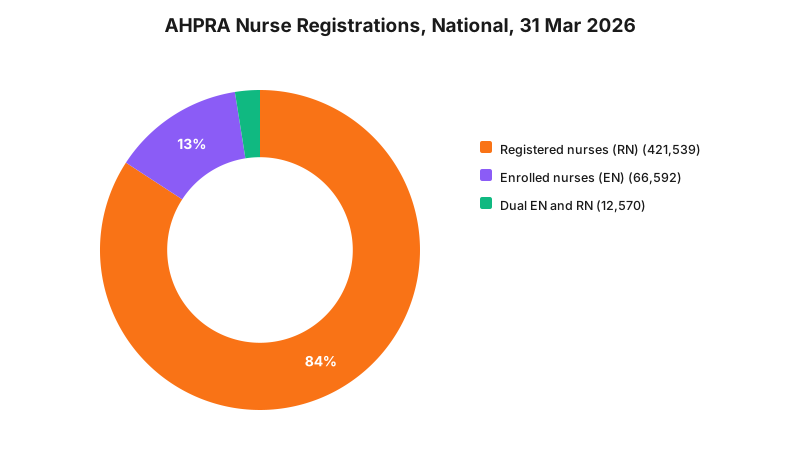
512,306 total nurse registrations nationally, including non-practising and provisional registrants not shown as separate slices above. None of this total carries a clinical interest area field, so no slice of it can be relabelled “cosmetic nurses” without inventing a number AHPRA does not publish.
What That Means for the Build
If your clinic’s website, media kit or investor materials cite a number for “how many cosmetic nurses” exist nationally, the fix is not finding a better number. It is sourcing the one you use honestly, and in most cases, not using a population-wide figure on a page about your own practitioners at all.
Never hardcode an unsourced practitioner-population figure in a bio page, About page or Person/MedicalOrganization schema block. A line like “one of just 2,400 qualified cosmetic injectors nationally” attaches a precision to the CNA’s range that the association itself does not claim, and a search engine or AI answer engine reads a figure in structured data as fact, with no chance for a human reader to spot the missing citation.
Attribute any circulating estimate to its actual source, by name, in the visible copy. “The Cosmetic Nurses Association estimates 2,000 to 3,000 cosmetic nurse injectors practise nationally” is defensible. “Australia has around 2,500 qualified injectors” is not, because it drops the source and rounds the range into a false-precision midpoint nobody actually measured.
Keep practitioner credibility claims specific to the individual, not the national population. A bio page can state a named nurse’s registration number, years of cosmetic-specific experience, and the specific training they hold, all verifiable against AHPRA’s public register search. A national population figure does none of that work.
Date-stamp any workforce figure you do cite. AHPRA’s quarterly registrant data changes every three months, so a national nurse total copied from an old report is stale before you even get to the separate problem of it not being cosmetic-specific.
What Each Circulating Number Actually Measures
| Source | What it counts | Latest figure | Period | Cite it as an injector headcount? |
|---|---|---|---|---|
| AHPRA / NMBA quarterly registrant data | All registered and enrolled nurses nationally | 512,306 | 31 March 2026 | No, not broken down by clinical interest area |
| Cosmetic Nurses Association | Self-reported estimate, membership-derived | 2,000 to 3,000 | Association estimate, acknowledged attrition | No, a range estimate, not a register total |
| AHPRA Cosmetic Surgery Hotline | Calls and notifications about cosmetic procedures | 1,500-plus calls, about 360 notifications | September 2022 to March 2025 | No, measures complaint volume, not practitioner supply |
| Training and CPD course providers | Attendance at injectable training courses | Not publicly aggregated | Not applicable | No, attendance is not the same as active practice, and providers do not publish combined totals |
Every row measures something real. None of them answers the specific question “how many cosmetic nurse injectors currently work in Australia” with a defensible number.
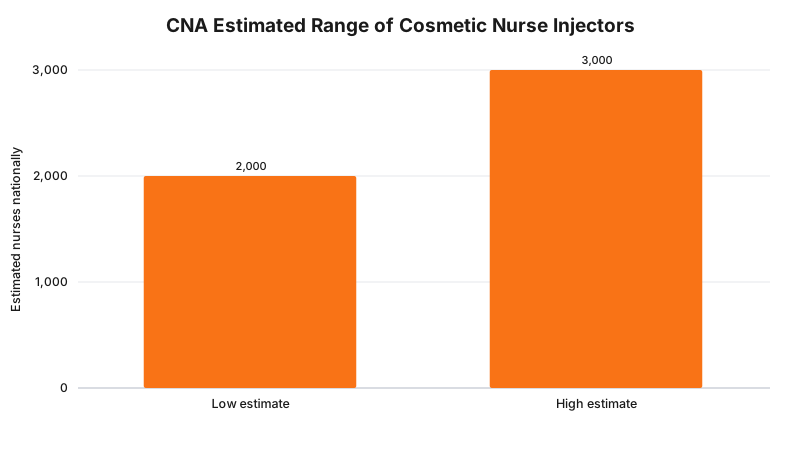
The Cosmetic Nurses Association’s own figure is a range, not a point estimate, and the association attributes movement within that range to member attrition rather than a measured change in the practising population.
A Worked Example
A Perth cosmetic clinic drafting its About page wanted a line that made the practice sound established without inventing a number. The first draft read: “Our nurse injector is one of a growing network of over 2,000 cosmetic injectors across Australia, trusted by thousands of patients.” That sentence borrows the CNA’s low-end estimate, restates it as a settled fact, and folds it into a “trusted by thousands” claim with no source attached to either number.
The defensible rewrite kept the same intent and dropped the false precision: “Our nurse injector holds current AHPRA registration as a registered nurse and has completed [named training body]‘s cosmetic injectables program. Industry estimates from the Cosmetic Nurses Association put the number of practising cosmetic nurse injectors nationally at 2,000 to 3,000, though no official register confirms that figure.” It names the CNA as the source, keeps the range instead of rounding it, states plainly that no register backs it up, and moves the real credibility claim onto something checkable: the named practitioner’s own registration and training.
Takeaway: a practitioner-population estimate does no useful work on a bio page. What a patient, a bank, or a regulator actually wants to check is the individual practitioner’s own registration and training, and that is the one claim on the page that can be verified in minutes against AHPRA’s public register search.
What to Check on Your Own Site
- Search your site, media kit and any partner directory listing for phrases like “one of,” “among,” “network of” or “join thousands” attached to a practitioner-population number, and identify where that number came from.
- Check practitioner bio pages and any
PersonorMedicalOrganizationschema block for a hardcoded national injector count with no citation attached. - If you cite the CNA’s 2,000 to 3,000 estimate anywhere, confirm the copy names the association, keeps the range rather than a rounded midpoint, and states that it is an estimate rather than a register figure.
- Confirm any AHPRA registration total you cite (512,306 nurses nationally, or any state subtotal) carries its reporting period, since the NMBA’s registrant data updates quarterly.
- Move any credibility claim currently resting on a national population figure onto the named practitioner’s own registration number, training provider and years of cosmetic-specific experience instead.
- Check whether a “verified network” or partner badge on your site implies a specific, checkable practitioner count. If the badge issuer cannot produce a register behind the number, treat the claim the same way you would treat an unsourced one on your own page.
The Enforcement Anchor
No infringement notice, AHPRA determination or court judgment naming a specific Australian clinic for an inflated cosmetic-injector headcount claim was found for this post. Stating that plainly is more useful than implying a precedent that does not exist.
What does exist, in the closely related cosmetic and dental sector, is the ACCC’s Federal Court action against SmileDirectClub. The ACCC announced on 11 November 2022 that the Federal Court had ordered SmileDirectClub to pay $3.5 million in penalties, after it admitted making false or misleading representations, on its website and in customer messages between May 2019 and October 2020, that consumers could claim a private health insurance reimbursement for its aligner treatment when 98.5% of the private health insurance market did not cover it. At least 26,300 consumers signed up for the treatment during that period. The claim was about insurance coverage rather than a workforce number, but the case confirms the ACCC brings real, well-penalised action against misleading marketing claims in this sector.
Section 133 of the Health Practitioner Regulation National Law separately prohibits advertising a regulated health service or business in a way that is false, misleading or deceptive, or likely to be. An unsubstantiated “one of Australia’s X,XXX cosmetic injectors” claim sits inside that provision, alongside the general prohibition on misleading or deceptive conduct under section 18 of the Australian Consumer Law. The regulator says advertising a regulated health service or business must not be false, misleading or deceptive; the build consequence is that any practitioner-population claim on your site needs a named, dated source and an honest range rather than an invented or rounded figure; whether a specific claim on your site crosses into misleading conduct is a question for your medical defence organisation or your lawyer.
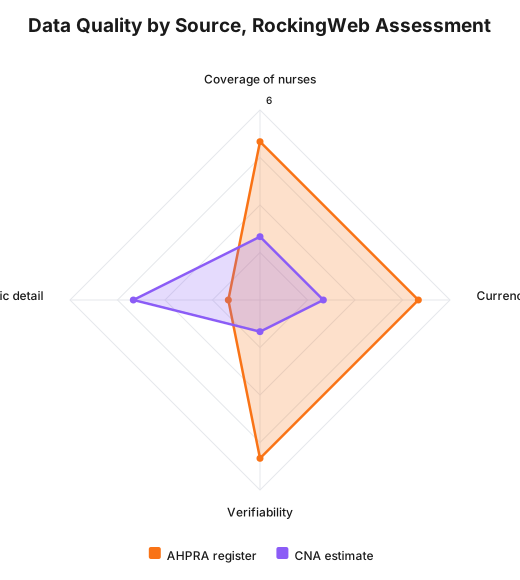
Scored 1 to 5, this is RockingWeb’s own qualitative assessment for illustration, not a published index. AHPRA’s register covers the whole profession and updates quarterly, but records nothing cosmetic-specific. The CNA estimate speaks directly to cosmetic work, but rests on self-reported membership with no independent verification.
Where This Gets Hard
The gap will not close on its own. A register field for clinical interest area would need the NMBA to decide cosmetic procedures deserve their own notation, the same way nurse practitioner endorsement or scheduled-medicines authorisation already carry one, and nothing in AHPRA’s public work program signals that is under consideration. Even a full CNA membership count would understate the true population, since not every nurse who injects joins an industry association. Training providers hold the closest thing to activity data, course completions, but none publish aggregate numbers, and finishing a course is not the same as maintaining an active cosmetic practice years later.
That leaves anyone asking “how many cosmetic nurse injectors work in Australia” a choice between two honest answers: cite the CNA’s estimate with its caveats attached, or say plainly the number is not known. There is no third option that produces a precise, defensible figure.
Status
The absence of an official cosmetic nurse injector count is a standing data gap, not a pending reform, as at 4 October 2026. No agency has proposed adding a clinical interest area field to AHPRA’s nurse registration data, and the September 2025 AHPRA cosmetic procedure guideline, which is in force and governs how this workforce practises, creates no register of who is doing the work. The AHPRA registration total and the CNA estimate cited in this post are each current as at their own stated reporting period and will move at each source’s next update.
Frequently Asked Questions
How many cosmetic nurse injectors are there in Australia?
No official figure exists. The number most often quoted, 2,000 to 3,000, comes from the Cosmetic Nurses Association, an industry membership body, not from AHPRA’s national register. The association describes it as an estimate affected by ongoing attrition, not a fixed count.
Does AHPRA count how many nurses perform cosmetic procedures?
No. The Nursing and Midwifery Board’s quarterly registrant data counted 512,306 registered and enrolled nurses nationally as of 31 March 2026, broken down by state, registration type, age and gender. It carries no field for clinical interest area, so nobody can filter that total down to nurses currently doing cosmetic work.
Is the Cosmetic Nurses Association’s 2,000 to 3,000 figure official?
No. It is a self-reported estimate from an industry membership association, not a government register or census. The association acknowledges the figure moves with member attrition, which is why it is quoted as a range rather than a single number.
Can I cite an injector headcount on my clinic’s website?
Only with a named source and an honest caveat attached. A bare claim like “one of Australia’s X,XXX cosmetic nurse injectors” cannot be verified against any register. Section 133 of the Health Practitioner Regulation National Law prohibits advertising a regulated health service or business in a way that is false, misleading or deceptive, so an unsourced headcount claim could put a clinic at risk under that provision, though whether a specific claim crosses into misleading conduct is a question for your medical defence organisation or your lawyer. Naming the CNA as the source of any estimate, and stating clearly that it is an estimate, is the defensible version.
Who does AHPRA’s September 2025 cosmetic procedure guideline actually cover?
The Guidelines for registered health practitioners who perform non-surgical cosmetic procedures, in effect since 2 September 2025, apply to every registered health practitioner except medical practitioners. Doctors remain under the Medical Board of Australia’s separate 2023 cosmetic guidelines, a different document with different requirements.
Get Your Practitioner Credibility Claims Checked
RockingWeb builds cosmetic clinic websites where every credibility claim on a practitioner page, in the visible copy and in the schema markup, traces to something a patient or a regulator can actually verify. If your site currently leans on an unsourced injector-count or “verified network” claim, talk to us about your clinic’s practitioner pages and we will tell you within one business day what needs a source and what needs to come down.
Sources
- AHPRA, Guidelines for registered health practitioners who perform non-surgical cosmetic procedures, in effect 2 September 2025, applying to all registered health practitioners except medical practitioners. Checked 4 October 2026.
- Nursing and Midwifery Board of Australia, quarterly registrant data report, reporting period 1 January 2026 to 31 March 2026 (512,306 nurse registrations nationally), as cited in RockingWeb’s cosmetic nurse scope of practice guide. Checked 4 October 2026.
- Cosmetic Nurses Association, public estimate of 2,000 to 3,000 cosmetic nurse injectors nationally, with acknowledged attrition. Self-reported industry membership estimate, not a formal practitioner register or count. Checked 4 October 2026.
- AHPRA, reported cosmetic surgery hotline and notification volumes, about 360 notifications investigated and about 300 closed between September 2022 and March 2025, alongside more than 1,500 hotline calls in the same period, as also cited in RockingWeb’s cosmetic surgery hotline complaints guide. Checked 4 October 2026.
- ACCC, SmileDirectClub to pay $3.5m for misleading claims, Federal Court order 11 November 2022. Checked 4 October 2026.
- Health Practitioner Regulation National Law, section 133, and Australian Consumer Law, section 18.
- RockingWeb, how many cosmetic clinics are in Australia, a related data-gap post covering business-count sources for the sector. Checked 4 October 2026.
Last reviewed: 4 October 2026.
Vikas Thakur
Founder of RockingWeb. 16 years of experience from working at TPG, iiNet and Monadelphous, now building websites, software and digital marketing for local businesses in Rockingham and Perth.