WA Redrew Its Cosmetic Laser Category in December 2025
Western Australia's Radiological Council replaced its "Superficial Cosmetic" laser category with "Lasers - Non-Ablative Cosmetic" in December 2025, and mandatory medical engagement now applies to every standalone cosmetic laser clinic in the state. Perth and Rockingham clinics advertising laser treatments should check their service pages match what their actual WA licence permits.
 Vikas Thakur Founder, RockingWeb 6 min read
Key takeaways
- WA’s Radiological Council replaced the “Superficial Cosmetic” laser category with “Lasers - Non-Ablative Cosmetic” in December 2025.
- The new category covers a broader range of non-ablative skin treatments, defined as procedures where the outer layer of skin stays intact.
- Hair removal, tattoo removal, vascular anomalies and pigmented birthmarks are explicitly excluded from the non-ablative cosmetic category.
- Class 3B and Class 4 lasers must hold a licence, an exemption from licence, or operate under direct supervision, and must be registered even while in storage.
- Non-medical practitioners need a recognised laser safety course plus supervised practical hours with formal competency sign-off before working independently.
- Mandatory medical involvement applies: written confirmation from a medical practitioner or nurse practitioner is required after an in-person consultation before each new treatment course, including skin cancer screening.
- A medical practitioner must also be involved in developing and endorsing a clinic’s cosmetic laser protocols.
- A standalone cosmetic laser clinic cannot legally operate in WA without this medical engagement in place.
Western Australia’s Radiological Council replaced its “Superficial Cosmetic” laser licensing category with “Lasers - Non-Ablative Cosmetic” in December 2025. The change widens what a licensed non-ablative treatment covers, but it also resets the compliance bar for who can perform it and what medical oversight has to sit behind it.
Perth and Rockingham are full of clinic websites advertising “laser hair removal,” “skin rejuvenation,” or “non-ablative resurfacing” under one loose banner, as if a single laser licence covers all three. It does not, and it never has under WA’s Radiation Safety Act 1975. WA splits cosmetic laser use into three separate purposes: hair removal, non-ablative cosmetic procedures, and tattoo removal, each with its own licensing pathway. The December 2025 category change touches the middle one specifically, and the mandatory medical engagement rule that comes with it catches a lot of standalone clinics off guard.
What actually changed in December 2025
Under the Radiological Council’s current guidelines, anyone using a Class 3B or Class 4 laser in WA must hold a licence, an exemption from licence, or be working under direct supervision from someone who does. Every such laser has to be registered, whether it’s in active use or sitting in storage.
The category itself is what moved. “Lasers - Non-Ablative Cosmetic” replaced the older “Superficial Cosmetic” label in December 2025, and it now allows a broader range of non-ablative skin treatments under the one category, treatments where the outer layer of the skin remains intact throughout the procedure.
| Treatment purpose | Category | What it covers |
|---|---|---|
| Non-ablative cosmetic procedures | Lasers - Non-Ablative Cosmetic (replaced Superficial Cosmetic, Dec 2025) | Skin treatments where the outer skin layer stays intact |
| Hair removal | Separate category | Not covered by the non-ablative cosmetic category |
| Tattoo removal | Separate category | Not covered by the non-ablative cosmetic category |
| Vascular anomalies, pigmented birthmarks | Excluded from non-ablative cosmetic | Requires its own separate licensing consideration |
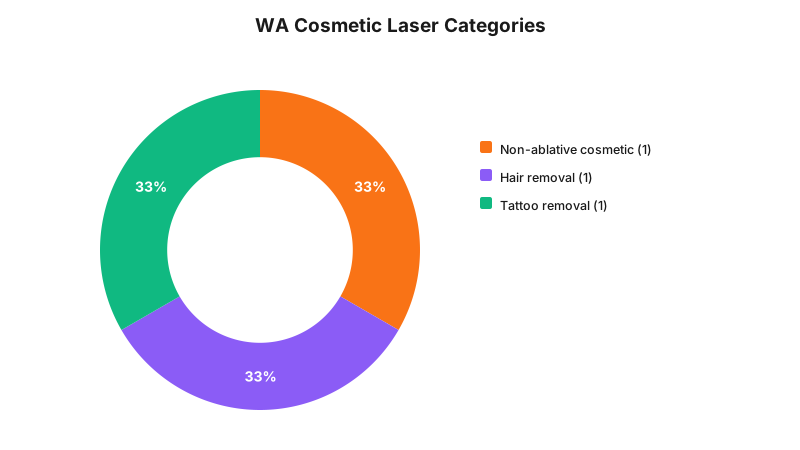
Takeaway: a clinic’s laser licence for one of these three purposes does not automatically extend to the other two, category by category, under the Radiological Council’s current framework.
Medical engagement is not optional, even for cosmetic-only clinics
This is the part that surprises clinic owners who assume a laser safety certificate and a supervised training log are the finish line. They are not. For non-ablative cosmetic procedures, WA requires written confirmation from a medical practitioner or nurse practitioner that the patient has had an in-person consultation before each new course of treatment, including screening for skin cancers or other relevant underlying conditions. That confirmation has to exist before the course starts, not as paperwork filled in afterward.
A medical practitioner also has to be involved in developing and endorsing the clinic’s actual laser protocols, not just nominally listed as a supervising contact. A standalone cosmetic laser clinic, one with no doctor or nurse practitioner genuinely engaged in patient screening and protocol sign-off, cannot legally operate under WA’s current rules.
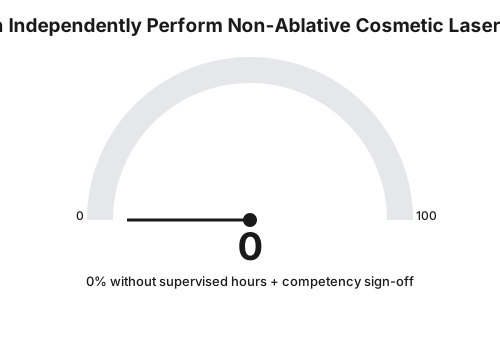
For non-medical practitioners specifically, the pathway runs through a recognised laser safety course, a minimum number of supervised practical hours under the immediate personal supervision of a WA licensee, and formal competency sign-off across both the consultation and the beam-on components of the procedure. Immediate personal supervision means the supervising licensee is physically present and directly observing, not reachable by phone.
Takeaway: medical engagement in WA is a structural requirement for the clinic itself, not a one-time certification a single staff member can hold and satisfy on the clinic’s behalf.
What to check on your clinic’s website today
A service listing that says “laser hair removal,” “skin rejuvenation,” or “non-ablative resurfacing” without distinguishing between them is describing three different licensing pathways as if they were interchangeable. That mismatch between marketing copy and actual licensed capability is exactly the kind of gap a free compliance read of your site is built to catch, alongside the advertising rules clinics already know to watch for.
Run this against your own site:
- Does the service page for “laser hair removal” describe a treatment your clinic is actually licensed for under that specific category, not the non-ablative cosmetic one?
- Does any “skin rejuvenation” or resurfacing page reference medical oversight, or does it read as a purely cosmetic, walk-in service with no mention of the required consultation?
- If the clinic markets itself as a standalone laser studio, is there a genuine, named medical practitioner involved in patient screening and protocol sign-off, and does the site reflect that accurately rather than implying otherwise?
A compliant clinic website build keeps service page language matched to what a clinic is actually licensed and staffed to deliver, which matters here specifically because the licence category and the medical engagement rule sit behind the page, not on it.
Takeaway: the December 2025 category change is a licensing detail, but the website mismatch it exposes is a marketing-copy problem clinics can fix without waiting on a regulator.
Get Your Laser Service Pages Checked
If your clinic’s website advertises laser hair removal, skin rejuvenation, or any non-ablative cosmetic treatment, a compliance read checks whether the page language matches your actual WA licence category and whether it reflects the medical engagement the Radiological Council now requires.
Request a free compliance read of your site
Sources and References
- Bravura Education, “NEW: Guidelines for Cosmetic use of Lasers in Western Australia (WA),” 23 February 2026. bravura.edu.au. Documents the December 2025 category change from “Superficial Cosmetic” to “Lasers - Non-Ablative Cosmetic,” the Class 3B/4 licensing requirements, and the mandatory medical engagement rule, citing the Radiological Council’s current Guidelines under the Radiation Safety Act 1975.
- Radiological Council of Western Australia. radiologicalcouncil.wa.gov.au. The regulatory body responsible for licensing Class 3B and Class 4 laser use in WA under the Radiation Safety Act 1975, referenced as the source of the current Guidelines in source 1.
Vikas Thakur
Founder of RockingWeb. 16 years building for companies like TPG, iiNet and Monadelphous, now focused on websites and marketing that comply with AHPRA's advertising guidelines and still book patients.